Showing posts with label Kate Simants. Show all posts

Thursday, 2 March 2023

When the Locked-room Itself Wants to Kill You. by Kate Simants


It was a kind of masochism in a way, writing a locked-room thriller in the height of lockdown when the last thing I – and everyone else – really wanted was to be locked in. My third novel, Freeze, which is published by Viper on March 2nd, follows the cast and crew of Frozen Out, a reality TV show set in the Arctic. The fear of the threat from within the boat – the killer – is rivalled only by the threat from without – the endless wastes of ice, the sea, the frankly terrifying weather. But though that climate is many people’s idea of hell, I found it to be the escape I desperately needed. 

Heat, for a born goth like myself, has been a lifelong adversary. When the post-Christmas adverts break out, seemingly tapping in to our collective yearning for bikinis and baking sand, I look out the window and wish the frost would last forever. So when it came to looking for a location for my new book – a place which could double as an imagined escape while under Covid house arrest – somewhere very, very cold was the top of my list. 

Not that it’s anything new, of course. Locked-room mysteries – or more accurately, closed-circle mysteries, where the murderer must be among a very limited number of characters – are often set in less-than welcoming environments. Though I’d shy away from the well-worn cliché of the location of a novel being one of its characters, the backdrop of Arctic certainly did a lot of the heavy lifting when it came to manipulating the events of the book. Early in my research, I spoke to a handful of Arctic guides, who talked me through what Greenland would really be like for a group of inexperienced people like those in my fictional TV show. I knew I’d made the right choice when one source told me, ‘make no mistake – the Arctic wants you dead.’ Obviously I shamelessly stole that line and gave it to the character of Craig Nduka, Frozen Out’s Arctic expert, then built on that sense of innate hostility at every opportunity. 

Ally Reynolds, author of Shiver, says a similar thing of her choice of the French Alps for her acclaimed debut Shiver. Twenty years ago, she was a freestyle snowboarder, and spent her first winter season in Chamonix. ‘It was such a unique environment,’ she told me, ‘stunningly beautiful, yet also incredibly dangerous. The weather could change at short notice, bringing storms, heavy snowfall and avalanches that could cut off roads and villages. The terrain is full of crevasses and cliffs, meaning you are literally one step away from death a lot of the time, so it seemed a perfect setting.’

Writing a powerful thriller means keeping the sense of fear close to hand at all times, so choosing a location that has some menace built-in means your baseline level of fear is already pretty high. Emma Haughton, author of locked-room Antarctica thriller The Dark and, more recently The Sanctuary based in the Mexican desert, says a similar thing. 

In terms of research,’ she says, ‘it came down to making deep isolation plausible as possible to the reader. That was easy to do with Antarctica because people there are completely cut off during winter. I always feel you’ve got to maximize the obstacles that any location might bring for your characters, so [in The Sanctuary] I built in scenes that hung on dangers like heat stroke, thirst, snake bites, large spiders (ugh!) and so on.’ 

For me, it was the location for Freeze that took up the bulk of my research time. As a former investigative journalist I have a terror of misrepresentation, and without the chance to go to Greenland myself, I spent weeks and months meticulously reading around the place. I made life slightly easier for myself by using a boat as the base, and writing about a TV show: having lived on boats and worked in TV, these were things I could write about naturally. But the deep-dive I did into resources about the Arctic served a dual purpose: not only of making the setting authentic, but also of taking me away from the crushing tedium of being stuck at home -even if it was only in my mind. 

That said, it wasn’t until I’d finished the novel that I noticed how much Covid itself had informed my story. Without even realising it, Freeze was a reflection of the real-life horror-show that started in 2020: a claustrophobic world of enforced enclosure, while an even greater threat lurked outside. 
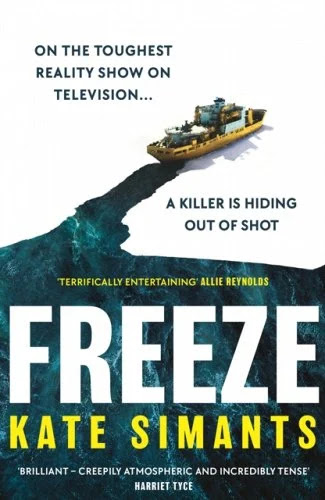
Freeze by Kate Simants published by Viper (Out Now) £14.99

The show is Tori Matsuka's baby. After years working her way up the ladder, she's finally launching her own production company with Frozen Out, and the late nights, the debts, the strain on her relationship will all be worthwhile. Everything is riding on the next twelve days. For camerawoman Dee, it's a chance to start again after the tragedy that tanked her undercover journalism career. Not even Tori, her oldest friend, knows the full truth of why Dee left her previous job, and she plans to keep it that way. But as errors and mishaps mount on set, tempers among the cast and crew start to fray. And when one of the contestants is found dead, only Dee realises the death wasn't natural - and from what she's seen from behind the camera, it won't be the last. As the Arctic ice closes in around them and all chance of escape is cut off, it becomes clear that although the world outside wants them dead, it's the secrets inside the ship that might cost them their lives.

More information about Kate Simants and her books can be found on her website. You an also follow her on Twitter @Kateboats and she can also be found on Facebook.


Saturday, 19 September 2020

A Q & A Interview With Kate Simants

Ayo: - For those who don't know you would you like to give us a bit of background information    about yourself.

Kate:- Of course. After my degree in English I worked for several years in the UK television industry, specialising in undercover investigations and police shows like Crimewatch UK. After that, I left London for Bristol, where I lived on the river Avon and focused on my writing. My first novel was published in 2019 by HarperCollins, and my second, A Ruined Girl, came out last year with Viper/Serpent’s Tail. I’m working on my third novel at the moment, which will be published by Viper in 2021.

Ayo:- Your first novel Lock Me In was shortlisted for the CWA Debut Dagger, did that (do you think) put more pressure on you when you started writing A Ruined Girl.

Kate:- You know what, that had never occurred to me. The CWA shortlisting really gave me a lot of momentum I think – I had been writing for a while when it happened and I’d almost lost faith in anything really happening with it. But after the shortlisting, I applied for a place on the UEA’s new Crime Fiction MA, and won a scholarship to study there, which was obviously another bog vote of confidence. A Ruined Girl was written as part of that course. I think getting on the CWA shortlist took the pressure off if anything -it kind of reassured me that I was going in the right direction, when before I had that old doubt that maybe I was wasting my time! 

Ayo:- Congratulations on A Ruined Girl winning the Bath Award. How did you feel after you heard that you had won?

Kate:- Thanks! I was utterly thrilled, and very surprised. I almost didn’t enter because I’d read some previous winners and didn’t think I had a chance, and then at every stage - longlisting, shortlisting – I was just so excited, and humbled, actually. It’s such a lovely thing though because Caroline Ambrose who runs it has created this wonderfully supportive community around the prize, and all the other entrants were so generous. Winning it was just mad, I was stunned. 

Ayo:- You have been an investigative broadcasting journalist how did this job impact on your writing.

Kate:- Well, apart from the in-depth knowledge that I picked up from the documentaries I worked on, I learned how to research efficiently. Obviously when we were making documentaries that exposed wrongdoing and/or criminality we had to make sure everything we alleged was absolutely watertight from a legal point of view: a discipline which isn’t strictly necessary when you’re writing fiction, but it was good training. I learned a lot about the police working on Crimewatch UK, the kind of behind-the- scenes cultural and social stuff that money can’t buy, which really stood me in good stead when I started writing about law enforcement. Scriptwriting was also great training for writing fiction – any experience of getting ideas across to a wide audience using words is basically invaluable when you become a novelist!

Ayo:- A Ruined Girl is as much about trust as it is about finding out what happened. What was the impetus for the story?

Kate:-  It’s always so hard to think back and find the source of where a story came from, but I think it was the convergence of a lot of particular themes of mine. Even before I worked on the Dispatches documentary in which I worked undercover in children’s homes, I was very conscious of children’s social care. A close family member was temporarily in the system, as were several friends, and even though there were plenty of people who worked in the industry who cared deeply for these young people, there were quite a few who saw opportunities for exploitation.

Ayo:- One of your main characters is Wren Reynolds, a probation officer who is investigating the disappearance of a young girl in a care home. How did your own experience in investigating care homes impact on your story?

Kate:- Well, I haven’t come across much other fiction set (even partially, as A Ruined Girl is) in children’s homes, so I think if I hadn’t had that experience, I wouldn’t have known much about what those places were really like as an insider working in them. The absolute gift of undercover work is that you get to see things for what they really are, without the people around you being observed. 

Ayo:- What are your favourite type of characters?

Kate:- That’s something that’s changing all the time actually. I used to think we needed to really like our main character in order to care about them but some of the most powerful, compelling books I’ve read recently have had pretty awful protagonists. Ottessa Moshfegh’s My Year of Rest and Relaxation, for example, has an overwhelmingly selfish character at its heart, and is one of the most memorable characters I’ve come across in a long time. 

Ayo:- There is a dark side to fostering and care homes but on the other hand they are necessary for society. Is there anything you could think of that could make fostering and care homes better?

Kate:- Are you sure you want to get me started with this?! I’ll try to keep it polite… I’d start with funding. The cuts to children’s services in the last decade has just been outrageous, a 29% drop across all councils with per-child cuts of up to 50% in the most deprived boroughs. As with any social care, the cuts invariably cause the most suffering among those without a voice – children, vulnerable people, and the many older and disabled people who rely massively on the rest of society to treat them with dignity. 

Ayo:- What do you think is the most important, characterisation or plotting?

Kate:- If I absolutely had to choose, it would be character. I have a really terrible memory for plots but I’ll remember a great character forever. Once you have a really powerful character, it’s a lot of fun to see them struggle out of the horrible situations the author puts them in – but if you don’t care about them in the first place, you’re not going to be impressed by even the cleverest plotline.

Ayo:- Do you plot beforehand, or do you just let the writing flow?

Kate:- The first three books I’ve completed (there’s an unpublished one of which we do not speak) have been meticulously plotted, but that’s mostly because they’ve had such complicated storylines. Things have changed as I’ve progressed through the books but I’ve worked out most of it beforehand, sticking to an excel spreadsheet to remind myself who knows what and when, and what has to be revealed at what point. The next one is going to be a bit more linear so while I’ll still have a clear plan, I’ll be a bit looser with it

Ayo:- Your characters Wren and Luke are very believable. Are they based on people you know in real life?

Kate:- Not so much with Wren, but Luke is a kind of composite of a few friends I had who were in care when I was a teenager, and a boy I met when I was undercover. I think teenage boys can get pretty demonised: there’s this image of them all being the same, being monosyllabic and angry. Of course they can be intimidating in groups, but a lot of the time, taken individually they’re really just little boys vying for a place in a pretty scary society. Boys like Luke don’t get to go home to a cosy house and the kind of unconditional love that allows them to take their armour off – he had to be on guard and tough, shields up, all the time. And that’s such a hard way to grow up. 

Ayo:- How would you like your characters to be remembered?

Kate:- Luke, to me, is the star of A Ruined Girl – I’d like people to remember him as someone who you’d cross the road to avoid if you saw him out at night, but to remember that once you get in his head he’s a vulnerable like everyone else. 

Ayo:- What made you decide to stop working in television and concentrate on writing?

Kate:- It’s not a very nice story: it was 5am on the morning of my birthday and I was working on a pilot fly-on-the-wall show following police officers in Oldham. We had a call that they’d been alerted to a suicide, so off we went with our cameras and filmed them cutting this poor guy down from a tree. As I was filming I just thought, what the hell am I doing? How is this in any way a positive thing? I put my energy into the writing a lot more after that.

Ayo:- What are you working on next, can you tell us about it?

Kate:- Well, I can’t tell you much at this point but it’s definitely going to be crime, and the undercover stuff is going to feature a lot more prominently! 

A Ruined Girl by Kate Simants (Published by Profile Books) Out now
On a dark night two years ago, teenagers Rob and Paige broke into a house. They beat and traumatised the occupants, then left, taking only a bracelet. No one knows why, not even Luke, Rob's younger brother and Paige's confidant. Paige disappeared after that night. And having spent her life in children's homes and the foster system, no one cared enough to look for her. Now Rob is out of prison, and probation officer Wren Reynolds has been tasked with his rehabilitation. But Wren has her own reasons for taking on Rob as a client. Convinced that Rob knows what happened to Paige, and hiding a lifetime of secrets from her heavily pregnant wife, Wren's obsession with finding a missing girl may tear her family apart...


Wednesday, 18 March 2020

Books to Look forward to from Serpent's Tail and Viper

July 2020

Resident is by David Jackson.  Thomas Brogan is a serial killer. Having left a trail of bodies in his wake, and with the police hot on his heels, it seems like Thomas has nowhere left to hide. That is until he breaks into an abandoned house at the end of a terrace on a quiet street. And when he climbs up into the loft, he realises that the can drop down into all the other houses on the street through the shared attic space. That's when the real fun begins. Because the one thing that Thomas enjoys even more than killing, is playing games with his victims. And his new neighbours have more than enough dark secrets to make this game his best one yet... Do you fear The Resident? Soon you'll be dying to meet him. '

August 2020

Two boys loved her. But which one buried her? Two years ago, teenagers Rob and Paige broke into the house of Paige's school counsellor and stole only a necklace, but traumatised their victims in the process. No one knows why. And Paige hasn't been seen since that night. Having spent her life in children's homes and the foster system, no one cared enough to look for her. Now Rob is out of prison, and probation officer Wren Reynolds has been tasked with his rehabilitation. But Wren has her own reasons for taking on Rob as a client. Convinced that Rob knows what happened to Paige, and hiding a lifetime of secrets from her heavily pregnant wife, Wren's obsession with finding a missing girl may tear her family apart...  The Knocks is by Kate Simants

October 2020

Constable Paul Hirschhausen runs a one-cop station in the dry farming country south of the Flinders Ranges. He’s still new in town but his community work – welfare checks and a light touch – is starting to pay off. Now Christmas is here and, apart from a grass fire, two boys stealing a vehicle and Brenda Flann entering the front bar of the pub without exiting her car, Hirsch’s life has been peaceful. Until he’s called to an incident on Kitchener Street, a strange and vicious attack that sickens the community. And when the Sydney police ask him to look in on a family living on a forgotten back road, it doesn’t look like a season of goodwill at all ...   Peace is by Garry Disher.