Showing posts with label Orion Books. Show all posts

Wednesday, 17 January 2024

Forthcoming books from Orion Publishing

 January 2024

Harbour Lights by James Lee Burke is a story collection from one of the most popular and widely acclaimed icons of American fiction, featuring a never-before-published novella. These eight stories move from the marshlands on the Gulf of Mexico to the sweeping plains of Colorado to prisons, saloons, and trailer parks across the South, weaving together love, friendship, violence, survival, and revenge. With his nuanced characters, lyrical prose, and ability to write shocking violence in the most evocative settings, James Lee Burke's singular skills are on display in this superb anthology.

The Clinic is by Cate Quinn. This place will change your life . . . or end it. Welcome to The Clinic. The world's most exclusive rehab clinic offers treatment to the rich and famous. Meg's sister Haley was one of them - a troubled country singer running from a terrible addiction. Between the luxury spa, the ayurvedic yoga and the world-class therapy, the clinic is a perfect place to heal and brush shoulders with the world's most beautiful people. Safely locked in the secluded compound, its patients are a thousand miles away from crazed fans and paparazzi... with no one to call for help. When Haley is found dead at the clinic, Meg checks in under an alias to find out why. Soon she's confronting a whole lot more than her own addiction - there's a killer on the loose and anyone could be next . . .

The Excitements is by C J Wray. Revenge is a dish best served old. Meet the Williamson sisters, Britain's most treasured World War II veterans. Now in their nineties, Josephine and Penny are in demand, popping up at commemorative events all over the country. Despite their age, they're in great form-sprightly and sparky, and always in search of their next "excitement." This time it's a trip to Paris to receive the Légion d'honneur, accompanied by their devoted great-nephew, Archie. Keen historian Archie believes his great aunts had minor roles in the Women's Royal Navy and the First Aid Nursing Yeomanry, but that's only half the story. There's a reason sweet Auntie Penny can dispatch a would-be mugger with a brolly. This trip to Paris is not what it seems either. Scandal and crime have quietly trailed the sisters since the war. Now armed with new information about an old adversary, these much decorated (but admittedly ancient) veterans intend to settle scores, avenge lost friends, and pull off one last heist before the curtain comes down on their illustrious careers.

Her teacher's pet, or his worst nightmare? Jessica Mooney seems like any other student at her university. She's talented, driven, and looks set to be this year's 'favourite' in charismatic Professor Crane's Law and Literature class. But unlike the other students competing for his good opinion, Jessica isn't what she seems. She's carrying a dark secret. Her sister is dead. Crane's to blame. And she's the only one who can bring him to justice. Will Jessica be able to get the answers and justice she seeks, or will her search for revenge destroy her first? The Favourite is by Rosemary Hennigan.

Lies cost lives. Three years ago police officer Georgina Ioannau was murdered, her killers never brought to justice. Now the prime suspects have been shot dead within hours of their return to the UK. Has someone finally taken the law into their own hands? Seeking out the truth will force Kate Daniels to confront her own past mistakes, and put her career, and her team's lives, on the line. The Longest Goodbye is by Mari Hannah. 


February 2024

It was my job to look and look and never look away, until I had captured every part of the scene, until I had told the story of those last moments that the dead could not...  For years, A.J. Hewitt was the first person into a crime scene. Before the detectives and the forensics team it was her alone with the body, the only sound her flashes firing as they lit up scenes of unimaginable horror. It was her job to shoot the photographs that revealed the circumstances of someone's final moments. Now in her debut book, The Darkroom, Hewitt takes us into the shadowy world of the crime scene photographer, and recounts remarkable tales, from murders to suicides, accidents to assassinations. In the tradition of Unnatural Causes, When the Dogs Don't Bark and All That Remains, this is a true crime book full of the wisdom that can be found in the darkness.

A true Victorian murder mystery... Great Yarmouth, September 1900: A young woman is found dead on the beach, a bootlace tied tightly around her neck. Despite her death attracting national attention in the press, nobody claims her. Detective Inspector Robert Lingwood of the Great Yarmouth police force declares he will not rest until the mystery of the young woman's death is solved. But it's only once the case has been referred to Scotland Yard that the layers of mystery start to peel away... 'Mrs Hood' was in fact Mary Jane Bennett, and this is her story. Following clues and tracking red herrings leads the police to close in on their one and only suspect. With arson, fraud, an affair and a sensation-hungry press, the murder gripped the nation in one of the most eagerly anticipated trials of the early twentieth century. The Mysterious Mrs Hood is by Kim Donovan who finally tells her great-great-aunt's story and the truth of evil duplicity in Victorian England

After the Carusos family home is destroyed by police with a no-knock warrant, the family struggle to return to normal. Two former inmates reunite on a TV set. They're both back on the straight and narrow ... until one sees the potential for an easy grift. A teenage boy must step into the man he'd like to be as a hostage crisis grips his hometown. A woman adrift meets a man tied to her grandmother's past, and awakens to the bloody history of the place she grew up. Owning Up is by George Pelecanos' and his portraits are characterized by shades of grey, resisting the mold of heroes and villains, victims and perpetrators, good and evil. At once streetwise and full of heart, Owning Up grapples with random chance, the bind of consequence, and the forked paths a life can take.


March 2024

As each prisoner dies, the bell will ring... After a drugs bust goes wrong, Deputy Sheriff Garrett Nelson is left wounded, with a permanent limp and a career in tatters. On his long road to recovery he finds one consolation - Hannah, his tough-as-nails physiotherapist, and soon they're planning a future together. Unfit for active police service, Nelson is left with few options, so he gratefully accepts his father-in-law's offer of a job at a Florida penitentiary on the grounds of an old Spanish mission in the Everglades. The prison's chapel, a working bell tower, is now an execution chamber. And Nelson must attend the executions. Working on Death Row comes with a few simple rules: - Do not let the inmates get under your skin. - Do not allow any prisoners to escape. - Do not take justice into your own hands. Garrett Nelson will break every one of them. The Bell Tower is by R J Ellory. 

Rome, 1659. Months after the plague has ravaged Rome, men are still dying in unnatural numbers, and rumour has it that their corpses do not decay as they should. The Papal authorities commission prosecutor Stefano Bracchi to investigate, telling him he will need considerable mettle to reach the truth. To the west of the Tiber, Girolama and her female friends are at work, helping other women with childbirths and foretelling their futures. Elsewhere in the city, a young wife, Anna, must find a way to escape her abusive husband. But in a city made by men for men, there are no easy paths out.  Stefano's investigation at the Tor di Nona prison will introduce him to horror, magic and an astonishing cast of characters. He will be left wondering if certain deeds should remain forever unpunished... The Book of Secrets is by Anna Mazzola.

Even Greater London 1887. An uninterrupted urban plane encompassing the entire lower half of England and, for complex reasons, only the upper third of the Isle of Wight. The immense Tower casts electricity through the sky, powering the mind-boggling mechanisms of the city. The engineer-army of Isambard Kingdom Brunel swarms across the capital, building, demolishing, and rebuilding whatever they see fit. And at the heart of it all sits the country's first private detective agency. Archibald Fleet and Clara Entwhistle hoped things would pick up quickly for their new enterprise. No-one is taking them seriously, but their break will come soon. Definitely. Probably. Meanwhile, police are baffled by a series of impossible bank robberies, their resources absorbed by the case. Which means that when a woman witnesses a kidnapping, Fleet-Entwhistle Private Investigations is the only place she can turn for help. They're more than happy to oblige! But what's the motive behind the kidnap? As Clara and Fleet investigate, they find more than they could ever have imagined . . . High Voltage is by Chris Sugden and Jen Sugden. 

April 2024

An innocent man faces execution. Can Baptiste save him? France, 1977. Baptiste is an intelligent but somewhat naive detective, sent to work in Clermiers, a town filled with corruption. A girl goes missing, presumed dead after bloody clothes are found close to an illicit party near an abandoned chateau. Baptiste believes he's nailed the culprit, the eccentric Gilles Mailloux. When he appears in court, the public call for the guillotine - and that's the sentence Mailloux gets. But as Mailloux awaits an appeal for clemency, he asks to see Baptiste, who's still haunted by the fact the girl's body remains missing. As the clock ticks towards execution hour, Baptiste begins to realise he may have made a terrible mistake... Baptiste is by David Hewson. 

Last Witness is by Lucie Whitehouse. One murder, three families destroyed. And a detective guilty of a crime of her own. When 18-year-old Ben Renshaw is found dead in city woodland, DCI Robin Lyons is plunged into one of Birmingham's most controversial cases. Months earlier, Ben and his best friend gave testimony that sent a former classmate, Alistair Heywood, to prison for a vicious sexual assault. Before the trial, the boys and their families endured months of brutal witness intimidation, for which the Heywoods, a privileged and influential local family, faced no legal repercussions. Instead, they vowed revenge. Is Ben's murder the fulfilment of that vow, the beginning of a bloody new chapter that will go on claim lives on all sides? Or is the truth - as the Heywoods claim - something entirely different? To solve the case, Robin has to negotiate the city's networks of power while walking a dangerous line: her own daughter, Lennie, has a secret that could threaten her liberty - and, if it comes out, Robin's, too. Before long, Robin comes to question whether she knows what justice is at all.

The Vanishing of John Blackwood is by Lisa Rookes. The debris from the night before is scattered underneath the village tree and across the cobbles. Red wine stains the ground like blood. And Joni has vanished. Joni Blackwood is my best friend. She was there for my first crush, stood beside me at my wedding, watched my daughter grow up. She's been there through the painful mess of the divorce, too. So when she suddenly goes missing on All Gallows' Eve, I'm first to raise the alarm. People outside the village say she must have been sacrificed in some pagan ritual. But All Gallows' Eve isn't like that. We're just simple folk enjoying an annual bonfire to keep an old tradition alive. It's mulled cider and local mums running charity bake sales to be in with a chance of winning Gallows Queen. Joni wins every year. My mum used to say this village was built on the roots of The Gallows Tree, that they're underneath the ground, under all of our houses. It used to scare me as a kid. Thick, snaking roots squirming under me. No matter how far you ran, they could tunnel after you. And when the bones of a small child are unearthed in the church graveyard, I have to wonder how many secrets are running through our village, like the roots of the tree. And I wonder if Joni can really outrun hers. And I wonder if I can really outrun mine.

May 2024

There are more than just secrets buried in these walls. It's the day of the demolition at White Cross Academy, and a crowd of former pupils and teachers have gathered to watch. But as the final charges are laid in the basement, the crew make a shocking discovery - a human skull. Former student DI Jennie Whitmore is assigned to the case, her first big murder investigation and one where there can be no room for mistakes. The remains are identified as Hannah Jennings, a popular, but troubled classmate who went missing during her lower Sixth year. As news of the body's discovery soon leaks, the small town erupts with intrigue, conspiracy and accusation. Jennie now finds herself at the heart of the storm, tasked with making up for the failings of the initial investigation to ensure that justice is finally done. At the centre is Hannah's five closest friends who used the basement as a base for the photography club. Jennie knows many of the suspects personally and she is convinced that one of this group of five knows the truth about what happened to the wilful, beguiling teenager. As Jennie unearths secrets buried deep, and lies repeatedly told, the assembled friends must reassess their past, before confronting the terrible realisation that one amongst them would rather kill to protect their new life, than pay for the sins of their teenage years. The Reunion is by M J Arlidge and Steph Broadribb.


June 2024

Farewell Amethystine is by Walter Mosley. The Easy Rawlins novels follow the infamous detective Easy Rawlins solving mysteries on the sun-soaked streets of Southern California. Ezekiel "Easy" Porterhouse Rawlins is an unlicensed private investigator turned hard-boiled detective always willing to do what it takes to get things done in the racially charged, dark underbelly of Los Angeles.

Daniel Clement has suffered a secret humiliation and to recover, takes respite at the monastery where he was a novice. But the monastery doesn't allow Daniel a break, for there are tensions building there too, as the secret past of novice master Father Paul is emerging. Tension mounts and a murder ensues. Meanwhile back at Champton, Daniel is the subject of village gossip, his mother Audrey is up to something again, there's trouble at the dress shop, up at the big house, and the puppies are running riot. Can Daniel be reconciled with detective Neil and solve the mystery? Murder at the Monastrey is by Richard Coles.

July 2024

Forget Me Not is by M J Arlidge. As a feud between drug gangs grips the city, a desperate mother begs DI Helen Grace to help find her teenage daughter. Grace soon discovers more missing girls, but the web of corruption she finds stretches far deeper and closer to home than she could have imagined. 

When coffee shop worker Cheryl meets handsome stranger Dale. It's a nightmare and a dream. Loan sharks keep banging at Cheryl's door. That is, until Dale sends them running for good with just a few words. A romance soon blossoms between Cheryl and Dale, whose family has bought the house next door to hers. But when Cheryl mwwts Dale's family, it's clear that they have dangerous secrets to hide. And as Cheryl uncovers the mystery of is family, it's clear that her life is in terrible danger. The Family is by Mandasue Heller.

Saturday, 11 November 2023

The Unexpected Star of the Show by Sharon Bolton

In July 2015, a car veered off the road near Stirling in Scotland. The driver was killed on impact; his passenger, a young woman, was trapped in the car, badly injured, for three days. She died in hospital shortly after police, finally, found the vehicle. It’s a dreadful story, one that remained with me for a long time. We expect, on our relatively small island, that when we need them, emergency services will be there. On this occasion, something went badly wrong.

Books often begin with a simple, if disturbing, idea and trying to imagine what the poor woman went through as she waited for help to arrive was the start of The Fake Wife. In my story, Olive Anderson, dining alone in a north-eastern hotel shortly before Christmas, is surprised by the arrival of a glamorous stranger who joins her, pretending to be her wife. What starts as an alluring game quickly turns dangerous and Olive is forced to leave the hotel with the stranger, driving into a heavy snowstorm. A split-second’s loss of concentration and the car leaves the road; both women are hurt and snow quickly covers their tracks. 

I like to think of The Fake Wife as my Russian Dolls book: each mystery unfolds to reveal another, deeper puzzle and only as we learn more about the characters at its heart – Olive, her MP husband Michael, the Stranger, Michael’s first wife Eloise, and the elusive and mysterious Maddy, do we start to glimpse the deadly game these people are playing. 

Well, that’s how the book should have panned out. Pretty soon, though, something else kicked in…

The Fake Wife was conceived as a thriller packed full of puzzles, psychological, but with plenty of pacy action along the way. What it wasn’t supposed to be was a police procedural. And yet, as all writers will know, sometimes characters grab a hold of a story and make it their own. As The Fake Wife took shape, gaining flesh on its bones, it became apparent that a character I hadn’t intended to play any sort of leading role was finding himself, increasingly, in the limelight. 

Garry Mizon, a nondescript traffic cop in his mid-thirties, who hates his job and is bored with his life, was supposed to be nothing more than a factotum: a means of getting my narrative from a to b. Garry was there to fill in the gaps, to let my real main characters – Olive, Michael, Eloise and Maddy – shine through. 

And yet, almost from the first chapter, Garry took charge. His personality – awkward, painfully shy but, ultimately, true as steel – shone through. In his clumsy, unassuming, anxious way, he began to dominate the page. He became the character I felt most invested in, the one I loved above all others. Full disclosure now: the team at Orion weren’t sure at first; wasn’t he a bit too – incompetent? Too much of a bozo? I toned him down a bit but clung on to what made this man essentially Garry and as the first proofs went out, I was vindicated. The most frequent feedback comment we got back was, “I love Garry!” Far from merely serving the narrative’s purpose, Garry became the book’s star. (As I write this, proofs are going out to key influencers along with a Garry Mizon winter survival pack and his ‘driving in winter conditions’ Spotify playlist.) 

Frankly, I should have known this would happen. After all, The Fake Wife is not my first rodeo. I should have remembered that when you pack a book with twisty, unsavoury characters, the readers need someone firmly in their corner. Garry is the story’s Everyman, the character with no interesting secrets, shady past or burning ambition. He isn’t particularly good at anything, especially not being a police officer. He has no superpower, no great skill (actually, he has a couple, but being Garry, he discounts both.) In Garry, I guess, we see ourselves, the ordinary man or woman caught up in something extraordinary. Garry’s doubts are our doubts, his insecurities and lack of confidence reflect our own. 

I lost track of this as I set out on the story that became The Fake Wife, concentrating far too much on the ‘glamourous’, much less likeable characters. Had I succeeded, the story would probably have failed. But the muse took charge and the book sorted itself out. 

How does this happen? The truth is, I don’t know. I’m just glad it does. 


The Fake Wife by Sharon Bolton is published by Orion on 9th November 2023. 

You're not who you say you are. But neither is she. Olive Anderson has accepted that tonight she'll be dining alone, without her husband. So when a beautiful stranger appears at Olive's dinner table, telling the waiter she's her wife, Olive is immediately unsettled.  But the stranger wants to talk, and isn't this what Olive wants on this lonely winter night? To vent to a perfect stranger? She's too ashamed to tell her real friends the truth - six months into the marriage they all warned her against, her life is a living nightmare. Perhaps Olive should have asked the fake wife who she's really married to. Perhaps she should have known this chance encounter had something to do with her secretive husband. Because there is a string of missing women connected to Mr Anderson, and by the morning, Olive will be the latest...

More information about the author and her books can be found on her website. You can also find her on X @AuthorSJBolton and on Facebook.


Thursday, 17 March 2022

The Pain at the Heart of the Story by Paul Finch


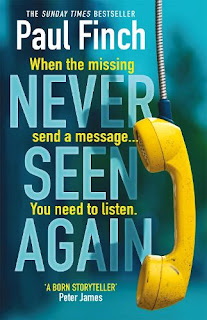
Surprise is often the response when I mention that my new novel, NEVER SEEN AGAIN, is about an investigative journalist rather than a police officer. That’s because I’m probably best known as an ex-cop. But not many are aware that when my cop days had ended I became a journalist, plying my trade on newspapers across Northwest England.

You moved from gamekeeper to poacher,” is a viewpoint I often hear.

It’s an oft-used term, of course, but it’s also an oversimplification.

It’s easy to think of the average cop as a law-enforcement robot who does the right thing because he or she is duty-bound, while the average journalist is a freebooter working both sides of the fence, driven by a moral compass that isn’t always consistent with everyone else’s.

I wouldn’t deny that in recent times we’ve seen some glaringly unprofessional journalism. We’re a politically divided nation, and many of our media outlets reflect this. But I’d contend that the basic journalistic instinct remains: report the news, present factual analysis, and if you must insist on taking sides, at least give the other side a right of reply. 

Ultimately, certainly in Britain, I’d argue that most investigative journalists, like most cops, seek an orderly and happy society, and set out to be the bane of the bad guys.

But there the similarities end.

To start with, and perhaps most obviously, journalists have no back-up. They possess no power of arrest, they can’t draw firearms, they don’t wield the might of Government. So, if they’re on the trail of belligerent people, it might turn risky.

From Elijah Parish Lovejoy back in 1837, to more recent heroes like Fritz Gerlich and Anna Politkovskaya, journalists have died on the job; Lovejoy at the hands of a pro-slavery mob who objected to his newspaper’s abolitionist stance, Gerlich on the Night of the Long Knives for exposing the realities of Nazi violence, Politkovskaya in 2006 when a contract killer cornered her in a Moscow lift after a career spent uncovering the wrongdoings of Putin’s government.

But perhaps the most palpable contrast between cop and journo is that, while both may seek to drive the cause of right, the cop works for the public sector, the journalist for the private. Even the most crusader-like reporting will have no impact if nobody reads it. And today, that news market is more crowded than ever, so the temptation to be sensational increases, the drive is on to get ever better stories, ever bigger headlines.

And this is the point at which people may decide they have a problem with journalism. At what stage does it become too scavenger-like? How can you respect a profession, which, though it produced such world-changing scoops as Woodward and Bernstein’s Watergate exposure can also show such shocking lapses of judgement as the News International phone-hacking scandal? 

Don’t get me wrong. Cops face dilemmas too. In many of my police novels, my heroes and heroines stray into and beyond ethical grey areas, but in those cases you could argue they are trying to remove some heinous and destructive elment from society. 

As a journalist, it’s harder to put such a positive spin on your indiscretions. Especially when, as the man in the street might say, “you’re trying to sell newspapers, mate”.

And this was the personal drama I sought to create at the heart of NEVER SEEN AGAIN. Where does it leave you when, in your efforts to expose villainy, but also to bump your sales and make yourself a star, the wheels come off so badly that it costs lives?

Where do you go when you’re used to being adored but now find yourself deservedly reviled? When the one thing you’re really good at is closed to you because no one will pay you to do it anymore?

It’s not too much of a spoiler to reveal that, in NEVER SEEN AGAIN, disgraced journo, David Kelman, gets a glimpse of redemption (though it’ll be the hardest road he’s ever taken). But it was his inner pain that I became most fascinated by.

How did I end up with such tunnel vision?

How did I not see the damage I was doing?

How did I become one of those callous monsters that I so enjoyed exposing?

I love a rollicking good thriller full of blood and thunder. But the human story is often equally (if not more) interesting. Whether I’ve managed to balance the two in NEVER SEEN AGAIN, only my readers can judge.

Never Seen Again by Paul Finch is published by Orion on 17 March in paperback, £7.99

A message no one was supposed to hear. Jodie Martindale's disappearance remains a mystery, unsolved to this day. A message that will change everything. David Kelman covered the story. But he made a huge mistake, which cost someone their life. A message from the missing. Now, he has evidence he shouldn't have. It's a message from Jodie - who has been missing for six years - but sent just two weeks ago...

More information about Paul Finch can be found on his website. You can also find him on Facebook and follow him on Twitter @paulfinchauthor

Thursday, 20 August 2020

Behind the Scenery by Paul Finch

While many of my previous crime novels have been set up and down the country, there’s always been a strong bias towards the North of England, and the Northwest in particular. 

This was always inevitable, I suspect. Not only was I born and raised there, but when I was a policeman and later, when I was a journalist, my hunting ground was Greater Manchester. I’ve never made any apologies for this because the Northwest, with its post-industrial landscape of depressed towns, derelict factories, and extensive, rubble-strewn spoil-land, makes an atmospheric backdrop for crime and thriller fiction that is almost second-to-none.

ONE EYE OPEN, though, will be very different. Because this new novel of mine is set in the border country between Essex and Suffolk, a pastoral landscape famous in the past for such practitioners of fine art as John Constable and Thomas Gainsborough, and well known today for its prosperous villages, scenic woodland walks and genial country pubs.

As settings for crime thrillers go, it’s a far cry from anywhere I’ve been previously. But there’s a story behind this.

I first became enamoured of this leafy corner of England because I have in-laws there. We’ve been visiting them more and more recently, slowly getting to know their friends and neighbours, and one summer day a couple of years ago, during a very genteel garden party, I was introduced to a chap who, like me, was a former copper. 
We chatted amiably, gradually comparing notes about the job. I confidently expected that mine would blow his out of the water. After all, rapes and murders were regular events on our patch. We’d had arson, aggravated burglaries, repeated gang violence, an armed robbery during which machine-guns were discharged. The Suffolk ex-copper’s recollections weren’t quite as lurid as mine, but he told me some fascinating tales all the same, making it quite clear that it wasn’t just poaching they had to cope with out there in the sticks. Okay, it wasn’t MIDSOMER MURDERS, but there was plenty going on behind the lovely scenery. 

Most interesting of all (certainly to me), rural Southeast England had allegedly become a retirement land for the London underworld. Apparently, this wasn’t something that even local people knew about widely. But the story was that gangland bigwigs who had been forced out of the game either through age or simply because they’d decided the time was right and didn’t fancy tangling with incoming syndicates from overseas (who by reputation were particularly deadly), had set up shop in secluded rural residences, some of them pretty extravagant, but nearly all hidden at the ends of long drives, or behind walls of privets or manicured shrubbery, where they were leading the lives of wealthy, law-abiding citizens.

I wasn’t quite sure how to take this, and my new pal was at pains to stress that it wasn’t happening everywhere, and that there’d never been a corresponding increase in local crime as most of these old lags were done with all that.

But I found the idea fascinating: that inner city crime, or the proceeds of it, could be flourishing unnoticed in England’s cosy heartlands, where the most dangerous thing that most visitors normally encounter are clumps of nettles or crumbling stone steps in idyllic country churchyards.

I checked with other guests, and while many were adamant that this wasn’t so, a couple advising that while there were lots of successful people locally, all had risen to prominence legitimately, some were more circumspect. 

It was a mixed bag of views, but by this time I’d been inspired.

I mean, is it really possible that a truly nefarious past can ever stay buried? I’d never considered organised crime as being like a village club, something you joined by paying a membership fee to and left by stopping paying. There is much mythology woven around the underworld, of course: that once you’re in, you’re in; that it never forgets; that by the nature of the beast, you are embroiled in activities from which you can never just walk away.

Whether any of this is real or not, or just a flight of imagination I’d gone on after a tipsy summer afternoon with a fellow ex-officer, I can’t say. But I knew I had the kernel of a new book.

And this one wouldn’t work so well in the smoky gloom of the North. Not when I had the garden of England as an alternative. 

A garden in which, in ONE EYE OPEN, serpents abound. 

One Eye Open by Paul Finch is published by Orion and is out now.
YOU CAN RUN
A high-speed crash leaves a man and woman clinging to life. Neither of them carries ID. Their car has fake number plates. In their luggage: a huge amount of cash. Who are they? What are they hiding? And what were they running from?
YOU CAN HIDE 
DS Lynda Hagen, once a brilliant detective, gave it all up to raise her family. But something about this case reignites a spark in her...
BUT YOU'LL ALWAYS SLEEP WITH... 
What begins as an investigation soon becomes an obsession. And it will lead her to a secret so dangerous that soon there will be nowhere left to hide.
ONE EYE OPEN

Thursday, 9 July 2020

Elle Croft on the Perfect Place to set a Crime Novel

©️Elle Croft
You might not think it when standing on the beach - white sand stretching endlessly in either direction, barely a soul in sight, and water so blue it’s hard to distinguish it from the sky - but the city of Adelaide, in South Australia, is the perfect place to set a crime novel. 

When I was growing up in Adelaide, in a suburb called Happy Valley, where koalas would occasionally cling to the gum tree in our backyard and kangaroos could be spotted grazing in the fields near my school, fellow students would brag, bizarrely, that Adelaide was the ‘murder capital of the world.’

It’s a myth, but it’s a long-perpetuated one. So engrained is this fact in urban legend that the hit TV series Dexter, about a serial killer with a strict moral code, created a promo around it. In the commercial, the actor who plays Dexter sits in an airport waiting for a flight. When asked by a fellow traveller where he’s headed, Michael C. Hall replies, deadpan, that he’s off to Adelaide as it has more serial killers per capita than any other city in Australia. He grins devilishly at the camera while the passenger beside him shifts uncomfortably. 

It’s a pretty chilling accusation to level at an otherwise innocuous coastal city, especially considering it’s not true. So why is it still stated as fact?

Perhaps because in 2008 the Australian Bureau of Statistics reported that South Australia had 15 per cent of the nation's convicted killers, but only 8 per cent of the population.

Or perhaps it’s just because Adelaide has a history of extremely mysterious (and often quite brutal) crimes.  

The Somerton Man is one such case, having baffled police, decoders and armchair sleuths for decades. An unidentified man was found dead on Adelaide’s Somerton Beach in December 1948. Rolled up in one of his pockets was a piece of paper, torn from the pages of a book of poetry called the Rubaiyat of Omar Khayyám, with the Persian phrase tamám shud (which means ended, or finished) written on it. Theories about spies and ciphers and poisons and stolen cars and a young nurse abound, but no one has ever answered the many questions this case poses (although we did our best when we covered it in the true crime podcast I co-host, called Crime Girl Gang)!

In January 1966, the Beaumont children, aged 9, 7, and 4, disappeared from a popular local beach and were never seen or heard from again. There were the ‘Family Murders’ in the 70s and 80s, the strange disappearance of Rhianna Barreau, and the stabbings of teenagers Fiona Burns and John Lee. Many of these cases remain unsolved to this day. 

And of course there were the infamous Snowtown murders, also known as the ‘bodies in barrels’ case - not quite in Adelaide, but still in the state of South Australia. The case made headlines across the world in the 90s, when the remains of eight murder victims were discovered in barrels stored inside an old bank vault.

That’s by no means an exhaustive list of strange and terrifying crimes that have been committed in Adelaide, but it does perhaps give an insight into how the city ended up with its macabre reputation.

When I began writing Like Mother, Like Daughter, I knew immediately that I wanted it to be set in Adelaide. Part of this was because I wanted to play into the city’s misguided reputation for producing dangerous killers. But there was more to it than that. 

Adelaide is a beautiful city. It boasts miles and miles of pristine sandy beaches, with dolphins frolicking close to shore on any given day. It has some of the most stunning wine regions in the world (producing mouth-wateringly delicious wines), amazing restaurants, wonderful wildlife, and it’s host to world-class cultural events every year (including what I maintain is the best book festival in the world because you sit outside under palm trees. Sorry, Harrogate, but you can’t beat that!).

In short, I wanted the chance to boast about the city I grew up in. If I had to add a bit of murder, kidnapping and general bad behaviour to make that happen, then so be it (although, rest assured, I set the worst crimes in Victoria, South Australia’s neighbouring state). 

Perhaps the ‘murder capital’ rumour isn’t going away any time soon, but there’s far more to Adelaide than just its darkest moments. And I hope that Like Mother, Like Daughter gives my readers a glimpse of all that it has to offer!

Like Mother Like Daughter by Elle Croft is published by Orion on 9th July.
If what they said was true, then the grotesque and the monstrous ran in her blood. It was imprinted within her very core, her DNA, a part of every cell in her body.  Kat's children are both smart and well-adjusted. On the outside.  Kat has always tried to treat Imogen and Jemima equally, but she struggles with one of her daughters more than the other.  Because Imogen's birth mother is a serial killer. And Imogen doesn't know.  They say you can't choose your family, but what if your family If what they said was true, then the grotesque and the monstrous ran in her blood. It was imprinted within her very core, her DNA, a part of every cell in her body.  Kat's children are both smart and well-adjusted. On the outside.  Kat has always tried to treat Imogen and Jemima equally, but she struggles with one of her daughters more than the other.  Because Imogen's birth mother is a serial killer. And Imogen doesn't know.  They say you can't choose your family, but what if your family chooses you?

Tuesday, 1 October 2019

ASK ME NO QUESTIONS – and why write about identical twins?

The germ of the idea for Ask Me No Questions started at a supermarket late at night. I imagined a woman walking the aisles, followed by a mysterious man in black. He thinks she’s someone else, in a case of mistaken identity. But why? I wondered. Perhaps he’s confusing her for her identical twin? And where is this identical twin now?

This woman became Thea Patterson and the man became Mortimer. From this tiny scene, Ask Me No Questionswas born.

So why twins? At the end of the day, I like to write about what I’m interested in. After all, writing and researching a book (and editing, and editing again…) takes the best part of a year, so why not write about something you’re fascinated in?

I read every news article and watched every documentary I could get my hands on. I studied Psychology at university and was always especially interested in twin studies. Scientists love to examine what happens to the same thing under different conditions, so identical twins who have grown up separately are ideal. How much of an influence does nature (their DNA) versus nurture (their families and home life) have? Even when identical twins have never met, they have similarities in their lives. From the small, such as driving the same type of car, to the more significant, like the same body language and gestures. These can’t be explained by mere coincidence, surely? There’s something incredible going on in those cells and neurons.

Strangely, many of my friends are identical twins, and I interviewed them to get insight into what it was like. While most of them talked about how annoying it was to be asked the same old questions (‘can you read each other’s minds?’ ‘can you feel each other’s pain?’) they did mention a few things that made me take note.

My friend told me about a game he played when they were teenagers. Taking a stack of cards, he held up one by one, while his twin had to guess what was on it. He got the first ten completely right. It freaked them out so they stopped, and they haven’t been able to replicate it since. My other friend, based in the UK, knew exactly when her twin sister was going into labour. In New Zealand.

It’s phenomenon like this that keeps me interested, that made me sit up a little straighter in my seat. The unknowable creates a fascination. It gives us something to wonder about.

But my friends also talked about the unique bond they had with their twins. One pair described viewing themselves as a collective, not as individuals. There was no sense of self outside the other. My other friends weren’t quite so connected, but all discussed the closeness, and being two halves of a whole. Fights were moved on from and quickly forgotten without saying sorry. After all, you’re fighting with yourself, so where’s the need for apologies?

They all talked about their mannerisms being similar; all could predict what the other would do in any given situation. And all had an innate sense of protection, at any cost.

So I followed the story to its next conclusion: if you take two sisters who look identical, with an unbreakable bond across eighteen years of their life, what happens when one does something unthinkable? Is it possible to forgive? And what if they both fell in love with the same man? What then? It’s these dilemmas I had so much fun exploring in Ask Me No Questions, and I hope you’ll enjoy reading what happens in the book.


Ask Me No Questions by Louisa De Lange (Orion Publishing)
Twins have a special bond someone will kill to break.  As children, Gabi and Thea were like most identical twin sisters: inseparable. Now adults, Gabi is in a coma following a vicious attack and Thea claims that, until last week, the twins hadn't spoken in fifteen years. But what caused such a significant separation? And what brought them back together so suddenly?  Digging into the case, DS Kate Munro is convinced the crime was personal. Now she must separate the truth from the lies and find the dangerous assailant - before any more blood is spilled 


Friday, 11 January 2019

Danish Criminal Academy Awards

Crimean author Jesper Stein has won the Harald Mogensen Award, which The Danish Criminal Academy is awarding for the best crime of the year. The prize goes to Stein's Crimea novel "Solo", which is the sixth volume in his popular and critically acclaimed crime scene with police officer Axel Steen as the protagonist.

The Danish Criminal Academy's debut award goes this year to Søren Sveistrup for the thriller novel "Kastanjemanden" (The Chestnut Man) Søren Sveistrup has also been the creator and author of, among other things, three seasons of "The Crime".  Both "Solo" and "The Crime" have been published by Politikens Forlag.

Credit Mark DeLong Photography
Finally, the Academy has awarded the American writer Michael Connelly the so-called Palle Rosenkrantz Award for this year's best foreign thriller novel for his book "Two Kinds of Truth" which is published by Klim.

All the awards are presented during the Crimean Fair in Horsens on the first weekend in April

The Palle Rosenkrantz Prisen recognizes the best crime fiction novel published in Danish. It is named in honour of Palle Rosenkrantz (1867-1941), who is considered the first Danish crime fiction author; his novel Mordet i Vestermarie (Murder in Vestermarie) was published in 1902. The Harald Mogensen Prisen recognizes the best thriller. It is named after Harald Mogensen (1912-2002), a Danish editor, in recognition of his contribution to the field of literary crime.

Wednesday, 31 October 2018

The Insider by Mari Hannah extract


I am pleased to host an extract from Mari Hannah's new book The Insider as part of the The Insider blog tour

It was the news they had all been dreading, confirmation of a fourth victim. For DS Frankie Oliver, the journey to the crime scene brought back memories of her father driving her around Northumberland when she was a rookie cop, pointing out the places where he’d been called to investigate serious incidents throughout his own police career, giving her the benefit of his advice along the way. He’d been doing this since she was a kid, only with less detail, leaving out the unspeakable horrors the locations represented. Back then, they were words.  Just words. Narratives that, if she were being honest, excited her in ways they should not. And then there was the night he stopped talking: an experience etched on their collective memory forever more – a night too close to home.

Flashlight beams bobbed up and down, illuminating sheets of horizontal rain. The detectives stumbled along the Tyne Valley track, heading east on the Northern Rail line linking Carlisle to Newcastle. No light pollution here. Under a dark, forbidding sky, it was difficult terrain, rutted and sodden so close to the water’s edge. The swollen river thundered by, a course of water liable to flash flooding. Red alerts for the area were a regular occurrence. At midday, Northumberland’s monitoring stations had warned of a serious threat to those living nearby. If the Tyne rose quickly, Frankie knew they would be in trouble. Many a walker had slipped into the water here by accident.

Few had survived.  Lightning forked, exposing the beauty of the surrounding landscape. A high-voltage electric charge, followed by the rumble of thunder in the distance, an omen of more rain to come. The lead investigator, Detective Chief Inspector David Stone, was a blurred smudge a hundred metres in front of her, head bowed, shoulders hunched against the relentless downpour.

Mud sucked at Frankie’s feet as she fought to keep up, two steps forward, one back, as she tried to get a purchase on the slippery surface. Her right foot stuck fast, the momentum of her stride propelling her forward, minus a wellington boot. She fell, head first, hands and knees skidding as she tried to stay upright. Dragging herself up, she swore under her breath as brown sludge stuck to her clothing, weighing her down.

Unaware of her plight, David was making headway, sweeping his torch left and right in a wide arc close to Eels Wood. He had one agenda and Frankie wasn’t it. With a feeling of dread eating its way into her gut, she peered into the undergrowth blocking her passage. Where was a stick when you needed one? As she parted the brambles, there was an ear-splitting crack, a terrifying sound. Before she had time to react, a tree fell, crashing to earth with an excruciating thump, unearthed by a raging torrent of water filtering off higher ground, its roots unable to sustain the weight of a century of growth, landing metres in front of her.

Frankie blew out a breath. Only once before had she come closer to violent death.

Hoping her luck would hold, she vaulted the tree and ploughed on. From an investigative standpoint, the situation was grim. Had there been any footprints adjacent to the line, they were long gone. As crime scenes go, they would be fighting a losing battle to preserve evidence, assuming they ever found the body spotted by an eyewitness, a passenger on an eastbound train.

Where the fuck was it?

Frankie expected to see the dragon ahead, a wide-eye LED searchlight used by emergency services, an intense beam of white light guiding her. As far as the eye could see there was no light visible, other than the beam of David’s flashlight.

Worrying. Exasperating. Frankie couldn’t be arsed with this.  Pulling her radio from her pocket, she pressed the transmit button hoping her link to Control wouldn’t be affected by the appalling weather. It would be a heavy night in the control room, for sure.

‘Oliver to Control. We’re in position. Can you repeat the
coordinates? We’re seeing bugger all out here.’ Silence.

‘Damn it! DS Oliver to Control. Are you receiving?

Over . . .’

A pause before her radio crackled to life: ‘Control: go ahead.’

Wiping rain from her nose with the back of her hand, Frankie repeated her request, yanking at the drawstring on the hood of her raincoat to stop water getting in. A useless exercise. She was well and truly drenched. ‘Have a word with first responders, will you? If they’re guarding a crime scene, they should know where the bloody hell they are. We need help here.’

‘Copy that. I’ll get back to you.’


The Insider by Mari Hannah published by Orion Publishing
'It was the news they had all been dreading, confirmation of a fourth victim. 'When the body of a young woman is found by a Northumberland railway line, it's a baptism of fire for the Murder Investigation Team's newest detective duo: DCI David Stone and DS Frankie Oliver.  The case is tough by anyone's standards, but Stone is convinced that there's a leak in his team - someone is giving the killer a head start on the investigation. Until he finds out who, Stone can only trust his partner.