Thursday, 13 June 2024

Theakston's Old Peculair and McDermid Debut Award Shortlists revealed


SHORTLISTS REVEALED FOR THE

THEAKSTON OLD PECULIER CRIME NOVEL OF THE YEAR 2024 AND INAUGURAL McDERMID DEBUT AWARD

Festival Dates: 18 – 21 July 2024               

www.harrogateinternationalfestivals.com

#TheakstonsAwards #TheakstonsCrime

Harrogate International Festivals has announced the shortlists for the Theakston Old Peculier Crime Novel of the Year 2024, the UK and Ireland’s most prestigious crime fiction award, and the inaugural McDermid Debut Award for new writers. The winners of both awards will be revealed on the opening night of the Theakston Old Peculier Crime Writing Festival, Thursday 18 July. 

The six books shortlisted for the Theakston Old Peculier Crime Novel of the Year, now in its twentieth year, take readers on a roller-coaster ride from serial-killer stalked fairgrounds and Blackpool backstreets to the Houses of Parliament, as established bestsellers compete with talented newcomers for the coveted awards. Crime fiction fans are now invited to vote for their favourite book to win at www.harrogatetheakstoncrimeaward.com.

 Two former winners in contention for the award are 2022 champion Mick Herron, the author behind Apple TV’s hit series ‘Slow Horses,’ who is nominated for his mesmerising stand-alone spy thriller The Secret Hours and two times winner Mark Billingham, shortlisted for the first time in eight years with The Last Dance, the first novel in the captivating new Detective Declan Miller series set in Blackpool.

They face stiff competition from two rising stars of the genre who are shortlisted for the first time: William Hussey with Killing Jericho where Traveller detective Scott Jericho must unpick a deadly mystery at a fairground before he becomes a killer’s next victim, and Jo Callaghan for her stunningly original debut In the Blink of An Eye, where DCS Kat Frank is partnered with an AI colleague as human experience combines with logic to solve a complex missing persons case. Jo was selected for the prestigious ‘New Blood’ panel celebrating outstanding debut talent at the Theakston Old Peculier Crime Writing Festival in 2023.

Two bestselling authors hoping to add the Award to their trophy cabinets are recent British Book Award Winner Lisa Jewell, shortlisted for her addictive domestic noir None of This is True, about a podcaster under threat from her ‘birthday twin’; and four-times Irish Book Award winner Liz Nugent, nominated for Strange Sally Diamond, a darkly humorous character-driven murder mystery set in rural Ireland.

The full Theakston Old Peculier Crime Novel of the Year 2024 shortlist (in alphabetical order by surname) is: 

The Last Dance by Mark Billingham (Sphere; Little, Brown Book Group) 

In the Blink of an Eye by Jo Callaghan (Simon & Schuster UK) 

The Secret Hours by Mick Herron (Baskerville; John Murray Press) 

Killing Jericho by William Hussey (Zaffre, Bonnier) 

None of This is True by Lisa Jewell (Century; Cornerstone) 

Strange Sally Diamond by Liz Nugent (Sandycove; Penguin Ireland) 

The shortlist for the inaugural McDermid Debut Award, named in recognition of world-famous crime writer Val McDermid, showcases six outstanding new voices writing across a broad range of subgenres from thrillers to cosy crime, locked room mysteries and historical crime.

Food writer, broadcaster and Master Chef star Orlando Murrin is shortlisted for Knife Skills for Beginners, a delicious mystery set in an exclusive residential cookery school in Belgravia. Another shortlisted novel with a culinary twist, Mrs Sidhu’s Dead and Scone by Suk Pannu introduces a mystery solving Indian caterer who is Slough’s answer to Miss Marple. Suk Pannu has written for much-loved TV comedy shows ‘Goodness Gracious Me’ and ‘The Kumars at No.42.’

Suzy Aspley, a former journalist who lives in Scotland, is nominated for Crow Moon, a chilling thriller centred around a mysterious disappearance, the first novel in the Martha Strangeways series. Daniel Aubrey, who also lives in Scotland, is shortlisted for Dark Island, a thriller about a neurodivergent reporter who uncovers a disturbing conspiracy after human remains are discovered on Orkney’s coast.

Manchester based Kuchenga Shenjé’s gripping historical crime novel The Library Thief explores identity and belonging as book binder’s daughter Florence sets out to uncover the dark mystery at the heart of a gothic mansion. A similarly unforgettable amateur sleuth features in Marie Tierney’s thriller Deadly Animals where a roadkill obsessed teenager embarks on a daring quest to unravel the truth behind the string of chilling deaths plaguing her Birmingham community.

Honouring internationally bestselling crime writer, Val McDermid, who helped to co-found the Theakston Old Peculier Crime Writing Festival in 2003 and whose dedication to fostering new voices in crime fiction through the New Blood panel is legendary, this new Award seeks to continue her legacy, celebrating and platforming the best debut crime writers in the UK. The Shortlist was selected by an academy of established crime and thriller authors and the Winner will be chosen by a panel of industry experts, without a public vote. All shortlisted authors receive a full weekend pass to the Theakston Old Peculier Crime Writing Festival and the Winner will receive a £500 cash prize.

Val McDermid said: ‘Curating the New Blood panel over twenty years exposed me to an extraordinary range of crime fiction I might otherwise have missed. I’m hoping that this new award will do the same for the army of avid readers out there looking for new talent.

The full McDermid Debut Award 2024 shortlist (in alphabetical order by surname) is: 

Crow Moon by Suzy Aspley (Orenda Books) 

Dark Island by Daniel Aubrey (Harper Collins) 

Knife Skills for Beginners by Orlando Murrin (Bantam, Transworld) 

Mrs Sidhu’s Dead and Scone by Suk Pannu (Harper Collins) 

The Library Thief by Kuchenga Shenjé (Sphere, Little Brown) 

Deadly Animals by Marie Tierney (Bonnier Books) 

Commenting on the shortlist for the Theakston Old Peculier Crime Novel of the Year 2024, Simon Theakston, Chairman of T&R Theakston, said: “Congratulations to all of the exceptional writers shortlisted for this year’s Theakston Old Peculier Crime Novel of the Year. This year’s list is particularly exciting, with big names at the top of their game competing against impressive newcomers. I can’t wait to see who the public and the judges vote for and look forward to awarding the coveted beer cask trophy to the winner at the opening night ceremony.

Commenting on the shortlist for the McDermid Debut Award, Sharon Canavar, Chief Executive of Harrogate International Festivals, said: “Awards night is always a special way to open the Festival but this year it promises to be more exciting than ever with the new McDermid Debut Award being presented alongside our other awards. The shortlisted books are all so original and introduce some compelling new voices. We are looking forward to welcoming the talented shortlisted authors to the Festival and finding out which of these stars of the future will carry off the Award.

The Theakston Old Peculier Crime Novel of the Year 2024 is presented by Harrogate International Festivals and sponsored by T&R Theakston Ltd, in partnership with Waterstones and the Daily Express, and is open to full-length crime novels published in paperback between 1 May 2023 and 30 April 2024.  The winner will receive £3,000 and a handmade, engraved beer barrel provided by T&R Theakston Ltd. 

The Winners of both Awards will be revealed on the opening night of the Theakston Old Peculier Crime Writing Festival, Thursday 18 July.  


Wednesday, 12 June 2024

Reading and Escapism! - By Dr Luke Deckard

Raymond Chandler criticised Dorothy L Sayers in his essay The Simple Art of Murder (1950) for commenting that crime fiction wasn’t a serious type of literature but one of escapism. She’s not the only one to snub the genre that was an author’s bread and butter. Before Sayers, Sir Arthur Conan Doyle famously hated Sherlock Holmes! He didn’t want to be remembered solely for that character because he felt they were silly, unimportant stories. 

I can imagine Raymond Chandler sitting at his desk, reading these quotes while swishing a glass of whisky, pausing to look at his cat and huff. Chandler’s rebuttal to Sayers was simple: all pleasurable reading is a form of escapism. If that meant your jam was mathematics, philosophy, or Western or romance, that was fine. Chandler disagreed with Sayers’s implication that escapist literature is essentially dumb and unimportant literature. 

Nevertheless, this attitude persists today. I once read a press release for a book described as a “frothy thriller” That baffled me! A book without substance! I would be devastated if my work was described as frothy! I instantly felt bad for the author. My reaction couldn’t have been unlike Chandler’s when reading Sayers’s comments. But it’s not uncommon to see people on social media describe a film or a book as ‘turn your brain off fun’ or ‘you don’t have to think about it.’

This attitude of disposable, empty, forgettable storytelling is far too common. And is often used to excuse poorly told stories. 

When I started to write bad Blood, it was for my PhD at Kingston University. One of the most challenging aspects at the start was battling with the idea of how to make this book meaningful and live up to the quality of what a PhD novel should be. I was dead set on writing a historical noir. I wanted gangsters, femme fatales, and a tough-talking yet charming PI. I wanted it to be thrilling, fun, and sexy. 

But is that literary? Is that good enough? Hard-boiled fiction was birthed out of pulp magazines printed on cheap disposable paper. Were the tricks and tropes just as disposable today? Was there any literary appeal left? I wrestled with these questions. 

In the same essay, Raymond Chandler says that form doesn’t matter; it’s style that counts. What he meant was you can write any ole genre, but it is the author’s flare that makes it pop and stand out. Then, Chandler’s criticism of Sayers and his comments on style all clicked. I knew what I needed to do: escape into the genre. I needed to embrace the form shamelessly and respectfully while making it my own.

That’s what Chandler was getting at—there is no literature of escape in a derogatory sense. Meaning no single genre is less than simply because of its formula.

The filmmaker Robert Meyer Burnett once phrased what audiences are genuinely after: they want good stories told well. Genre is irrelevant. The form isn’t the it thing that makes something work. It’s all about style! The execution. That’s why you can read two books in the same genre and love one but hate the other. Audiences don’t seek out bad, forgettable, disposable art. So, we writers shouldn’t treat stories as such. When we’re hungry, we don’t go into a restaurant and say, ‘Give me the worst thing on the menu, please!’ We want something delicious. 

When I think about the book described as a frothy thriller, what the headline was trying to say was it’s a fun ride. The word choice of frothy was a mistake. The value of fiction doesn’t come from the seriousness of its content or ‘realism’, but from the joy the readers have with a well-executed story. That’s what Burnett means by a good story told well.

And that’s what I attempted to do with Bad Blood. It wasn’t about ‘writing literature’ or trying to make something more out of it. The form is the form. So I wrote it for the people who love noir fiction, who love historical fiction, who love Edinburgh, and tough and gritty atmospheres. There was no shame in embracing the tropes and trying to subvert a few along the way! If someone escapes into my book, that’s a beautiful achievement! 

So readers, feel free to escape into fiction! It’s not a bad thing. But do keep your brains switched on!

Bad Blood by Luke Deckard (Sharpe Books) Out Now

London 1922. American ex-pat Logan Bishop, suffering from shell-shock and an addiction to morphine, is working as a Private Investigator. When Logan’s father, Reverend Daniel Bishop, arrives from Chicago, desperate to see his son, Logan wants nothing to do with him. That is, until his father is brutally attacked. Daniel begs his son to find Greta Matas, a Bolshevik woman with an unknown connection to his father, in Edinburgh before she is murdered. Before Logan can learn more, his father slips into a coma. Logan takes the first train to Edinburgh. The journey proves far from routine, however, and two mysterious men follow the investigator out of Waverley Station. Logan soon discovers that Greta is missing and her son, Peter, is wanted for murder. The case begins to take a darker and deadlier turn than he ever imagined. As Edinburgh police suspect Logan of keeping information from them, the pressure to find Greta and her son increases. Secrets and lies are exposed as Logan clashes with Chicago gangsters, the authorities, and Edinburgh’s elite to expose the truth behind the woman's disappearance.

You can find Bad Blood on Amazon UK and Amazon US

More information about Dr Luke Deckard can be found on his website. You ca also find him on X @LukeWritesCrime. You can also find him on Facebook.


Thursday, 6 June 2024

Elliot Sweeny on A Killing in Paradise and surviving evil acts

 These are cruel men you’re after, Kasper. You’ll need to be cruel back to survive.’

Walk into the National Gallery in Trafalgar Square, and it won’t take long to encounter brilliant reproductions of violence, murderous, grotesque, raptly enjoyed by visitors. Dickens’ 1849 account of the public hanging in Southwark, and the odious glee on faces in the circus crowd as the ropes fall captured a similar glee. More recently, a 2019 Netflix documentary entitled Don’t F*** With Cats about Luka Magnotta, a cat and human killer who filmed and uploaded his work onto the internet, caused a viral shebang amongst viewers, and was an unprecedented hit.

The lure to watch suffering is ubiquitous, and nothing new. But what does seem new, and what disturbs me, is this intersection between these sadistic interests, and the age of digital commoditization in which we live. When fights erupt in public places, rather than intervene or flee, members of the public reach for their phones, and hit record. A few hours later, these shaky videos appear on the circuit, clickbait for YouTube, Insta-likes, ‘content’; they generate thumbs-up emojis on WhatsApp groups and Facebook, the gore seeming comic-book, desensitized, allowing consumers to snigger at the pain of others with impunity. As disturbing as the double murders of Nicole Smallman and Bibaa Henry in 2021 was the discovery that two attending police officers charged with protecting the sisters’ bodies had in fact photographed them, and then shared the images amongst friends for their amusement and self-promotion. Why?

The second in the Dylan Kasper series, A Killing in Paradise, aims to explore this phenomenon: what is behind the draw to capturing and circulating brutality against the defenceless and vulnerable? Is evil of this sort inherent? Or a biproduct of the times we live in? The book, of course, is dark as hell.

The story picks up six months after the close of Book One, The Next to Die. Out-of-work PI and full-time misanthrope Dylan Kasper is commissioned to investigate the stabbing of a teenager from the notorious Paradise Estate where he was raised. The Met have made assumptions about the victim, based on socioeconomics and race; but Kasper uncovers the truth: he was killed because of something he stole, an art-snuff movie showing a prostitute being butchered.

Kasper is sickened by of the barbarity on this film and compelled to thwart the makers. He discovers that the victim on this snuff was only the latest, murdered by a nefarious organisation stretching into the higher echelons of society. Red Rose Productions cater to a buoyant market united by a love for exploitation and torture-porn. And when the ringleaders target Kasper, he must ask how far he is he willing to go to combat evil.

At times, writing this book felt like self-harm. In my day job I’m a mental health nurse, and regularly support the victims of abuse, violence, and extreme coercion; at times, it can have a gruelling, vicarious impact on my own state of mind. To then come home to these characters and themes felt harsh. 

But I persevered. In the same way a loose scab needs picking, once the story had set root, I couldn’t leave it until it was grown. For not only was this a vehicle in which I could write about the violence I see through my work; it was also a way to develop my protagonist’s own uncomfortable capacity for, and pull towards, the violence that has shaped him, and which he perpetrates and revels in.

Kasper – the name a fusion of the kids’ friendly ghost character but spelled with a ‘kicking-K’ for impact – is a protagonist of contradictions. A solipsistic, self-destructive pugilist, a heavy drinker, bereaved father, and self-imposed bachelor, he is nonetheless a man with a firm moral backbone, albeit hidden beneath a coating of boxing brawn and beer fat.

I am drawn to central characters like this – flawed, melancholic, reckless; yet ultimately good. No matter how dangerous Kasper’s adversary is – and in A Killing in Paradise, I’ve really gone to town with the bad guys – we know that the biggest villain will always be him, and his attempts to make the cruel world he inhabits a little less cruel is a way to placate, but never extinguish, the shadows that lurk in the recesses of his soul, and which will ultimately be his undoing.   

 A Killing in Paradise by Elliot Sweeney (Headline Publishing) Out Now.

A young man has been murdered on the notorious Paradise estate in London. The police have their assumptions; out-of-work private investigator Dylan Kasper, more than familiar with the neighbourhood, has his own. Kasper takes it upon himself to get to the bottom of the killing. He soon discovers the reason the boy was killed that the police will never find - or want to find. A highly incriminating piece of evidence tying an illegal production company to the government and police alike. But this is just the beginning. Kasper has made a name for himself getting under the skin of the most brutal killers in the capital. When those dearest to Kasper are suddenly thrust into view, he will have to make an impossible choice. Will the inhabitants of Paradise feel safe at last, if the price must be paid in blood?

More information about Elliott Sweeney and his writing can be found on his website. You can also follow him on "X" @ellywelly1


Lily Samson on : How Roald Dahl’s Switch Bitch inspired my debut thriller, The Switch

I remember being shocked when I first read it: The Great Switcheroo by Roald Dahl. I was thirteen years old at the time. I had grown up devouring Roald Dahl and his magical classics for children: Matilda, The Witches, Danny the Champion of the World. Discovering his twist-in-the-tale stories was a delicious shock. Though his children’s fiction involves waspish humour and caricature villains, they are also very tender books, in my opinion, often involving a sweet relationship between parent(figure) and child. But his short stories were darker, all nastiness and schemes and games and come-uppances, with added spice; whilst they were far more ‘adult’, sex was often a theme explored with a school-boyish glee.

I loved The Great Switcheroo. It’s about two men who live opposite each other, who decide to creep into each other’s houses and swap wives in secret, in the dark, without them knowing. Dahl always anchored his outrageous conceits with a forensic attention to practical detail – each man spends weeks practising creeping into each other’s house, paying attention to the creak on the stairs and so on. Dahl has been accused of misogyny – unsurprisingly given that the story was originally written for Playboy and subsequently included in a collection called Switch Bitch. However, the men do get a come-uppance; their actions have consequences. The end result of their manipulations is the discovery that their partners have been sexually unsatisfied in the past and the secret swap has brought them a fulfilment not known before. The men are humiliated. They realise that they have trapped themselves in their own game.

I decided to turn the story on its head and explore the female equivalent: what would happen if two women decided to swap their male partners without them knowing? What if they also paid attention to every detail, a la Dahl, to the perfume they wear, the underwear, their shampoo, to see if they could pull it off?

I set the story in Wimbledon village, the home of many a glamorous millionaire. When my heroine, Elena, gets a housesit to stay there with her partner, she meets a dazzling couple called Sophia and Finn. Sophia is like a Hitchcock star; Finn exudes Cary Grant charisma. Elena feels drawn to them and so when Sophia makes an indecent proposal – inspired by reading Dahl’s story in homage to him – to practise a swap, Elena is initially uncertain and shocked. Sophia’s logic is twisted and like all manipulators, she plays different cards to win her argument: one minute, she assures Elena that the swap, a ‘perfect crime’, requires attention to detail, and the next she airily justifies sex without consent by declaring that all men enjoy sex and wouldn’t mind the game. Soon Elena is sucked in despite her moral concerns and the games become an addiction that spirals out of control. They are uncertain, too, whether their male partners have sensed what is happening and are playing them in turn.

For Sophia has her own agenda, one that she doesn’t reveal to Elena at first – behind her game is another shadow game. I wanted The Switch to be a domestic thriller, one where the darkness and danger tiptoes it slowly and mounts on every page, until the ending escalates into darkness and terror, kidnapping and a conspiracy to murder.

Like Dahl, I was interested in the theme of class. Elena studied at Cambridge but is from a working-class background, which echoes my own experiences – I grew up in a house in benefits and was the first person in my family to end up at university. I know that when you switch class outwardly, something inside never quite catches up: you find yourself in a liminal space, never quite fitting in. Sophia senses this and plays on it, using it to subtly undermine Elena. Their female friendship is warm and sincere at first, but gradually becomes toxic. However, having grown enjoying thrillers such Fatal Attraction, I didn’t want Sophia to be a caricature female villain who is manipulative for the sake of it. She has suffered secret trauma, and troubles in her past which have shaped her misandrist actions in the present; she has come to see life as a game which she needs to control. I wanted everyone in the book to be behaving terribly, but not be entirely unsympathetic, to create a thriller that was a cocktail of sex, lies and deceit.

The Switch by Lily Samson (Cornerstone) Out Now

TWO COUPLES. Elena and Adam are housesitting in Wimbledon and are instantly seduced by their new upscale surroundings. Sophia and Finn are their beautiful, enigmatic neighbours who invite them into their world. ONE TWISTED GAME. When Sophia proposes a wicked game to Elena whereby, they will swap partners in secret, it's not long before Elena starts to experience a sexual awakening that blossoms into an illicit love affair. But Sophia's plans are far more complex and dangerous than Elena could ever have imagined... WHO WILL SURVIVE?

You can follow Lily Samson on “X” @LilySamsonbooks


Tuesday, 4 June 2024

Oliver Harris on Secrets and Spies

My new novel, The Shame Archive, began with a handful of questions. Do MI5 or MI6 have recordings of people in compromising situations? If so, how is it stored? And what would happen if it all leaked? The roots of this curiosity lay in an abiding interest in a less talked about side of intelligence, that of psychological operations. Plenty has been written about agent running, but the idea of a dirty tricks department remains somewhat taboo. Though not on the internet’s more esoteric fringes.

A decade ago, trying to research MI6, I’d regularly come across odd but detailed blogs by someone calling themselves ‘Nick’ who alleged that he was sexually abused by a group of men in the 1970s and 1980s, taken to parties where he was handed over to high-profile figures from politics, the military and intelligence services. ‘Nick’ included just enough detail to sound authentic, but the posts seemed over the top. Indeed, perhaps reflecting my own paranoia, I became suspicious that this was precisely the idea: a convenient MI6-crafted decoy to distract those Googling the dark side of intelligence work.

I didn’t think much of them again until, a few years later, I went online and saw that the claims had been picked up by a journalist, and subsequently the police who launched an investigation. This was in the wake of Savile, when accusations of abuse and cover-up had a new credibility. The operation garnered significant media attention but was later criticized for its handling and the lack of evidence. In 2016, the Metropolitan Police publicly apologized to those falsely accused and closed the investigation without bringing any charges.

‘Nick’ was discredited, and himself charged with perverting the course of justice, but the rationale put forward for an establishment cover-up intrigued me. The claim was that by suppressing these secrets, MI5 and MI6 could place pressure on individuals of interest to them. The threat of blackmail has certainly been part of tradecraft more broadly. In Northern Ireland, where all gloves were off, British security services were closely involved with the Gemini Health Studios on Antrim Road, a brothel in which cameras were used to record people and then force them to spy on the IRA. Much darker speculation surrounds the Kincora boys’ home in East Belfast, where several individuals with Loyalist ties were eventually arrested for systematic child abuse. A Historical Institutional Abuse Inquiry criticised MI5 officers for consistently obstructing police investigations, and for the destruction of MI5 files relating to the home. MI5 successfully persuaded the government not to set up a full public inquiry, leaving the theory that they were in some way exploiting the perpetrators believable.

But for evidence of the amount of personal secrets that must be washing around in intelligence service archives it’s not necessary to look further than the vetting process for their own staff. Until 1991 there was a ban on gay men and women serving in MI6 or anywhere else in the Diplomatic Service. The likes of double-agents Guy Burgess and Anthony Blunt had cemented an association between homosexuality and spying for the Soviet Union, and anyone harbouring a secret personal life was deemed vulnerable to blackmail. It is inevitable, therefore, that MI6 kept a close eye on the private lives of many Foreign Office employees. There was a similar situation at the BBC who, with the help of MI5, kept extensive records on their staff’s political and sexual orientation. And if this is what we do to our own, what might we do to our enemies? We don’t hesitate to attribute the art of kompromat to Russia, but how often is it practised by those tasked with protecting Western interests?

The final news story that inspired my novel was that of Jeffrey Epstein, who systematically plied influential men with young girls on his private island, and whose sudden death in custody before he could throw any light on it all prompted speculation about why he had done so. Was Epstein running a honey-trap operation, compromising prominent global political figures to suit intelligence interests? William Burns, director of the CIA, held three meetings with Epstein in 2014 while he was deputy secretary of state. Epstein himself was likely involved in the arms trade in the 1980s, which could have led him to work for numerous governments. Whatever the truth, the question remains: why was he amassing this knowledge of others’ transgressions?

The Shame Archive was a way of exploring the idea of blackmail as an intelligence tool. The idea of these secret videos leaking seemed a much more devastating threat to the establishment than the various recent disclosures of financial documents exposing their offshore accounts. And if this archive of shame did make its way into the public domain, how would the military and intelligence services respond? The idea of a very new type of national emergency seemed more plausible than ever, as conflict moves increasingly online. NATO now runs cyber defence HQs in Mons and Talinn. In 2015, the British Army established 77th Brigade, a hybrid unit with specialist skills to combat new forms of information warfare. The rise of AI makes it very possible that our next security crisis is a digital one, and the subsequent battle takes place in our own minds, in the space between trust and prurience, belief and doubt.

The Shame Archive by Oliver Harris (Little Brown Publishing) Out Now

How does a secret service confront its past, when its secrets must never be revealed? Buried deep in MI6's digital archives is the most classified directory of all. It doesn't contain war plans or agent profiles, but shame: the misdeeds of politicians, royalty, business leaders and the service's own personnel. There are seven decades' worth of images and recordings, usually acquired for the sake of assessing risk, sometimes as a guard against betrayal, often engineered by MI6 for their own purposes. They are the most sensitive two thousand terabytes of data in the Service's possession. When material from the archive begins appearing online, panic spreads through the Establishment like wildfire. At first, the security breach only manifests itself in apparently random events: a suicide, a disappearance, a breakdown. But when it's discovered that the individuals concerned were all contacted by the same anonymous person, a connection comes into focus. The archive has been leaked. The hunt is now of unprecedented urgency before the entire political and business systems are fatally weakened. That's when they call for Elliot Kane...

More information about Oliver Harris and his work can be found on his website. Yu can also follow him on X @oliharris808 and on Facebook .


Sunday, 2 June 2024

International Thriller Writers Thriller Awards 2024


The 2024 International Thriller Writers Thriller Award winners are:-

BEST HARDCOVER NOVEL 

All the Sinners Bleed by S.A. Cosby (Flatiron Books) 

 BEST AUDIOBOOK 

The Last Orphan by Gregg Hurwitz (Macmillan) Narrated by Scott Brick 

BEST FIRST NOVEL 

The Peacock and the Sparrow by I.S. Berry (Atria) 

BEST PAPERBACK ORIGINAL NOVEL 

The Paleontologist by Luke Dumas (Atria) 

BEST SHORT STORY 

Unknown Caller by Lisa Unger (Amazon Original Stories) 

BEST YOUNG ADULT NOVEL 

Stateless by Elizabeth Wein (Little, Brown & Co.) 

BEST E-BOOK ORIGINAL NOVEL 

The Killing Room by Robert Swartwood (Blackstone Publishing) 

***


ThrillerMaster Award Recipients: 

Tess Gerritsen and Dennis Lehane

Silver Bullet Award Recipient: 

Louise Penny

Thriller Legend Award Recipient

Audible

ThrillerFan Award Recipient: 

Ayo Onatade


Saturday, 1 June 2024

2024 Fingerprint Award Winners


Capital Crime Festival have announced the winners of their 2024 Fingerprint Award Winners - 

Overall Best Crime Book of the Year:

None of This Is True, by Lisa Jewell (Century)

Thriller Book of the Year:

The Only Suspect, by Louise Candlish (Simon & Schuster UK)

Historical Crime Book of the Year:

The House of Whispers, by Anna Mazzola (Orion)

Genre-Busting Book of the Year:

Killing Jericho, by William Hussey (Zaffre)

Debut Crime Book of the Year

Death of a Bookseller, by Alice Slater (Hodder & Stoughton)

True Crime Book of the Year: 

No Ordinary Day: Espionage, Betrayal, Terrorism and Corruption—the Truth Behind the Murder of WPC Yvonne Fletcher, by Matt Johnson (Ad Lib)

Audiobook of the Year: 

Over My Dead Body, by Maz Evans, narrated by Maz Evans (Headline)

Thalia Procter Lifetime Achievement Award: 

Lynda La Plante 

Congratulations to the winners and nominated authors.


Wednesday, 22 May 2024

The Joffe Books Prize


BRITAIN’S BIGGEST CRIME PRIZE SEARCHES FOR THE NEXT BESTSELLING WRITER OF COLOUR.

The Joffe Books Prize is looking for a talented new crime fiction writer of colour, with one of the UK’s largest literary prizes for the winner.

This year the Joffe Books Prize judging panel includes A.A. Chaudhuri, bestselling author of She’s Mine, and literary agent Gyamfia Osei from Andrew Nurnberg Associates.

The prize invites submissions from un-agented authors from Black, Asian, Indigenous and minority ethnic backgrounds writing in crime fiction genres including: electrifying psychological thrillers, cosy mysteries, gritty police procedurals, twisty chillers, unputdownable suspense mysteries and shocking domestic noirs.

The winner will be offered a prize package consisting of a two-book publishing deal with Joffe Books, a £1,000 cash prize, and a £25,000 audiobook offer from Audible for the first book.

The submission period ends at midnight on 30 September 2024.

HOW TO ENTER

Entrants are invited to submit their full-length manuscript, written in English, along with a synopsis of the book and author biography, to prize@joffebooks.com.

This prize is open to UK residents and British citizens (including those living abroad) only. The opening date for entries is 15 May 2024. The competition closes 30 September 2024, 23.59 GMT. No entries received outside this period will be accepted.

The full Terms & Conditions can be found on our website: www.joffebooks.com/terms-and-conditions

ABOUT THE PRIZE

The winner will be offered a prize package consisting of the following: a two-book publishing contract with Joffe Books on its standard author agreement terms; a £1,000 cash prize; a two-year membership to the Society of Authors; a £25,000 audiobook contract with Audible for the first book. The prize is a package and can only be accepted in its entirety.

The prize will be offered to the selected winner. Joffe Books may choose an alternative winner if acceptance is not confirmed within one week.

Northumberland-based Christie J. Newport won the inaugural prize in 2021, followed by Sam Genever in 2022 and Renita D’Silva in 2023. Christie’s winning entry and debut novel, The Raven’s Mark, is available online and in all good bookshops now!

 THE JUDGES

The 2024 judges are A.A. Chaudhuri, Gyamfia Osei, Emma Grundy Haigh, Jasmine Callaghan, Jasper Joffe and Kate Lyall Grant. The winner of the competition will be selected by these judges based on the quality and commercial potential of the work.

A.A. CHAUDHURI, BESTSELLING AUTHOR OF SHE’S MINE: “I am so incredibly thrilled and honoured to be a Judge on the Joffe Books Prize Panel. Since its inception in 2021 this fantastic competition, which continues to go from strength to strength, has allowed a plethora of exceptionally talented writers of colour in the crime fiction genre to shine through, and I’m beyond excited to be a part of that process this year.”


GYAMFIA OSEI, LITERARY AGENT: “I'm delighted to be judging the Joffe Books Prize this year alongside A.A. Chaudhuri and Emma Grundy Haigh. The cohort of writers were brilliant last year so I can't wait to dive into the 2024 entries!”


EMMA GRUNDY HAIGH, EDITORIAL DIRECTOR AT JOFFE BOOKS: “The Joffe Books Prize, now in its fourth year, just keeps going from strength to strength. The prize is dedicated to amplifying #ownvoices and publishing truly excellent crime fiction. With Audible’s involvement, it is also the largest prize package for crime fiction in the UK. We have great plans for this year and the addition of Jasmine Callaghan as one of the judges is just the start!”


JASMINE CALLAGHAN, PROJECT EDITOR AT JOFFE BOOKS: “I couldn’t be more excited to join the panel of the Joffe Books Prize. I feel honoured to be taking part in the competition, which is actively addressing the lack of diversity in publishing and amplifying underrepresented voices with real passion. I know this is going to be the best year yet.”

ABOUT A.A. CHAUDHURI

A.A. Chaudhuri is a former City lawyer, turned thriller writer. She is the author of The Scribe and The Abduction, featuring feisty lawyer Maddy Kramer. Her first highly acclaimed psychological thriller, She’s Mine, was named the L.J. Ross Book Club pick of the month. Alex lives in Surrey with her family. Besides being an avid crime fiction reader, she enjoys fitness, films, anything Italian and a good margarita!

ABOUT GYAMFIA OSEI

Gyamfia Osei represents an array of brilliant authors writing across adult and children's books, including Dean Atta, Busayo Mataluko and Frances Mensah Williams. She is a keen advocate of commercial fiction and, in the crime and mystery space, particularly loves cosy crime, domestic suspense and thrillers with a strong romantic thread. She is always looking for well-plotted, fast-paced narratives with authentic characters who lodge themselves in her mind long after she’s finished reading.

ABOUT JOFFE BOOKS

Joffe Books is one of the UK’s leading independent publishers of excellent commercial fiction, especially crime and mystery fiction. Joffe Books is renowned for working closely with authors from across the world to create fantastic books and turning them into bestsellers. Since 2014, Joffe Books has published more than 500 books by more than 70 authors and has sold over 10 million books. The publisher’s roster of award-winning authors and New York Times, USA Today and Amazon bestsellers includes Joy Ellis, Faith Martin, Robert Goddard, Rick Mofina, Volker Kutscher, Simon Brett and Stella Cameron. Joffe Books won Trade Publisher of the Year at the Independent Publishing Awards in 2023 and was a finalist for Publisher of the Year at the Romantic Novelists’ Association Awards 2023 and shortlisted for Independent Publisher of the Year at the British Book Awards in 2024 for the fifth year in a row.

While Joffe Books maintains open submissions for all authors, this competition is designed to offer an opportunity to Black, Asian and minority ethnic writers, who are particularly underrepresented in crime fiction publishing.


Thursday, 16 May 2024

Extract from Murder Under the Midnight Sun by Stella Blómkvist

 I sprint through the ruins of the building.

Alexander is reversing the jeep out of the yard in front of the new farmhouse when I come running down the pasture.

I run for the silver steed.

Sissi sees me coming and opens the driver’s door.

The black jeep’s about to turn onto the road as I haul my car around in a half-circle in the gravel and put my foot down hard. The tyres howl on the dirt road’s surface, kicking up dust that surrounds us like a storm cloud.

He’s heading north.

Where’s the bastard going?’

He’s not making for Sauðárkrókur, that’s for sure.’

I hand Sissi my phone.

Call Lísa Björk,’ I tell him. ‘Make sure she’s in touch with Raggi.’

I’m on the black jeep’s tail.

Alexander isn’t hanging around. But the silver steed is steadily closing the gap. It’s raring to go like a racehorse that doesn’t know the meaning of coming second.

He’s driving fast on the coast road leading north.

Where does this road go?’

First out to Skagatá, from there to Skagaströnd and Blönduós and then onto Highway One,’ Sissi replies.

There’s no more than a few metres between the cars.

Alexander must realise that he’s not getting away from me. I’ll always be on his tail. 

Like a vengeful witch.

What will his desperation make him do?

He could easily do something crazy, like braking hard in the hope of wrecking my silver steed.

It’s a risk I have to take.

He could also make a serious mistake. He could lose control of the jeep.

We hurtle along the coast road at an insane speed in this mad race. I keep the silver steed as close as I dare.

It’s just as well there’s no other traffic. But I know that could change at any moment.

There’s a truck coming the other way!’ Sissi yells.

Alexander has clearly noticed it too late.

He swerves to avoid a collision. But he’s in the loose gravel at the side of the road. Like an idiot, he stamps hard on the brakes.

The black jeep is hurled off the road. It rolls over and over on its way towards the sea. It ends up on the rocky shore.

I stop the silver steed by the side of the road. I jump out and hurry down to the shore where the jeep lies on its side.

Alexander is held in by the seatbelt.

There’s blood on his face. But he’s conscious.

I go to the front of the jeep. I stare at him through the shattered windscreen.

Tell me where you buried Julia’s body,’ I say.

Alexander looks back at me with a wild glint in his eye.

Then he starts to laugh like a maniac.

You’ll never find a body at Gullinhamrar,’ he says, alternately coughing and laughing. ‘Never. Not ever.’


Murder Under The Midnight Sun bycStella Blómkvist, Translated by Quentin Bates (Corylus Books)

What does a woman do when her husband's charged with the frenzied killing of her father and her best friend? She calls in Stella Blomkvist to to investigate - however unwelcome the truth could turn out to be. Smart, ruthless and with a flexible moral code all of her own, razor-tongued lawyer Stella Blomkvist is also dealing with a desperate  deathbed request to track down a young woman who vanished a decade ago.  It looks like a dead end, but she agrees to pick up the stone-cold trail - and she never gives up, even if the police did a long time ago. Then there's the mystery behind the arm that emerges from an ice cap, with a mysterious ruby ring on one frozen finger? How does this connect to another unexplained disappearance, and why were the police at the time so keen to write it off as a tragic accident?

Brutal present-day crimes have their roots in the past that some people would prefer to stay forgotten. As Stella pieces together the fragments, is she getting too close to the truth and making herself a target for ruthless men determined to conceal secret sins?


Tuesday, 14 May 2024

Old Peculiar Crime Writing Festival Launch


The full line-up for the 2024 Theakston Old Peculier Crime Writing Festival, held 18-21 July at the Old Swan Hotel, has been revealed with Festival Chair Ruth Ware curating a ground-breaking programme that includes some of the biggest names in crime fiction.              

From cutting edge AI and technology’s impact on criminal investigation, to the complexities and capabilities of neurodivergent sleuths; from the shadowy world of spies and twisty whodunnits, to boundary-pushing psychological thrillers, there is plenty to surprise and thrill in this year’s programme.     

Programme highlights include an all-star lineup of acclaimed writers and global bestsellers including Mick Herron, Louise Candlish, M.W. Craven, James Comey, Lucy Foley, Femi Kayode, Saima Mir and many more. 

They'll join Special Guest headliners Chris Carter, Jane Casey, Elly Griffiths, Peter James, Erin Kelly, Vaseem Khan, Dorothy Koomson, Shari Lapena, Abir Mukherjee, Liz Nugent and Richard Osman in what promises to be an unforgettable celebration of the genre. 

Tickets for individual events are on general sale from 10am on Thursday 16 May. The full programme can be found here. It would be  a crime to miss it!


Friday, 10 May 2024

2024 CWA Dagger Short lists announced


The 2024 shortlists for the prestigious Crime Writers’ Association (CWA) Dagger awards, which honour the very best in the crime-writing genre, have been announced.

Created in 1955, the world-famous CWA Daggers are the oldest awards in the genre and have been synonymous with quality crime writing for over half a century.

 The shortlist for the Gold Dagger, which is awarded for the best crime novel of the year, includes the debut novel Black River from Nilanjana Roy. She is up against stalwarts of the genre, Mick Herron for The Secret Hours, and Dennis Lehane, with Small Mercies. 

The bestselling children’s author Maz Evans also makes the list with her debut adult novel, Over My Dead Body. As does the Irish-American author Una Mannion, with her haunting second novel, Tell Me What I Amand the Chinese-Indonesian author, Jesse Sutanto, with Vera Wong’s Unsolicited Advice for Murderers.

Past winners of the prestigious Gold Dagger, include Ian Rankin, John le Carré, Reginald Hill, and Ruth Rendell.

The Ian Fleming Steel Dagger, sponsored by Ian Fleming Publications Ltd, showcases the thriller of the year.

The shortlist sees relative newcomer Jordan Harper, with his second thriller, Everybody Knows, up against TJ Newman, the former flight attendant who became a Hollywood sensation, with her latest thriller, Drowning, and Japanese author Kotaro Isaka for The Mantis; Kotaro is best-known for Bullet Train, which was adapted into a Brad Pitt movie. 

They’re joined on the Fleming shortlist by SA Crosby, Eli Cranor, and Femi Kayode.

The much-anticipated John Creasey (New Blood) Dagger highlights the best debut novels.

Among the rising stars of 2024 is Jo Callaghan with her BBC Between the Covers Book Club pick, The Blink of an Eye; and the Victorian gothic, The Tumbling Girl from Bridget Walsh. The shortlist also includes Amy Chua’s The Golden Gate, Kate Foster with The Maiden, Dan McDorman’s West Heart Kill and Go Seek by Michelle Teahan.

The Historical Dagger shortlist sees Voices of the Dead by Ambrose Parry in contention with A Bitter Remedy by Alis Hawkins. 

They’re joined by Lucy Ashe with Clara & Olivia, Louise Hare’s Harlem After Midnight, Jake Lamar’s Viper’s Dream, and Scarlet Town by Lenora Nattrass.

The ALCS Gold Dagger for Non-Fiction shortlist sees Nicholas Shakespeare’s Ian Fleming: The Complete Man, up against The Art Thief by Michael Finkel, the true story of the world’s most prolific art thief who accumulated a collection worth over $1.4 billion. 

Also in the Non-Fiction category are Matt Johnson and John Murray for No Ordinary Day, Jennifer McAdam with Douglas Thompson for Devil’s Coin, Alex Mar’s Seventy Times Seven and How Many More Women? by Jennifer Robinson and Keina Yoshida.

The shortlist for the Crime Fiction in Translation Dagger includes The Prey from the Icelandic author Yrsa Sigurðardóttir’s, translated by Victoria Cribb, and Maud Ventura’s My Husband, translated by Emma Ramadan, which was a sensation in France, likened to Patricia Highsmith and Gone Girl

They’re joined by the Spanish journalist and author, Juan Gómez-Jurado, Sweden’s Âsa Larsson, French author Cloé Mehdi, and Korea’s Im Seong-sun. 

Maxim Jakubowski, Chair of the CWA Daggers’ committee, said: “Once again, our independent judges across all the Dagger categories have come up trumps. Their selections feature well-established authors and new faces, a refreshingly diverse palette highlighting the talent of writers from all origins and publishers large and small, and a steadfast affirmation of how healthy the crime and mystery field is right now. We at the CWA couldn't be prouder.”

 The CWA Daggers are one of the few high-profile awards that honour the short story.

This year sees the bestselling juggernaut Lee Child with his story Safe Enough. He’s up against Mia Dalia, J Benedict Jones, Sanjida Kay, Ambrose Parry, and FD Quinn.

The Dagger in the Library nominees are voted by librarians and library users, chosen for the author’s body of work and support of libraries. This year sees firm favourites from the genre on the shortlist: Louise Candlish, MW Craven, Anthony Horowitz, Cara Hunter, and LJ Ross.

The Best Crime and Mystery Publisher of the Year Dagger, which celebrates publishers and imprints demonstrating excellence and diversity in crime writing, pits big publishing houses Headline (Hachette), Michael Joseph (Penguin Random House), Simon & Schuster, and Pushkin Vertigo (Pushkin Press) against independent publishers Joffe Books and Canelo Crime. 

The CWA Diamond Dagger, awarded to an author whose crime-writing career has been marked by sustained excellence, is announced in early spring and in 2024 it was jointly awarded to Lynda La Plante and James Lee Burke.

The CWA Dagger shortlists were announced on 10 May at the UK’s largest crime fiction convention, CrimeFest, hosted in Bristol.

The winners will be announced at the award ceremony at the CWA gala dinner on July 4.


The Shortlists in Full:


GOLD DAGGER

Over My Dead Body by Maz Evans, Headline

The Secret Hours by Mick Herron,  Baskerville (John Murray)

Small Mercies by Dennis LehaneAbacus (Little Brown)

Tell me What I Am by Una Mannion, Faber & Faber

Black River by Nilanjana Roy, Pushkin (Vertigo)

Vera Wong’s Unsolicited Advice for Murderers, by Jesse Sutanto  HQ (Harper Collins)


IAN FLEMING STEEL DAGGER

All the Sinners Bleed by S A Cosby , Headline (Hachette)

Ozark Dogs, by Eli Cranor  Headline (Hachette)

Everybody Knows by Jordan Harper, Faber & Faber

The Mantis, by Kotaro Isaka Harvill Secker (PRH) 

Gaslight, by Femi Kayode Raven Books (Bloomsbury)

Drowning by T J NewmanSimon & Schuster


ILP JOHN CREASEY (NEW BLOOD) DAGGER

In The Blink of An Eye by Jo Callaghan Simon & Schuster UK

The Golden Gate by Amy ChuaCorvus (Atlantic Books)

The Maiden by Kate Foster, Mantle (Pan Macmillan)

West Heart Kill by Dann McDorman, Raven Books

Go Seek by Michelle Teahan, Headline Publishing Group

The Tumbling Girl by Bridget WalshGallic Books


HISTORICAL DAGGER

Clara & Olivia by Lucy AsheMagpie (Oneworld Publications)

Harlem After Midnight by Louise Hare, HQ (HarperCollins)

A Bitter Remedy by Alis HawkinsCanelo

Viper's Dream by Jake Lamar, No Exit Press

Scarlet Town, by Leonora Nattrass Viper (Profile Books)

Voices of the Dead by Ambrose Parry, Canongate Books


CRIME FICTION IN TRANSLATION DAGGER

 Red Queen by Juan Gómez-Jurado  (translated by Nick Caistor,) Macmillan

The Sins Of Our Fathers by Âsa Larsson, (translated by Frank Perry), Maclehose Press

Nothing Is Lost by Cloé Mehdi (translated by Howard Curtis), Europa Editions UK

The Consultant by Im Seong-Sun, (translated by An Seong Jae) Raven Books

The Prey by Yrsa Sigurdardottir (translated by Victoria Cribb), Hodder & Stoughton

My Husband by Maud Ventura, (translated by Emma Ramadan), Hutchinson Heinemann


ALCS GOLD DAGGER FOR NON-FICTION
 

The Art Thief by Michael Finkel, Simon & Schuster

No Ordinary Day by Matt Johnson with John Murray, Ad Lib Publishers

Devil’s Coin by Jennifer McAdam with Douglas Thompson  Ad Lib Publishers Ltd

 Seventy Times Seven, by Alex Mar Bedford Square Publishers

How Many More Women? by Jennifer Robinson & Keina Yoshida  Endeavour

Ian Fleming: The Complete Man by Nicholas Shakespeare  Vintage


SHORT STORY DAGGER

Safe Enough by Lee Child from An Unnecessary Assassin, edited by Lorraine Stevens, Rivertree

The Last Best Thing by Mia Dalia from Bang!:An Anthology of Modern Noir Fiction, edited by Andrew Hook, Head Shot Press

The Also-Rans by Benedict J Jones from Bang!:An Anthology of Modern Noir Fiction edited by Andrew Hook, Head Shot Press

The Divide by Sanjida Kay from The Book of Bristol edited by Joe Melia and Heather Marks, Comma Press

The Spendthrift and the Swallow by Ambrose Parry, Canongate Books

Best Served Cold by FD Quinn  from An Unnecessary Assassin edited by Lorraine Stevens, Rivertree

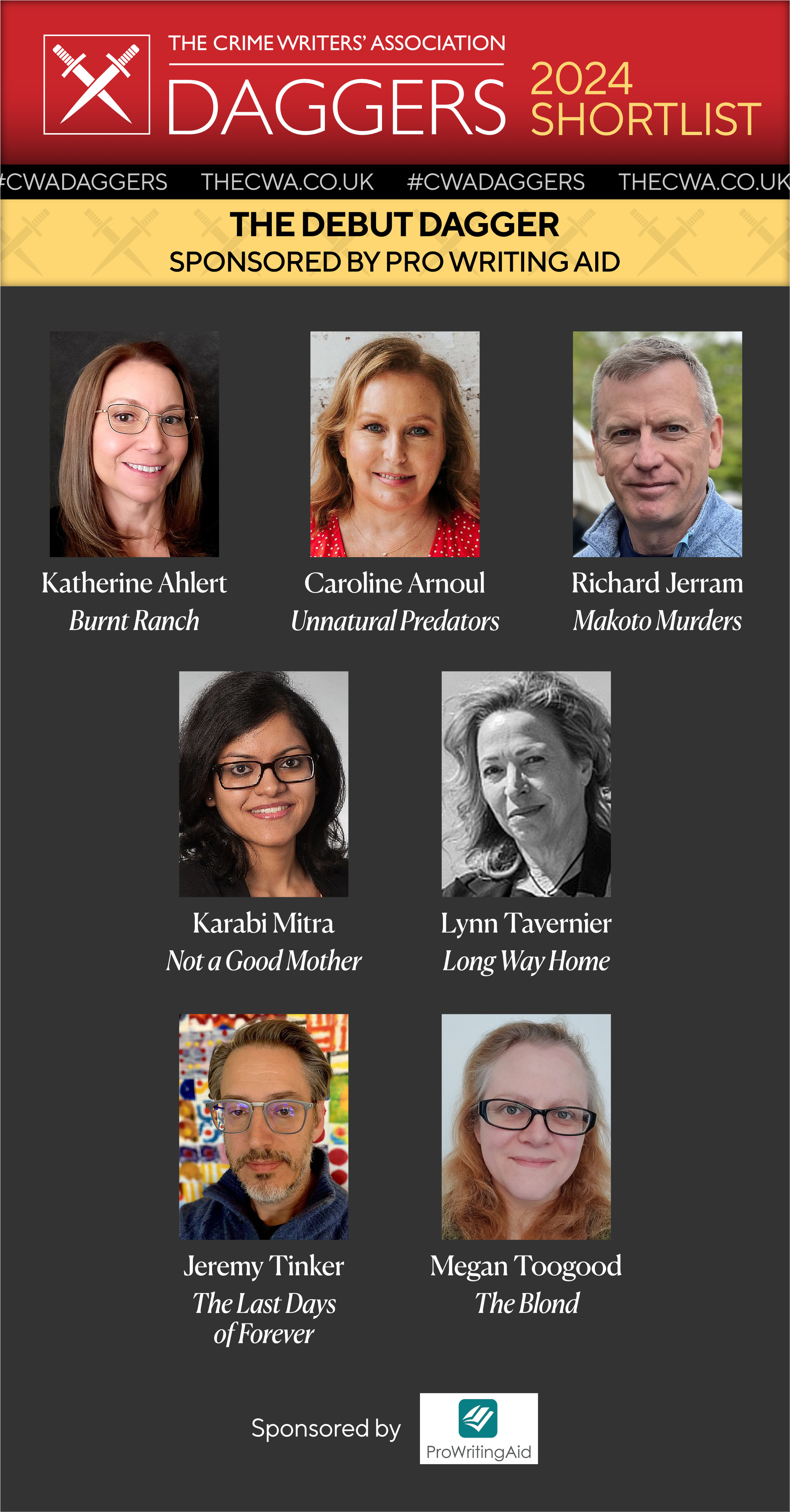
 DEBUT DAGGER

Burnt Ranch by Katherine Ahlert

Unnatural Predators by Caroline Arnoul

Makoto Murders by Richard Jerram

Not a Good Mother by Karabi Mitra

Long Way Home by Lynn McCall

The Last Days of Forever by Jeremy Tinker

The Blond by Megan Toogood


DAGGER IN THE LIBRARY

 Louise Candlish 

MW Craven

Cara Hunter

Anthony Horowitz

LJ Ross 


PUBLISHERS’ DAGGER


Canelo

Headline (Hachette)

Joffe Books

Michael Joseph (PenguinRandomHouse)

Pushkin Press

Simon & Schuster