Showing posts with label Sharpe Books. Show all posts

Friday, 6 December 2024

Crime in the First World War

 Why set a crime story against the backdrop of the First World War? 

There are many good reasons, of course – not least the moral ambiguity and jeopardy that war provides – but the real reason, for a writer, is that one is drawn to it. 

And in my case that began a long time ago with a handful individuals, who led me on a path that would end with Cut and Run, my new crime thriller about an injured ex-serviceman named Frank Champion who goes to back to France in 1916 to solve a murder.

I’ll start with the maiden aunts. Did you ever have a maiden aunt? They don’t make them anymore, not in the sorts of numbers that they did back then. I had three – sisters – who lived in Edmonton in North London in a house without, seemingly, a television set and where the dining table was always laden with the sort of high tea that an Edwardian would have recognised – and relished. 

Olive, Dorothy and Alice were unmarried because their would-be husbands had been killed in the First World War; young men who were part of Vera Brittain’s famous lost generation, following a conflict which claimed the lives of one in four junior officers. What’s more, for my three maiden aunts, that lost generation included their elder brother, whose photograph was framed surrounded by the flags of the allied nations, and proudly displayed on the wall on the upstairs hall.

He never came home, was all Olive would say, when I did what a five-year-old like me would do and ask about him. I dare say it was conveyed with what we would now regard as resolute understatement, but that’s what people were like then. 

Another first-hand recollection of the world of the Great War came from my grandmother who remembered seeing the Tommies going off to fight on the trains. In my memory they are waving through at the windows at her. One of her strongest recollections was being called into the playground and told to told by the headmistress that at 11 o’clock precisely that the war would end and the guns would fall silent across Europe. The joy and import in her words travelled through time. 

Then there was my grandfather – my dad’s father, who fought and was injured in the war, but survived. He was in the horse artillery and there are pictures of him in the 1970s carrying around an enormous hearing aid. A decent man, I’m told, but hard to know, my father said. What the experience taught him was that the most important job of a junior officer was to protect their men against the senior officers. Which would be hilarious if it wasn’t so tragic. And surely it informs the outlook of my book’s protagonist Frank Champion.

The final – and probably the most important – personal interaction that informs the backdrop to Cut and Runis my meeting with a Great War veteran Smiler Marshall who died in 2005, before his 109th birthday. I interviewed him in 2000 when he was 104. 

A farrier by trade, he had joined the Essex Yeomanry after shaking hands with Lord Kitchener at a recruitment event in 1914 was a cavalryman who would fight at the Somme – and much else, serving until 1921. During our conversation, in between singing wartime songs, he told me, with tears in his eyes, about the horrors of what he’d seen, about going out into no man’s land and seeing his mates killed. He left me in no doubt that war was a dreadful, profound waste of life. 

Smiler was one of the last Great War veterans to die. He was followed by Harry Patch who died in 2009 at 111. ‘When the war ended, I don’t know if I was more relieved that we’d won or that I didn’t have to go back,’ Patch recalled in 2004. ‘Passchendaele was a disastrous battle—thousands and thousands of young lives were lost. It makes me angry. Earlier this year, I went back to Ypres to shake the hand of Charles Kuentz, Germany’s only surviving veteran from the war. It was emotional. He is 107. We’ve had 87 years to think what war is. To me, it’s a licence to go out and murder. Why should the British government call me up and take me out to a battlefield to shoot a man I never knew, whose language I couldn’t speak? All those lives lost for a war finished over a table. Now what is the sense in that?’ 

But it happened and some 900,000 British and British Empire were killed in the process, out of around 20 million worldwide.

So before the slaughter and loss of the Great War recedes from our memories and the folklore of our shared culture, joining the Crimean, Napoleonic or the Seven Years war in the archive – I wanted to bring that world back. Because it’s only a few handshakes in to our past, a great-grandfather or a maiden aunt away. And that is but a blink in the eye in time.
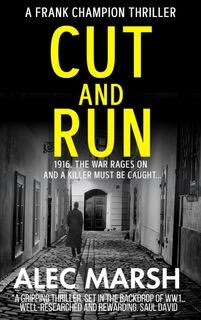

Cut and Run by Alec Marsh (Sharpe Books) Out Now

March 1916, The Great War rages across Europe. In the British Army garrison town of Bethune in northern France, a woman’s body is found in a park. Her throat has been cut. Marie-Louise Toulon is a prostitute at the Blue Lamp, the brothel catering exclusively to officers of the British Army stationed in the area. Wounded ex-soldier Frank Champion is brought in to investigate the crime - to find the killer believed to be among the officer corps. But almost before his investigation gets underway another woman from the Blue Lamp is killed, her throat also cut. A third prostitute, meanwhile, has gone missing. Then two more bodies are uncovered, including that of a British Army captain who appears to have taken his own life with his service revolver. But all is not what it seems… Champion must face a race against time to save the life of another woman - at the risk of dying himself.

Cut and Run by Alec Marsh is published by Sharpe Books in paperback priced £8.99 and Kindle, priced £3.99. It also available in KindleUnlimited: 

More information about Alec Marsh and his books can be found on his website. You can also find him on X @AlecMarsh and on Instagram @marsh_alec. You can also find him on Facebook.

Wednesday, 12 June 2024

Reading and Escapism! - By Dr Luke Deckard

Raymond Chandler criticised Dorothy L Sayers in his essay The Simple Art of Murder (1950) for commenting that crime fiction wasn’t a serious type of literature but one of escapism. She’s not the only one to snub the genre that was an author’s bread and butter. Before Sayers, Sir Arthur Conan Doyle famously hated Sherlock Holmes! He didn’t want to be remembered solely for that character because he felt they were silly, unimportant stories. 

I can imagine Raymond Chandler sitting at his desk, reading these quotes while swishing a glass of whisky, pausing to look at his cat and huff. Chandler’s rebuttal to Sayers was simple: all pleasurable reading is a form of escapism. If that meant your jam was mathematics, philosophy, or Western or romance, that was fine. Chandler disagreed with Sayers’s implication that escapist literature is essentially dumb and unimportant literature. 

Nevertheless, this attitude persists today. I once read a press release for a book described as a “frothy thriller” That baffled me! A book without substance! I would be devastated if my work was described as frothy! I instantly felt bad for the author. My reaction couldn’t have been unlike Chandler’s when reading Sayers’s comments. But it’s not uncommon to see people on social media describe a film or a book as ‘turn your brain off fun’ or ‘you don’t have to think about it.’

This attitude of disposable, empty, forgettable storytelling is far too common. And is often used to excuse poorly told stories. 

When I started to write bad Blood, it was for my PhD at Kingston University. One of the most challenging aspects at the start was battling with the idea of how to make this book meaningful and live up to the quality of what a PhD novel should be. I was dead set on writing a historical noir. I wanted gangsters, femme fatales, and a tough-talking yet charming PI. I wanted it to be thrilling, fun, and sexy. 

But is that literary? Is that good enough? Hard-boiled fiction was birthed out of pulp magazines printed on cheap disposable paper. Were the tricks and tropes just as disposable today? Was there any literary appeal left? I wrestled with these questions. 

In the same essay, Raymond Chandler says that form doesn’t matter; it’s style that counts. What he meant was you can write any ole genre, but it is the author’s flare that makes it pop and stand out. Then, Chandler’s criticism of Sayers and his comments on style all clicked. I knew what I needed to do: escape into the genre. I needed to embrace the form shamelessly and respectfully while making it my own.

That’s what Chandler was getting at—there is no literature of escape in a derogatory sense. Meaning no single genre is less than simply because of its formula.

The filmmaker Robert Meyer Burnett once phrased what audiences are genuinely after: they want good stories told well. Genre is irrelevant. The form isn’t the it thing that makes something work. It’s all about style! The execution. That’s why you can read two books in the same genre and love one but hate the other. Audiences don’t seek out bad, forgettable, disposable art. So, we writers shouldn’t treat stories as such. When we’re hungry, we don’t go into a restaurant and say, ‘Give me the worst thing on the menu, please!’ We want something delicious. 

When I think about the book described as a frothy thriller, what the headline was trying to say was it’s a fun ride. The word choice of frothy was a mistake. The value of fiction doesn’t come from the seriousness of its content or ‘realism’, but from the joy the readers have with a well-executed story. That’s what Burnett means by a good story told well.

And that’s what I attempted to do with Bad Blood. It wasn’t about ‘writing literature’ or trying to make something more out of it. The form is the form. So I wrote it for the people who love noir fiction, who love historical fiction, who love Edinburgh, and tough and gritty atmospheres. There was no shame in embracing the tropes and trying to subvert a few along the way! If someone escapes into my book, that’s a beautiful achievement! 

So readers, feel free to escape into fiction! It’s not a bad thing. But do keep your brains switched on!

Bad Blood by Luke Deckard (Sharpe Books) Out Now

London 1922. American ex-pat Logan Bishop, suffering from shell-shock and an addiction to morphine, is working as a Private Investigator. When Logan’s father, Reverend Daniel Bishop, arrives from Chicago, desperate to see his son, Logan wants nothing to do with him. That is, until his father is brutally attacked. Daniel begs his son to find Greta Matas, a Bolshevik woman with an unknown connection to his father, in Edinburgh before she is murdered. Before Logan can learn more, his father slips into a coma. Logan takes the first train to Edinburgh. The journey proves far from routine, however, and two mysterious men follow the investigator out of Waverley Station. Logan soon discovers that Greta is missing and her son, Peter, is wanted for murder. The case begins to take a darker and deadlier turn than he ever imagined. As Edinburgh police suspect Logan of keeping information from them, the pressure to find Greta and her son increases. Secrets and lies are exposed as Logan clashes with Chicago gangsters, the authorities, and Edinburgh’s elite to expose the truth behind the woman's disappearance.

You can find Bad Blood on Amazon UK and Amazon US

More information about Dr Luke Deckard can be found on his website. You ca also find him on X @LukeWritesCrime. You can also find him on Facebook.