Showing posts with label Anthology. Show all posts

Tuesday, 21 July 2026

Guilty Secrets with Martin Edwards

 Martin Edwards is an award-wining novelist and short-story writer. He is also a well-known editor of numerous anthologies. He is a former Chair of the Crime Writers Association and current President of the Detection Club. Aside for awards for his books, in 2011 he was awarded the CWA Red Herring Award in recognition of his services to the Association. In 2018 he was awarded the Dagger in the Library and in 2020 he was awarded the CWA Diamond Dagger. The most recent anthology he edited is the CWA Guilty Secrets.

Ayo:- Congratulations on editing Guilty Secrets which is of course the latest CWA Anthology. How many anthologies have you now edited and does it get any easier?

Martin:- I just counted, and this one is my sixtieth anthology. As with most things, experience does help, in that you get a better sense of which stories work together to form an appealing mix, and you feel a bit more confident about your selection judgments. 

Ayo:- Guilty Secrets is about folklore and mythology with the emphasis on the Supernatural, science and speculative fiction along with the mysterious. How did you decide on the theme?

Martin:- I like to devise anthologies of stories with fairly broad themes that can be interpreted creatively and perhaps in unexpected ways. My general approach as an editor is to have a fairly light touch on the tiller, so that the contributors have the freedom to exercise the full range of their talents. I chose this particular theme because it seemed to me to offer lots of interesting possibilities.

Ayo:- You clearly like writing short stories as you have written so many, what made you want to write short stories?

Martin:- I love reading short stories and I love writing them. When I was about thirteen, I was given a CWA anthology as a Christmas present, and it fascinated me. At that point I’d never heard of the CWA, but I already knew I wanted to be a crime writer and I felt I’d love to join an organisation full of people who did what I yearned to do. Of course, I never dreamed that I’d become Chair of the CWA, or win CWA awards, or edit the CWA anthology for thirty years. So I’ve been very lucky. And a constant element during all that time has been my enthusiasm for writing short stories, partly inspired by that first CWA book. And there’s no doubt that some ideas work better in short stories than in novels. Also, you can take risks in a short story, and experiment in ways that would be difficult, perhaps impossible, in a full-length novel. Which I find very exciting. 

Ayo:- Can you remember the very first short story that you wrote and your feelings about it once you had written it

Martin:- Definitely. It was a story called ‘Are You Sitting Comfortably?’ and it won first prize in a Southport Writers’ Seminar competition. It felt absolutely thrilling, an unforgettable joy! The judge was the fiction editor of Bella and she published the story in the magazine. At that time, I hadn’t had a novel accepted, so it really was a breakthrough moment. What’s more, Robert Barnard was in the audience, and he recommended the story to the editor of Ellery Queen’s Mystery Magazine¸ with which I’ve had a long and happy association. This was a wonderful start to my career as a published author of crime fiction and despite my extreme inexperience at the time, I still feel that it was a good story and ‘different’ from the norm. And I still like to try to be inventive and not follow a predictable path with my writing. This approach possibly has its downsides in commercial terms, but I believe it has kept me fresh as a writer, and perhaps it is why I can honestly say that I take at least as much pleasure in my writing now as I have ever done.

Ayo:- Is there a theme you would like to put together for an anthology.

Martin:- For years, I’ve had the idea of editing a book of mysteries inspired by the music of Burt Bacharach, who for me is pop music’s equivalent to Agatha Christie (i.e. ground-breaking and subtly sophisticated, under-estimated by some, but loved by many more). And I’m pleased to say that What the World Needs Now will soon be published, and that proceeds will go to autism charities in the UK and US. A worthy project, in my opinion, and it’s a book I’m extremely proud of, with great stories by the likes of Mark Billingham, Charles Todd, Sarah Hilary, and Ragnar Jonasson. And a foreword by Rupert Holmes, ace crime writer and composer of ‘The Pina Colada Song’!

Ayo:- Since short stories are compact, every element must work hard to build a specific world do you find this difficult?

Martin:- Not really. Writing short stories seems to come fairly naturally to me. I love writing novels as well, but I find them harder work, simply because the scale is much larger.

Ayo:- Short stories force you to omit more than you include. Have you ever written a short story that you would like to expand to a novel.

Martin:- Not exactly, but when I created the character of Rachel Savernake, and had the idea of writing a very different kind of novel about her, I was conscious that she was a very unorthodox individual, not really like anyone else in the crime genre. So I wrote a short story about her, just to see how much I enjoyed writing the character. I never tried to get that story published, but I proved to my own satisfaction, at least, that she was a strong character who would sustain an intricate novel. This gave me the confidence to write Gallows Court and the next five (so far) Rachel Savernake novels. And I still love writing about her. 

Ayo:- Short stories often end on a lingering note rather than a neat resolution. How do you know when a story is truly finished? 

Martin:- I sometimes wonder if any good piece of writing is ever truly finished. You can always try to improve what you’ve written (or what someone else has written - I did have the temerity to write a new ending for Anthony Berkeley’s brilliant classic mystery The Poisoned Chocolates Case!). I am very, very committed to revision and making my work better. But realistically, you have to draw a line somewhere, with both novels and short stories, or you’d never publish anything. I must admit, though, that five minutes after I submit something to a publisher, I have an idea about how I could have improved what I’ve written! And it’s this quest for constant improvement that helps to keep me energised and enthused as a writer.

Ayo:- With all the short stories that you have written, do you have a favourite?

Martin:- There are quite a lot that I’m very fond of, including some that never attracted a great deal of attention, perhaps because the books they appeared in didn’t get much publicity. The stories that have won or been shortlisted for prizes, such as ‘Murder and its Motives’, ‘Acknowledgements’ and ‘The Bookbinder’s Apprentice’, are all stories I’m proud of, but there are others, such as ‘Squeaky’, ‘InDex’, ‘The Woman Who Never Was’, and perhaps especially ‘The Outsider’, that I think are just as good. And I’m pleased with my two recent reverse chronology stories, ‘Don’t Look Back’ and ‘The Scares’; the former just got a great review in Publisher’s Weekly and the latter is in Guilty Secrets.

Ayo:- Writing short stories is incredibly difficult would you rather write a short story or a novel?

Martin:- I love writing both, but of course short stories take less time, which is a point in their favour! I enjoy subverting readers’ expectations, and a good short story can do that – so can a good novel, of course. I suppose writing a novel that works really well is especially satisfying – in my case, books like The Crooked Shore or Hemlock Bay would, at least in my opinion, fall into that category, as would the novel I’m doing edits on right now, Fever Island.

Ayo:- What would you say to someone who is considering writing a short story but is hesitant.

Martin:- As with so many things in life, I think that one should ask oneself what one really wants to do, and be clear about that, before wondering how to go about doing it. If you really want to write a short story, then I’d say: definitely go for it, and the chances are, you’ll find the experience very rewarding, in artistic if not necessarily financial terms. If you’re not sure you really want to do it, perhaps find something else you feel really enthused about instead. For me, commitment is a very important thing for a writer. There’s nothing whatsoever wrong with being committed to writing a story that sells, either. But I think being committed to writing a story that has that precious element of difference and is not like lots of other stories is even more appealing.

Ayo:- When can we expect to read your next short story.

Martin:- What the World Needs Now is due out soon, and it includes my story ‘Who Gets The Guy?’, inspired by a rather lovely if little-known song by the great Dionne Warwick. It’s a tale about the music business in the 60s and I really enjoyed writing it.


Guilty Secrets: From the Crime Writers Association - Beyond and Within (Flame Tree Publishing) Out Now

Editor Martin Edwards has commissioned an entertaining range of stories from the membership of the world's most celebrated group of crime and mystery writers, the Crime Writers' Association (CWA). Founded over 70 years ago by John Creasey, the Crime Writers’ Association supports, promotes and celebrates this most durable, adaptable and successful of genres, while supporting writers of every kind of crime fiction and non-fiction. In this new collection, enjoy 23 original, thrilling mysteries packed full of enthralling characters, drama and intrigue, by the following authors: Martine Bailey, Christine Poulson, Dea Parkin, Martin Edwards, C.J. Carver, Kate Ellis, Shawn Reilly Simmons, Phil Lecomber, L.C. Tyler, Glenda Young, Antony Johnston, Simon Dinsdale, Renita D’Silva, Paul Gitsham, Yvonne Eve Walus, Brian Price, Pam Plumb, Nick Guthrie, Margaret Holbrook, Andy Sykes, Cath Staincliffe, Roland Moore and Rachel Amphlett.

The Flame Tree Beyond and Within short story collections bring together tales of myth and imagination by modern and contemporary writers, carefully selected by anthologists, and sometimes featuring short stories from a single author. Overall, the series presents a wide range of diverse and inclusive voices with myth, folkloric-inflected short fiction, and an emphasis on the supernatural, science fiction, the mysterious and the speculative.


Tuesday, 19 August 2025

Short Stories: a personal perspective - Martin Edwards


My first published fiction was a short story. ‘Are You Sitting Comfortably?’ won a competition at a seminar organised by a writers’ circle, and was duly published in a national magazine, and then in Ellery Queen’s Mystery Magazine in the US. After that, there was no stopping me. Although my next published work was my debut novel, All the Lonely People, I’ve kept writing short stories, as well as editing anthologies of short crime fiction. I don’t keep count, but the tally at the moment is about seventy stories and forty collections, so you could certainly say that I’m as committed to the short form as I am to the novel.

Where did this love of the short story come from? It goes back a long way, that’s for sure. I can remember asking for, and being given as a Christmas present, a Crime Writers’ Association anthology when I was about thirteen. That book contained stories by great names of the genre such as John Dickson Carr and Edmund Crispin, and it fired my imagination. So did an anthology of ‘tales of terror’ edited by Crispin, which includes one of my all-time favourite short stories, the wonderfully haunting and enigmatic ‘Three Miles Up’ by Elizabeth Jane Howard.

Later, as I began to write fiction for publication, I found the short story liberating. You can do almost anything with it. ‘Are You Sitting Comfortably?’ was an unorthodox type of mystery, and from time to time I’ve tried further experiments with the form. So ‘An Index’ is a crime story which takes the form of a short extract from an index to a book. ‘Acknowledgments’, which won the inaugural CWA Margery Allingham Prize, is a skit on those sections in books where the author acknowledges help received. For an American anthology with a Sherlock Holmes theme, I wrote ‘The Observance of Trifles’, a story in the form of a blog post, and accompanying comments.

Even if you’re not in the mood to push the boundaries in structural terms, the short form offers endless possibilities of subject, theme, and mood. There are ideas which, to my mind, suit a short story but not a novel. One day I went for a test drive in a car. The chatter of the showroom salesman gave me the idea for a story, but it was clear from the outset that it would only make a short piece, rather than a novel. The result was ‘Test Drive’, which was shortlisted for the CWA Short Story Dagger. Occasionally, I read novels which seem to me to be just expanded short stories; an example I came across the other day is Miles Tripp’s A Man Without Friends, published in 1970, which contains a brilliant central idea connected with the vagaries of justice, but not quite enough (in my opinion, anyway) for a truly satisfactory full-length book. 

A particular setting often inspires me to write a short story. Typically, a trip on holiday or to a festival (in pre-pandemic days, of course!) might introduce me to an interesting location that I’d like to write about. Not knowing the place in depth, I wouldn’t want to produce a novel with that setting. Maintaining authenticity for, say, five thousand words is much easier than in a book of ninety thousand words. So I’ve written stories set in places as varied as Hartlepool (‘Lucky Liam’) and Hawaii (‘Catch of the Day’). Wandering the darkened streets of Venice one night, I lingered in front of a shop window and a rather macabre thought sprang to mind. The upshot was a story called ‘The Bookbinder’s Apprentice’, which won the CWA Short Story Dagger, and represented a real breakthrough in my crime writing career. And when I was hired to give a series of lectures about crime fiction to passengers on the Queen Mary 2, I read about the history of the ship while on board. This gave me the idea of writing a story set on the original Queen Mary: the eventual result was ‘The Locked Cabin’. 

The Locked Cabin’ wasn’t an easy story to write. I began with the idea of a crime taking place on the ship, but couldn’t figure out what to do with it. I left it for a while, and then started thinking about the possibility of writing a short ‘locked room mystery’. The two ideas coalesced, and I was able to start work on it in earnest.

Something of the same kind happened after I visited Bletchley Park. I had an idea for a story about war-time code breakers, but somehow it didn’t come to life, so again I left it to simmer. Months later, I visited Jersey to give some talks about writing. Whilst on the island, I visited Gorey on a lovely sunny day, and thought that I’d like to use the resort as a setting. I came up with a way of combining this backdrop with the code breaking story. The result was ‘The Sound of Secrecy’.

There’s something else you can do with a short story. You can treat it as a professional exercise. When I first dreamed up the idea for the novel that became Gallows Court, I was very taken with it. The concept involved an extremely ruthless and fabulously rich young woman called Rachel Savernake, who arrives in London in 1930, and becomes involved in a series of bizarre murder mysteries. My thinking was that I’d try something fresh as a novelist, writing a book very different from my other work: an attempt to ‘break out’, so to speak. It was bound to be a gamble, especially given that I didn’t know how the novel would develop. So I decided to write a short story featuring Rachel, to see if I enjoyed writing about her and if I felt I could ‘soak’ myself in this rather unusual character for a year or two. I wrote the story, and found that I loved writing about Rachel. This encouraged me to crack on with the novel. One thing led to another, and the Rachel books have become my most successful novels. I never tried to publish the short story – it was simple a trial run, a way of acclimatising myself to a new type of crime writing. But I have recently written a story which features Jacob Flint, another key character in the series, although Rachel does not appear.

As a reader, I love a short story that has something special about it. Preferably an ingredient that would be difficult or impossible to replicate in a novel. So my favourite short story is Shirley Jackson’s ‘The Lottery’. In the crime genre, you can’t go far wrong with the likes of the Jackson’s fellow American Fredric Brown or, in Britain, three authors who contributed to several of my anthologies: Ruth Rendell, Reginald Hill, and Peter Lovesey. Among contemporary writers, the American Art Taylor has won many awards and is a master of the form.

These days, we’re also frequently told that we live in an age of shortening attention spans. If that is true, then it’s one more good reason to relish short stories. They may not take long to read, but the best examples give lasting pleasure. 

And Then There Were More Edited by Martin Edwards (Flame Tree Publishing) Out 23 August 2025

A CWA anthology celebrating members' fiction from over the years, Then There Were More is a delightful compilation of stories from some of the best crime writers of the last century. The first CWA anthology, Butcher’s Dozen, appeared in 1956, and was co-edited by Julian Symons, Michael Gilbert, and Josephine Bell. The anthology has been edited by Martin Edwards since 1996, and has yielded many award-winning and nominated stories in the UK and overseas. Founded over 70 years ago by John Creasey, the Crime Writers’ Association supports, promotes and celebrates this most durable, adaptable and successful of genres, while supporting writers of every kind of crime fiction and non-fiction.  The full list of featured authors in this book is: Anne Perry, Christine Poulson, Andrew Taylor, Amy Myers, Judith Cutler, Gillian Linscott, Martin Edwards, Bernie Crosthwaite, Catherine Aird, Simon Brett, Yvonne Eve Walus, John Harvey, Kate Ellis, Zoe Sharp, Bill Knox, Cath Staincliffe, Liza Cody, Ann Cleeves, and Peter Lovesey.

More information about Martin Edwards can be found on his website. You can also find him on Facebook, at X @medwardsbooks and on Instagram @medwardsbooks. You can also sign up to his newsletter on his website. Information about the CWA can be found here and the Crime Readers can be found here.

Friday, 11 July 2025

Conan Doyle Estate to collaborate with Simon and Schuster


Arthur Conan Doyle © Conan Doyle Estate

Simon & Schuster UK has entered into an official collaboration with the Conan Doyle Estate on a programme of new and backlist titles following on from their recent collaboration, Holmes & Moriarty by Gareth Rubin.

The partnership will see the creation of “new works based on the characters created by Sir Arthur Conan Doyle”, and some backlist titles, both inside and outside the Holmes canon, “repackaged and republished”. All titles will be officially endorsed by the Conan Doyle Estate.

To launch the publishing programme, Simon & Schuster UK will be publishing a short-story anthology entitled Sherlock, which will feature an introduction by Stephen Fry, along with new stories from Kate Mosse, Anthony Horowitz, SA Cosby, Sarah Perry, Joe Hill, Vaseem Khan, Janice Hallett, Abir Mukherjee and Steve Cavanagh. Sherlock will be published in autumn 2026.

Katherine Armstrong, deputy publishing director for Crime and Thriller Fiction, agreed the deal with Jon Wood at Rogers, Coleridge and White for world all-language rights including audio. Atria, part of Simon & Schuster US, will also be publishing the new works and distributing the backlist titles.

Armstrong said: “I am particularly delighted to be working with the Conan Doyle Estate on these projects. Not only do I – and everyone at Simon & Schuster – share the Estate’s aim to create a lasting legacy of Conan Doyle’s works for many generations to come, but the Sherlock Holmes stories were some of my favourites growing up. I could not be more thrilled to be collaborating with the Estate on a full programme of backlist and new projects to take us to at least 2030”.

Doyle’s influence on the crime-fiction genre has been immense and the character of Sherlock Holmes has seen and inspired many iterations over the past 140 years, but Doyle was also an intrepid traveller, a soldier, a campaigner for justice, and a scientist, among other things, so there is a wealth of material to explore. I am incredibly excited by the brilliant authors who have already agreed to write new short stories for our Sherlock anthology, and we are also working on a new official biography of Conan Doyle to publish on the anniversary of his death in 2030. There are many exciting projects in the pipeline that I can’t wait to share with existing fans and to introduce to new readers!

Richard Pooley from the Conan Doyle Estate said: “The Conan Doyle Estate’s mission is to further the works of Sir Arthur Conan Doyle and keep atorch shining on him and his characters for generations to come. Nearly 140 years ago, Conan Doyle created one of the worlds most famous fictional characters. To ourknowledge, Sherlock Holmes is still the most depicted character in print, film and TV. But it was Conan Doyles genius and significant involvement in so many aspects of life wemust also remember. As he himself wrote: ’I havehad a life which, for variety and romance, could hardly be exceeded. The Simon & Schuster official collaboration with the Conan Doyle Estate will help to bring Sir Arthur out of the shadow of Sherlock Holmes and to continue to tell the life story and work of this remarkable renaissance man.”

Jon Wood added: “Arthur Conan Doyle was a renaissance genius in so many ways – a crime writer, a science-fiction novelist, a politician, a thinker and a visionary. He was also the creator of unarguably the most successful fictional character of all time – Sherlock Holmes. This new relationship with Simon & Schuster worldwide is an unparalleled opportunity to rediscover Arthur and revitalise all his works. I’m so grateful to be part of these effortsalong with the Estate, Katherine Armstrong and the whole team around the world.” 


Wednesday, 5 October 2022

Maxim Jakubowski on Black is the Night


It actually began with a shot.

An imposing cathedral somewhere in the French provinces. A happy couple on the steps leaving the ceremony behind, smiles on their faces, the bride wearing the obligatory white. And then the shot breaks up the cheering crowd and the groom collapses to the floor.

It was Paris in 1968 and my first encounter with Cornell Woolrich, the week that François Truffaut's 'La Mariée Etait en Noir' opened. A film classic better known here as 'The Bride Wore Black', adapted from the unforgettable novel by Cornell Woolrich.

At first it was a little confusing as, having been brought up in France, I hadn't made the connection between Woolrich and William Irish, a pseudonym he used on a number of books and short stories, and which French publishers somehow had highlighted on the majority of his books issued there. I had probably read a number of his stories in magazines, probably those of a more supernatural bent as I was at the time more of an expert on SF &fantasy and hadn't immediately puzzled out the Irish/Woolrich connection. To this day his books are generally signed by William Irish in France. An oddity of the French publishing scene where, similarly the wonderful novels by my dear, late friend Derek Raymond, are attributed to his real name, Robin Cook (as the US writer of medical chillers is almost unknown there...).

At any rate, this was my introduction to the dark world of death, broken love and melancholy loners that is characteristic of Woolrich.

He is an author's author. The general public mostly know him because of the many film and TV adaptations: 'Phantom Lady', 'Rear Window', Mississippi Mermaid', 'I Married a Dead Man', 'Black Angel', 'Deadline at Dawn', 'Night has a Thousand Eyes', 'Union City', and over 50 others.

Flash forward 20 years and I decide to launch Black Box Thrillers, a new imprint to rediscover some of the classics of noir, much inspired by the fact that so many wonderful US authors appear to be better known in Europe and are mostly out of print in their own language. And my first choice is, naturally, Woolrich. By now I have read all his books and a good chunk of his hundreds of stories and I am not just a fan but, with my own writing hat on, heavily under his influence.

He 'talks' to me; over the gulf of years we share some of the same obsessions: the cloak of night, the breathless passage of time that none of us can halt, the seductiveness of the femme fatale who we know is bad for us but can't stop lusting after, the downbeat endings, the strong sense of despair that life sometimes throws in our path.

I have no doubt that had I not read Woolrich (and a few other noir poets of the night like Marc Behm, David Goodis and Jim Thompson) I might have not begun writing crime & mystery and remained in the SF & fantasy ghetto. So, you know who to blame!

A Sunday dim sum lunch with Nick Landau and Vivien Cheung of the Titan group and my erstwhile silent partners in Murder One saw us brainstorming ideas for some new projects for Titan Books to follow up on the anthologies I had edited for them and which had performed reasonably well. Somehow the subject of Woolrich came up in the conversation as Nick is as much of a classic film fan as I am.

There have been a spate of recent anthologies with American small presses featuring stories influenced by the music of many luminaries: Joni Mitchell, Bruce Springsteen, Billy Joel, Jimmy Buffett, etc... Lightning struck Baker Street (which is where the restaurant we were dining in was...)! Why not do the same with influential writers? We agreed on the spot Woolrich would be the first (I have since followed up with a similar book under the halo of J.G. Ballard, which will appear in 2023).

There were crime authors I knew who shared my passion for Woolrich which I approached and every single one came on board without a moment's hesitation. Then I mentioned the project on social media and was deluged by fervent expressions of interest. Some writers I would never have dreamed of contacting, others whose work does not on the surface appear to have any connection with Woolrich but were adamant in expressing how important he was for them. I had an embarrassment of potential contributors to the anthology and had to turn down so many with a heavy heart. And then there were dozens of speculative submissions; two of which actually made it into the final book.

I am absolutely delighted by the volume that came together. Truly marvellous stories, each and every one flying high under one aspect or another of the melancholy and murderous world that Cornell Woolrich created. Not imitations, but tales that are in his image, some that reflect twists on his themes, others that ingeniously transpose his world into contemporary times without losing the essential poignancy that lies at the heart of his work, every one a winner.

I have now edited, for good or worse, well over a hundred anthologies but 'Black is the Night' is undoubtedly in my Top 5.

Black is the Night edited by Maxim Maxim Jakubowski (Titan Books) Out Now

A gritty and thrilling anthology of 28 new short stories in tribute to pulp noir master, Cornell Woolrich, author of 'Rear Window' that inspired Alfred Hitchock's classic film. Featuring Neil Gaiman, Kim Newman, James Sallis, A.K. Benedict, USA Today-bestseller Samantha Lee Howe, Joe R. Lansdale and many more. An anthology of exclusive new short stories in tribute to the master of pulp era crime writing, Cornell Woolrich. Woolrich, also published as William Irish and George Hopley, stands with Raymond Chandler, Erle Stanley Gardner and Dashiell Hammett as a legend in the genre. He is a hugely influential figure for crime writers, and is also remembered through the 50+ films made from his novels and stories, including Alfred Hitchcock's Rear Window, The Bride Wore Black, I Married a Dead Man, Phantom Lady, Truffaut's La Sirene du Mississippi, and Black Alibi. Collected and edited by one of the most experienced editors in the field, Maxim Jakubowski, features original work from: Neil Gaiman, Joel Lane, Joe R. Lansdale, Vaseem Khan, Brandon Barrows, Tara Moss, Kim Newman, Nick Mamatas, Mason Cross, Martin Edwards, Donna Moore, James Grady, Lavie Tidhar, Barry N. Malzberg, James Sallis, A.K. Benedict, Warren Moore, Max Decharne, Paul Di Filippo, M.W. Craven, Charles Ardai, Susi Holliday, Bill Pronzini, Kristine Kathryn Rusch, Maxim Jakubowski, Joseph S. Walker, Samantha Lee Howe, O'Neil De Noux , David Quantick, Ana Teresa Pereira, William Boyle


Monday, 21 February 2022

New Anthology from World Famed CWA


The world-famous Crime Writers’ Association (CWA) has released a new collection of crime stories written by its members.

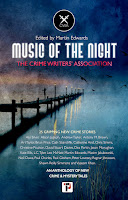
Music of the Night edited by Martin Edwards, invited CWA authors to submit short stories on the theme of music. An array of award-winning authors features in the anthology, which is published by Flame Tree Press on 22 February.

The 25 stories include four by CWA Diamond Dagger winners – the highest honour in UK crime writing – alongside nine authors who have never previously contributed to a CWA anthology.

Author and editor Martin Edwards said: “The stories are an eclectic mix, which reflects the wide range of tastes in music, and within the crime genre itself. The hope is this collection will entice readers with familiar and established authors while giving readers the chance to sample works by writers they may not have yet discovered.

One of the UK’s most prominent societies, the CWA was founded in 1953 by John Creasey. It works to support, promote and celebrate the crime writing genre, and runs the prestigious Dagger awards. Membership includes authors at all stages of their career.

The CWA has published anthologies of members’ works for more than fifty years; Martin Edwards has edited them for nearly half that time. A consultant to the British Library’s Crime Classics, Martin is also a former chair of the CWA and current President of the Detection Club.

Maxim Jakubowski, Chair of the CWA and an influential figure in the publishing world, also features in the collection.

Maxim said: "As an anthologist myself, I've always admired Martin Edwards' work in this very particular field, and I was delighted he was able to include a story of my own in Music of the Night, thus combining our mutual admiration for the work the CWA has done since its inception, and our own personal love of music. A winning combination for all involved, and a fascinating snapshot of some of the most exciting authors in the genre at work today.”

The Diamond Dagger authors whose stories are included in the collection are Catherine Aird, Peter Lovesey, Andrew Taylor, as well as Martin Edwards, who received the Diamond Dagger in 2020.

Martin Edwards said the theme of music has a long fascination with many in the crime genre: “Sherlock Holmes was fiction’s most famous violinist, Agatha Christie dreamed of a musical career as a child, and music features in any number of classic detective novels, as well as contemporary stories; Ian Rankin’s love of music is apparent in many of his novels.

Contributors include Paul Charles, who spent many years working in the music business with acts such as Van Morrison and Elvis Costello.

Music of the Night is the first CWA anthology of brand-new writing to be published by Flame Tree Press after the success of Flame Tree’s Vintage Crime anthology, which celebrated CWA members’ work from the mid-1950s onwards, tracing the development of the genre across half a century.


Flame Tree Press is the imprint of long-standing independent Flame Tree Publishing, dedicated to full-length original fiction in the horror and suspense, science fiction & fantasy, and crime, mystery and thriller categories. The list brings together new authors and the more established; the award winners and exciting, original voices.

Nick Wells, Publisher at Flame Tree Press, said: “Flame Tree is proud to be the steward for the current annual anthology, Music of the Night. This collection of new stories is both a fitting tribute to the CWA’s legacy of great writing while reflecting the vitality of the contemporary membership. It's been a joy to publish.

The CWA also offers a platform for unpublished stories with its annual Margery Allingham Short Mystery competition, the closing date for both is February 28.

Music of the Night, edited by Martin Edwards and published by Flame Tree Press, is out on 22 February. Buy in bookshops or online


Wednesday, 14 April 2021

New Welsh Women's Crime Anthology - Call for Submissions


A New Chapter in Welsh Women’s Crime Writing: 

Call for Submissions of Original Short Fiction 

by Katherine Stansfield

An exciting development is afoot at Welsh publisher Honno, the longest-standing independent women’s press in the UK, and I’m delighted to be able to share the news in this blogpost.

In spring 2022, Honno will publish an anthology of crime fiction, showcasing the talents of new and established women crime writers in Wales today. I’m thrilled to be co-editing the anthology with Honno editor Caroline Oakley. The book will be launched at a special event at the Gŵyl CRIME CYMRU Festival in Aberystwyth in 2022.

‘Honno is delighted to be joining Katherine Stansfield in curating a volume of the best of Welsh women’s crime writing to tie in with Crime Cymru’s splendid new festival. I’m personally looking forward to reading some great new voices and gripping stories from a few familiar names.’ Caroline Oakley

Whether you’re a published author or a debutante, we want to hear from you. As editors, Caroline and I are looking for gripping stories that are complex and convincing, chilling or comforting and with a crime or a mystery at their heart, from the most diverse possible selection of Welsh women writers. The new anthology will offer a follow-up to Honno’s brilliant 2009 crime fiction anthology Written in Blood. With the boom crime writing is enjoying in the UK, and the hard work of Crime Cymru to raise the profile of crime writing in Wales, the time is right for a new volume of crime fiction from the country’s women writers.

Submissions are open to stories featuring ‘traditional’ crime fiction elements of detectives and police as well as amateur sleuths. Contemporary crime fiction takes many forms. Tales of mystery and unease, the macabre and the strange all contribute to the crime canon so if your story is bordering on horror – a close relative of crime fiction – the editors would be keen to read it. We welcome stories set in rural or urban settings, historical periods or contemporary landscapes.

Wales is home to a growing number of crime writers (as the Crime Cymru membership attests) and the country is increasingly popular as a setting for crime drama. This new anthology from Honno is an opportunity to celebrate the crime writing talents of Wales’ women writers, but submissions don’t have to be set in Wales or concerned with particularly ‘Welsh’ themes.

Thinking of submitting? Here’s what you need to know:

Submissions should be between 1500 and 5000 words in length and previously unpublished.

The deadline for submissions is 30 June 2021 and the contents will be announced at the end of August. The resulting anthology will be published in spring 2022. All the selected contributors will receive a fee for the publishing rights to their work.

Send your submission to editor@honno.co.uk with the subject line Honno/Crime Anthology 2022 by midnight on: 30 June 2021.

If you’re not sure whether you meet Honno’s criteria for publication drop us a line and we’ll let you know.

You can find out more about Honno here.


Thursday, 18 July 2019

Flame Tree to publish Crime Writers’ Association anthology

Flame Tree Publishing have agreed a deal with the Crime Writers’ Association to publish the latest anthology of stories by CWA members, to be edited by Martin Edwards. Vintage Crimes will be a CWA anthology with a difference, celebrating members’ work over the years. The book will gather stories which members have contributed to CWA anthologies from the mid-1950s until the twenty-first century. Publication is scheduled for summer 2020.

There are many gems of crime writing in the CWA archives,” Martin Edwards commented. “This book will contain stories by great names of the past, great names of the present together with a few hidden treasures by less familiar writers.”

Nick Wells, Publisher at Flame Tree Publishing said "We're absolutely thrilled to work with the CWA and Martin Edwards, setting out a path to bring back the best writing by the best writers in crime from the past 70 years at the CWA. We aim to restore the glory of the short story and inspire the next generation of mystery writers, readers, reviewers and bloggers."

The first CWA anthology, Butcher’s Dozen, appeared in 1956, and was co-edited by Julian Symons, Michael Gilbert, and Josephine Bell. The anthology has been edited by Martin Edwards since 1996, and has yielded many award-winning and nominated stories in the UK and overseas.

Tuesday, 27 August 2013

Putting it Together: Selecting the Stories in Troubled Daughters, Twisted Wives by Sarah Weinman

(photo credit: Michael Lionstar)
An anthology may have a great concept or an ideal news hook, but if the stories themselves aren't top-quality, the whole thing falls down. That's why, when Akashic first published Brooklyn Noir all the way back in 2004, it proved to be such a success: there were so many excellent stories set around the borough (where I've lived for the last three years) that it bolstered the very simple idea of short noir fiction rooted to a particular city or urban area. And there's simply no way the publisher could have kept the Noir series going, now dozens of volumes strong, without hundreds of quality stories.

As such, when I began on what is now Troubled Daughters, Twisted Wives, I knew I had a lot of work ahead of me. Would I be able to include this fabulous story by one of my favorite writers? Would I be able to find a fabulous story by one of my favorite writers? And could I find an appropriate story at all? Would a tantalizingly brief listing of a story by a possible candidate turn into a blazing gem a new audience could discover anew? There were so many different levels of inquiry I had to balance – and that's sticking solely to matters of content, not finance.

The first order of business was seeing which stories had recently been reprinted in other anthologies. I started with those because they were in print, generally easy to find, listed the relevant rightsholders, and their electronic files were readily available (which would make my publisher happy.) So I must thank Denise Hamilton for including Margaret Millar's stellar “The People Across the Canyon” in LA Noir 2 and Elizabeth George for doing the same with Nedra Tyre's stealth disturber “A Nice Place to Stay” in A Moment on the Edge: 100 Years of Women in Crime Fiction.

It's no fun, though, to repeat too many stories from anthologies past. So in a few instances, I would find a different story by another oft-anthologized author. Shirley Jackson's “Louisa, Please Come Home” and Patricia Highsmith's “The Heroine” were part of respective short story collections, but not reprinted elsewhere for some time. George included stories by Charlotte Armstrong, Dorothy Salisbury Davis and Joyce Harrington, but I ended up going with different ones: “The Splintered Monday”, “Lost Generation” and “The Purple Shroud”, respectively, because they seemed better suited to Troubled Daughters' domestic suspense theme. A different story by Dorothy B. Hughes appeared in Otto Penzler's Best American Noir of the Century,  but I went with “Everybody Needs a Mink”, a lighter-hearted, sly take on suburbia and living beyond one's means.

Other candidate authors required a lot more hunting. It took a long time to find an appropriate story by Elisabeth Sanxay Holding, which seemed odd to me, as she was one of the key authors I knew I must include, based on novels like The Blank Wall and The Old Battle-Ax. But it wasn't until I followed some blind alleys to find myself poring through a bound volume of the long-gone American Magazine from the summer of 1949 that I found “The Stranger in the Car” – a novella, yes, but in perfect keeping with my chosen theme. It took almost as long to find something suitable by Vera Caspary, as she did not publish that many short stories, preferring to publish novels or write screenplays (or treatments.) But “Sugar and Spice” fit the bill for its exploration of the deepening jealousy between two women who, frankly, ought to have known better.

That left room for some unexpected surprises. While poring through a stack of old Ellery Queen Mystery Magazine issues last summer, I found “Mortmain” by Miriam Allen deFord, a writer I knew of dimly but not enough to know her reputation in the crime fiction world. I later learned she was better known for her science fiction stories and anthologies, her feminist radicalism and passion for social justice, and for writing true crime, but was also a vastly underrated mystery short story writer – which “Mortmain” demonstrates brilliantly. A similar “aha” moment happened at the Center for Fiction in New York City, where I spent several days poring through numerous old anthologies. In one of the annuals I found “Lavender Lady” by Barbara Callahan, which floored me on a first read and then again when finalizing the lineup.


The final tally of fourteen stories is as good as I could make it. But of course, there were authors I wished I could have included but could not because of suitability issues, publishing good stories too early or too late for my chosen time period, or other reasons. But there were certainly enough writers of domestic suspense to fill several volumes, not merely one. It's up to readers to decide if they wish to see more, though!

Sarah Weinman is the news editor for Publishers Marketplaceand writes the monthly “Crimewave” mystery and suspense column for the National Post. Her work has appeared in the Wall Street Journal, the Los Angeles Times, the Washington Post, the New York Observer, Slate, and the New Yorker online, among other publications.  

For more information, check out sarahweinman.com or domesticsuspense.com

One of the most anticipated collections of stories is published today, 27 August 2013.  The collection entitled - Troubled Daughters, Twisted Wives: Stories from the Trailblazers of Domestic Suspense.   The collection is edited by crime critic Sarah Weinman and is a salute to the real femmes fatales of the domestic suspense genre—and the deceitful children, deranged husbands, vengeful friends, and murderous wives they unleashed.

Weinman asks: Where would today’s bestselling authors like Gone Girl’s Gillian Flynn, Sue Grafton, or Tana French be without the pioneering women writers who came before them and created the psychological thriller?  In this new anthology, including hair-raising stories by Patricia Highsmith, Shirley Jackson, Vera Caspary, and more, Weinman brings together fourteen tales by women who—from the 1940s through the mid-1970s—took a scalpel to contemporary society and sliced away to reveal its dark essence. 


Thursday, 22 January 2009

Murder One - Last Chance...........

Like many, I am upset about the demise of Murder One. However, there is still a little time left to potter on down to the shop and pick up some bargains. Initially Murder One was due to close on Saturday 24 January 2009, but luckily for us this has been extended by a week. So those of you who have not managed to get to the shop there is still a bit more time to do so.


I have at last got my hands on the excellent short story collection called “These Guns for Hire – 31 Short Stories about Hitmen” which was edited by JA Konrath. I have been trying to read these stories since it was first published.