Showing posts with label Penguin Modern Classics. Show all posts

Tuesday, 17 October 2023

The Return of Penguin Greens

From the 1930s onwards crime novels published by Penguin had covers using a lot of green ink. This led to a clear distinction between two different kinds of novel – effectively all other novels (orange) and crime novels (green). This had the unintended effect of implying that these were different reading experiences or had different statuses when, of course, some ‘crime’ novels are simply among the best novels of any kind whereas orange novels came to seem more middle- to-upper brow even if they might be in practice be much less well written, ambition and plausible than novels by Dorothy M. Sayers, say, or Raymond Chandler. 

Famously it was on returning from a visit to Agatha Christie that Allen Lane, standing on a platform at Exeter station, had the idea for Penguin paperbacks and in the 1950s he once celebrated Christie’s birthday by printing in one go a million copies of her books (10 different novels x 100,000).

Crime of every description has therefore, from the most horrific to the most genteel, always stood at the heart of the entire Penguin enterprise. For reasons not now clear in the 1980s it was decided to drop the green spine and publish all fiction with an orange spine. Then design moved on again, often restricting the Penguin element to the bird logo itself and only keeping hints of Penguin orange. Around the same time light blue Pelicans were also dropped, with the Penguin colour schemes restricted to the black-spined Penguin Classics or the various shades of eau-de-Nil and grey for Penguin Modern Classics.

I have published various series as a Penguin employee over the years—Great Ideas, Little Black Classics and others—and it is really almost with a sense of embarrassment that it has taken until 2023 to realize that one of the most potent and fun traditional Penguin colour codes was simply lying around waiting to be reused: Green for Crime. I mention this because it is at some level shameful that it should have taken so many years to come up with something so straightforward that it barely qualifies as a concept or an idea: why didn’t we do this a decade ago? Two decades?

Lurking within Penguin Modern Classics we already published some of the greatest crime writers – Dorothy B. Hughes’s sensational In a Lonely Place, Eric Ambler’s great pre-War thrillers, Chester Himes’s wonderful, frenzied fantasies of Harlem, Ross Macdonald’s novels of southern California’s squalor lurking under the pretty surface. I am myself responsible at Penguin for the backlist of two great writers in the genre, John le Carré and Len Deighton, and yet had not noticed until very recently that these could be assembled into a matchless series of the greatest crime writers.

Once, very belatedly, we decided to proceed with the idea it seemed a shame not to add other writers. We already published Georges Simenon’s extraordinary books, of which he wrote so many (and at such a consistent level of excellence) that it would make sense to showcase a couple simply to give readers a way into his enormous oeuvre. Josephine Tey’s novels had just come out of copyright, so this provided the opportunity to publish her superb, unsettling The Franchise Affair and Brat Farrar. We also had C.S. Forester’s wonderfully nasty little shocker Payment Deferred about a murderous South London miser (written long before Forester became famous for the Hornblower novels).

For the series to be fresh though it needed some new discoveries and a lot of time was spent reading sometimes terrible books (please do not read anything by Peter Cheyney!) but also books which had just aged badly. I was particularly sorry that Helen MacInnes now seemed so lacklustre as my parents had loved her novels of international espionage when they were published – but now they seemed to consist predominantly of people endlessly walking around, having meals and checking into hotels, with very occasional outbursts of unengaging and tasteful violence.

Battling through some quite neither-here-nor-there stuff though made it much easier to spot wonderful things. Many recent crime novelists remain in print because of Kindle editions or print-on-demand versions, but it was very exciting to find two giants of British thriller writing from the 1970s and 1980s, Anthony Price and Michael Gilbert, available to be discovered. Both giants in their day, their work still has an ingenuity and excellence which has in no way dated – so Price’s Other Paths to Glory and Gilbert’s Game Without Rules joined the list. And I was tipped off to try Dick Lochte, whose 1985 debut Sleeping Dog is a classic, extremely funny piece of neo-noir with the simple but useful advice: if you are a jaded private investigator in L.A. and a girl on roller-skates asks you to help her find her missing dog, don’t say yes. The other great find was the Japanese writer Edogawa Rampo (real name Tarō Hirai – his pen name derives from the Japanese pronunciation of Edgar Allen Poe). Between the wars he wrote a number of thrilling and disturbing classics, some with a wonderful Tintin-like flavour (Gold Mask and The Black Lizard) and others with the depravity dialled up (Beast in the Shadows). All three of these are in the series. 

We are now finishing work on a third set of ten, including some just wonderfully recommendable stuff! Shirley Jackson’s We Have Always Lived in the Castle, Ian Fleming’s From Russia with Love, Anthony Price’s The Labyrinth Makers and John le Carré’s The Night Manager. Best of all (but of course they are all best) is a long forgotten classic of New York City noir, The Deadly Percheron by John Franklin Bardin, set in a gloomy wartime Manhattan and Coney Island. The fate of its decent psychiatrist hero as he unwillingly wades deeper and deeper into an inexplicable, surreal and truly horrible urban underbelly has to be experienced to be believed.

Here are the three sets, with the third not published until June 2024:

  1. Davis Grubb NIGHT OF THE HUNTER
  2. Edogawa Rampo BEAST IN THE SHADOWS
  3. Dorothy B. Hughes IN A LONELY PLACE
  4. Josephine Tey THE FRANCHISE AFFAIR
  5. Eric Ambler JOURNEY INTO FEAR
  6. John le Carré CALL FOR THE DEAD
  7. Georges Simenon MAIGRET AND THE HEADLESS CORPSE
  8. Len Deighton SS-GB
  9. Ross Macdonald THE DROWNING POOL
  10. Chester Himes COTTON COMES TO HARLEM
  11. Dick Lochte SLEEPING DOG
  12. Raymond Chandler THE BIG SLEEP & FAREWELL, MY LOVELY
  13. Anthony Price OTHER PATHS TO GLORY
  14. Michael Gilbert GAME WITHOUT RULES
  15. Georges Simenon MAIGRET’S REVOLVER
  16. C.S.Forester PAYMENT DEFERRED
  17. Edogawa Rampo THE BLACK LIZARD
  18. Eric Ambler THE MASK OF DIMITRIOS
  19. Josephine Tey BRAT FARRAR
  20. John le Carré TINKER TAILOR SOLDIER SPY
  21. Anthony Price THE LABYRINTH MAKERS
  22. Chester Himes A RAGE IN HARLEM
  23. John le Carré THE NIGHT MANAGER
  24. Edogawa Rampo GOLD MASK
  25. Ian Fleming FROM RUSSIA WITH LOVE
  26. Georges Simenon NIGHT AT THE CROSSROADS
  27. John Franklin Bardin THE DEADLY PERCHERON
  28. Ross Macdonald THE UNDERGROUND MAN
  29. Shirley Jackson WE HAVE ALWAYS LIVED IN THE CASTLE
  30. Cornell Woolrich I MARRIED A DEAD MAN

Any suggestions anyone might have for unfairly out-of-print crime and espionage classics would be warmly received!

Simon Winder is the Publishing Director at Penguin Press. 


Thursday, 12 January 2023

Penguin Modern Classics to publish three Eric Ambler novels

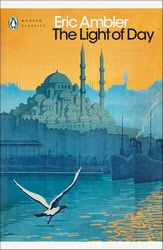
On 26th January 2023, Penguin Modern Classics will publish three wildly enjoyable novels from the father of the spy thriller, Eric Ambler: Passage of Arms, The Light of Day and A Kind of Anger. Ambler is often said to have invented the modern suspense novel, and his disciples include John le Carré, Alfred Hitchcock, Graham Greene and Len Deighton. These are a must-read for fans of the genre.

Eric Ambler (1909-98) was born in London to parents who were part-time entertainers. He studied engineering but left college without taking a degree and became a copywriter in the advertising industry. Between 1937 and 1940, he published his great anti-fascist spy thrillers: Uncommon Danger, Epitaph for a Spy, Cause for Alarm, The Mask of Dimitrios, and Journey into Fear. In 1940, he joined the Royal Artillery and was later transferred to the army film unit. After the war he worked as a screenwriter in England and Hollywood and married his second wife, a leading Hollywood producer. Passage of Arms, The Light of Day and A Kind of Anger are his post-war novels.

A Kind of Anger

The last time anyone saw Lucia Bernardi, she was driving at top speed away from a Swiss villa - leaving the body of her murdered Iraqi lover behind. Now she has vanished, along with a potentially explosive set of papers, and disgraced journalist Piet Maas has been sent to follow her trail to the South of France. But finding her is just the start of his problems. Soon, amid a cast of con men, secret agents and revolutionaries, he must decide whether to land the scoop of his lifetime - or follow Lucia into ever more dangerous waters.

A Passage to Arms

An Indian clerk, Girija Krishnan, sees the opportunity of his lifetime when he stumbles on an abandoned cache of arms hidden in the Malayan jungle. If he can sell the weapons, he will be able to achieve his lifelong dream of owning a bus company - although the penalty for gun-running is death. Soon his decision becomes the catalyst for a chain of events involving an entrepreneurial Chinese family, a corrupt Colonel and, finally, a naïve couple of American tourists who find themselves horribly out of their depth.

The Light of Day

Small-time hustler Arthur Abdel Simpson ekes out a living in Athens by robbing gullible tourists. But when an attempted theft backfires, he finds himself out-smarted and blackmailed into driving a highly suspicious car across the border to Istanbul. Then the Turkish secret police get involved, and Simpson becomes embroiled in something far deeper, and more dangerous, than he could imagine. Featuring a heart-stopping jewel heist, this compulsive, morally complex thriller became the basis for the classic filmTopkapi.


Tuesday, 9 February 2021

Chester Himes - Harlem Detective Series

Chester Himes

Harlem Detective Series

Published by Penguin Modern Classics | 25 March 2021

Paperback £9.99

Himes posed questions that few of his contemporaries dared to raise: What defines an “authentic” black voice?” Hilton Als, The New Yorker

A conman disguised as a nun, a preacher flogging one-way tickets to Africa, a golden Cadillac big enough to cross the ocean. Every one of Chester Himes’ ground-breaking crime novels buzzes with a barely-contained chaotic and darkly witty energy, echoed in vibrant new jackets featuring Harlem collages by Romare Bearden.

 Chester Himes was born in Jefferson City, Missouri in 1909 and grew up in Cleveland. Aged 19 he was arrested for armed robbery and sentenced to up to 25 years in jail. In jail he began to write short stories, some of which were published in Esquire. Upon release he took a variety of jobs, from working in a California shipyard to journalism to script-writing, while continuing to write fiction. Like many African-American writers of his generation, he later moved to Paris, where he was commissioned by La Série Noire to write the first of his Harlem detective novels, La reine des pommes/A Rage in Harlem, which won the 1957 Grand Prix du Roman Policier. In 1969 Himes moved to Spain, where he died in 1984.

One of crime fiction’s most overlooked writers, Himes’ inimitable stories take the reader through the criminal underbelly of New York alongside hardboiled Harlem detectives ‘Coffin’ Ed Johnson and ‘Grave Digger’ Jones. His brutally comic surrealism combined with his authentic treatment of the Black Harlem underclass, more myth than reality to most white Americans of the period, earn him a unique place among crime writing giants such as Raymond Chandler, Dashiell Hammett and Jim Thompson.

 A Rage in Harlem

Jackson's woman has found him a foolproof way to make money - a technique for turning ten dollar bills into hundreds. But when the scheme somehow fails, Jackson is left broke, wanted by the police and desperately racing to get back both his money and his loving Imabelle. The first of Chester Himes's novels to feature the hardboiled Harlem detectives, A Rage in Harlem has swagger, brutal humour, lurid violence, a hearse loaded with gold and a conman dressed as a Sister of Mercy.

 The Real Cool Killers

The night's over for Ulysses Galen. It started going bad for the big Greek when a knife was drawn, then there was an axe, then he was being chased and shot at. Now Galen is lying dead in the middle of a Harlem street. But the night's just beginning for our detectives, because they have a smoking gun but it couldn't have killed Galen, and they had a suspect but a gang called the Real Cool Moslems took him. And as patrol cars and search teams descend on the neighbourhood, their case threatens to take a turn for the personal.

 All Shot Up

A golden Cadillac big enough to cross the ocean has been seen sailing along the streets of Harlem. A hit-and-run victim's been hit so hard she got embedded in the wall of a convent. A shootout with three heistmen dressed as cops has left an important politician in a coma - and a lot of money missing. And Grave Digger Jones and Coffin Ed Johnson are the ones who have to piece it all together.

 The Heat’s On

Coffin Ed and Grave Digger Jones have lost two criminals. Pinky ran off - but it shouldn't be hard to track down a giant albino man in Harlem. Jake the drug dealer, though, isn't coming back - he died after Grave Digger punched him in the stomach. This might cost them both their badges, unless they can track down the cause of all this mayhem - like the African with his throat slit and the dog the size of a lion with an open head wound.

 Cotton Comes to Harlem

A preacher called Deke O'Malley's been selling false hope: the promise of a glorious new life in Africa for just $1,000 a family. But when thieves with machine guns steal the proceeds - and send one man's brain matter flying - the con is up. Now Grave Digger Jones and Coffin Ed mean to bring the good people of Harlem back their $87,000, however many corpses they have to climb over to get it.