The Police Procedural is
a staple of the Crime, Mystery and Thriller genre, so we asked former Police
Commander turned writer Graham
Bartlett for some insight. For
those who maybe unfamiliar with the name, will however be familiar with the
names Peter
James and Roy Grace; the
award winning writer of the best-selling Police Procedural series set in [but
not restricted to] Brighton [Sussex, England] and his Investigator.
Graham Bartlett has over
a thirty year career, which commenced as a Beat Cop, culminated into his
becoming Chief
Superintendent – and who now has taken
up writing. It was while working with Sussex Police, that Peter James and Graham Bartlett’s paths would cross.
This is a timely book considering 2016 marks Peter James’ recognition by
his peers at The Crime Writers Association [which he chaired for
two consecutive terms], with the Diamond Dagger Award – click here for video of Peter at Crimefest 2016, where he acknowledged this
accolade in a witty speech.
So with thanks to Sophie Ransom and Pan Macmillan; Shots Magazine got to
spend some time with Graham Bartlett during the Theakstons Crime-Writing Festival to investigate the
Police Procedural, with of course emphasis on his own work, and the link
between the fictional detectives, and that of their real life counterparts.
The Police Procedural has
truly international appeal. In North America and Canada, we have many popular
series, from Michael
Connelly’s Harry Bosch
Thrillers, as Connelly was a renowned journalist covering the crime beat in Los
Angeles before turning to penning his own thrillers.

We had Evan
Hunter aka Ed McBain with his 87th
Precinct team, former cop Joseph Wambaugh, Jeffery
Deaver with his Lincoln Rhyme
mysteries, Tess
Gerritsen and her Jane
Rizzoli and Maura Isles, James
Patterson and Alex Cross, Craig Johnson and Walt Longmire, Thomas
Harris with Will Graham and Clarice Starling, Linda
Fairstein and Alexandra Cooper, and Canadian Louise
Penny and Inspector Armand
Gamache, Karen
Slaughter and Will Trent, James
Lee Burke and Dave Robicheaux, Elizabeth George and Thomas Lynley, John Sanford and Lucas Davenport – and I
could go on and on, as well as the crossover to Film and TV versions as well as
the iconic characters such as Dirty Harry Callahan as portrayed by Clint
Eastwood, from a character created by screenwriters Harry and Rita Fink –
though there are far too many others to name, apart
from this one and this
one which are personal favourites.

Though reading through
the list of American Police Detectives and their writers, one would think this
sub-genre is dominated by the United States and Canada. However I would assert
that the Police Procedural is very much alive and kicking in Europe.
Though many European
Police Procedurals have their roots across the Atlantic [in terms of influence]
as well as the legendary Swedish Writing Duo, as I discovered when I
interviewed the late Stieg Larsson’s Father who told me “Stieg’s mother and I both read crime novels
by Maj
Sjöwall and Per Wahlöö, and there were many others, such as Mickey
Spillane. I don’t feel we encouraged Stieg and his
brother to read this kind of book, but maybe we did.”
We soon had Jo Nesbo and his Harry Hole thrillers, the Late Henning Mankell and his Wallander thrillers, and of course a personal favourite, Arnaldur Indridason and his Reykjavik Detectives. I have to state for the
record, that his novel Jar City, which was originally titled ‘Tainted Blood’ when first
published in the UK, is one of my all-time favourite police procedurals. And like in America the popularity in Europe for
Police Procedurals, be they Novels, TV, or Film continues and in-concert with
our interest in how order is maintained in society.
Without
appearing jingoistic, I have to say that when it comes to the Police
Procedural, the British have some of the most engaging series on the market
currently. From Ian Rankin’s Rebus, Peter Robinson’s Alan Banks, Val
McDermid’s
Carol Jordan and Tony Hill, Lynda La Plante’s Jane Tennison, PD James’ Adam Dalgliesh, Ruth Rendell’s Wexford,
Stuart MacBride’s Logan McRae, Mark
Billingham’s Tom Thorne, Reginald
Hill’s Dalziel & Pascoe, David
Mark’s DS Aector McAvoy, and many, many others.
Which brings us back to one of the most popular British
Police Procedural series currently in print; the Roy
Grace Thrillers penned by Peter James. Now
after over a decade, the appeal of the fictionalised adventures
of the Sussex Police does not seem to abate. This lead to an interesting
companion book, just released “Death
Comes Knocking : Policing Roy Grace’s Brighton” by
former Police Officer Graham Bartlett and Peter James.
Both writers James and Bartlett attended the 2016 Theakstons
Crime Writing Festival, where Shots got a chance to
investigate the police procedural in more detail, with a focus on the Roy Grace
Thrillers, and this companion volume, ‘Death Comes Knocking’.
Ali Thank
you for talking to Shots Ezine, so firstly we can see from Death Comes
Knocking, your passion for Law Enforcement; so tell us where the passion for
writing comes from? Are you a reader and if so what were the early books from
childhood that made an impression?
Graham From as early as I can remember I have
loved books. I don’t know whether I’m just an escapist but I love immersing
myself in other people’s worlds, be it their reality or their fiction. I think
it all started with Wilbur Smith’s Courtney series. I found the intermingling
of power, rivalry, love and tragedy, together with the stunning description of
African life and landscapes completely addictive.
In the police I found that I had a particular gift for writing
readable reports, on even the dullest and most turgid topic. When I started to
blog I was delighted with the reaction, even more so when one was picked up by
a local paper. That made me think ‘hang on, maybe I can string a sentence or
two together when I retire.’ I asked Peter James’ advice and the rest is
history!
AK And
tell us a little about when you first met Peter James? And could you tell us a little about
David Gaylor of Sussex Police who also worked with Peter.
GB Sussex Police had a long history helping
Peter with his research. David Gaylor was his principle contact and he became
the blue print for Roy
Grace. David, one of the most driven and talented detectives I
worked with, was my boss for a few years. When he retired, he suggested to
Peter that he linked up with me. I had just become the Superintendent at
Brighton so was in an ideal position to take on the mantle. We got on famously
which was handy as there were some aspects of what we did that Peter wasn’t
allowed to see. He completely understood that and was never offended when he
was asked to dissolve into the background.
AK So what do you put down to Peter’s
international success with the Roy Grace novels, though you do mention the
authenticity and research in these books, but that only gets you so far in
terms of popular appeal?
GB The research is important as it underpins
the whole story but I think the characters Peter creates, with all their
strengths and flaws, are so utterly believable that readers really care about
them. People
want Grace to get his man but also they want him to find happiness
in his personal life and not be so put upon by his bosses. The plots themselves
are so wonderfully interwoven that they do not bog the reader down nor confuse
them. As in reality, they ebb and flow, they collide and they co-exist but life
goes on in spite of them and Peter nails that every time.
AK So
I have to ask, which of Peter’s Roy Grace thrillers is your favourite and why?
GB When I picked up the first Roy Grace novel,
Dead Simple I was stunned with its brilliance. Since then, year on year, each
new instalment has been amazing. It’s hard to pick out a first amongst equals
but, until this year, Dead Man’s Grip and Not Dead Yet have stood out. Then
along came Love You Dead, the most recent Grace offering. I remember reading
drafts of this and excitedly phoning Peter to tell him that this was his best
yet. The pure evil of the villainous Jodie and the scheming murderous ways she
entraps her various prey, together with the re-introduction of the psychopath
Tooth was riveting. The climax was brilliantly conceived; it honestly left me breathless.
AK I
am very fond of his Perfect People techno-thriller, as well as his horror
and short stories, so have you read any of his non-Roy Grace work? [And if so
your thoughts?]
GB I loved Perfect
People too. Not many people know this but Peter wrote that
years ago and wanted to wait for the right time to publish it. He started to
become concerned that the science was catching up with the fiction he had
created so, into the shops it went and, as with all his books, it was a
blockbuster.
I have read many of his supernatural thrillers and love
them, especially Host. They are much darker than the Grace novels but sometimes
you can see traces of his previous genre in his present one, especially in You
Are Dead. I always struggle how someone so friendly and warm as Peter can come
up with such shocking and evil people and plots.
AK Had
you attempted any writing [outside of your Police activity] before Death Comes
Knocking? And was it your retirement from the service that prompted your first
foray into literature?
GB Running the UK’s second busiest police
station got in the way of my ambition to write, but having tried my hand at
blogging – which I must get back to – I knew I wanted to write in some form
when I retired. I am so glad I did. I find it incredibly rewarding. I like
nothing more than locking myself in the office and letting the words flow. It
is like a second calling for me. I know Peter James has given me an amazing
platform for my first book but, whatever the future holds, I will certainly
carry on.
AK Peter
indicated in the forward and in your opening that care had to be taken with
police vernacular, such as “…they proceeded in a Northerly direction…….” As
fiction and commercial writing is a differing beast; so how did you approach
the task of avoiding “Police Speak”?
GB I’d like to think that I have never really
‘proceeded’ or ‘observed.’ I’ve always preferred to ‘walk’ or ‘see!’ Many of
the jobs I held in my latter years involved working with people outside of the
police, so I had to become jargon-free. That said I still had some of the old
ways. I tended to describe everything in painstaking detail, with numerous
caveats, and in strict chronological order. Julie, my wife and most forthright
editor, and Peter, kept a sharp eye out for Police Speak and cajoled, or rather
beat, it out of me!
AK I
found your sense of humour added an extra
dimension to your recollections, as some of the cases are disturbing, so is
‘Gallows Humour’ a coping mechanism for the law enforcer when faced with the
darkest aspects of human nature and society?
GB Absolutely, and it’s the same for the
other emergency services as well as the military. It’s never disrespectful but
we see things that no person should ever see and you have to learn to deal with
that. If, after every distressing incident, we carried its burden around with
us we would eventually become ill and unable to do the difficult job the public
deserves. By using humour to cope we are able to emotionally move on quicker
and be ready for the next tragedy. It doesn’t always work, however, as I
discuss in the chapter Every Detective’s Nightmare. Were it not for my
incredible wife, I could have lost everything.
AK Humour
comes across with the forgers David Henty and Clifford Wake, which epitomises
the memory of gentleman criminals. It is in stark contrast to some of the
darker recollections, including the issues of Brighton’s drug problem and the
psychopath such as Paul Teed – so after thirty years policing Sussex and
publishing your recollections [in-concert with Peter James], how has it
affected you as a person?
GB I don’t know what I would be like without
those thirty years of dealing with the public at both it’s worst and best. I
joined at 18 so had no life experiences before I became a cop but I know that
wonderful career shaped me. I have never looked to judge anyone. That might be
surprising but I have seen so much good and bad in the same people that I have
tried to focus on the deeds rather than categorise them. Every criminal has a
story, as does every victim. I was, and am, passionate about protecting people
from harm and seeking justice after a quest for the truth. I don’t subscribe to
stereotypes or hysteria.
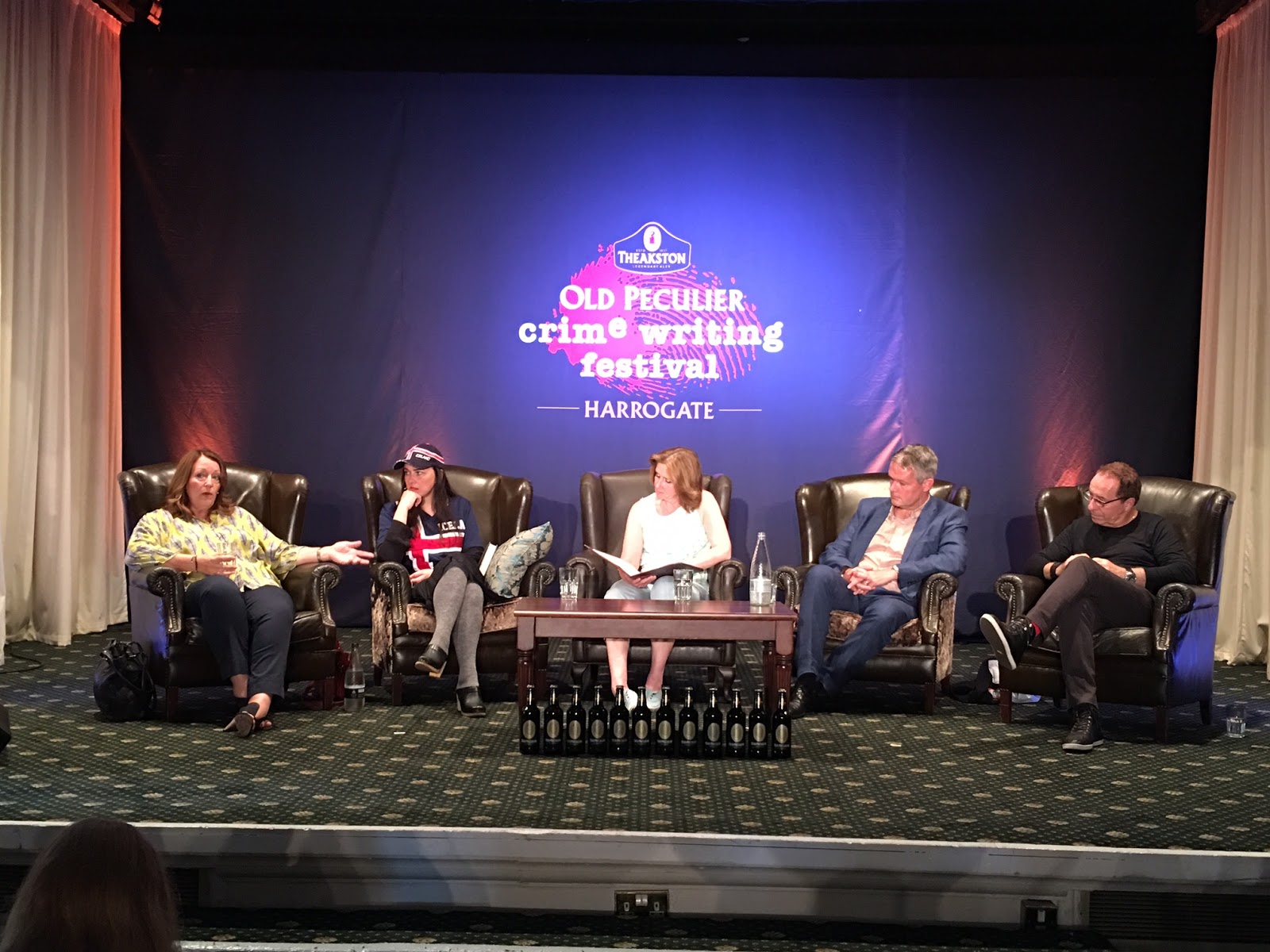
[L-R Mari Hannah,Yrsa
Sigurðardóttir, S J Bolton, Graham Bartlett Peter James]
I am still the one who will walk towards danger rather
than away. That’s crazy but it is how I was conditioned and I will probably end
up getting hurt one day because of it!
I am very hard to shock and when bad things happen, or
look like happening, I am most comfortable when I am at the tiller trying to
put things right or at least stop them getting worse. That’s the training and
the culture, but when I was commanding a firearms incident or a potential riot
I realised that if I didn’t sort things out no-one else would.
AK And tell us about the reaction from
Macmillan when they were approached about Death Comes Knocking?
GB When we first mentioned Death Comes
Knocking to Geoff Duffield, the Creative Director of Pan Macmillan, his
reaction was astonishing. He was so enthused by the concept and saw a real gap
in the market that this type of non fiction could fill. As expected, however,
he was very quick to stress that the concept wouldn’t carry the book itself,
neither would the Roy
Grace brand. It had to stand on its own two feet and be very
well written.
When we submitted the first draft to Ingrid Connell, who
became our editor, I was so nervous that I may not have cleared the two hurdles
Geoff had set. Peter and our agent Carole Blake had worked hard on the book
with me but I knew we would only get one chance. It was a JFK moment when the
offer came through from Pan Macmillan; I will always remember where I was (on
the Brighton to London train en route to a Sam Smith concert!). They were blown
away by the first draft and eager to snap it up. I must admit I thought that
was the job almost done. Little did I know that was just the beginning of the
hard work.
AK I
enjoyed your appearance at Theakstons Harrogate, so tell me what you got up to while at
the event, and also about the promotional activity that is required in
launching a work such as “Death Comes Knocking”?
GB My first reaction when I arrived at the
Swan Hotel Harrogate on the Thursday evening was ‘What am I doing? I have no right
to be here. This is for proper authors!’ However, I couldn’t have been made to
feel more welcome. Firstly sharing a bottle of wine with the legend Jeffrey
Deaver then bumping into Mari Hannah, who I have the greatest respect for, was
a real privilege. Obviously I spent time with Peter but after the panel event,
so many people were fascinated by Death Comes Knocking, my previous and current
career and how I work with Peter that I made lots of new friends.
The promotional work outside of Harrogate was like a
whirlwind. We took part in countless radio, TV, newspaper and magazine
interviews. We gave sell out author talks and book signings and were frantic on
social media tapping into the various angles that Death Comes Knocking covers.
I lapped it all up and was delighted by the reaction to the book.
AK And
do you think you will attempt a full fictional novel? Or do you prefer writing
about your Police Experiences?
GB Yes, I definitely would like to write a
novel. I have actually started one. It’s so rewarding being able to write about
the real world of policing but I think I could create all sorts of mischief and
intrigue by applying my knowledge and my new found writing skills to a police
procedural. I am coming at it from a completely new angle so hopefully, when I
eventually finish it, people will love it.
AK Had
you trouble selecting the vignettes and tales from your career for the book,
and did you outline, or did you allow yourself to just sit down and write, and
then tidy up afterwards in re-drafting?
GB At first I gulped when we agreed we would
aim for 100k words. How would I find enough stories? But, as with every
journey, I started with a single step (or chapter) and just kept building. With
at least two of the chapters (Bad Business and Horror Amongst Thieves) I
started researching one thing and ended up writing something different, and far
better.
I re-read all the Grace novels as I wanted to ensure the
stories linked with those, so that triggered some memories but we ended up
leaving some stories out as we had so many.
I didn’t write chronologically at first, I just wrote as
I researched. Once we had the full manuscript I went back and put all the
chapters in order then wove the career and personal timelines into the
narrative so the whole book flowed.
AK I
am sure you have many other tales in your 30 year career as a Law Enforcer, so
do you foresee a companion volume to Death Comes Knocking?
GB That would
be great but I can’t say too much about that at the moment!
AK Thank
you for your time, and please get back to writing volume 2
GB It’s a
pleasure. I may do just that!
Shots have discounted copies of DEATH COMES KNOCKING
available here and
our review is here and
discounted copies of LOVE YOU DEAD by Peter James are available here as
are all of the Roy Grace Thrillers from this link here
Shots would like to pass our thanks to Graham Bartlett,
Peter James, Sophie Ransom, Pan Macmillan and Theakston’s Crime Festival for
their help with this interview.
The Roy Grace Series
Dead Simple [2005]
Not Dead Enough
[2007]
Dead Man's
Footsteps [2008]
Dead Tomorrow
[2009]
Want You Dead
[2014]
You Are Dead [2015]
More information about the work of Peter James is
available here
Photos from Theakstons Crime-Writing Festival 2016,
with Mari Hannah,Yrsa Sigurðardóttir, S J Bolton, KJ Howe, Peter
James, Graham Bartlett are (c) 2016 A Karim