Think of a magic trick: a coin appears from mid-air; a rabbit hops out of a black top hat; the magician pulls your chosen playing card from the pack. The items appear as if conjured, yet the rational side of you knows the magician had those things hidden away all along.
The same applies to much of the writing process. Stories quietly develop in the recesses of our mind and then pop to the front as an idea, and we think: ah, yes, that’s it! When it comes to characters they appear, as if by magic, as fully formed human beings (or at least they do to me). They are the rabbit in the hat, hopping out of our heads and onto the page and very often we have no idea how the hell we’ve done it.
This was true for Connie Lithgow, the central character in my new novel, Don’t Say A Word. One of Connie’s defining features is her mutism. The shock of witnessing her parents’ death at aged five robbed her of her speech. The lack of treatment and understanding from those left to raise her meant she never fully recovered. At the start of the novel, Connie is rushed to hospital after attempting suicide at her dying husband’s bedside, and it’s left to her daughter and her friend to unlock her silent prison before it’s too late. But it was down to me to understand this character and bring her to life for the reader.
Connie’s mutism was innate from the start. So too was her resilience, determination, loyalty and an underlying, burning frustration. What was less clear was why she had these traits; I had to rework the magic trick in reverse and unpick this woman to her bare-bones and backstory.
A bit of method-research was required.
The best way to get into Connie’s head, I thought, would be to live with mutism myself. Self-Imposed mutism. The first weekend that my children were at their dad’s I got down to it. I wouldn’t speak for the entire weekend.
It was bloody brilliant. Peaceful and stress-free. I thought about the silent weekend retreats my friend Heidi favours, and I finally understood the appeal. Silence really can be golden.
It was as I came to the end of the weekend that I realised my mistake. I had chosen not to speak; it hadn’t been imposed. I had spent the weekend on my own, writing my book and taking breaks for yoga and coffee. The reason mutism hadn’t been an issue is because I hadn’t put myself into any situations where it would be an issue. My experience was false.
The next weekend I had alone I changed tac. I decided not to write at all, but to live a bit. I went to the cinema, food shopping, took myself out for lunch. The experience was entirely different. The people I met were eager to help and always polite, but I was treated like a child; spoken down to in simple language, voices were raised even though I signalled that my hearing was unaffected. I used a notebook to communicate and the people I wrote to adopted looks of patronising patience. The sense of being misunderstood and underestimated was frequent.
By the end of the weekend, I was intensely frustrated. Whereas previously, I enjoyed the isolation of cutting myself off from the world; this time, I wanted to lock myself away because it felt easier, safer and less maddening.
The upside of this? I understood my protagonist. Communication is a vital part of our identity: threaten this and we not only affect our ability to interact; we transform the idea of how we are perceived and even who we are. Is there anything more isolating than feeling misunderstood and unknown?
Connie has become one of my favourite characters; I have a huge fondness and sense of protection for her. She may not be cuddly, soft or cute, but she’s the best rabbit I’ve ever pulled from my writerly hat.
Don't Say A Word is by Rebecca Tinnelly (Hodder & Stoughton)
Some family secrets demand to be told . . . Connie lost her words at the age of five, the day she witnessed her mother and father's untimely death. Since then she has been all but mute, only being able to choke out a few select words. Now, years on, Connie's husband is on his deathbed and all she can do is quietly sit by his side. But there are so many dreadful secrets locked up in Connie's silent prison. And time is running out to set them free . . .
Could you be the next Martina Cole, Lynda La Plante or Ian Rankin?
Capital Crime and the DHH Literary Agency have launched an innovative new competition for aspiring crime and thriller authors.
To enter, all you need to do is visit http://www.capitalcrime.org/new-voices-awards-entry/ and upload the first three chapters of your unpublished novel. Everyone who buys a ticket to attend Capital Crime will be able to read your entry and vote for their favourite. The authors of the ten highest placed entries will be revealed on Thursday 19th September and the winner, judged by the Capital Crime team from the top ten entries, will be announced at Capital Crime’s opening night cocktail party on Thursday 26th September to the readers, agents and publishers in attendance.
The competition costs £10 to enter and entries close at midnight on Wednesday 18th September 2019. The names of the ten most popular entrants will be announced the next day. The overall winner will be announced on the 26th September and will receive a trophy and a prize of £250.
SCOTLAND REVEALS
THEIR ‘CRIME IN THE SPOTLIGHT’ WRITERS WHO WILL BE APPEARING ON STAGE WITH SOME
OF THE BIGGEST NAMES AT THE 2019 FESTIVAL
Bloody Scotland will again be supporting
new writers by pairing established authors with ‘support’ acts just starting
out on their crime writing career.
Graeme Macrae Burnet, author of His Bloody Project was famously ‘In the
Spotlight’ as a support act for Ian Rankin before it was shortlisted for the
Man Booker and the initiative has been praised on Open Book, BBC Radio 4 for
being innovative and breaking the boundaries of traditional book festivals.
Authors ‘In the Spotlight’ this year include Judith O’Reilly, a former producer
for Newsnight and Channel 4 News who is paired with David Baldacci straight
from leading the torchlight procession; Jackie McLean, who volunteered at
Bloody Scotland now makes her way on to the main stage herself with Chris
Brookmyre and Michael Robotham; Gordon Kerr, who as Head of Marketing at
Waterstones selected Alexander McCall Smith as Book of the Month and will now
share the stage with the much loved international star and Noelle Holten,
better known to everyone in the crime fiction world as the power
blogger Crime Book Junkie, who will be on stage with the even more
powerful Ian Rankin and First Minister, Nicola Sturgeon.
The full list includes authors published by Scottish and English independents,
large London conglomerates and some self-published authors with a mix of male
and female crime writers. One of last years authors ‘in the spotlight’, Claire
Askew who last year took to the stage with Ann Cleeves and Louise Penny has
this year been shortlisted for both the debut and the main McIlvanney Prize.
The finalists will be revealed on 6 September.
List of Authors –
Judith O’Reilly (Northumberland) with
David Baldacci, Friday 20th, 8.30pm (Killing
State, Head of Zeus)
Geraldine Hogan (Ireland) with Dr David
Wilson, Saturday 21st, 10am (Silent Night,
Bookouture)
Jackie McLean (Glasgow) Chris Brookmyre
& Michael Robotham, Sat 21st, 11.45am (Shadows,
Thunderpoint)
Gordon Kerr (East Kilbride & Dorset)
with Alexander McCall Smith, Sat 21st 1.30pm (The Partisan Heart, Muswell Press)
Fiona Erskine (Edinburgh & Teeside) with
Denise Mina & Louise Welsh, Sat 21st 3.15pm (The Chemical Detective, Oneworld)
Daniel James (Newcastle) with Richard
Osman, Sat 21st 5pm (The Unauthorised Biography of Ezra Maas, Dead Ink Books)
Noelle Holten (Birmingham) with Ian
Rankin & Nicola Sturgeon, Sat 21st, 8pm (Dead Inside, Harper Collins)
Anne Pettigrew (Greenock) with Professor
Angela Gallop, Sun 22nd, 11am (Not the Life Imagined, Ringwood)
Neil Lancaster (Highlands) with Lin
Anderson & Alex Gray, Sun 22nd, 12.45pm (Going Dark, Self Pub)
Douglas Watt (Edinburgh) with Ambrose
Parry and Nicci French, Sun 22nd, 2.30pm (The Unnatural Death of a Jacobite,
Luath)
Anna Sayburn Lane (London) with Yrsa
Sigurdardottir & Sally Magnusson, Sun 22nd, 4pm (Unlawful Things, Self)
Christine Laurenson (Shetland) with
Stuart MacBride & Mark Billingham, Sun 22nd 5.30pm (Dark Business, Self)
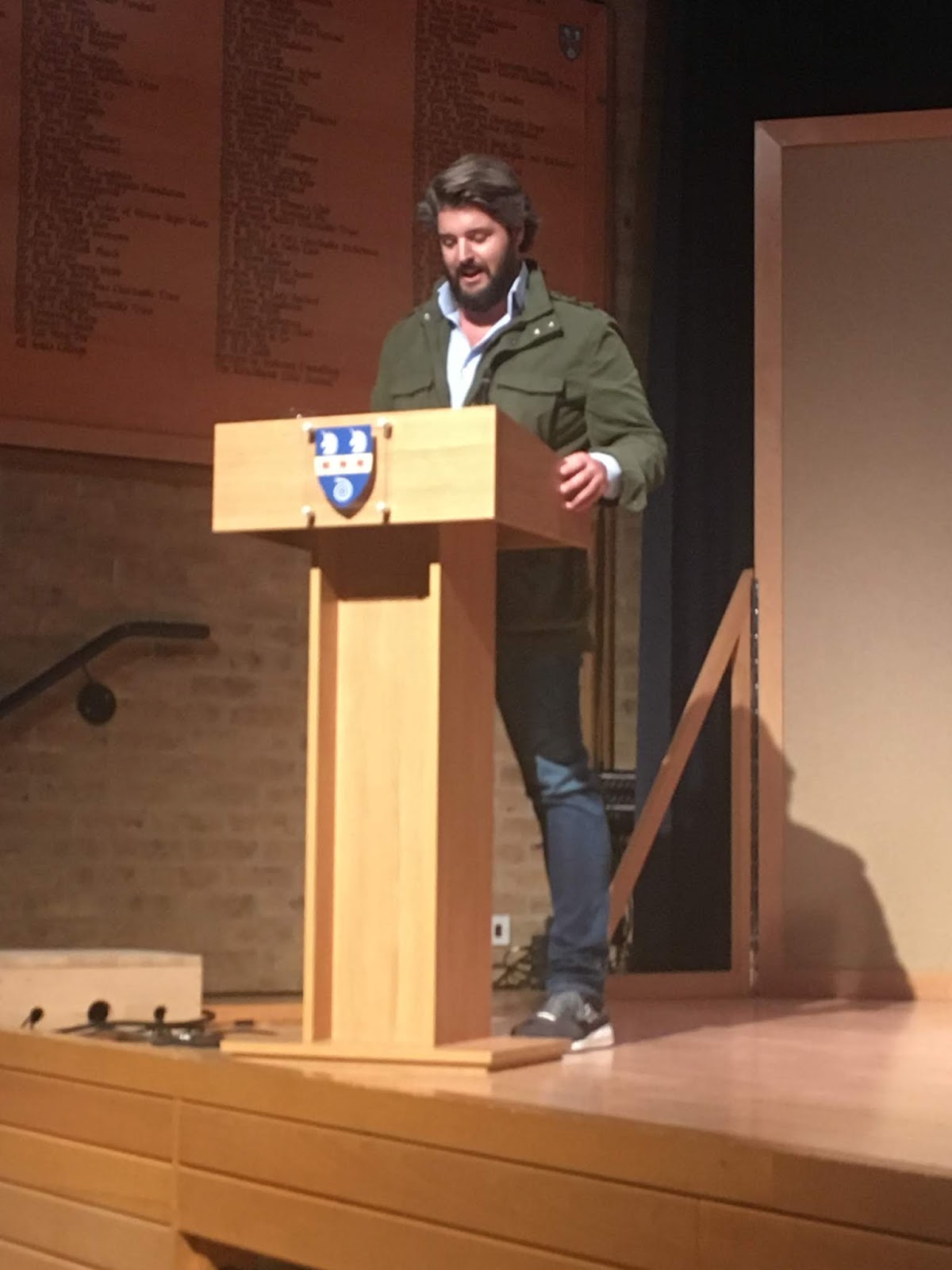
The Sunday at St Hilda’s is always tinged with sadness as one realises that the wonderful weekend is about to end. However, one of the best things about the weekend is always the Sunday Lecture by the Guest of Honour. This year prize-winning author Denise Mina gave the Sunday lecture entitled ‘Narrative: How it Shapes The World’. She spoke about storytelling (which is a single act performed by two brains), crime fiction, (crime writing is the new social novel) neural pathways, and feminism and reader expectations. Along with Christianity, Lenin and Andy Warhol. Quite eclectic! Talking about the narrative it is seen as being very good for small groups but not so good for large ones. Furthermore, one has to remember that there is crime fiction and the marketing of crime fiction. Denise Mina also expressed the view that crime writers not only write to make a living but also due to the fact that they have the need to write. Crime fiction is vital, it is about social structure. Our culture is saturated with crime fiction and it is changing the world. There is however certain things that you have to do if you want to break the genre. UK readers do not appear to be happy with meta fiction stories as compared to US readers. True crime is also the outlier child of crime fiction. What do we talk about when we talk about genre fiction - crime fiction in this case?
A bit of information – Denise Mina is fascinated by Podcasts. One of the Podcasts that she is particularly keen on is called ‘Stuff to Blow Your Mind’.
You certainly had to be there to appreciate the lecture and the nuances of everything that was said by Denise. Totally enthralling.
Nicci French and Mary Paulson-Ellis gave the final papers of the day. Nicci French talked
Nicci French (Nicci Gerrard & Sean French)
about The Rise of the Suspense Thriller. Amongst the things they spoke about was the view that there was a need for crime fiction. There are of course books that were not originally thought to be crime novels and a good example is Jane Eyre, which now reads as a gothic thriller. Another example is Wuthering Heights, which is also a thriller. Agatha Christie is seen as a modernist writer specifically with the novel The Murder of Roger Ackroyd. With this years theme firmly in mind Nicci French expressed the view that Freud’s writing is a ‘gamechanger”.
Mary Paulson-Ellis in a wide ranging paper spoke about her love of Kate Atkinson with a paper entitled Kate Atkinson, a love story’: the literary, the detective and the journey of the self towards the light’. One of the things that was stated was the fact meta fiction is one of Kate Atkinson’s hallmarks in her work. Brilliantly illustrated with power point presentation including some small terrier illustrations.
Both Andrew Taylor and Val McDermid who step down from the Committee were named Emeritus Fellows over the weekend for services rendered.
Thinking about all the brilliant papers that were given over the weekend it is sometimes hard to put into words how relaxing, refreshing and enjoyable the weekend was. It has constantly been this way in my opinion and will continued to be. It was sad to say goodbye but already we know the dates for next year which are from the 14 to 16 August 2020. The theme will be historical though the exact Crime Fiction Weekend title is yet to be confirmed. Put the dates in your diary! They are already in mine.
A big huge thanks to all who were involved in organising the weekend and a special thank you to Natasha Cooper for once again chairing the event with such aplomb and charm.
I am sure that I am not the only one that will be looking forward to next year!
After a brief introduction the first full day at St Hilda’s saw Andrew Taylor talking about Josephine Tey. The title of the paper being A Gathering of Strangers: The Crime Fiction of Josephine Tey. Josephine Tey is one of the two authors that have influenced Andrew Taylor the other being Patricia Highsmith so it was quite apt that Sarah Hilary who was the second author taking part in the first session gave a paper on Patricia Highsmith. Andrew Taylor spoke about Josephine Tey’s first novel The Man in The Queue. Interesting to note that crime writer Catherine Aird has a family connection to Josephine Tey. Andrew Taylor suggested that if you were going to start reading Josephine Tey then he would suggest that you either start with Brat Farraror The Franchise Affair. Sarah Hilary’s paper was entitled Uncomfortably Naked: Patricia Highsmith’s Talent for Perversion. As Sarah explained Highsmith is a particular hero of hers.
After a brief coffee break the second session in the morning saw Nicholas Utechinn who is
the historian for the Sherlock Holmes Society of London talk about why Sherlock Holmes was a gamechanger and an historical perspective of Sherlock Holmes and his creator Arthur Conan Doyle. The title of his paper was‘I Suppose I am The Only One in the World’ – Sherlock Holmes Challenges. Holmes of course was seen as the first “forensic detective”. He was well known for the way in which forensics played a part in his deductions. We were also informed that Sidney Paget drew over 300 drawings for the Sherlock Holmes short stories and that the Strand Magazine loved the Sherlock Holmes stories when they were first published. They way in which Holmes solved his case showed why he was the supreme gamechanger. Nicholas Utechinn expressed the view that whilst he did not mind the parodies that were written about Holmes he was not keen on Sherlock Holmes pastiches. There are also around 423 active Sherlock Holmes societies around the world and the first Sherlock Holmes film was shown in 1903 but it only lasted around 11 seconds. The title of the film was Sherlock Holmes Was Baffled. An interesting titbit of information is that Nicholas Utechinn is distantly related to Basil Rathbone who played Sherlock Holmes in 14 Hollywood films between 1939 to 1946 as well as in a radio series.
After Nicholas Utechinn, Scottish author Graeme Macrae Burnet spoke about ‘The Small World of Simenon’. As Graeme talked about Simenon he explained that as he was doing his research he read around 90 of his books. Simenon. Simenon of course was a prolific author and published around 500 novels and numerous short works. Graeme informed the audience that the first Simenon book that he read was Belle, which was not in fact a Maigret book. In Belle, Spencer Ashby, a teacher, is charged with the murder of Belle, the daughter of a friend of his wife's wife, whom the couple has been sheltering for a month and who is strangled in his room. Did he or did he not commit the crime? In Belle we see the world through the eyes of Spencer Ashby and the debilitating effect that accusation of murder has on him. French reviewers have called Graeme himself “Le Simenon écossais”. Both papers saw us listening to two authors explaining in their own ways not only the importance of their work but also the reasons why their work is so important within the genre and why they are in fact game changers.
After lunch saw the papers take on a more non-fictional slant. First, Scottish author Lin
Anderson spoke about Forensic Fact and Fiction and the way in which she incorporates fact into her novels and her interest in forensic science. Her interest in forensic science led her to take a Diploma in Forensic Science. At the time that she did the course she did it along side another author Alex Gray and they were the only two authors on the course. Lin Anderson and Alex Gray are the joint founders of Bloody Scotland. She also explained how her character Rhona MacLeod came into being. One of the points raised by Lin was the fact that people go back to series because of the characters that they want to know more about.
Professor Niamh Nic Daeid who spoke after Lin Anderson explained the complexities of forensic and real crime scenes. She also gave a
fascinating talk on the history of forensic science (which started over 150 years ago) and the changes that were/ have been taking place. One of the other issues that got mentioned was the way in which crime books and television programmes (better known as the “CSI effect”) have complicated trials as some people tend to believe what they have seen on television (e.g. when watching CSI) or read in a crime novel. It was explained that DNA is not found in all cases and that there have been times when counsel have had to state at the start of a trial the fact that there is no DNA! The other problem that tended to arise in trials where there is DNA is the fact that the expert witnesses are not always asked the correct questions so as to elicit the answers that are needed to explain the DNA properly. CSI Investigators also need to learn how to communicate properly. One view that was also expressed was the fact that with the rise of forensic science it had invariably lead to the “death” of the amateur investigator.
An exciting piece of news that was revealed was the fact that Val McDermid has been heavily involved in a new crime drama called Traces which is due to be shown on UKTV Alibi Channel in November. Traces is set in a forensic laboratory and has just finished filming.
The second set of papers given in the afternoon saw Mick Herron talking about the late great Reginald Hill and his books including those written under various pseudonyms with a paper entitled ‘From Cluedo to Ludo – The Changing Games of Reginald Hill’ As Mick Herron explained, Reginald Hill did not play by the rules when it came to his writing. Furthermore, Reginald Hill was always excited not only by other crime writers but also “serious” writers. When thinking about Reginald Hill’s books and the way in which they were written included a lot of social history covering the last quarter of the 20thCentury.
Will Dean (who was the last speaker of the day) spoke about Peter Høeg’s novel Miss Similla’s Feeling For Snowwhich was first published in 1993 in the United Kingdom. A sense of place is very important for Will Dean (which is one of the reason’s why he likes Miss Similla’s Feeling for Snow) as a sense of place anchors him to the story and he eloquently expressed what it was like living with snow and ice for months on end in the remote Swedish forest where he currently lives. For him it is cheaper to fly to
Will believes that Peter Høeg’s book not only bends and stretches the boundaries of the genre but also deals with Denmark’s post-colonial legacy. A similar author that does this is Abir Mukherjee with his Sam Wyndham and Banerjee series set in the Raj era of India.
According to Will Dean, Peter Høeg’s agreed the ending did not work very well and Henning Mankell agreed that the one book that he would have loved to have written Miss Similla’s Feeling For Snowexcept for the ending.
The first full day at St Hilda’s is always full of wonderful papers, insightful questions and is one of the reasons why I keep on returning year after year to the crime weekend.
The evening started with a drinks reception (this time on the lawn) which was then followed by dinner. As part of the evening entertainment at the P.D. James dinner a special mystery whodunit entitled The Game Changer, which had been written by Natasha Cooper (the Chair of the weekend this year) was performed in the dining room by a number of the speakers. It was down to everyone else to see if they could deduce who the murderer was! Yes I do know the answer and no I am not telling just in case it is performed again elsewhere.
Longstanding attendees of course know the drill and we all once again ended up in the SCR after dinner for the rest of the night until sleep called.
As can be expected the drinks reception and the dinner was of course a lovely affair. The drinks reception was held in the South Foyer due to the weather but that did not put a damper on the event and the buzz and chatter made one realise that St Hilda’s Crime Fiction weekend has well and truly started. It is always enjoyable to meet up in the SCR
(Senior Common Room), as it is becomes the meeting place or us all during the weekend.
The after dinner speech was given by Val McDermid, which was entitled ‘From Victims, Vixens and Vamps to Valkyries, Vanquishers and Victors’. Unsurprisingly Val had everyone in fits of laughter as she spoke about “Gamechangers of the genre”. Certainly a brilliant start to the weekend.
After the dinner and a brief word from Natasha Cooper who is the Chair for the weekend we duly retired to the SCR where more conversation took place and a chance to mingle with the other attendees.
One always gets the feeling when attending St Hilda’s that you are in a calm and restful place. Once you walk through the gates you tend to forget that the Oxford town centre is less than 10 minutes walk away as you really can’t hear any traffic. It is also lovely to wake up such magnificent views.
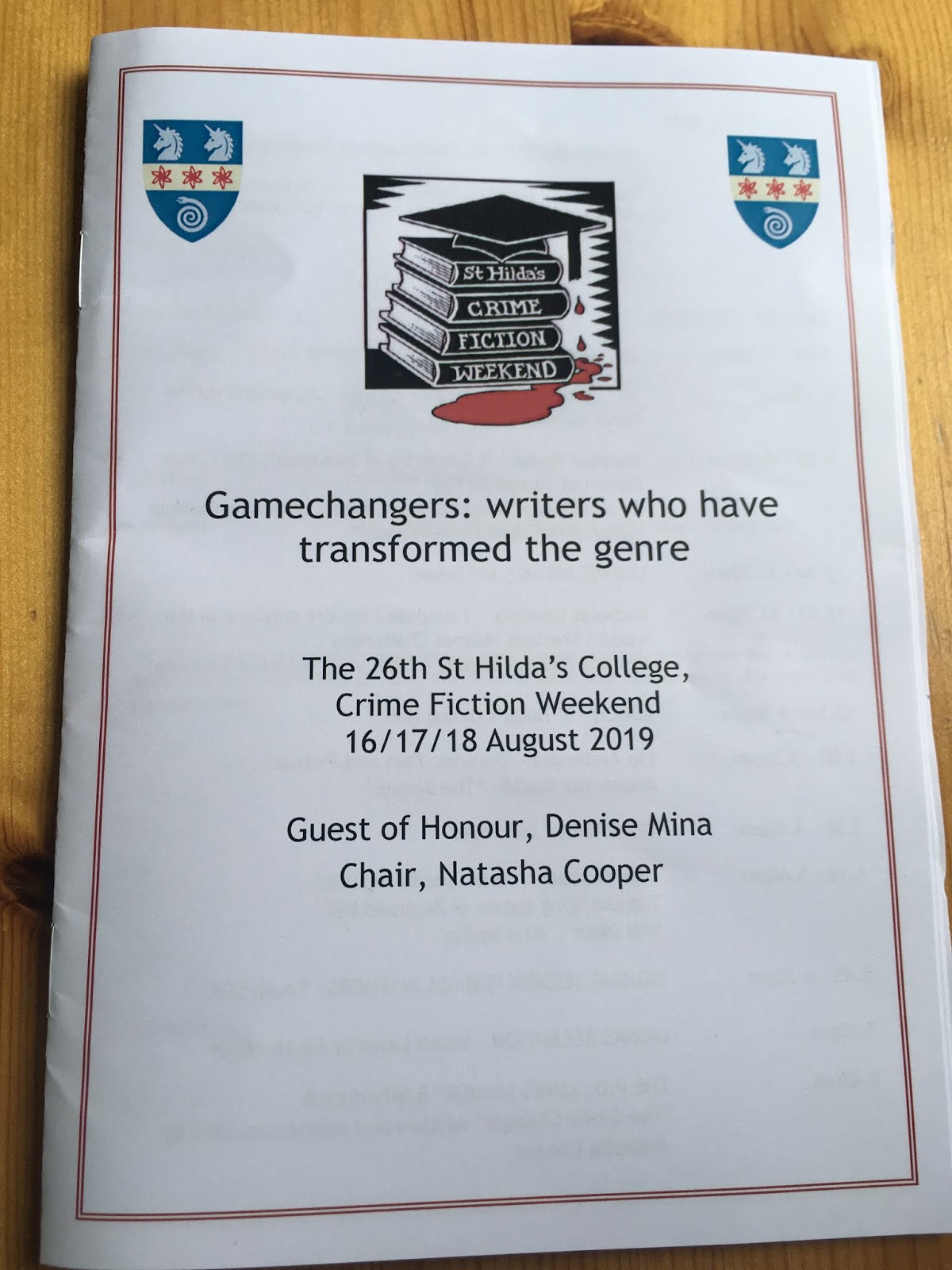
So it is Friday and for so many of us at this time of the year it is time for our annual pilgrimage down to Oxford for the St Hilda’s Crime Fiction weekend. If you have never been then you are missing a treat. This year the theme is Gamechangers: Writers Who Have Transformed the Genre and the weekend is due to be chaired by Natasha Cooper. The guest of Honour is Denise Mina.
The only downside at the moment is that it is raining but that does not hide the brilliant view from my usual room. I love where they have put me as it allows me to look out over the River Cherwell.
The weekend is due to start properly at 6:45pm when we all gather for a drinks reception. Normally it would take place on the South Lawn but looking at the weather I think this year it is going to be in the South Foyer. No matter where it is held the start of St Hilda’s is always enjoyable as you catch up with various friends and introduce the new attendees to
the weekend and for those that feel like it dress up!
This evening the guest speaker is going to be Val McDermid who is a long standing attendee of this weekend and who is also an alumna of St Hilda’s. Her after dinner speech is entitled ‘From Victims, Vixens and Vamps to Valkyries, Vanquishers and Victors’.
Are
you a lover of crime fiction looking for new discoveries or hoping to
rediscover old favourites?Look no
further.
There
are few contemporary guides that cover everything from the golden age to
current bestselling writers from America, Britain and all across the world, but
the award-winning Barry Forshaw, one of the UK’s leading experts in the field,
has provided a truly comprehensive survey with definitive coverage.
Every
major writer is included, along with many other more esoteric choices. Focusing
on a key book (or books) by each writer, and with essays on key crime genres, Crime
Fiction: A Reader’s Guide (with a foreword by Ian Rankin) is designed to be
both a crime fan’s shopping list and a pithy, opinionated but unstuffy
reference tool and history. Most judgements are generous (though not
uncritical), and there is a host of entertaining, informed entries on related
films and TV.
Currently
available for pre-order from Amazon!This is a book that should be on everyone’s bookshelf!
Bloody Scotland is delighted to reveal that the ‘special guest’ interviewing Ian Rankin on Saturday 21 September will be First Minister, Nicola Sturgeon.
A self-confessed crime fiction fan, the First Minister was last seen at the Harrogate Crime Festival singing backing vocals with the Fun Lovin’ Crime Writers hot from their appearance at Glastonbury.
We can’t promise any singing but can promise a fascinating conversation between two of the most iconic figures in Scotland. Ian Rankin is the man who led the Tartan Noir charge to the top of international bestseller charts. At the last count he had sold some 30 million books that have been translated into thirty-six languages and have been bestsellers around the world. As a contemporary social commentator – and thrilling storyteller – Ian Rankin has few rivals.
The First Minister said:
“Ian Rankin is one of Scotland’s most celebrated crime writers, world-renowned for his page-turning thrillers - so it’s a real pleasure for me to interview him at the Bloody Scotland International Crime Writing Festival."
“Now in its eighth year, Bloody Scotland is attracting writers and audiences from around the world with its excellent programme - and I look forward to attending this year’s festival.”
Ian Rankin said:
“I’ve probably done hundreds of events during my time as an author but this is a first for me. I’ve no idea what the First Minister will ask or where our conversation will lead. I just know she’s one of the best-read politicians currently gracing the world stage - and she definitely knows her crime fiction!”
Tickets are selling fast. 430 tickets had already been sold for the event prior to this announcement. Capacity for the Albert Halls in Stirling is 700. The event will take place at 8pm. They are in good company, also on the bill at the Albert Halls that day are Dr David Wilson with Lin Anderson, Chris Brookmyre and Michael Robotham, Alexander McCall Smith with Alex Gray, Denise Mina and Louise Welsh and Richard Osman with Mark Billingham which has already sold out.
For further information, to request press tickets or an interview with any authors appearing at the Festival please contact fiona@brownleedonald.com07767 431 846 @brownlee_donald @bloodyscotland
We are delighted to present this exclusive feature, from writer / reviewer and Shots Magazine’s Spanish representative
- John Parker, in conversation with John Connolly;
so after many, many years reviewing his work, the two Johns’ finally met up.
From Spain -
Celsius 232 is a festival of
literature, a festival of fantasy, horror and science-fiction. Fortunately, a
lot of crime fiction can be found in these genres.Since 2012 when George R.R. Martin visited
Avilés, the festival has grown in size and stature. This year, among many
others, the festival was visited by the likes of Sarah
Pinborough, Hanna
Jameson and John Connolly.
Shots correspondent in Spain, John Parker, happens to live in Avilés, the small
town where the festival takes place. He was able to interview John Connolly
on Friday, 19th of July.
John Parker: You
are here promoting El Frio de la Muerte which over in the UK is known as A
Game of Ghosts that we Parker fans all read a couple of years ago. How are
the Spanish taking to this book? I believe you sold out in Gijon at the Semana
Negra?
John Connolly: I
did! That was quite lovely. I assume it’s going ok. I know that Tusquets
haven’t thrown me out on the street yet. That’s the main thing! Tusquets have
been an incredibly supportive publisher from the beginning and have found ways
to publish books that aren’t part of the Parker series simply because they are
important to me as a writer and my development as a writer so they’ve been
wonderful. And it’s quite nice here in Spain. Genre is taken with a degree of
seriousness, I think.
John Parker: The
readers of SHOTS are probably a bit more up to date than over here in Spain.
You and I have done a number of online interviews but you were very busy when THE
WOMAN IN THE WOODS came out (laughs out loud). You travel an awful lot!!
John Connolly: I
do! Yeah, I travel more than I would like to, to be perfectly honest. I’ve been
trying to travel a little bit less but that hasn’t worked out this year,
certainly.
John Parker: You
have South Africa to come and Australia?
John Connolly: Yeah,
Australia and the Far East and then probably the States in October. So yeah, I
miss my dogs and my kids.
John Parker: Sorry
to hear about the death of your dog…
John Connolly: ………Poor
old Coco! Yes, my other half still breaks up in tears. She really misses him.
John Parker: Ok,
moving on to THE
WOMAN IN THE WOODS… one of the characters, Holly tells an invented
fairy-tale to her son called “The woman in the Woods” which I think worked
fantastically well. Can you comment on where this story came from? Its origins?
Was it something you came up with yourself or was it based on some other fairy-tale?
John Connolly: No,
no but I suppose I’ve spent so long fascinated by fairy-tales and they have
become such a part of the novels. It’s not just, you know books like The Book
of Lost Things or the stories in the Nocturnes collections but, you know, the
Americans write perfectly good crime fiction by themselves. They don’t really
need some Irish bloke coming in to write imitation crime fiction and I’ve kind
of come to realise over the years that I do bring something slightly European
to these novels and one of them is that fascination with fairy tales and folk
tales. And so the woods in my novels are
not really the Maine woods at all. They are, I realise, the woods of the fairy
tales I read as a child. Because, you know, the Americans have a very practical
view of the woods. You know, bad things can happen but only if you wander off
the trail and you get a bit lost and you didn’t bring enough food and you
forget to stay in one place so that the Rangers can find you. Whereas
I am more fascinated by the metaphoric possibilities and the mythic
possibilities of fairy tales so there are things like those elements in THE
WOMAN IN THE WOODS that arise quite naturally in the context of what I am writing,
I suppose, because of that fascination with that history from my childhood.
John Parker: Yes,
I read very recently in your second collection of short stories NOCTURNES2, the story called The Hollow King which
was originally to do with the theme of Blood, Sweat and Tears which had a real
fairy-tale feel to it. I loved it.
John Connolly: Yeah,
yeah! I’ve never written a … I can’t write short crime short stories. I am
unable to do it. For me, crime fiction works best in the long form and
supernatural fiction works best in the short form.
John Parker: Yes,
you have spoken about that before..
John Connolly: Yeah,
so when Mark
(Billingham) asked me to do that, I said that all I can offer you is
something that is going to be a fairy story or a ghost story. And at that point
I think I was revising The Book of Lost Things for the tenth anniversary and so
I was thinking along those lines and… ( a loud crashing noise from outside
interrupts us)… Blimey!!
John Parker: You
recently announced that The Book of Lost Things is being made into an animated
film.
John Connolly: There
is a studio that seems very intent on doing it and I agreed to, well, I offered
to write the script. I think they were quite surprised. I don’t think they had
conceived of me doing it. It had been, as I understood it, in the past it had
been through a couple of iterations that hadn’t worked. And when I met them, I
thought, actually I kind of understand what you’re trying to do and I think I
can probably do it. And so they were very open to that possibility.
John Parker: Speaking of the film genre, you had a story
adapted into a film starring Kevin Costner. Over here it was called La Otra
Hija or The Other Daughter whereas in English it was The New Daughter.
John Connolly: Yeah,
The New Daughter after the story and with a whole lot of Spanish involvement.
John Parker: Yes,
it was directed by Luis Berdejo. Were you happy enough with the adaptation?
John Connolly: You
know, one of the things about a short story is that you are giving someone the
seeds to go and adapt it. You know, a novel is a work of contraction. If you
are going to adapt it, you tend to have to excise an awful lot of material but
the short stories work for expansion. So they essentially took this idea and
went in the wrong direction with it. I was very flattered that they did it.
John Parker: Now,
a question which you may not be able to answer but with the growth of platforms
like Netflix and HBO and Disney taking over the world, now more than ever the
possibility exists that we may yet see Charlie Parker on the small screen.
John Connolly: There
is a script. I’ve read the script for the adaptation of the first novel. Or at
least the first part of the first novel. And they have been working on this for
two years. So, the company that has it is quite serious about it and is now
shopping it around. And you are right. It has changed. Previously your options
were that it was going to be a two-hour movie and even if it was a book you
loved, two hours or two hours and ten minutes was about the limit on it.So they didn’t tend to be very satisfactory
experiences and now you have ten or twelve hours potentially in which to
explore a novel. And you know the model is something like the Bosch series
which is essentially a book a series. The difficulty is that now there is so
much stuff being made, so much content being thrown up on the wall that I am
not sure that a lot of stuff gets time to develop as it would in the past, where
the space is allowed for it to maybe have its little ups or downs at the
beginning before it goes on … but, we shall see. I personally think they are
quite difficult books to adapt so I don’t envy them the task.
John Parker: You
said at the weekend at Semana Negra, “It’s difficult to be Catholic and
completely rational”. (Laughter) Can you expand on that?
John Connolly: Yeah,
well, it was that discussion about the combination of genres that I suppose I
have been doing for a while and I had dinner with Otto Penzler, who I get on
very well with, in New York about four or five months ago and Otto still seemed
to take the view that you can create these combinations. You probably shouldn’t
but you can do it but he still, after all these years, still didn’t quite
approve of it. He’s from that school, you know, it’s that post-enlightenment
belief in that human beings and the universe can be so understood by
approaching the process of rationalism and yet people in the world are a lot
stranger than that and, you know, I come from a Catholic background…
John Parker: You
were brought up by the Christian Brothers as was I.
John Connolly: Yes,
I was brought up by the Christian Brothers. I was an altar boy! So, I bring all
of this baggage with me so I find it very difficult to accept that as the final
position on human motivation, I suppose. So, you know, my novels, a bit like
(James Lee) Burke who was a huge influence on me, are just suffused with
Catholicism, you know, suffused with expiation and guilt. All crime fiction has
redemption and possible redemption running through it but if you come from that
Catholic or Christian background, that word redemption is weighted with a very
different kind of baggage and we bring a different conception to it.
John Parker: OK.
Going back to The Woman in the Woods and the character Pallida Mors who I think
is quite a chilling creation…..did you come up with the idea for the character
through readings of the Odes of Horace or were you listening to the death metal
band Damned by the Pope?
(Raucous laughter)
John Connolly: I
can’t say that I listened to the death metal band. It’s not one of my favourite
genres. Yeah, you know, you’re always looking for… you always have an ear out,
just as you have an eye out for shiny things; you have an ear for names and details
that catch you. I came across Palida Mors and I thought, well, that’ll be good,
it gets put in the little list of things that might prove useful and it
eventually did.
John Parker: Your
latest book, A Book of Bones is enormous!
John Connolly: It is
enormous! Sorry!
John Parker: Well,
I love these long books. I’m a big fan of novels like The Stand by Stephen
King, Ghost Story by Peter Straub, The Ceremonies by T.E.D Kline and I thought
the structure of this novel was beautiful. Let’s be honest, some critics didn’t
like it but for me, the structure and the way it contains stories within
stories was a pure delight.
John Connolly: You
know it’s very much influenced and makes a lot of nods towards (Charles
Dickens’) Bleak House which I think is the greatest novel in the English
language. So, I’ve been reading a lot of 19th century fiction and
what I liked was that space to create a world for people to lose themselves in
it and to have all those narrative cul-de-sacs that don’t necessarily
contribute hugely to the progression of the plot but have those little moments
of pleasure. One of the things Dickens is great at doing, particularly in the
more picaresque novels like The Pickwick Papers, is that he will have a
character tell you a story just for the pleasure of telling you a story and I
love that. And also it seems to reflect an element of the narrative which is
that this book has been buried in other books and so you come across fragments
of it in other volumes and so the idea that the reader would come across
unmediated short stories… nobody says that now I’m going to tell you a short story,
you get this fragment of the book and so I thought it was almost like a
physical demonstration of a metaphor running through it.
John Parker: The
Fractured Atlas…. It’s quite a thing NOW, I’d like to tell you something that
some may find hard to believe but quite late on in the book when Parker is
talking to Kevin Moon, the father of the first victim, I literally cried. I
mean, I have daughters
…
John Connolly: Uh huh,
sure, yeah, I have sons
John Parker: It
was such a beautifully moving piece of writing and I thought you did it
wonderfully I just wanted to mention it…
John Connolly: Thank
you. It’s very nice of you to say so.
John Parker: So, I
wonder where are we going to go with Charlie next?I understand you are going to do a prequel,
for want of a better word?
John Connolly: Yes,
people call it a prequel and I don’t really think of it in those terms but I’ve
been saying in a lot of these Spanish interviews that every book has to be an
experiment. And every book has to try
something new and I had an idea for a book that simply didn’t work in the
context of the series as it stands.And
also, it seemed nice that A Book
of Bones marks the full stop and an end of a sequence of six novels that kind
of intertwine and come full circle. And it seemed almost like a palate cleanser
as it was so different and it gives everybody a chance to draw breath, and I
live in fear of becoming Season 8 of The X-Files. You have to be so tied up
with the mythology of what’s gone before to enjoy the books that the idea of
giving people something that doesn’t have any of this baggage, that has no
supernatural elements and has a very different philosophy to it was appealing
to me.
Kind of what happens to me is
that halfway through the writing of one book, you get that spark of the next
book and it’s just a spark, it’s nothing more than that. Once that spark
happens, I am committed to it. It doesn’t become a very conscious thing of,
“Well, now I’m going to sit down and write a prequel”. This is just the
appropriate thing to do, the right thing to do and I’ve learnt to go along with
it by this stage.
John Parker: Right.
Remind us of the title.
John Connolly: The
Dirty South
John Parker: Well,
we had better start finishing off….
John Connolly: No, no,
it’s quite all right. It’s a pleasure.
John Parker: Some
years ago, Ali
Karim interviewed you and asked you what you were reading and you were
reading “Under The Dome” by Stephen King. What are you reading now? Any
recommendations?
John Connolly: I’ve
just finished a novella “To Be Taught, If Fortunate” by American SF writer, Becky
Chambers which is out in August. It’s just extraordinary. I just think as a
writer she is extraordinarily gifted and extraordinarily humane and I just love
her books. Now I’m about to start Oscar Wilde’s “The Picture of Dorian Gray”
which I’ve never read.
John Parker: I
must mention your radio show From ABC to XTC which I was listening to earlier
today.
…….Laughter……I’ve got Living
By Numbers stuck in my head
John Connolly: That’s
a great song! It’s fantastic! New Musik!
John Parker: It’s
just stuck there, lodged in my head, It just won’t go away.
John Connolly:……Yeah,
yeah, yeah (laughs)….
John Parker: It’s
like an earworm, yeah? But are you listening to anything new? Or are you still
listening to older stuff? I listen to a lot of 60s, 70s and 80s stuff.
John Connolly: I
suppose because of the show, I do listen to an awful lot of older stuff and I
have become very conscious, as with my reading, of the gaps in my knowledge.
There is just so much new stuff. You go to a book store on a Thursday in
England and the shelves… the whole table’s just changed again. And part of me
thinks, I haven’t even read all the old books I’m supposed to have read yet,
hence ‘The Picture of Dorian Gray’. So, most of my listening now is older
music. I don’t know enough about classical music, I don´t know enough about
jazz… With the radio show what I found is that even though I grew up in that
era, all the stuff missed me. I lived in Dublin. We had a couple of pirate
radio stations but even then they were pretty mainstream. I didn’t really
listen to John Peel. I was probably a little bit young at that stage for it and
so an awful lot of peculiar little cul-de sacs of indie music passed me by so
I’m engaged in a kind of process of deep excavation of the 80s.
John Parker: The
last thing I read of yours was the essay “I Live Here” which is at the end of Night Music: Nocturnes
Volume 2; I loved it and I thought why can’t John do his own “Danse
Macabre” like Stephen King ?........Laughter......You talk about anecdotes. I
mean there are a lot of anecdotes about your feelings on Herbert Van Thal, on
Doctor Who, Jekyll and Hyde and I am convinced there is a whole new audience
waiting to read this book. Would it
interest you to do that?
John Connolly: I
suppose I wrote Horror Express for kind of the same reasons, to explore that
idea of nostalgia and those formative influences on me when I was a teenager particularly
so , yeah Horror Express came but . you know the problem with Horror Express,
it was supposed to be 15 or 20,000 words long but 42,000 words later and six
months of research, I suddenly thought, my God, this has got a little bit out
of hand. So down the line, very possibly but I still think Danse Macabre may be
the final word. I think it’s such a lovely book.
John Parker: Oh
yeah, I love it.
John Connolly:Yeah, it really is. It was a pleasure to
read.
John Parker: Ok,
John, that’s all we’ve got time for
John Parker: Well,
yes, indeed …at last,
at last… Thank you very much.
John Connolly: You
are welcome. And why did you end up in Avilés ….?
John Parker: It’s
a long story….laughing……
And the two Johns' head to the
bar……
Shots Magazine pass thanks to
Tusquets, John Connolly’s Spanish publisher and the organisers of the festival,
particularly Jorge Iván Argiz who made Celsius 232 happen.
And to Shots reviewer and our Spanish
representative John Parker, who is a Graduate-qualified English/Spanish
Teacher, owner and director of CHAT ENGLISH, an English Language Centre in
Avilés on the north coast of Spain John is a voracious reader, and has loved
horror fiction for many, many years.
Remember to book your seat for
this year’s inaugural Capital Crime Convention, to be hosted in London 26 – 28TH September as John
Connolly is one of the guests at the event – more information HERE
A listing of John’s book
reviews and features at Shots Magazine is available HERE and
a final thanks to Kerry Hood and the team at John’s British Publisher Hodder
and Stoughton, because they are a fine group of people, and we miss Kerry so
much.
Photos (c) 2019 John Parker, Ali Karim, Ayo Ontade and Hodder & Stoughton

 Think of a magic trick: a coin appears from mid-air; a rabbit hops out of a black top hat; the magician pulls your chosen playing card from the pack. The items appear as if conjured, yet the rational side of you knows the magician had those things hidden away all along.
  Connie has become one of my favourite characters; I have a huge fondness and sense of protection for her. She may not be cuddly, soft or cute, but she’s the best rabbit I’ve ever pulled from my writerly hat.