Sunday, 12 March 2023

2022 Hammett Prize Shortlist


The International Association of Crime Writers, North America have announced the 2022 Hammett Prize Shortlist. 

The Hammett Prize is given for literary Excellence in Crime Writing. Books must be published in the English language in the U.S. or Canada. 

Copperhead Road, by Brad Smith (At Bay Press)
Gangland, by Chuck Hogan (Grand Central)
Don’t Know Tough, by Eli Cranor (Soho Crime)
Pay Dirt Road, by Samantha Jayne Allen (Minotaur)
What Happened to the Bennetts, by Lisa Scottoline (Putnam)

Congratulations to al the nominated authors. The winner will be announced Summer 2023.

Sunday, 5 March 2023

Crime Programme at the FT Oxford Literary Festival


The Oxford Literary Festival once have again got a crime fiction programme. The programme can be found here.

The highlights include

Simon Mason and Cara Hunter – Chaired by Peter Guttridge

Writing in the Shadow of Morse on Saturday 25 March 2023 at 10:00am in the Weston Lecture Theatre.

Val McDermid and Sue Black:- 

The Facts of Fiction: The Author and the Forenscis Anthopologist on Saturday 25 March 2023 at 12:00pm in the Sheldonian Theatre.

Cara Hunter, Andrew Thompson and Joey Giddings:-

Ask the Experts: Everything you Wanted to Know about Crime Investigations on Saturday 25 March 2023 at 4:00pm at the Oxford Martin School: Seminar Room.

Anthony Horowitz:-

Thrills and Spills:From the Diamond Brothers to Alex Rider on Sunday 26 March 2023 at 10:00am in the Sheldonian Theatre.

Mick Herron interviewed by Chris Pattern

The Chancellor's Lecture: A Life of Crime on Wednesday 29 March 2023 at 6:00pm in the Sheldonian Theatre.

Friday, 3 March 2023

Barry Award Nominations 2023


Deadly Pleasures Mystery Magazine have announced the Barry Award Nominations for 2023. 

Novels in each category are arranged in alphabetical order based on the author’s last name.

Best Mystery or Crime Novel

The Accomplice by Steve Cavanagh (orion)

Desert Star by Michael Connelly (Little,Brown) 

The Dark Flood, Deon Meyer (Atlantic Monthly)

Shifty’s Boys by Chris Offutt (Grove Press)

Secret Identity by Alex Segura (Flatiron Books)

City on Fire by Don Winslow (William Morrow)

Best Debut Mystery or Crime Novel

Before You Knew My Name by Jacqueline Bublitz (Atria/Emily Bestler)

Don’t Know Tough by Eli Cranor (Soho Crime)

Shutter by Ramona Emerson (Soho Crime)

The Maid by Nita Prose (Ballantine)

Blood Sugar by Sascha Rothchild (Putnam)

Dirt Creek by Hayley Scrivenor (Flatiron)

Best Thriller

In the Blood by Jack Carr (Atria/Emily Bester)

Winter Work by Dan Fesperman (Knopf)

Sierra Six by Mark Greaney (Berkley)

Bad Actors by Mick Herron (Soho Crime)

Killers of a Certain Age by Deanna Raybourn (Berkley)\

Goering’s Gold by Richard O’Rawe (Melville House)

Congratulations to all the nominated authors and books. Winners will be announced at the Opening Ceremonies of Bouchercon San Diego on 31 August 2023

The Hotel That Inspired the Kind Worth Saving by Peter Swanson

A few years ago, I spent three nights by myself at an old resort hotel in Maine. The reason I was at this hotel (the name of which I’ll leave unsaid) was fairly complicated. The short story version is that I was helping a friend transport his kids to and from a nearby summer camp. The interesting part of the story, at least to me, was that the hotel was once a grand resort getaway, the kind of place where people spent their summers, taking the waters, getting out of the heat of the city. 

The bones of that original hotel were still evident in the wrap-around porch, the enormous dining room, a sloping lawn dotted here and there with cupolas and shuffle board courts, but everything was a little bit run-down and shabby. The families had been replaced by golfers enticed by the cheap drinks from the bar and the buffet dinners, and I’d say the average age of the clientele was around the three-quarters of a century mark.

I enjoyed my time there despite what was a notable hospital smell in the hallways and bedrooms. I discovered a musty library on the third floor filled with donated books from vacations past. I found an adjacent game room with stacked board games, the most recent of which was probably the original Trivial Pursuit from the 1980s. And did I mention the drinks were cheap? This wasn’t that long ago but mixed drinks were at most about four dollars apiece.

Along with the senior set, there were a few miserable teenagers at the hotel, brought along by parents or grandparents, and the expressions on their faces reminded me of pictures I’d seen of prisoners of war. There were so few young people at the hotel that I did wonder if they’d gravitate toward one another in solidarity. This thought led to an idea for a story. I imagined a hotel like this one, and two teenagers, each brought there against their will for an extended stay. These teens would recognize each other as coming from the same town, although they’d never spoken before. The girl would be a star gymnast and popular and the boy would be a strange loner.

In any other circumstance they would never become friends but these two kids, eventually named Joan and Richard, become not just friends but partners in crime. The library from the real hotel made it into my imagined hotel—the Windward Resort in Kennewick, Maine—and my two young people use it to meet in secret, have long conversations, and hatch a plot to remove a common enemy.

There’s a moment after coming up with a new idea when I need to decide what length of story that idea will justify. In other words, am I writing a short story, or a novella, or do I have enough story to write an entire book? At first, I didn’t think that Joan’s and Richard’s secret and murderous friendship was quite enough for a full novel, but then I thought of a way to bring two more characters into the tale. 

These characters were familiar to me, already, because they were from my second novel, The Kind Worth Killing. I’d always wanted to return to my detective character, Henry Kimball, and to the antihero from that book, Lily Kintner. I realized that Joan and Richard would continue their relationship long after leaving the Windward Resort and that there was a way in which both Henry and Lily could become part of their story. And that’s when I realised that I was writing a novel, and not just a novel, but a sort of sequel to The Kind Worth Killing.

So I’d like to thank that old resort hotel in Maine for bringing me both Joan and Richard, and for bringing me back to my old friends Henry Kimball and Lily Kintner. As a writer you never know where you are going to get stories from; it’s both the joy and the haphazardness of the profession. Maybe I’ll go back to that hotel someday, maybe to celebrate the release of The Kind Worth Saving. The rooms might be musty but the drinks are cheap.

The Kind Worth Saving by Peter Swanson is out now (Faber, £14.99)

The ingenious sequel to The Kind Worth Killing finds private detective and former teacher Henry Kimball embroiled in a labyrinthine mystery involving the infidelity of one of his ex-pupils' husbands.Two's company, three's fatal. 'Do you remember me?' She asked, after stepping into my office. When private detective and former teacher Henry Kimball is hired to investigate an ex-pupil's cheating husband, he senses all is not quite what it seems, and before he knows it he's gotten far too close to the other woman. As the case gets ever stranger, he turns to the only person he can trust, Lily Kintner, someone with dark secrets of her own.

More information about Peter Swanson and his work can be found on his website. He cn also be found on Twitter @PeterSwanson3, on Instagram @peterswanson and on Facebook.


Thursday, 2 March 2023

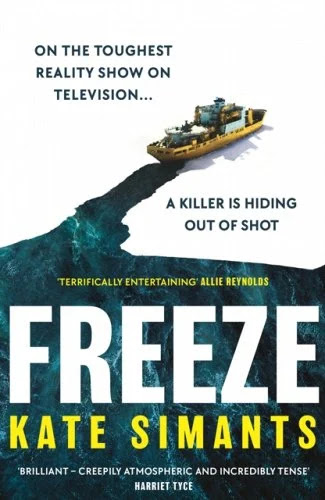
When the Locked-room Itself Wants to Kill You. by Kate Simants


It was a kind of masochism in a way, writing a locked-room thriller in the height of lockdown when the last thing I – and everyone else – really wanted was to be locked in. My third novel, Freeze, which is published by Viper on March 2nd, follows the cast and crew of Frozen Out, a reality TV show set in the Arctic. The fear of the threat from within the boat – the killer – is rivalled only by the threat from without – the endless wastes of ice, the sea, the frankly terrifying weather. But though that climate is many people’s idea of hell, I found it to be the escape I desperately needed. 

Heat, for a born goth like myself, has been a lifelong adversary. When the post-Christmas adverts break out, seemingly tapping in to our collective yearning for bikinis and baking sand, I look out the window and wish the frost would last forever. So when it came to looking for a location for my new book – a place which could double as an imagined escape while under Covid house arrest – somewhere very, very cold was the top of my list. 

Not that it’s anything new, of course. Locked-room mysteries – or more accurately, closed-circle mysteries, where the murderer must be among a very limited number of characters – are often set in less-than welcoming environments. Though I’d shy away from the well-worn cliché of the location of a novel being one of its characters, the backdrop of Arctic certainly did a lot of the heavy lifting when it came to manipulating the events of the book. Early in my research, I spoke to a handful of Arctic guides, who talked me through what Greenland would really be like for a group of inexperienced people like those in my fictional TV show. I knew I’d made the right choice when one source told me, ‘make no mistake – the Arctic wants you dead.’ Obviously I shamelessly stole that line and gave it to the character of Craig Nduka, Frozen Out’s Arctic expert, then built on that sense of innate hostility at every opportunity. 

Ally Reynolds, author of Shiver, says a similar thing of her choice of the French Alps for her acclaimed debut Shiver. Twenty years ago, she was a freestyle snowboarder, and spent her first winter season in Chamonix. ‘It was such a unique environment,’ she told me, ‘stunningly beautiful, yet also incredibly dangerous. The weather could change at short notice, bringing storms, heavy snowfall and avalanches that could cut off roads and villages. The terrain is full of crevasses and cliffs, meaning you are literally one step away from death a lot of the time, so it seemed a perfect setting.’

Writing a powerful thriller means keeping the sense of fear close to hand at all times, so choosing a location that has some menace built-in means your baseline level of fear is already pretty high. Emma Haughton, author of locked-room Antarctica thriller The Dark and, more recently The Sanctuary based in the Mexican desert, says a similar thing. 

In terms of research,’ she says, ‘it came down to making deep isolation plausible as possible to the reader. That was easy to do with Antarctica because people there are completely cut off during winter. I always feel you’ve got to maximize the obstacles that any location might bring for your characters, so [in The Sanctuary] I built in scenes that hung on dangers like heat stroke, thirst, snake bites, large spiders (ugh!) and so on.’ 

For me, it was the location for Freeze that took up the bulk of my research time. As a former investigative journalist I have a terror of misrepresentation, and without the chance to go to Greenland myself, I spent weeks and months meticulously reading around the place. I made life slightly easier for myself by using a boat as the base, and writing about a TV show: having lived on boats and worked in TV, these were things I could write about naturally. But the deep-dive I did into resources about the Arctic served a dual purpose: not only of making the setting authentic, but also of taking me away from the crushing tedium of being stuck at home -even if it was only in my mind. 

That said, it wasn’t until I’d finished the novel that I noticed how much Covid itself had informed my story. Without even realising it, Freeze was a reflection of the real-life horror-show that started in 2020: a claustrophobic world of enforced enclosure, while an even greater threat lurked outside. 

Freeze by Kate Simants published by Viper (Out Now) £14.99

The show is Tori Matsuka's baby. After years working her way up the ladder, she's finally launching her own production company with Frozen Out, and the late nights, the debts, the strain on her relationship will all be worthwhile. Everything is riding on the next twelve days. For camerawoman Dee, it's a chance to start again after the tragedy that tanked her undercover journalism career. Not even Tori, her oldest friend, knows the full truth of why Dee left her previous job, and she plans to keep it that way. But as errors and mishaps mount on set, tempers among the cast and crew start to fray. And when one of the contestants is found dead, only Dee realises the death wasn't natural - and from what she's seen from behind the camera, it won't be the last. As the Arctic ice closes in around them and all chance of escape is cut off, it becomes clear that although the world outside wants them dead, it's the secrets inside the ship that might cost them their lives.

More information about Kate Simants and her books can be found on her website. You an also follow her on Twitter @Kateboats and she can also be found on Facebook.


Extract from The Writing Retreat by Julia Bratz

 Chapter 5

The shout from the conductor startled me out of a half sleep.

We were approaching the station. The floppy-haired boy next to me was long gone, the car nearly empty. The train slowed with a juddering whine. A fuzzy, electronic voice repeated: “This is . . . [inaudible].”

If I’d been sleeping more deeply, I would’ve missed the stop alto- gether. Rushing to pull my suitcase from the rack, I found myself wait- ing behind the only other person disembarking. She was short, with blond hair spilling out the bottom of a bright orange ski cap. Could she be going to Roza’s too? The train steps were steep and both of us stum- bled, righting ourselves on the pavement. Outside, the wind slapped our faces. She turned and squinted at me.

“Are you by any chance going to Roza Vallo’s?” Her words were fast and choppy, like she was rushing to get them out before she sprinted away.

“I am!” I’d managed to remain somewhat calm on the train, but now excitement and fear lit up my entire body. I stuck out my hand. “I’m Alex.”

“Poppy.” Her little hand squeezed surprisingly hard. “Oh my god, are you just like dying?”

I laughed at her openness. Her animated face and Valley girl intonation were so different from what I would’ve expected at a Roza Vallo retreat.

Yes, absolutely.” I grinned. “I can’t believe it’s actually happening.” “Girl, me neither!” Her warm brown eyes widened. “I’ve been driving everyone I know nuts. I’ve just been freaking out about it. Oh should we find the car? It's probably down there.” She continued to chatter as we crossed the icy terrain, across the platform and down the stairs. Below, in the small lot, a black car waited, steam rising from the tailpipe.

“Oh thank Jesus. I’m so effing cold.” She beelined for the car and I hurried to keep up. A man climbed out as we neared.

“Afternoon, ladies.” He had a flat upstate accent and a full, white- flecked beard. We greeted him and jumped into the back of the car.

In- side, it was deliciously warm and smelled like fake vanilla. An air freshener shaped like a cookie hung from the rear view mirror, along with a rosary.

“I’m Joe,” he called.

“Hi, Joe. I’m Poppy. This is Alex.” She grinned at me, eyes crinkling. There were faint lines around her eyes and mouth; I had the feeling that she smiled a lot.

“Poppy! Haven’t heard that name before.” Joe pulled smoothly out of the lot.

“It’s Scottish.” She shrugged.

“Scotland, huh?” Joe said. “I’ve always wanted to go there.”

“It’s great. Really violent, though. People are constantly getting into fights. Once I saw two men walk out of a church and punch each other.”

Joe and I laughed and Poppy leaned back, pleased. “Do you work for Roza, Joe?”

“Sometimes. Not directly. I just work for the cab service up here.” He glanced back at us in his rearview mirror.

“You from here?” I asked.

“Born and raised.” He dipped his head. “It’s a nice area. Pretty isolated, though. Guessing that’s why Ms. Vallo likes it.”

“Have you interacted a lot with her?” Poppy asked.

“Nah, she keeps to herself when she’s here. Her staff—I think her name’s Yana, the one who calls—they set up the transportation when people come in from the city.”

“How long has she been up here?” Poppy leaned forward, grabbing onto the back of his seat with pink-painted nails. She was definitely trying to get some kind of inside scoop.

“I think she bought the estate in 2000? Took a few years for her to fix it up. The place had really gone to shit.” He coughed. “Pardon my French.”

Poppy noticed me watching her. “I’m super obsessed with Roza.” She rolled her eyes. “And Blackbriar. I’m such a sucker for haunted houses.”

“Oh, yeah. I totally get it.” For the past few weeks I’d been focusing so much on the reality of spending a month with Roza and Wren that I hadn’t even thought about the estate. Of course, I knew all about it. After I’d read Devil’s Tongue at twelve, I’d done a deep dive into Roza on a library computer the first week of school. She’d fixed up Black- briar just a few years before then, and several magazines and papers had covered the transformation. It only made sense that one of her houses was the site of unsolved murders.

"You know the story, right?' Poppy asked me. "Of course. Daphne and Horace'.

“And Lamia.” She grinned like I’d passed a test. But anyone who was more than a casual fan of Roza’s knew the story, which was itself like something out of one of her novels.

Oil baron Horace Hamilton built Blackbriar Estate in the late  nine- teenth century. A lifelong bachelor, he fell for waitress in town, Daphne Wolfe. 

Daphne caused a stir, first by her much younger status, then when she started séance  group. The spiritualist community at that time considered Daphne a powerful channeler, initially through automatic writings, then drawings and paintings. The trouble started when Daphne claimed to have connected with a powerful female demoness named Lamia. Daphne told her group that Lamia wanted to channel a “great commission” through her art.

The others in the group became disturbed by Lamia and left. Horace forbade Daphne to welcome a dark spirit into the house. After a huge snowstorm, the staff returned to find Daphne and Horace dead. Horace had been eviscerated in bed. And Daphne was in the basement, her body burned beyond recognition.

Most assumed that Daphne, caught in the throes of a psychotic break, had killed Horace in his sleep and then lit herself on fire. But, mysteriously, the rest of the basement was completely untouched, including three completed paintings nearby.

“So you grew up here,” Poppy said. “You heard all the stories about Blackbriar?”

“Oh, sure.” He chuckled. “We used to dare each other to spend a night inside. The doors were locked but people went in through a bro- ken window in the back.”

“Oh my god. You stayed there?” Poppy’s eyes sparkled with interest.

“Nope, not me. I was way too scared.” He considered. “My cousin did once. He ended up falling down the basement stairs and breaking his ankle. Everyone said it was the curse.”

“The curse?” I repeated.

“That female demon, whatever her name was. People said she’s still there.” He cleared his throat. “You couldn’t pay meto stay there, to be honest. I don’t know if I believe in demons or whatever, but there’s definitely some odd energy in that house.”

“Uh-oh.” Poppy sounded gleeful. “I guess we’ll have to let you know.”

The houses and buildings abated and eventually we were surrounded by unending woods. I used the time for some deep breathing. Every mile we were getting closer and closer. Every minute that passed meant one fewer minute before seeing Roza—which was overwhelmingly exciting— and Wren—incredibly horrifying. It was so strange to balance the two, and they both revved up my system, causing a fluttering in my chest.

“The cell service is cutting out,” Poppy announced. “Is that normal?” “Unfortunately, yes.” He glanced back at us. “Real spotty up here.” The undulating line of woods opened up briefly to showcase several long gray buildings. figure stood at the mailbox by the road—a woman whose strands of loose gray hair flew out from beneath a furry hunter’s cap. I nudged Poppy and she looked over. The woman raised a hand, her

plain face solemn but kind.

Poppy waved cheerfully back. “Who’s that?”

“That’s a nun, believe it or not,” Joe said. “That nunnery’s been there for two hundred years.”

“I love it!” Poppy watched out the back window. “How many live there?”

“There are only about ten of them now, I think. Ten nuns in that big place. But they live here all year round. Have a few cows and chickens. Make some real tasty jams that they sell out by the road sometimes.”

“Aww, that’s cute.” Poppy returned to her phone.

“They’re pretty cut off from the world, aren’t they?” I asked. “They have interns in the summer.” Joe’s dark eyes alighted on mine

in the rear view mirror. “College kids who help out with the gardens. But in the winter they’re alone, far as I know.” He cleared his throat. “They’re actually the closest people to Blackbriar.”

“How far are we?” A new flush of excitement and fear filled my chest.

“Not far. About fifteen miles.”

“Whoa.” Poppy glanced at me. “So we’re going to be super isolated.” “Pretty much,” Joe said. “Especially if there’s big storms. Last winter the people who live out here got snowed in twice.”

“So when you say ‘snowed in,’ what does that mean, exactly?” Poppy asked.

“Well, it didn’t used to be this bad. Maybe a few snowfalls here and there. But last year and the year before, there were some big storms. It took a few days for the snowplows to come all the way out. Until then, they were stuck.”

“Yikes.” Poppy bit her lip. “What if the power goes out?”

“Most places have backup generators. Don’t worry. I’m sure the house has a couple.”

We moved on to happier topics, and ten minutes later, we slowed to turn onto a bumpy gravel path. We’re here.Every cell in my body crack- led with new energy.

“Is this it?” I tried to sound calm. “Sure is,” Joe responded.

Breathe. Breathe. Breathe.

“Oh my god.” Poppy’s hand shot out and found mine. Hers was bony and cold, a skeleton’s grip. We wound through a long, curving path with some potholes that made us fly up in our seats. Poppy giggled nervously. “You’d think a millionaire would fix her driveway,” Joe muttered.

As if in answer, the gravel turned into cement, and we smoothly transitioned out of the trees to an open space.

Of course I’d seen pictures, but in real life it was even more impressive than I’d expected. The Victorian fortress towered over us, magnificent and proud. The doorway was flanked by two turrets, and snow-cloaked ivy climbed up the gray stone walls. There were so many windows, all milky white with the pale setting sun. It unsettled me, like looking at eyes rolled up into a head.

“Wow,” Poppy breathed.

“Beautiful, huh?” Joe sounded proud, as if taking ownership in the sight.

My unease faded, and now I felt only joy. This was it. This was Roza Vallo’s mansion. 

This was real. This was happening. I quivered with anticipation as we pulled into the circular drive and stopped at the front steps.

“Well, girls, this is our stop.” Joe opened his door and the cold swept into the warm space. Poppy was still staring at the house. "Ready?" I asked.

She turned and there was a peculiar look—uncertainty? apprehension?—on her face.

But then she smiled. “Yeah! Let’s do it.”

Joe had already taken both our suitcases from the trunk, and now he rubbed his gloved hands, as if eager to go.

“Oh, wait, can I—should we give you a—” I plunged my hand into my purse.

“No need, it’s all taken care of.” It was strange seeing Joe head-on after the forty-five minutes in the car. He was similarly taking stock of me, his expression serious. “You two be careful, okay?” He reached out and I shook his hand.

“Thank you, Joe! You’re the best!” Poppy cried, wheeling her suit- case to the front steps. I followed, glancing back to see Joe already pulling around the drive.

“Okay, girl.” Poppy grinned, her hand hovering over the circular doorbell. “Ready?”

For a second, I couldn’t breathe, but I nodded, and Poppy pushed. A deep thrum came from the house, like a purr or a growl. My fingers tightened on my suitcase’s handle as the door slowly creaked open.

The Writing Retreat by Julia Bratz, (Magpie / Oneworld Publication) Out Now

A book deal to die for. Five attendees are selected for a month-long writing retreat at the remote estate of Roza Vallo, the controversial high priestess of feminist horror. Alex, a struggling writer, is thrilled. Upon arrival, they discover they must complete an entire novel from scratch, and the best one will receive a seven-figure publishing deal. Alex’s long-extinguished dream now seems within reach. But then the women begin to die.

Trapped, terrified yet still desperately writing, it is clear there is more than a publishing deal at stake at Blackbriar Estate. Alex must confront her own demons – and finish her novel – to save herself.

Julia Bratz can be found on Twitter and Instagram @juliabratz