Showing posts with label Garry Disher. Show all posts

Wednesday, 19 November 2025

Forthcoming books from Profile Books (Including Viper)

 January 2026

Vivian Dies Again is by C E Hulse. Time heals all wounds. Except blunt force trauma. Vivian Slade is a cautionary tale. The wrong side of thirty, she's no longer the life and soul of the party - she's a party of one. But she's determined to turn over a new leaf, even if that means going to a family gathering where everyone hates her. Turns out, someone really hates her - enough to push her off a balcony to a very messy end. But then Vivian wakes up! Only to be murdered again. And again. Stuck in a baffling time loop, Vivian's only ally is a sleep-deprived waiter who just wants to finish his shift. Will Vivian be able to solve her own murder? Only time will tell...

February 2026

The Nowhere Children are expecting you... High in the mountains sits Nowhere, a verdant valley surrounded by walls of rock. People have lived at Nowhere for centuries, though never for long, and rarely happily. Its last owner was its most famous: movie star Leaf Winham, who built Nowhere House as a refuge to hide from his fame... and to hide his crimes. Only when Nowhere House went up in flames were the graves discovered, the last resting places of lost young men who would never go home. Years later, Nowhere valley has become a sanctuary for runaway children, a place where adults cannot enter. Drawn by this promise, fourteen-year-old Riley pulls her brother Oliver from his bed in the middle of the night, hoping to find a new family. But the Nowhere Children are fierce in defending their valley and their secrets. For something dark lives in the ruins of Nowhere House, something that asks a terrible price for sanctuary.. Nowhere Burning is by Catriona Ward.

Mischance Creek is by Garry Disher. A deadly drought. A broken town. It's the worst drought in a generation, and the people of Senior Constable Paul Hirschhausen's vast outback beat are suffering. Foreclosures. Failing businesses. Petty quarrels that are spiralling out of control. So when a naive tourist runs into a ditch beyond the ruins of Mischance Creek, Hirsch is relieved to step away from Tiverton. But Annika Nordrum asks for more than just roadside assistance. Her father's body was found at the bottom of a mineshaft seven years ago - his death ruled an accident - and her mother hasn't been seen since. Can Hirsch close this cold case before the town reaches breaking point?

Inspector Jian and his daughter Weiwei just want to go back to their home in China: but Jian is facing a corruption charge in his absence and risks arrest. Instead he tries to scrape a living on London's meanest streets as an illegal immigrant, reduced to hustling Mah Jiang for cash. A bleak future looks to be growing bleaker still when a triad gang blackmail him into tracking down an unlikely young robber. In No Exit Jian and Weiwei scramble between London's grimiest bedsits and its swankiest penthouses as they penetrate the glittering world of 'princelings' - the rich children of the Chinese elite, who treat the city as their playground. Locked in a desperate struggle, with no way out in sight, It will take all their wiles, as well as some lucky gambles, to come out of this latest venture alive. No Exit is by Simon Lewis.

March 2026

Intelligence is by Robert Newman. Was he about to recruit her into the secret service? She held her breath. Frogwoman, codebreaker, assassin, saboteur - whatever it was, she'd do it!  Oxford, 1938. Ida and Medora are two brilliant young philosophers at the heart of a group who gather in storied rooms to dance, drink and debate theories of right and wrong. But as the world spins towards war, theoretical questions of life and death become all too real. While her friends are called up to do intelligence work, Ida, the irrepressible Texan outsider, seeks academic distraction. Then she stumbles across secret Nazi information that could radically change the direction of the war. Can she and Medora capture the attention of the spymasters and mandarins in London on time to save lives.


'You are quite the chameleon, aren't you? You could wear anything, do anything, and yet you choose plain, plain, plain. Is it all a front for a secret life?' Anna Harris knows how to blend in, to be whoever she has to be to get by. But somehow she has ended up in a quaint, sleepy village, swallowed into the lives of her boyfriend and in-laws. She's not unhappy, but this isn't the life she remembers choosing. When vivacious Sofia Carstairs moves to the village, Anna is reminded of the freedom she once had. She used to be carefree and rebellious. But is she willing to throw away her future for some fun? Perhaps leading two lives is more enticing than one. After all, Anna's not a bad person. She just wants to try it out...The Artful Anna Harris is by Tracy Maton.

May 2026

The Hollow Boys is by Tariq Ashkanani. Two children lost. The wrong one found. It's a warm evening in September when nine-year-old Danny Yates comes back from the dead. He walks into town half-starved and silent, ten months after he and his best friend Will Keefe were presumed drowned. And when Danny does finally speak, he swears that he's not Danny. He's Will. Danny's mother is convinced that her boy has come back wrong. More than that, she thinks the town itself is now at risk from whatever dark force returned her son. Chief of Police John Deacon is more interested in how the sinister disappearance of two boys could have been written off as a tragic accident, and who was responsible. What happened to Danny to make him take on his friend's name, his personality? And does Danny's return mean there's a chance that Will is still alive?

June 2026

North Dakota, 1970s. Renee 'Cash' Blackbear, a nineteen-year old Ojibwe woman spends her days playing pool, drinking beer and driving trucks for the local wheat farmers. When the body of the Ojibwe man is found in a field just outside of time, Sheriff Wheaton – Cash's guardian and only friend – and asks for her help. For Cash has an intuitive nature , and she knows that the answers will be found on the Red Lake Reservation. But navigating local racial tensions brings its own dangers, and soon Cash isn't only searching for justice: she is fighting for her life. Murder on the Red River is by cMarcie R. Rendon.


Saturday, 16 August 2025

Shortlists for further Ned Kelly Awards announced


The Australian Crime Writers Association announced the shortlists for the 2025 Ned Kelly Awards for the Best International Crime Fiction, Best True Crime but also Best Crime Fiction.

Best International Crime Fiction Nominees

Return to Blood, by Michael Bennett (Simon & Schuster UK)

Leave the Girls Behind, by Jacqueline Bublitz (Allen & Unwin)

The Waiting, by Michael Connelly (Allen & Unwin)

A Case of Matricide, by Graeme Macrae Burnet (Text)

Moscow X, by David McCloskey (Swift Press)

Home Truths, by Charity Norman (Allen & Unwin)


Best True Crime Nominees

They’ll Never Hold Me, by Michael Adams (Affirm Press)

A Thousand Miles from Care, by Steve Johnson (William Collins)

The Kingpin and the Crooked Cop, by Neil Mercer (Allen & Unwin)\

Meadow’s Law, by Quentin McDermott (HarperCollins)

The Lasting Harm, by Lucia Osborne-Crowley (HarperCollins)


Best Crime Fiction Nominees

Shadow City, by Natalie Conner

Sanctuary, by Garry Disher

Unbury the Dead, by Fiona Hardy

The Creeper, by Margaret Hickey

Cold Truth, by Ashley Kalagian Blunt

Highway 13, by Fiona McFarlane

17 Years Later, by J.P. Pomare

Storm Child, by Michael Robotham


Thursday, 29 May 2025

2025 CWA Daggers Shortlist announced


The 2025 shortlist for the prestigious Crime Writers’ Association (CWA) Dagger awards, which honour the very best in the crime-writing genre, are announced.

Created in 1955, the world-famous CWA Daggers are the oldest awards in the genre and have been synonymous with quality crime writing for over half a century.

The prestigious KAA Gold Dagger, sponsored by Kevin Anderson & Associates, is awarded for the best crime novel of the year

The shortlist includes the debut novel from Bonnie Burke-Patel’s Died at Fallow Hall, up against established authors in the genre, including RJ Ellory with The Bell Tower, Tana French’s The Hunter, and Attica Locke’s Guide Me Home.

It also features two historical crime books with D.V. Bishop’s A Divine Fury, and Anna Mazzola’s The Book of Secrets.

The Ian Fleming Steel Dagger, sponsored by Ian Fleming Publications Ltd, showcases the thriller of the year.

The shortlist sees Lou Berne’s masterful thriller, Dark Ride, up against previous winner of the Steel Dagger, MW Craven, with Nobody’s Hero. Also making the list are Garry Disher with Sanctuary, Abir Mukherjee’s Hunted, Stuart Neville with Blood Like Mine and the iconic American author, Don Winslow with City in Ruins.

The much-anticipated ILP John Creasey First Novel Dagger highlights the best debut novels.

Among the rising stars of 2025 is the debut set in the shadow of the Yorkshire Ripper, Katy Massey’s All of Us Are Sinners. Jessica Bull’s Miss Austen Investigates, Justine Champine’s Knife River, Anders Lustgarten’s Three Burials are also contenders alongside Gay Marris with A Curtain Twitcher's Book of Murder and Marie Tierney with Deadly Animals.

The Historical Dagger, sponsored by Morgan Witzel in memory of Dr Marilyn Livingstone.

Two novels feature on both the Gold and the Historical Dagger shortlist. DV Bishop’s A Divine Fury is the fourth in the Cesare Aldo series featuring a sixteenth century detective in Florence, and Anna Mazzola’s The Book of Secrets set in 17th century Italy. 

The shortlist also includes Chris Lloyd: Banquet of Beggars, Clare Whitfield with Poor Girls, and A.J. West, The Betrayal of Thomas True which is set in a London underworld in the year 1710.

Nadine Matheson, Chair of the CWA, said: “Congratulations to everyone who has been shortlisted for these prestigious awards. It’s not only a joy but it’s inspiring to see such a rich variety of stories and voices being celebrated. The 2025 CWA Daggers shortlist is a true reflection of the growing strength of crime writing today. The contributed work of every shortlisted writer is shaping the future of the genre, and their work reminds us why we fell in love with these stories in the first place.

The Crime Fiction in Translation Dagger, sponsored in honour of Dolores Jakubowski, features the smash-hit, Waterstones Book of the Month, Butter by Asako Yuzuki, translated by Polly Barton.  The queer debut gangland thriller The Night of Baba Yaga from Japan’s Akira Otani also makes the shortlist shortly after winning the 2025 CrimeFest Debut Crime Novel of the Year, sponsored by Specsavers.

The ALCS Gold Dagger for Non-Fiction includes a giant of the genre with John Grisham and Jim McCloskey’s Framed, which looks at ten wrongful convictions, and Kate Summerscale’s retelling of the Christie murders, The Peepshow: The Murders at 10 Rillington Place.

The CWA Daggers are one of the few high-profile awards that honour the short story.

This year sees multiple bestselling names from the genre up for the award including Janice Hallett, and Ruth Ware, up against lesser established names such as the academic and expert on Agatha Christie, J.C Bernthal, with the short story, A Date on Yarmouth Pier.

The Best Crime and Mystery Publisher of the Year Dagger, which celebrates publishers and imprints demonstrating excellence and diversity in crime writing, pits independent publisher Bitter Lemon Press against Faber, Orenda, Pan Macmillan, and Simon & Schuster. 

2025 sees the announcement of two new CWA Dagger Awards. The Twisted Dagger celebrates psychological thrillers and dark and twisty tales that often feature unreliable narrators, disturbed emotions, a healthy dose of moral ambiguity, and a sting in the tail. 

Shortlisted titles include Beautiful People by Amanda Jennings, Catherine Steadman’s Look in the Mirror, and Nightwatching by Tracy Sierra.

The Whodunnit Dagger celebrates books that focus on the intellectual challenge at the heart of a good mystery. Books in this category include cosy crime, traditional crime, and Golden Age-inspired mysteries. Amongst the six shortlisted authors are Lisa Hall with The Case of the Singer and the Showgirl and Laura Marshall with A Good Place to Hide a Body.

The Dagger in the Library nominee longlist is voted by librarians and library users, chosen for the author’s body of work and support of libraries. 

This year’s sees established names including the bestselling phenomenon Richard Osman, the acclaimed Kate Atkinson, JK Rowling’s crime alter-ego Robert Galbraith, the award-winning mystery author Janice Hallett, bestseller Lisa Jewell and author of sixty historical crime novels, Edward Marston.

The Emerging Author Dagger, which has been going for over 20 years, celebrates aspiring crime novelists and is sponsored by Fiction Feedback, also welcomes six new upcoming authors.

The competition is open to unpublished authors, and is judged on the best opening for an unpublished crime novel. The winner will gain the attention of leading agents and top editors; over two dozen past winners and shortlisted Debut Dagger authors have signed publishing deals to date.

The CWA Diamond Dagger, awarded to an author whose crime-writing career has been marked by sustained excellence, is announced in early spring and in 2025 was awarded to Mick Herron.

The winners will be announced at the award ceremony at the CWA gala dinner on 3 July.

 The Shortlist in Full:

KAA GOLD DAGGER

A Divine Fury by D V Bishop (Macmillan)

The Bell Tower by R J Ellory (Orion)

The Hunter by Tana French (Penguin Books Ltd)

Guide Me Home by Attica Locke (Profile Books Ltd)

 Book of Secrets byAnna Mazzola (Orion)

I Died at Fallow Hall by Bonnie Burke-Patel (Bedford Square Publishers)


IAN FLEMING STEEL DAGGER


Dark Ride by Lou Berney (Hemlock Press/ HarperCollins)

Nobody's Hero by M W Craven (Constable/Little Brown, Hachette)

Sanctuary by Garry Disher (Viper/Profile Books)

Hunted by Abir Mukherjee (Harvill & Secker/ Penguin Random House)

Blood Like Mine by Stuart Neville (Simon & Schuster)

City in Ruins by Don Winslow (Hemlock Press/HarperCollins)


ILP JOHN CREASEY (NEW BLOOD) DAGGER

Miss Austen Investigates by Jessica Bull (Penguin Random House/ Michael Joseph)

Knife River by Justine Champine (Bonnier Books UK/ Manilla Press)

Three Burials by Anders Lustgarten (Penguin Random House/ Hamish Hamilton) 

A Curtain Twitcher's Book of Murder by Gay Marris (Bedford Square Publishers)         

All Us Sinners by Katy Massey (Little, Brown /Sphere)

Deadly Animals by Marie Tierney (Bonnier Books UK/ Zaffre)

 HISTORICAL DAGGER

A Divine Fury by D.V. Bishop (Macmillan)

Banquet of Beggars by Chris Lloyd (Orion Fiction/Orion Publishing)

The Book of Secrets by Anna Mazzola (Orion Fiction/Orion Publishing)

The Betrayal of Thomas True by A.J. West  (Orenda Books)

Poor Girls by Clare Whitfield (Aries / Head of Zeus)


CRIME FICTION IN TRANSLATION DAGGER

Dogs and Wolves by Hervé Le Corre (Europa Editions UK) tr. Howard Curtis

Going to the Dogs by Pierre Lemaitre (Maclehose Press) tr. Frank Wynne

The Night of Baby Yaga by Akira Otani (Faber & Faber) tr. Sam Bett

The Clues in the Fjord by Satu Rämö (Zaffre) tr.  Kristian London  

Butter by Asako Yuzuki (4th Estate) tr. Polly Barton

Clean by Alia Trabucco Zerán (4th Estate) tr. Sophie Hughes


ALCS GOLD DAGGER FOR NON-FICTION 

Unmasking Lucy Letby by Jonathan Coffey & Judith Moritz (Seven Dials)   

The Lady in the Lake by Jeremy Craddock (Mirror Books)   

Framed by John Grisham & Jim McCloskey (Hodder & Stoughton)  

The Criminal Mind by Duncan Harding (PRH/Michael Joseph)   

Four Shots in the Night by Henry Hemming (Quercus)   

The Peepshow: The Murders at 10 Rillington Place by Kate Summerscale (Bloomsbury Circus)   

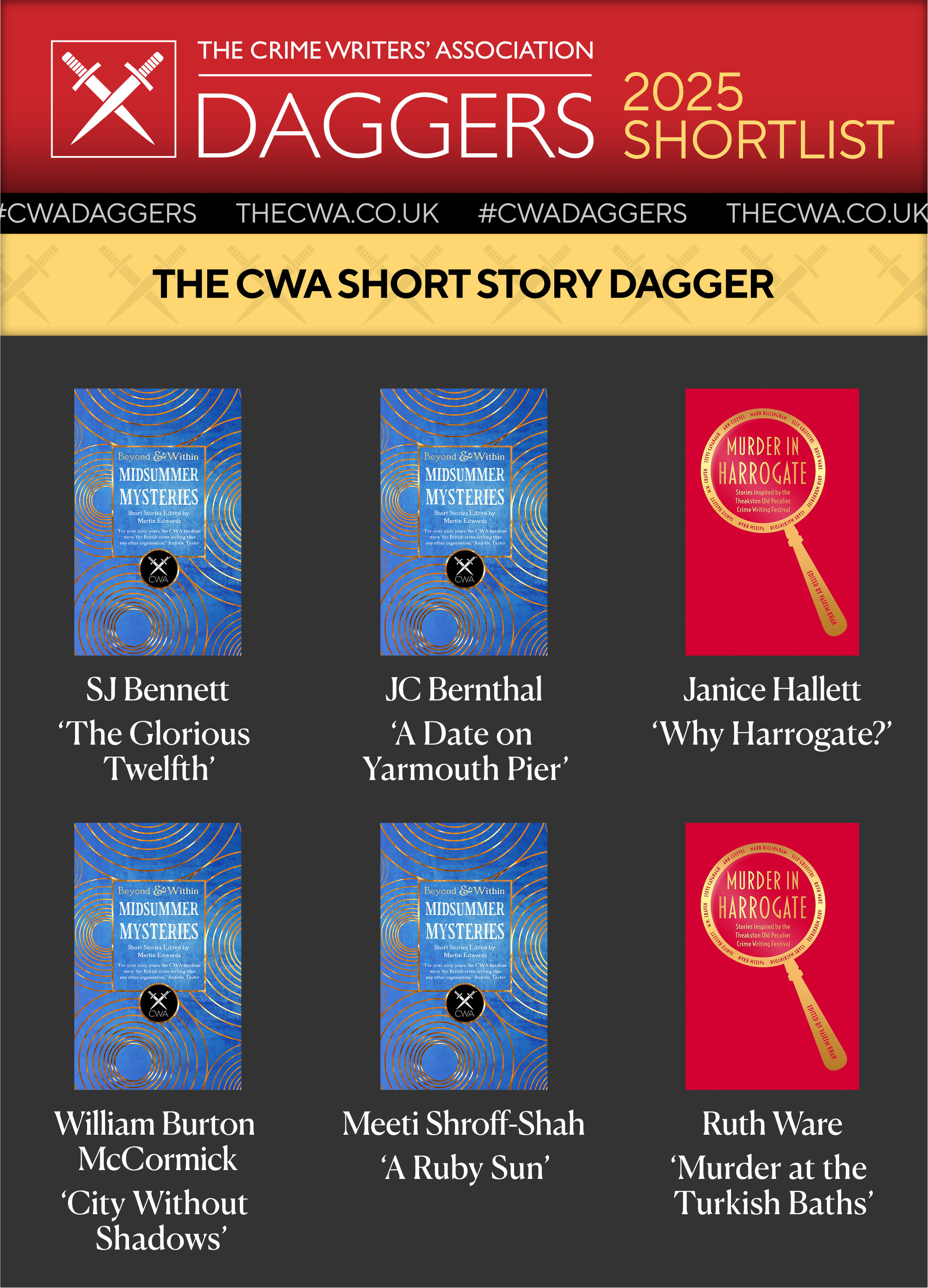
SHORT STORY DAGGER


The Glorious Twelfth’ by S.J Bennett: in Midsummer Mysteries edited by Martin Edwards (Flame Tree Publishing/Flame Tree Collections)

A Date on Yarmouth Pier’ by J.C Bernthal in Midsummer Mysteries edited by Martin Edwards (Flame Tree Publishing/Flame Tree Collections)

'Why Harrogate?’ by Janice Hallett in Murder in Harrogate edited by Vaseem Khan (Orion Publishing Group/Orion Fiction)

City Without Shadows’ by William Burton McCormick in Midsummer Mysteries edited by Martin Edwards (Flame Tree Publishing/Flame Tree Collections)

‘A Ruby Sun’ by Meeti Shroff-Shah in Midsummer Mysteries edited by Martin Edwards (Flame Tree Publishing/Flame Tree Collections)

‘Murder at the Turkish Baths’by Ruth Ware in Murder in Harrogate edited by Vaseem Khan, (Orion Publishing Group/ Orion Fiction)


WHODUNNIT DAGGER

 A Death in Diamonds by SJ Bennett, (Bonnier Books UK, Zaffre)

 Murder at the Christmas Emporium by Andreina Cordani,(Bonnier Books UK, Zaffre)

 The Case of the Singer and the Showgirl by Lisa Hall, (Hera Hera)

A Good Place to Hide a Body by Laura Marshall, (Hodder & Stoughton )

 A Matrimonial Murder by Meeti Shroff-Shah, (Joffe Books)

Murder at the Matinee, by Jamie West, (Brabinger Publishing)

TWISTED DAGGER

Emma, Disappeared by Andrew Hughes (Hachette Books Ireland)

Beautiful People by Amanda Jennings (HarperCollins/ HQ FICTION)

The Stranger In Her House by John Marrs (Amazon Publishing/ Thomas & Mercer)

The Trials Of Marjorie Crowe by CS Robertson (Hodder & Stoughton)              

 Nightwatching by Tracy Sierra: (PRH/ Viking)

Look In The Mirror by Catherine Steadman (Quercus)           

DAGGER IN THE LIBRARY


Kate Atkinson

Robert Galbraith

Janice Hallett

Lisa Jewell

Edward Marston

Richard Osman


PUBLISHERS’ DAGGER

Bitter Lemon Press

Faber & Faber

Orenda Books

Pan Macmillan

Simon & Schuster


EMERGING AUTHOR DAGGER

Bahadur Is My Name by Loftus Brown, 

Funeral Games by Shannon Chamberlain

 Soho Love, Soho Blood by Hywel Davies

Ashland by Joe Eurell

 The Fifth by Shannon Falkson,

Murder Under Wraps by Catherine Lovering, 


Saturday, 8 April 2023

Forthcoming books from Profile Books (Incl Serpent's Tail and Viper Books)

 July 2023

Sanderson's Isle is by James Clarke. 1969. Thomas Speake comes to London to look for his father but finds Sanderson instead, a larger-than-life TV presenter who hosts 'midweek madness' parties where the punch is spiked with acid. There Speake meets Marnie and promises to help her find her adoptive child, who has been taken by her birth mother to live off-grid in a hippie commune in the Lake District. Forced to lie low after a violent accident, Speake joins Sanderson on a tour of the Lake District, where he's researching a book to accompany his popular TV series, Sanderson's Isle. Fascinated by local rumours about the hippies, Sanderson joins the search for their whereabouts. Amid the fierce beauty of the mountains, the cult is forming the kind of community that Speake - a drifter who belongs nowhere - is desperate to find but has been sent to betray.

Elliott has never thought of himself as a hero. Until one dark night he meets Rebecca, a scared and vulnerable young woman who needs his help. There's a man harassing her, following her; would he mind pretending to be her boyfriend, just while she walks home, to put him off? And that is that - just a favour for a stranger - until there is a knock at Elliott's door. It's the man who was following Rebecca. He claims he's her ex-boyfriend, but it's clear that he's been stalking her. He's obsessed, dangerously so. He wants Rebecca, and will do anything to have her. When Elliott eventually tries to tell him the truth, the man doesn't believe him. The only way to save himself is to get Rebecca to explain. There's just one problem: Rebecca is nowhere to be found. And now it looks like one good deed will cost Elliott everything. One Good Deed is by David Jackson.

August 2023

When hate runs deep the innocent suffer. Constable Paul Hirschausen's rural beat in the low hills of South Australia is wide. Daybreak to day's end, dirt roads and dust. Every problem that besets small towns and isolated properties, from unlicensed driving to arson. But now, just as Hirsch has begun to feel he knows the fragile communities under his care, the isolation and fear of the pandemic have warped them into something angry and unrecognisable. Hirsch is seeing stresses heightened and social divisions cracking wide open. His own tolerance under strain; people getting close to the edge. Today he's driving an international visitor around: Janne Van Sant, whose backpacker son went missing while the borders were closed. They're checking out his last photo site, his last employer. A feeling that the stories don't quite add up. Then a call comes in: a roadside fire. Nothing much - a suitcase soaked in diesel and set alight - but two noteworthy facts emerge. Janne knows more than Hirsch about forensic evidence. And the body in the suitcase is not her son's. Day's End is by Garry Disher.

I have a gift. I see people as ghosts before they die. Of course, it helps that I'm the one killing them. The night after her father's funeral, Claire meets Lucas in a bar. Lucas doesn't know it, but it's not a chance meeting. One thoughtless mistyped email has put him in the crosshairs of an extremely put-out serial killer. But before they make eye contact, before Claire lets him buy her a drink, even before she takes him home and carves him up into little pieces, something about that night is very wrong. Because someone is watching Claire. Someone who is about to discover her murderous little hobby. The thing is, it's not sensible to tangle with a part-time serial killer, even one who is distracted by attending a weekly bereavement support group and trying to get her art career off the ground. Let the games begin... You'd Look Better as a Ghost is by Joanna Wallace. 

October 2023

Secrecy came naturally to John le Carre, and there were some secrets that he fought fiercely to keep. Adam Sisman's definitive biography, published in 2015, provided a revealing portrait of this fascinating man; yet some aspects of his subject remained hidden. Nowhere was this more so than in his private life. Apparently content in his marriage, the novelist conducted a string of love affairs over five decades. To these relationships he brought much of the tradecraft that he had learned as a spy - cover stories, cut-outs and dead letter boxes. These clandestine operations brought an element of danger to his life, but they also meant deceiving those closest to him. Small wonder that betrayal became a running theme in his work. In trying to manage his biography, the novelist engaged in a succession of skirmishes with his biographer. While he could control what Sisman wrote about him in his lifetime, he accepted that the truth would eventually become known. Following his death in 2020, what had been withheld can now be revealed. The Secret Life of John le Carre by Adam Sisman reveals a hitherto-hidden perspective on the life and work of the spy-turned-author and a fascinating meditation on the complex relationship between biographer and subject. 'Now that he is dead,' Sisman writes, 'we can know him better.'

Scarlet Town is by Leonora Nattrass. A rigged election. A feuding Cornish town. A suspicious death. And a perspicacious pig. Disgraced former Foreign Office clerk Laurence Jago and his larger-than-life employer the journalist William Philpott have escaped America - and Philpott's many creditors - by the skin of their teeth. They return to Laurence's home town of Helston in Cornwall in the hope of rest and recuperation, but instead find themselves in the middle of a tumultuous election that has the inhabitants of the town at one another's throats. Only two men may vote in this rotten borough, and when one of them dies in suspicious circumstances, Laurence is ordered to investigate on behalf of the town's political patron, his old master the Duke of Leeds. Then the second elector is poisoned and suspicion turns on the town doctor, the gentle Pythagoras Jago, Laurence's own cousin. Suddenly Laurence finds himself ensnared in generations of bad blood and petty rivalries, with his cousin's fate in his hands... 

One dead Santa. A town full of suspects. Will you discover the truth? Christmas in Lower Lockwood, and the Fairway Players are busy rehearsing their festive pantomime, Jack and the Beanstalk, to raise money for the church roof appeal. But despite the season, goodwill is distinctly lacking amongst the amateur dramatics enthusiasts. Sarah-Jane is fending off threats to her new position as Chair, the fibreglass beanstalk might be full of asbestos, and a someone is intent on ruining the panto even before the curtain goes up. Of course there's also the matter of the dead body. Who could possibly have had the victim on their naughty list? Join lawyers Femi and Charlotte as they read the round robins, examine the emails and pore over the police transcripts. Will the show go on? The Christmas Appeal is by Janice Hallett.

November 2023

No Exit is by Simon Lewis. Inspector Jian and his daughter Weiwei just want to go back to their home in China: but Jian is facing a corruption charge in his absence and risks arrest. Instead he tries to scrape a living on London's meanest streets as an illegal immigrant, reduced to hustling Mah Jiang for cash. A bleak future looks to be growing bleaker still when a triad gang blackmail him into tracking down an unlikely young robber. In No Exit Jian and Weiwei scramble between London's grimiest bedsits and its swankiest penthouses as they penetrate the glittering world of 'princelings' - the rich children of the Chinese elite, who treat the city as their playground. Locked in a desperate struggle, with no way out in sight, It will take all their wiles, as well as some lucky gambles, to come out of this latest venture alive.


Thursday, 26 August 2021

Ned Kelly Award Winners Announced


The winners of the 2021 awards were announced in an online presentation hosted by crime author Christian White. The complete shortlist can be found here.

The winners are 

Best Debut Crime Fiction 

The Second Son by Loraine Peck. 

Best True Crime 

Stalking Claremont by Bret Christian. 

Best International Crime Fiction

We Begin at the End by Chris Whitaker. 

Best Crime Fiction 

Consolation by Garry Disher.

Established in 1995, the Ned Kelly Awards are Australia’s oldest, most prestigious awards honouring crime fiction and true crime writing. The ACWA reported a record number of entries for the awards in their 26th year, with 149 entries, a 50% increase on previous years.

Congratulations to all the nominated authors and winners.

Thursday, 29 July 2021

2021 Ned Kelly Awards shortlist


The Australian Crime Writers Association (ACWA) have announced the shortlist for the 2021 Ned Kelly Awards. 

Best Crime Fiction

Consolation by Garry Disher (Text)

Gathering Dark by Candice Fox, (Penguin)

A Testament of Character by Sulari Gentill, (Pantera)

The Survivors by Jane Harper, (Pan)

The Good Turn by Dervla McTiernan, (HarperCollins)

Tell Me Lies by J P Pomare, (Hachette)

When She Was Good by Michael Robotham, (Hachette)

White Throat by Sarah Thornton, (Text)

Best Debut Crime Fiction

The Good Mother by Rae Cairns, (Bandrui Publishing)

The Second Son by Lorraine Peck, (Text)

The Bluffs by Kyle Perry, (PRH)

The Night Whistler by Greg Woodlands, (Text)

Best True Crime

The Husband Poisoner by Tanya Bretherton, (Hachette)

Stalking Claremont: Inside the hunt for a serial killer by Bret Christian, (HarperCollins)

Public Enemies by Mark Dapin, (A&U)

Hazelwood by Tom Doig, (Viking)

Witness by Louise Milligan, (Hachette)

Best International Cime Fiction

The Guest List by Lucy Foley, (HarperCollins)

The Secrets of Strangers by Charity Norman, (A&U)

Take Me Apart by Sara Sligar, (Text)

We Begin at the End by Chris Whittaker, (A&U)

Broken by Don Winslow, (HarperCollins).

Congratulations to all!

Established in 1995, the Ned Kelly Awards are Australia’s oldest, most prestigious awards honoring crime fiction and true crime writing.

For more information about the 2021 shortlists, go to the ACWA website.


Tuesday, 21 April 2020

SHOTS MAGAZINE Q&A WITH CRAIG SISTERSON, AUTHOR OF SOUTHERN CROSS CRIME


In the foreword to Southern Cross Crime, published this week in ebook and audiobook (paperback publication delayed until 24 September due to COVID-19), CWA Gold Dagger winner Michael Robotham calls the book “a long overdue guide to the very best in Australian and New Zealand crime fiction, film and TV drama, put together by one of the world’s most knowledgeable and respected reviewers and interviewers, Craig Sisterson”.


Sisterson is a lawyer turned features writer and crime fiction expert from New Zealand who currently lives in London. He writes for newspapers and magazines in several countries. In recent years he’s interviewed hundreds of crime writers and talked about the genre on national radio, top podcasts, and onstage at festivals on three continents. He’s been a judge of the McIlvanney Prize and Ned Kelly Awards and is founder of the Ngaio Marsh Awards and co-founder of Rotorua Noir. Southern Cross Crime (Oldcastle Books) is his first book.

What inspired you to write Southern Cross Crime?
It’s one of those projects that came together from a lot of threads over time, to the point where the book now seems (and several friends have said this to me) an inevitable outcome of a few different things I’d been doing over the years.

I’ve always loved mystery fiction, since I was a wee kid growing up in a small-town at the top of the South Island of New Zealand, devouring the Hardy Boys, Agatha Christie, and Sherlock Holmes. As a reader I love discovering new-to-me authors to enjoy, alongside old favourites, and as a reviewer and features writer I love shining a light on a diverse array of crime storytellers. Alongside some other crime fiction reviewers spread across the world, I used to participate in some ‘Global Reading Challenges’, and it was always fun to showcase some antipodean crime writers who’d become new discoveries for my overseas peers.

Some of the first author interviews I did for magazines, more than a decade ago, were with Australian and New Zealand crime writers, so for quite a while I’ve been aware of some really terrific antipodean storytellers, even if their books weren’t readily available in the UK and US at the time. In more recent years I’ve really enjoyed Barry Forshaw’s ‘Noir’ series of Pocket Essential guides to European, Nordic, British, and American crime fiction, and as the likes of Jane Harper’s The Dry began making a big mark globally and more and more Australian and New Zealand crime writers got published in the UK, I began to wonder if there might be a place for a similar guide to Australian and New Zealand crime writing.

Barry was very generous when I ran the idea past him back in 2018, and he even introduced me to his publisher and recommended that I be the person to write such a book.

The result is Southern Cross Crime.

What will crime fans find in the pages of Southern Cross Crime?
Like Barry’s books, it’s designed as a ‘readers guide’ to the crime fiction from my part of the world – mainly books but also some television and films. There are separate entries for around 250 authors, plus a few dozen TV shows and films. Other authors and books are listed at the end of various sections.

I’ve tried to write it in an accessible, magazine style, rather than an academic or encyclopaedic style, and there are doses of my own personality or writing style sprinkled throughout. Hopefully it will be an engaging and fun read for keen crime fiction fans, where they can dip in and out of it at their leisure to learn more about some authors they may already know, and discover many new-to-them storytellers too.

Along with the 300 or so storyteller and screen stories entries, I’ve also included a section in the book, ‘The Unusual Suspects’, of extended interviews with some of the leading figures of ‘Southern Cross Crime’. Unfortunately, we lost two legendary and influential Australian crime writers, Peter Corris and Peter Temple, the year I began working on the book. However, I’d interviewed Peter Corris several years ago for Good Reading magazine, so that feature is included in Southern Cross Crime, and thanks to Michael Robotham and the recollections of others I’ve also put together a special chapter about Peter Temple.

It wouldn’t have felt right to write this book and not highlight those two gentlemen.

What was a fun fact you uncovered during the research process for Southern Cross Crime?
Hmm… before writing the book I was already aware that the history of antipodean crime writing dated back to the earliest days of the detective fiction genre (in terms of novels and short stories). The bestselling detective novel of the 19th century wasn’t written by Wilkie Collins or Sir Arthur Conan Doyle, as many might think, but by a New Zealand lawyer who’d moved to Melbourne to further his dreams of becoming a playwright (Fergus Hume, The Mystery of a Hansom Cab). One of the earliest writers of police tales was Mary Fortune, who wrote dozens from the Australian goldfields in the 1860s. Thanks to the research of the likes of Lucy Sussex, I was already aware of these historic figures.

But what I didn’t know was that the very first Edgar Award given out by the Mystery Writers of America back in 1954, actually went to an Australian. Charlotte Jay (pen name of Adelaide writer Geraldine Halls) won for Beat Not the Bones, a psychological thriller about an Australian woman who travels to New Guinea to uncover the truth behind her husband’s death. Talking to award-winning crime writer Alan Carter recently about that book (he’d come across it during his PhD studies), he described it as “fantastic, radical and well ahead of its time… A vivid, often hallucinatory, gut-punching beautifully written book".

So, while we’re experiencing an antipodean crime wave in recent years, the currents certainly run long and deep back through the decades and centuries.

What were the most enjoyable things, and the most challenging things, about writing this type of ‘readers guide’ book
The most enjoyable thing was to get to swim in the waters of Australian and New Zealand crime for an extended period of time. By the time I began writing Southern Cross Crime I’d already reviewed a couple of hundred antipodean crime novels for various outlets, and interviewed dozens of authors, but there was still so much more to explore and enjoy.

While the likes of Ngaio Marsh, Jane Harper, Emma Viskic, Paul Cleave, Michael Robotham, Peter Temple, Vanda Symon, Adrian McKinty, Candice Fox, Liam McIlvanney, Stella Duffy, Garry Disher and others may be familiar to some British or American readers (having each been international bestsellers or won or been shortlisted for CWA Daggers, Edgars, and other prestigious writing prizes in the northern hemisphere), they’re merely the crest of our antipodean crime wave. So, I really loved reading and writing about a huge range of other Australian and New Zealand crime writers. It was like a trip back home, between the pages.

I also really enjoyed interviewing the likes of Garry Disher and Candice Fox, and Lindy Cameron of Sisters in Crime Australia, for ‘The Unusual Suspects’ section of Southern Cross Crime, adding to the authors I’d already interviewed over the years for various features.

The most challenging thing? Apart from the slog that is writing, re-writing and editing a project of this size (enjoyable and frustrating in equal measure), the toughest thing was probably settling on who got included and who didn’t. You might think that 300 entries would be plenty, but the health of modern Australian and New Zealand crime writing is such that dozens of interesting authors have still been left out. That was tough, drawing the line while trying to showcase a wide variety of styles, settings, and storytellers. We simply couldn’t mention everyone. Early on I  decided to focus on the ‘modern era’, from the mid-1990s (the last quarter century, give or take) when the Australian Crime Writers Association was established and the likes of Peter Temple and Paul Thomas began breaking through

Even so, I’m bracing myself for the inevitable ‘where’s so and so’? response.

What books do you have on your bedside table (or eReader) right now?
Well, I’m currently helping out with the longlisting for the 2020 Ngaio Marsh Awards – the international judging panel will consider the longlist and choose the finalists and winners later this year, so there are several New Zealand crime novels sitting there. Outside of those, I’ve just finished Fair Warning, the new one from Michael Connelly out next month, and The Thursday Murder Club, the debut from British TV host Richard Osman (both are excellent, in different ways). The hardcover I’ve just started is Walleye Junction, the third in Karin Salvalaggio’s terrific series about Montana investigator Macy Greeley, and the e-books I have on the go are Exit by Belinda Bauer and The Monsters We Make by Kali White.

How is Australian and New Zealand crime writing similar or different to British crime writing?
Well, Australia and New Zealand share many links to the United Kingdom: historically as part of the British Empire and now still being part of the Commonwealth, through language and various institutions (parliamentary and legal systems), trade, and sporting ties etc.

So there are strong links between our cultures, even though we’re on complete opposite sides of the globe. At the same time, as I realised more and more as I travelled abroad as an adult, Australia and New Zealand aren’t simply just little slices of Britain in the South Pacific. We have very different landscapes, different wildlife, different senses of humour. We’ve grown up with a mixture of cultural influences: British, American, and our own. Even though we have historic ties to Europe, we’re actually part of the South Pacific and closer to Asia.

All those differences, and others, play a part in the crime fiction we produce.

‘Southern Cross Crime’ (a collective term for Australian and New Zealand crime writing that was coined by Emma Viskic a couple of years ago), offers overseas mystery readers an exciting dive into an array of physical and social landscapes that blend familiar and exotic.

Australia and New Zealand are sibling nations in some ways, vastly different neighbours in others. There’s a kind of shared frontier spirit and connectiveness to the land somewhat akin to the American Southwest. In a relative sense, many Aussies and Kiwis have an adventurous nature and more laidback attitude. Both are sparsely populated island nations, but in very different ways. Australia spreads a population about half of England’s across a country the size of the continental United States, whereas New Zealand is slightly larger than all of Great Britain while having a population similar to Scotland. Australia is an arid nation with most of its populace living in coastal cities; New Zealand has a cooler climate full of mountains, forests, lakes, and lush countryside. Australia has several of the deadliest critters on the planet, New Zealand an abundance of unusual birdlife.

So both are very different to the UK, in several ways.

But while the stark landscapes of the Outback in books like The Dry or Scrublands may seem particularly exotic to British readers, there can be subtler differences in terms of sensibilities and sense of humour. In the way everyday Aussies and New Zealanders view the world and interact with it. “People talk about our landscapes, but I think it’s the humour that sets us apart a bit,” said Glasgow-based Australian author Helen Fitzgerald (The Cry, Ash Mountain) at a raucous session on antipodean crime I chaired at last year’s Newcastle Noir festival.

Last question. You have a dinner party for yourself and five antipodean crime writers, dead or alive. Who would the five be and why?

Bloody hell, that’s a tough choice! Okay, okay, I’ll play. Hmm… I’ve had such a great time with many Aussie and Kiwi crime writers at various festivals and events (and in the bar) at home and overseas, but rather than picking a great crew from past adventures, I’m going to put together a dinner party full of people I’ve never met in person.

Let’s start with the Grande Dame herself, Ngaio Marsh. From all accounts she was a fascinating person, and I’d love to chat to her about Shakespeare, crime writing, and splitting life between New Zealand and the UK. Let’s add the late great Peter Temple, who I’m sure could bring plenty to the party. A little swerve here, but I’m going to invite Aaron Pedersen, an Aboriginal actor who features heavily in the screen section of Southern Cross Crime. He’s a tremendous actor (Mystery Road, Jack Irish, The Circuit, City Homicide, etc) who grew up in the Outback and has led a fascinating life (he cares for his brother, who has cerebral palsy). I’d love to meet him. Let’s add Kerry Greenwood, the creator of Phryne Fisher and one of the only active Australian women crime writers when Sisters in Crime Australia got started almost thirty years ago. And finally, Garry Disher. Masterful storyteller who’s one of the giants on whose shoulders the new generation have stood.

That’d be a great dinner party. We’d have a backyard barbeque. I’d cook scallops and other seafood for an entrée, some lamb and great cuts of fish for the main with some nice salads, and we can argue over the origins of Pavlova for dessert, with some boysenberry ice cream.

Damn, now I’m hungry.

SOUTHERN CROSS CRIME: THE POCKET ESSENTIAL GUIDE TO THE CRIME FICTION, FILM & TV OF AUSTRALIA AND NEW ZEALAND (Oldcastle Books, 23 April 2020) is available in ebook and audio download this week, with the paperback edition now available from 24 September.