Showing posts with label H R F Keating Award. Show all posts

Wednesday, 25 May 2022

Cover Story: The Life of Crime – by Martin Edwards

Writers like me hate to admit it, but when it comes to selling books, the cover artwork is just as important as the contents. Booksellers make judgments about what to stock based on the cover artwork they see in publishers’ catalogues. Book buyers, too, are drawn to some covers rather than others. And the same is even true online, where the ‘thumbnail’ image of a book poses special design challenges. So when I was working on my history of crime fiction, The Life of Crime, I kept wondering how my publishers, HarperCollins, would approach the question of the cover.
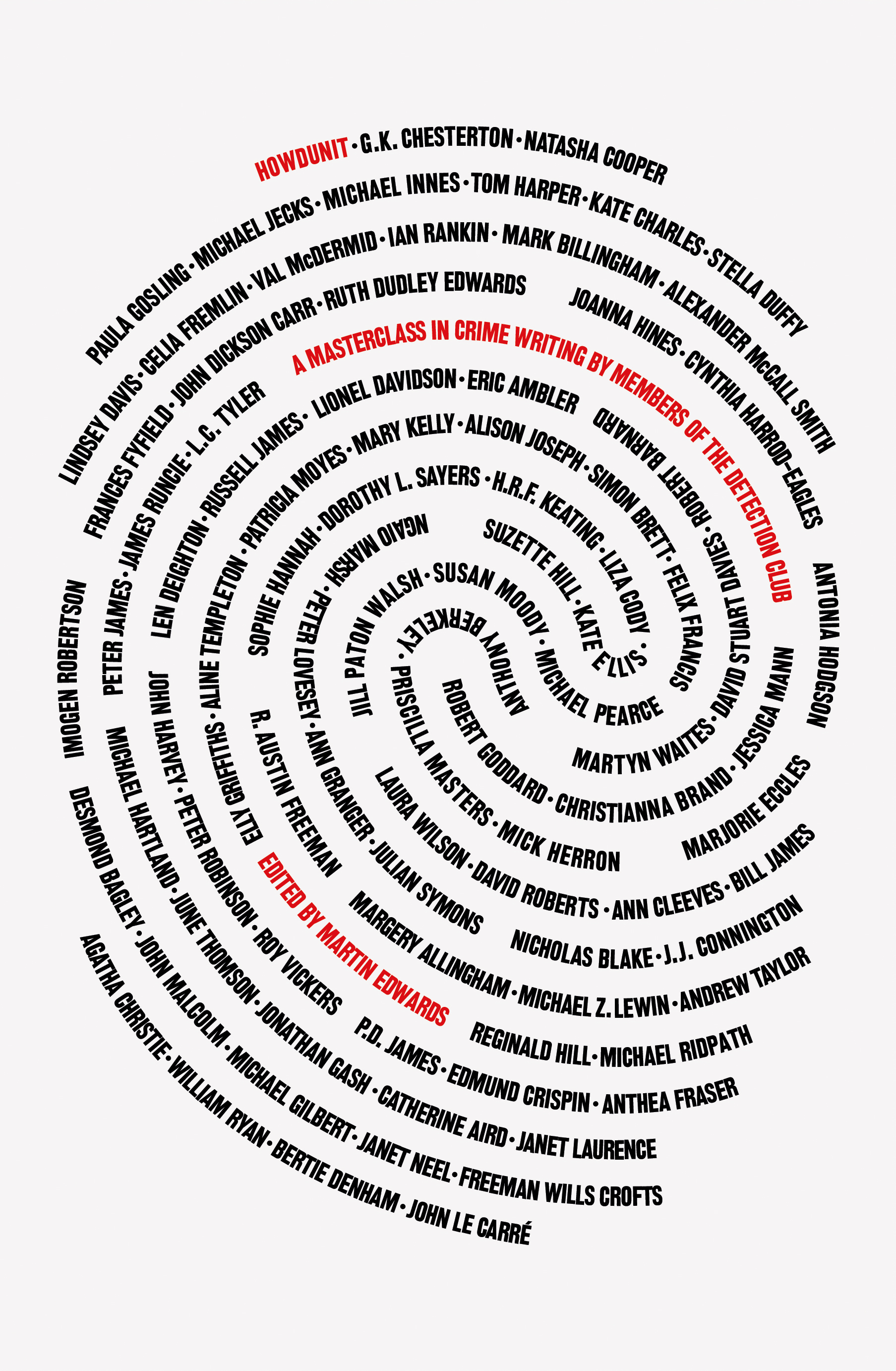
I was truly delighted to be told that the brief had been given to Steve Leard. Steve is a freelance graphic designer based in Plymouth, specialising in book design, branding and illustration. After initially getting his break in the publishing world by working at Bloomsbury, he now regularly designs covers for publishers both large and small and around the world. I was already familiar with his meticulous approach because he’d designed the wonderful artwork for a previous book of mine. This was Howdunit, a book about the art and graft of crime writing which I put together to celebrate the Detection Club’s ninetieth birthday – so it contained essays by ninety different writers.

Sometimes,’ Steve explained, ‘the challenge itself is actually the key to solving the design problem. With so many names to fit on one cover, a device was needed to carry them all. Crime covers often use certain tropes to identify the genre, so using a fingerprint on a crime cover isn't exactly ground-breaking, but trying to use it in a different way to give this book a twist seemed like a good idea and could help to house all of the names. I liked the idea of seeing the cover from across the bookshop or as a small thumbnail on Amazon and initially seeing something suggesting a fingerprint, but then the closer you look you realise it’s actually made of lots of names.

The practicalities are all-important, Steve explained: ‘I initially created the design on the computer using Illustrator. From early on in the process I was keen to create a rubber stamp to physically print the design, which would add to the feel of it being an actual fingerprint. This could have been achieved to a degree on the computer, but for me, you can’t beat physically producing work away from the computer to achieve a better result. It may seem like a small detail to some, but those details mean everything really. Once the cover had been approved by the publishers, I contacted Blade Rubber Stamps in London, who turned the design into a rubber stamp, which I then printed and scanned back onto the computer.

 I suggested to him that another challenge was to retain the simplicity of the design, which is what gives the cover its strength. ‘Yes,’ Steve said. ‘It’s quite unusual in trade publishing to have no hierarchy on the cover, so not clearly having the title of the book large and clearly defined. Credit for this has to go to Claire Ward – the Art Director at Harper Collins. I’m still not sure how she managed to get this cover approved without any major changes, but I’m very pleased she did!’ Me too. The book proceeded to win the H.R.F. Keating award and was nominated for four other major prizes in Britain and the US.
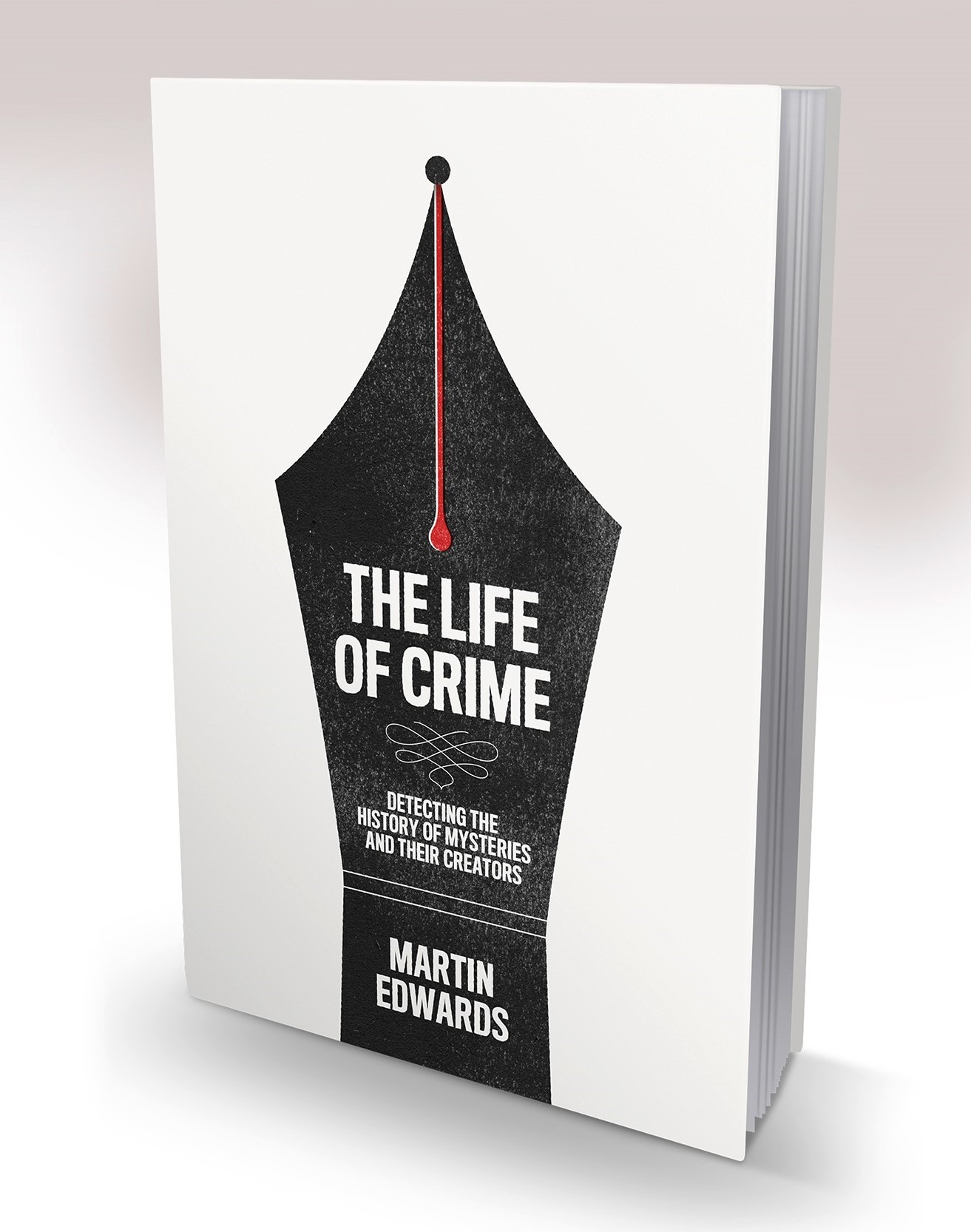
The Life of Crime is a very different book, in that the contents are all my own work, rather than a combination of pieces by ninety different authors. Given that the scope of the book is wide-ranging, it made sense for Steve to focus on a relatively simple (yet eye-catching) image to give a flavour of the book, rather than trying to reflect the complexity of the genre’s evolution since the late eighteenth century, since that might risk creating an impression of clutter.

After the success of Howdunit,’ Steve says, ‘I wanted The Life of Crime to feel part of the same design family, so when the design had been approved I once again had a rubber stamp made to give that textured feel that worked so well on the previous book. Like Howdunit, the challenge with this cover was creating something that fits into the crime/thriller market, but not heavily relying on genre tropes and cliches. I wanted this book to feel big and iconic, to reflect the fact that it is the first major history of crime fiction in 50 years.

As I’m writing this article ahead of publication, I’ve no idea how critics and readers will react to The Life of Crime. But at least I’m confident of one thing. It looks good on the shelf!

The Life of Crime by Martin Edwards (HarperCollins) Out 26th May 2022.

In the first major history of crime fiction in fifty years, The Life of Crime: Detecting the History of Mysteries and their Creators traces the evolution of the genre from the eighteenth century to the present, offering brand-new perspective on the world's most popular form of fiction. Author Martin Edwards is a multi-award-winning crime novelist, the President of the Detection Club, archivist of the Crime Writers' Association and series consultant to the British Library's highly successful series of crime classics, and therefore uniquely qualified to write this book. He has been a widely respected genre commentator for more than thirty years, winning the CWA Diamond Dagger for making a significant contribution to crime writing in 2020, when he also compiled and published Howdunit: A Masterclass in Crime Writing by Members of the Detection Club and the novel Mortmain Hall. His critically acclaimed The Golden Age of Murder (Collins Crime Club, 2015) was a landmark study of Detective Fiction between the wars. The Life of Crime is the result of a lifetime of reading and enjoying all types of crime fiction, old and new, from around the world. In what will surely be regarded as his magnum opus, Martin Edwards has thrown himself undaunted into the breadth and complexity of the genre to write an authoritative - and readable - study of its development and evolution. With crime fiction being read more widely than ever around the world, and with individual authors increasingly the subject of extensive academic study, his expert distillation of more than two centuries of extraordinary books and authors - from the tales of E.T.A. Hoffmann to the novels of Patricia Cornwell - into one coherent history is an extraordinary feat and makes for compelling reading.

More information about Martin Edwards and his work can be found on his website. You can also follow himon Twitter @medwardsbooks and also on Facebook.


Monday, 24 February 2020

Martin Edwards Receives 2020 CWA Diamond Dagger

The author awarded the highest honour in British crime writing, the Crime Writers’ Association (CWA) Diamond Dagger, has been announced. 

Martin Edwards joins icons of the genre who have been recognised with the accolade, including Ruth Rendell, Lee Child, Ann Cleeves, Ian Rankin, PD James, Colin Dexter, Reginald Hill, Lindsey Davis, Peter Lovesey, and John Le Carré.

Praise for Martin:
"Martin Edwards is not only a fine writer but he is also ridiculously knowledgeable about the field of crime and suspense fiction.  He wears his learning lightly and is always the most congenial company.  He is also a great champion of crime writing and crime writers.  He has been an active (and proactive) member of the CWA for many years and has guided countless writers into publication through his scrupulous editorship of short story anthologies.  His novels feature an acute sense of place as well as deep psychological insights.  As a solicitor, he knows the legal world more intimately than most of his fellow novelists.  He is a fitting winner of the Diamond Dagger." - Ian Rankin

Martin knows more about crime fiction than anyone else working in the field today.  He's always been a fan of the genre and his passion shines through in his work: the fiction, the non-fiction and the short stories.  In his editing, he's brought new writers and forgotten favourites to discerning readers.  I'm delighted his work is being recognised in this way.” - Ann Cleeves

Martin’s fiction alone makes him a truly worthy winner of the Diamond Dagger.  His editorial excellence, his erudition, his enthusiasm for and contributions to the genre, his support of other writers, and his warm-hearted friendship are the icing on the cake.” – Lee Child

Martin Edwards is a thoroughly deserved winner of this prized award. He has contributed so much to the genre, not only through the impressive canon of his own wonderfully written novels, but through his tireless work for crime-writing in the UK.” – Peter James

Martin is not only one of the finest crime writers of his generation. He is the heir to Julian Symons and H.R.F.Keating as the leading authority on our genre, fostering and promoting it with unflagging enthusiasm, to the benefit of us all. I'm delighted that our community can show its gratitude by honouring him in this way.” – Peter Lovesey

Martin Edwards is a wonderful choice to receive the Diamond Dagger. He takes stellar roles in both the legal profession and crime-writing in a way few could manage. He’s a very fine writer but has also devoted huge energy to both the CWA and Detection Club – all done quietly and companionably, which is a rare thing. I love a man who takes care of archives. I am delighted for him, but as we always say: it’s for lifetime achievement – but please don’t stop what you do so well!” –Lindsey Davis

Alongside his career as a prolific novelist, Martin is a renowned editor, reviewer, columnist and versatile writer of non-fiction, and is a leading authority on crime fiction. He has also enjoyed a separate career as a solicitor, and is recognised for his expertise in employment and equal opportunities law.

The Diamond Dagger award recognises authors whose crime writing careers have been marked by sustained excellence, and who have made a significant contribution to the genre.

Andrew Taylor, chair of the Diamond Dagger sub-committee and winner of the award in 2009, said: “I’m delighted that the CWA Committee has decided to honour Martin with this year’s Diamond Dagger. Given the range and quality of his work, together with his enormous contribution to the genre as a whole, he is the perfect recipient.

Linda Stratmann, CWA Chair, said: “Martin Edwards has been honoured not only as an
award-winning author and editor, but also as a tireless promoter of crime writing. He researches and preserves the history of the genre, and has introduced the modern reader to classics of the past that might otherwise have been forgotten.

Martin’s first novel, All the Lonely People, was shortlisted for the CWA John Creasey Memorial Dagger in 1991. Since then his crime writing has won multiple awards in the UK and US. In 2018 he received the CWA Dagger in the Library, awarded by British librarians. He has won the CWA Short Story Dagger, the H.R.F. Keating award, and in 2014 the inaugural CWA Margery Allingham Prize. His novels have been shortlisted for the Theakston’s Prize and the Lakeland Book Award, while in 2017 his non-fiction book The Golden Age of Murder was shortlisted for the CWA Gold Dagger. In the US he has received the Mystery Writers of America Edgar Allan Poe award, an Agatha award, and two Macavity awards from Mystery Readers International. In 2017 he received the Poirot award for his outstanding contribution to the genre.

Martin Edwards said: “The Diamond Dagger is special because it’s conferred by my fellow authors and because the previous winners are so illustrious. To be part of the warm and welcoming community of crime writers for the past thirty years has been a joy. I fell in love with crime fiction when as a young boy I first discovered Agatha Christie. From then on, my only ambition was to write a detective novel that people might enjoy reading. But I never imagined receiving an accolade like this. I’m truly honoured.”    

Originally known for his Harry Devlin and the Lake District Mysteries series, Martin is now making waves with his 1930s-set thrillers. His latest novel Gallows Court revived the Golden Age of crime fiction with a unique twist, featuring the character Rachel Savernake, and was last year nominated for the CWA Historical Dagger and shortlisted for the eDunnit award. The sequel, Mortmain Hall, is published in April by Head of Zeus.

In 2015, Martin followed in the footsteps of Agatha Christie, G.K. Chesterton and Dorothy L. Sayers by being elected President of the Detection Club, the world’s oldest social network of crime writers. The Club will celebrate its 90th birthday this year by publishing Howdunit (HarperCollins), edited by Martin; a masterclass of crime writing by leading exponents of the genre. He is consultant to the British Library’s bestselling Crime Classics series, and wrote the award-winning companion volume, The Story of Classic Crime in 100 Books. He is also archivist of the Detection Club and the CWA and a former Chair of the CWA. Author of over sixty short stories, since 1996 he has been the editor of the CWA’s annual anthology.

Martin was born in Knutsford, Cheshire, and now lives in Lymm. After graduating with a first class honours degree in law from Balliol College, Oxford, he became a solicitor, acting for many high profile clients. He was head of employment law at Mace & Jones, and subsequently a partner with Weightmans LLP, with whom he remains as a consultant. Author of four editions of Equal Opportunities Handbook, he says, “The appeal of fiction is not so very different from the appeal of employment law. Both concern conflicts in human behaviour – and how best to resolve them.”

Ayo Onatade & Martin Edwards ©Ayo Onatade
The CWA Diamond Dagger is selected from nominations provided by CWA members. Nominees have to meet two essential criteria: first, their careers must be marked by sustained excellence, and second, they must have made a significant contribution to crime writing published in the English language.