Showing posts with label January Magazine. Show all posts

Friday, 24 August 2012

J. Kingston Pierce’s Book to Die For -- The Eighth Circle by Stanley Ellin


J. Kingston Pierce is the editor of the crime-fiction blog The Rap Sheet, which has won the Spinetingler Award and been nominated twice for an Anthony Award. He also writes the book-design blog Killer Covers and serves as senior editor of January Magazine. Pierce is the author of more than half a dozen non-fiction books, including San Francisco: Yesterday & Today (2009), Eccentric Seattle (2003), and America’s Historic Trails with Tom Bodett (1997). He lives in Seattle, Washington.


I’m always surprised when I get to talking with committed detective-fiction fans, and I ask them whether they have read Stanley Ellin’s The Eighth Circle ... and almost invariably, the answer is “no.” In fact, I can count on the fingers of one hand the number of people who’ve actually said “yes” to that question.

How is it that The Eighth Circle, which was first released back in 1958 and a year later won the Edgar Allan Poe Award for Best Mystery Novel, could be so roundly forgotten? Well, it doesn’t help that it hasn’t been reissued much over the ensuing decades; the last edition appears to have come out in Britain in 2004. Certainly the handsomest and probably the most coveted version, however, is the Dell paperback from 1959 (shown below), which features a Robert McGinnis cover illustration. I like that edition so much, I’ve purchased a handful of copies over time and now pass them out to readers who seem especially deserving of an introduction to this remarkable tale.

The Eighth Circle ranks as a standout because it doesn’t try to jam in all of the conventions of the genre, and even endeavors to play against a few. Yes, this is a private-eye novel with a certifiable member of that breed as its protagonist: Murray Kirk, the son of a New York City grocer, who, after an unsuccessful stint practicing law, answered an advertisement to join Frank Conmy’s upscale Manhattan investigations firm and was hired on the spot. And yes, it boasts a plot filled with dire possibilities: Kirk, who’s now risen to become the suave head of the firm, and has even taken over the late Mr. Conmy’s elegant Central Park-side apartment, is hired to save the bacon of Arnold Lundeen, a policeman attached to the Vice Squad, who’s been caught up in a huge corruption scandal linked to a city-wide betting ring. But there’s no classic femme fatale in these pages, unless you imagine schoolteacher Ruth Vincent, Lundeen’s black-haired and long-lashed fiancĂ©e, to be more dangerous than she ever lets on. Furthermore, there are no bloody demonstrations of fisticuffs here, or even a gun drawn until well into Ellin’s story--and that weapon turns out to contain no bullets.

Ellin, who’s said to have studied several P.I. firms before sitting down to pen The Eighth Circle, offers here what at least seems to be a more realistic portrayal of the mid-20th-century sleuthing biz. Complete with officious secretaries. And plenty of paperwork and accounting responsibilities. And some boredom besides--because really, no modern enterprise exists independent of the periodically mundane, does it?

What ultimately propels this novel’s plot and keeps the reader hooked is the ethical quandary in which Murray Kirk finds himself. Despite his much-studied air of professional distance, he winds up falling hard for cop Lundeen’s unflashy but warm-hearted betrothed. In fact, he reasons that if he could get Lundeen out of the way--somehow reveal or manufacture the man’s guilt without leaving too many of his own fingerprints behind--he could have Ruth Vincent all to himself. The problem is, the more Kirk works on this case and tries to redirect things to his advantage (something that isn’t entirely lost on his veteran employees), the more clearly he recognizes the innocence of his client and the consequent hopelessness of his heart’s pursuit of darling Ruth.

It’s only too bad that Ellin abandoned Murray Kirk after The Eighth Circle (though he did go on to compose other P.I. novels, including 1979’s Star Light, Star Bright). As the exemplar of a less-disheveled, more-businesslike and morally divided gumshoe, he could really have been a contender in this genre.

Thursday, 23 August 2012

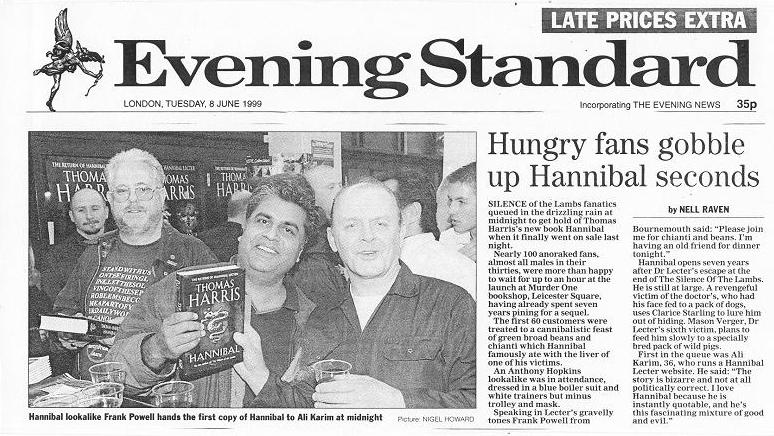
Ali Karim's Silence To Die For - The Silence of the Lambs by Thomas Harris


Ali Karim is Assistant Editor at Shots eZine, a contributing editor at January Magazine & The Rap Sheet and writes for Crimespree Magazine, Deadly Pleasures. He is an associate member of The Crime Writers Association [CWA], International Thriller Writers [ITW] and the Private Eye Writers of America [PWA]. Karim contributed to ‘Dissecting Hannibal Lecter’ ed. Benjamin Szumskyj [McFarland Press] a critical examination of the works of Thomas Harris; The Greenwood Encyclopedia of British Crime Fiction [ed. Barry Forshaw] and the Edgar and Anthony Award nominated ITW 100 Thriller Novels ed David Morrell and Hank Hagner [Oceanview Publishing]. In 2011 at the Anthony Awards held at Bouchercon St Louis, he was presented with the 2011 David Thompson Memorial Award for Special Services to the Crime and Thriller Genre.

Ali Karim is also the programming chair for Bouchercon 2015 in Raleigh, North Carolina, USA.

When Ayo Onatade asked me to write about John Connolly and Declan Burke’s Books To Die For, she remarked that she didn’t need to guess which featured book and essay I would chose. She was right, despite the massive array of masterful essays from some of our leading writers commenting on novels that appear at the apex of the genre, there will always be one book, and one writer that I would die for.

Firstly, I have to admit my love and hatred of books like this, having contributed to them myself. The love of these peer reviews / appreciations comes from my own reading compulsion, and reading extensively allowing me to learn about life and the “world / reality” I see before me through the eyes of others. The hate comes from my knowledge that I am far from as ‘well-read’, as I consider myself, though this is tempered by using tomes such as this, in seeking out books and writers that I have overlooked, or perhaps cajoling me to re-read a particular work due to someone else noticing something or aspects writing, that I had missed. Much of this comes from my understanding of the aging process in a reader. Some books that knocked ‘me for six’, when I was a teenager, when I re-sampled them later in middle age, have not stood the test of time. Others however appear much more complex than my teenage mind understood at the time I first cracked their spines. You see, the books [per se] have not changed [unless they are redux versions, like Stephen King has done with ‘The Stand’ releasing it a decade later with additional text that was edited out in the first release]. Though what has changed is the reader [and his/her mind]. Age [and life] alter ones thinking and cognition and therefore changes aspects of the book, when re-read many years later with a more mature mind.

I have to applaud the Irish writers Connolly and Burke for producing such an interesting and hefty tome; an audacious idea soliciting erudite and passionate essays from some of the worlds greatest writers about books that enthused them. For what is life without passion and enthusiasm? And who best to select such milestones in the crime and thriller genre than the writers who plough that dark road themselves. The contributors are a “who’s who” of contemporary fiction, and to list them all would be a feat itself, and proves what a herculean task Connolly and Burke have achieved. Speaking in hyperbolic terms, the novel and essay that Ayo Onatade guessed would be the one I would write about is of course Kathy Reichs’ essay on Thomas Harris’ The Silence of the Lambs.

Reichs’ essay is filled with insights, that start with Harris’ precursor, the 1981 Red Dragon and Harris’ reoccupation with the injustices of God, as viewed by Lecter and Harris’ own Southern Baptist past. As a scientist, Reichs indicates the layered authenticity in the narrative from Harris’ own journalistic background as a crime reporter, but special mention is made on the characterization, how Harris carves the protagonists and antagonists as if deploying the skills of a master sculptor. Writing about such a well known work of the genre is a tricky assignment, though Reichs’ excels at showing the importance of secondary characters such as the Smithsonian entomologists Pilcher and Roden and how the scenes that flow from the narrative owe more to Poe than Ludlum. She uses the term ‘unsettling’ in her examination of Harris’ novel and how this atmosphere bleeds into the narrative, making the reader as edgy as one of Buffalo Bill’s victims. Naturally mention of the examination of the relationship between Lecter and Starling is shown as being pivotal to the proceedings. The critical point in the examination of Harris’ Silence of the Lambs rests in the opening from the editors “Harris maintains a low media profile and is reputed to find the process of writing intensely difficult: he has published only five novels in thirty-seven years”. This indicates that to produce something as definitive as Silence of the Lambs is hard, hard work, something that is shared with the novels dissected in this wonderful book.

Kathy Reichs’ last line ‘His writing greatly influenced mine’ shows the respect she has for this genre-shaping novel; a work that is as unsettling as it is insightful. Reading it makes one feel what it is like, to be that rabbit hypnotized and paralyzed by the headlights of that oncoming car, the self same metaphor that Harris uses in the first chapter. The Silence of the Lambs is not a book that you walk away from without your worldview being shaken, like a bullet wound, when you close the covers, it remains inside you, reminding you what the dark end of the street feels like.

Continuing the hyperbolic theme, Books To Die For is probably the most important work chronicling the novels and writers that make the crime and thriller genre the most interesting part of fiction-publishing. Any enthusiast who does not have this volume on their bookshelf is depriving themselves of the most enlightening glimpse of what the vertigo-inducing heights that crime and thriller fiction can scale. Reading it is like going back into a time machine, as you get flooded with memories of ‘what and who you were’ when you read some of these magnificent novels; because they scar your psyche.

Bravo Mr John Connolly and Mr Declan Burke for producing such a treat, and one that will endure and one that I hope to see in the non-fiction award nominations for 2012.  

And Ayo, you guessed right, it will always be The Silence of the Lambs for this reader, as Thomas Harris has produced a monster of a novel, and one that Kathy Reichs’ essay does justice to.

Tuesday, 18 January 2011

Newsy Stuff!

The BBC are indulging us viewers with more foreign crime fiction. In this case it is Danish crime fiction in the shape of The Killing a twenty-part series which takes place over 20 hours. The first two episodes are due to be shown on Saturday 22 January between 9:00pm and 10:50 pm on BBC 4. More information can be found on the BBC website.

The estate of the late Arthur Conan Doyle has authorised an official new Sherlock Holmes story. The novel is due to be published in September and is to be written by author Anthony Horowitz who is best known for his Alex Rider novels and as a director. The full article in the Guardian can be found here.

According to the Bookseller Jonathan Cape has acquired a literary thriller set in an Oxford College. The novel The novel Every Contact Leaves a Trace is by Elanor Dymott and is narrated by Alex, a young London lawyer trying to piece together the mystery surrounding his wife's brutal murder in the grounds of Worcester College, Oxford.

Not strictly crime fiction related but related to the law is the Justice series due to be shown on BBC 4. The episode that may be of interest is “The Highest Court in the Land” where four of the Justices of the Supreme Court talk frankly and openly about the nature of justice and what it means to them. More information can be found on the BBC website.

The saga of Stieg Larsson still continues. According to the Guardian Eva Gabrielsson the late author’s partner is planning on finishing the last millennium novel. The full article can be found here.

According to Book Trade author Pauline Rowson has teamed up with libraries across the south coast to launch the search for the South's best young crime writers in a national competition organised by the Crime Writers' Association (CWA) and sponsored by Crimefest, Britain's international crime fiction convention. More information can be found on Pauline Rowson’s website and the full press release can be found here.

Hodder Editor Sue Fletcher has bought the rights to a debut thriller set in Tokyo by Journalist Su Quinn. More info can be found here.

According to January Magazine talks are in progress over a TV detective series set in bath during Jane Austen’s time. The series which will be 8 one hour episodes have already been written and are due to be filmed next year in Bath. The series will revolve around ex-Bow Street Runner Jack Swann, who moves from London to Bath and will each week confront the city’s villains. Read here for more information. (Thanks to Janet Rudolph at Mystery Fanfare for the above information)