Showing posts with label Mental Health. Show all posts

Thursday, 5 March 2020

“Examining Outliers—the Inspiration Behind The Recovery of Rose Gold” Stephanie Wrobel

Copyright Stephanie Wrobel
For as long as I can remember, human behavior has fascinated me. So much so that, for a time, I considered becoming a psychologist. I quickly realized I was more adept at observing people than helping them solve their problems, but the interest lingered—particularly in society’s outliers. Geniuses, outcasts, liars, killers: I’m dying to know what goes through all of their minds, how they make sense of the world, why they’re so different from you and me (presuming, of course, you’re not a murderer).

I first learned of Munchausen syndrome by proxy (MSBP) from my best friend, who is an elementary school psychologist in Colorado. For those who are unfamiliar, MSBP is a mental health disorder wherein a caregiver fakes or induces illness in the person they’re caring for, usually a child, in order to get attention or love from doctors and nurses. My friend suspected a couple of the parents whose children she worked with have undiagnosed MSBP.

As she explained it to me, I was riveted, needed to know more. With a few clicks of the keyboard, I discovered that perpetrators of MSBP are usually women, often mothers. I was stunned—wasn’t the mother/child bond supposed to be sacred? 

The answer was, apparently, not always.

I kept researching, poring over short- and long-form accounts of survivors, as well as news articles and a medical textbook. I examined MSBP in broad strokes, then began to build profiles of both perpetrators and survivors. From these general profiles I was able to establish a few traits my main characters had to have before fleshing them out to make them my own. I studied commonly faked illnesses, rigged lab tests, harmful substances to put in the bloodstream, and how real-life perpetrators trick doctors. These topics are not for the faint of heart!

One firsthand account in particular stuck with me: a memoir called Sickened: The Memoir of a Munchausen by Proxy Childhood by Julie Gregory. Julie’s mother had MSBP, and Julie is the survivor of her abuse. In the book, she recounts driving home from the doctor’s office with her mom one afternoon. Her mother praises her for being such a good girl, says she deserves a treat—“here, have a lollipop”—and pulls out a box of matches. Julie was just a little kid and didn’t know any better. She ate the match, having no idea it was one of the things making her sick.

That image of a child sucking on a match has haunted me for years. What could possibly be going through the mind of a person to make them willing to do such a thing to their own daughter? It got me wondering about these women, these mothers: do they know that they’re lying to everyone around them? Or do they honestly think they’re doing what’s best for their children?

These questions were the impetus for my book—a story about mother Patty and daughter Rose Gold. Though the latter is the titular character, it was Patty’s head I first wanted to walk around inside. How would she behave if everyone discovered her deepest, darkest secret? Would she seek revenge on the daughter who betrayed her, who testified against her in court, thereby sending her to prison? Would she be able to stage a comeback?

I wondered, too, how that daughter would fare once she finally broke free of her mother. Would she flail or fly? How would she feel toward the mother who fussed over and adored her while also routinely poisoning her?

The hardest part of writing the novel was getting Rose Gold’s voice right. She was socially isolated for most of her childhood, so both her worldview and vocabulary are limited to what Patty has taught her. At the beginning of the novel, she has not yet learned social norms, colloquialisms or pop culture references, things the rest of us take for granted. I was constantly going back and rephrasing chapters so they sounded less like me and more like her.

Patty, on the other hand, came to me quite easily—perhaps worryingly so! Her voice is closer to my own, and she doesn’t experience much emotional growth throughout the novel. If you give her credit for nothing else, you have to admit: she sticks to a story. My goal in writing unlikeable characters is to try to make the reader empathize with them at some point—even if it’s for one chapter, one scene, one sentence. If I’ve laid the groundwork properly, that just might happen here. I can’t wait to see what readers make of Patty and Rose Gold Watts.

The Recovery of Rose Gold by Stephanie Wrobel.  Published by Penguin Books. (Out now) 
Rose Gold Watts believed she was sick for eighteen years.  She thought she needed the feeding tube, the surgeries, the wheelchair . . .  Turns out her mother is a really good liar.  After five years in prison, Patty Watts is finally free. All she wants is to put old grievances behind her, reconcile with the daughter who testified against her - and care for her new infant grandson.  When Rose Gold agrees to have Patty move in, it seems their relationship is truly on the mend. And she has waited such a long time for her mother to come home.  But is she still the pliable young girl she once was? And is Patty still as keen on settling an old score?  Because if mothers never forget then daughters never forgive.

Thursday, 30 May 2019

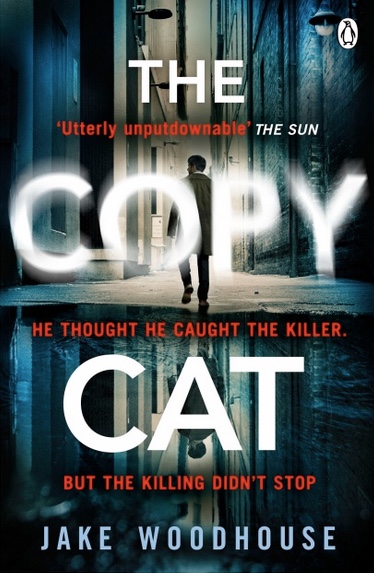
Jake Woodhouse on Mental Health and the War on Drugs

PTSD is hot right now. It’s almost become de rigueur in TV cop shows and films. Where once
there was the alcoholic inspector, solving the case whilst battling the demon drink, we  now have conflict veterans and police diagnosed as suffering from varying forms of Post-Traumatic-Stress-Disorder. It’s gone so far that in Don Winslow’s Savages its even played as a joke; one of the characters, a returning Veteran from Afghanistan who is completely unfazed by the conflict he’s been involved with, is diagnosed by his closest friends to be suffering from extreme LPTSD, or Lack-of-Post-Traumatic-Stress-Disorder.

In one sense it’s good that PTSD is portrayed so widely, it’s made us more aware of the results of extreme stress and how that can impact on people, and therefore on society as a whole. But in another sense we’re running the risk that very ubiquity of it in fiction ends up belittling it in the process.

I’ve tortured my main character Inspector Jaap Rykel over the course of three books and for The Copycat I felt I needed to do something more; I needed to show the results of that torture. So I became interested in PTSD and after reading round the subject, mostly dry and academic, I decided to speak to the only people who could really tell me anything of note, the sufferers themselves. And what I found, time and time again, was that PTSD was something that they were having to treat on their own.

The majority of people found the medications prescribed did little to ease the symptoms and had such wide ranging and in some cases, devastating side effects, that they’d rather face the flashbacks and nightmares. The therapy sessions, if they were even available, were gone into with hope but soon transformed into something to be got through, a long hard slog with no real benefit. 

There is however an emerging acceptance of something which genuinely helps, is backed up by emerging science, and is incredibly cheap and side-effect free.  It just so happens that it’s also been a major enemy of a war waged for much of the twentieth century, the War on Drugs.

The postscript has yet to be written on the War on Drugs, mainly because it is still on-going today. This despite the fact that it’s widely acknowledged to be unwinnable and also, in the eyes of increasingly large numbers of people, and like so many other wars, one which should never have been started in the first place.  The sheer stupidity of such an approach, punishing people for their use instead of asking why they are using in the first place, will go down in history as one of the most damaging and inhumane policies ever put into force.

But propaganda is strong, especially when it aligns with the puritanical streak which, though sometimes hidden, nevertheless runs deep through western culture. Why should people be allowed to get ‘high’, it’s disgusting, think many whilst drinking their third or fourth glass of a lovely little white from the Loire valley, or a big fat Malbec from Argentina.

That’s certainly what the average Swiss citizen thought in the 1990’s. At the time Switzerland was in the grip of a Heroin epidemic, users were injecting in public parks, turning to crime and street prostitution to get money, money which would end up in the pockets of the dealers and ultimately the drug cartels. Stronger enforcement never seemed to work, so an incredibly brave and forward thinking woman put forward a radical idea. She argued that it wasn’t the heroin itself which was the problem, it was everything else around it. The lack of social support for those who needed it most as the real problem. 

What if heroin was made available for those who needed it, in a safe place with medical staff and clean needles? Would the street crime problems go away? It would be unthinkable for a politician, in twenty-first century Britain, to stand up with such a proposal in parliament even today, let alone enact such a policy. But in Switzerland it was enacted, because the woman with the radical idea was Ruth Dreifuss, who would go on to be the country’s first women President. 

Her proposal was to run a trial for five years and then hold a national referendum on whether to continue it or not. The critics called it mad, puritans up and down the cantons were disgusted by the idea and the general resistance was extremely high. Nevertheless, the trial went ahead and as promised five years later a referendum was held. The vote was almost unanimous; the trial was an astounding success and should be extended indefinitely. The people had spoken. 

So what changed the minds of so many Swiss who’d opposed it so vehemently when it was proposed? Maybe it was the fact that street crime plummeted, street prostitution disappeared, citizens could take their children to the park without the fear they’d jab themselves on a dirty needle, the black market for heroin virtually disappeared overnight. All of this in itself is enough to prove the war on drugs was deeply misguided. But there was more. And it has to do with mental health.

Because it turned out that once you stopped forcing people to go to the black market, and penalising them for using but instead allowed them to use in a safe place with access to medical facilities and a non-judgemental atmosphere, a large portion of the users found, and sustained, gainful employment whilst they were attending the heroin clinics.

Even more astoundingly, at least for many observers who’d been brought up with the propaganda that heroin would inevitably fry your brain – who can forget the ‘this is your brain on drugs’campaign where an egg was progressively scrambled in front of the viewer’s eyes – many users eventually weaned themselves off it all together. It needs to be said again; many users weaned themselves off it altogether.  This is astonishing, given the narrative surrounding heroin at the time. It has chemical hooks, we were told, once you started you’d never be able to stop. The rhetoric was endless and also, as the Swiss heroin clinics proved, completely, mind-bendingly wrong. 

What emerged was a different picture, one where heroin use was often to get them through a period of deep emotional stress which they were unable to cope with alone. They weren’t bad people, they were just in bad situations and had found a form of self-medication which helped them deal with it. Framed like this, what kind of extreme lack of compassion would we show as a society for punishing people who are down on their luck and need help? 

Which brings us back to PTSD. It turns out many suffers have found something to help with their particular bad situation, and that something is a plant in the rose family, and one which has a history as medicine stretching back centuries; Cannabis Sativa.

The whole sorry history of how this highly beneficial plant became illegal in the first place has been documented at length elsewhere and can’t be gone into here (see Johann Hari’s Chasing the Scream for an excellent and detailed investigation into this), but needless to say it had nothing to do with the plant being inherently dangerous or bad for you, it’s neither, and everything to do with racism entrenched in the US administration during much of the 20th Century. ‘Weed’ was the drug of Mexicans and Black people, both of whom the establishment hated, and the prohibition of Cannabis was in large part simply a tool to enable continued persecution, whilst claiming it wasn’t about race. 

In fact, medical research, hampered by so long because it was illegal, is gradually revealing just why Cannabis is so useful for so many conditions. The discovery in the 1980’s  of the endocannabinoid system which is both present and essential to all mammalian life (that’s right, you are ‘high’ on the endogenous cannabinoids flowing through your brain as you read this) has opened up new vistas in the treatment of a whole host of diseases which medicine is currently failing to make headway with.  The old arguments that it causes mental health issues, psychosis in particular, have not a single shred of compelling evidence which suggests causation. In actual fact, in an almost unbelievable twist of irony, Cannabis is now being studied for it’s anti-psychotic properties.

Turns out all those teenagers who went psychotic after ingesting the demon Skunk (Skunk, despite what the rabid tabloids are constantly screaming at us, is variety of cannabis with a particularly pungent aroma but which is no more powerful than any other variety) were actually self medicating an illness they most likely already had. But from the outsider’s point of view the equation was simple, Skunk equals mental health problems when in fact all those people were doing was, knowingly or unknowingly, self-medicating their illness the same way the heroin users in Switzerland were.

Which brings us back to Inspector Jaap Rykel in The Copycat.

He too has found a way to help deal with his PTSD, but when he’s compelled back onto the force to help on a case he’d closed years previously, his self-medication brings him into conflict with his peers and superiors. After all, he’s spent his life upholding the letter of the law, and now he’s forced, for his own mental health, to break it.

Thursday, 25 April 2019

Snip, snip, snip… The background to the novel, Mr Todd’s Reckoning by Iain Maitland

The idea for Mr Todd’s Reckoning dates back to May 2015 when my eldest son Michael, who’d spent time in hospital and The Priory with depression and anorexia, came back to live in the family home. These were tough times, to put it mildly. We thought we were going to lose him at any moment.

Michael would spend ages in the kitchen each evening snip, snip, snipping away at vegetables in a wok, cutting them into a million pieces. I would sit nearby and the constant start-stop, start-stop snipping drove me mad. I couldn’t shout “Shut up for a minute” at him, as I might have done with my other two robust children, as he was in a fragile state; things were touch and go for a long time.        

I let off steam by writing what became the first scene of Mr Todd’s Reckoning – a troubled son with mental health issues and a stressed father feeling tense and edgy and having to bottle everything up – and then put it to one side whilst I wrote other books.

Dear Michael, Love Dad is a memoir telling the story of our family and Michael’s downfall. Out Of The Madhouse, co-written with Michael, tells of his days in The Priory and how he came back, slowly but surely, from the brink to become the happy person he is today. I then wrote a man-on-the run thriller, Sweet William.

When I was looking to write my next book, I came back to that snip, snip, scene and wondered if I could develop it into a novel. I had the idea of a father and son forced to live together in a tiny, cramped bungalow, unemployed, tense, feeling claustrophobic, and what might happen to them. The whole thing bubbled with possibilities. Father kills son? Son kills father? What if someone from outside then turned up – a girlfriend perhaps or maybe an old school friend?  

I started writing, as I do, with only a vague sense of where it might be going – no more than one or two pivotal events in my mind. I wrote one scene at a time, edging forwards and backwards, tweaking and adding to each scene as I went along. I had settled by then on the thought that, at some point, one would lash out at the other and kill him – not meaning to – and how he would then deal with that on different levels; emotionally, practically and so on.

I found it easy to get into the minds of my two main characters – Mr Todd Senior and Mr Todd Junior. One began as angrier version of me. The other was a twitchier version of Michael. I had lots of emotions within me because of what happened with Michael; guilt, frustration, anger etc. I had an idea of how Michael’s mind worked as I had read his diaries from The Priory.   

As with Sweet William, once I’d got inside the minds of my characters, the outline I had in my head changed significantly. For me, characters drive the story and where it’s all going to go. As I got to know my characters better, they started to become real people in my head – quite different from Michael and me – and took the story in a whole new direction towards the murder, mayhem and madness that you’ll read about in Mr Todd’s Reckoning.

Iain Maitland’s latest novel, Mr Todd’s Reckoning, is published this month by Saraband books, £8.99 paperback original    

 Behind the normal door of a normal house, in a normal street, two men are slowly driving each other insane. One of them is a psychopath. The father: Mr Todd is at his wits' end. He's been robbed of his job as a tax inspector and is now stuck at home... with him. Frustrated. Lonely. Angry. Really angry. The son: Adrian has no job, no friends. He is at home all day, obsessively chopping vegetables and tap-tap-tapping on his computer. And he's getting worse, disappearing for hours at a time, sneaking off to who-knows-where? The unholy spirit: in the safety of suburbia, one man has developed a taste for killing. And he'll kill again.