Showing posts with label Paul Finch. Show all posts

Wednesday, 28 January 2026

Dean Koontz talks to Shots Magazine


Thomas and Mercer publishing have released two remarkable novels this January that are difficult to pigeon-hole. These two novels were not crime fiction per se, nor horror fiction per se but they were page turners that combined elements of both genres that kept me up way past my bedtime. They also provoked deep introspection.

So what were these two books?

We had Paul Finch with his harrowing THE LODGE and now hot of the presses comes Dean Koontz with his extraordinary THE FRIEND OF THE FAMILY, which is a treat for the bibliophile …..

…….Koontz’s tale commences in 1930 with a teenage girl Alida, one of the attractions of the ‘Ten-in-One’ show at McKinsey’s Travelling Carnival. The girl has a beautiful face, but beneath her shoulders lies hideous body deformations akin to the British human exhibit John Merrick [aka The Elephant Man]. Alida is exploited by being paraded nearly naked by the odious Forest ‘Captain’ Farnham for the amusement of the curious and the uncouth. Alida escapes the indignities she is forced to endure by her voracious appetite for books, especially Dickens……

Read More HERE

Following our review, I had a few questions for this prolific author.

Last time I had a chance to chat to Dean Koontz was close to two decades ago, at the London Book Fair on a video screen via Margaret Atwood’s Long Pen.

Our short exchange is archived at Jeff Peirce’s The Rap Sheet HERE

So with the release of THE FRIEND OF THE FAMILY, we present Dean Koontz in conversation with Shots Magazine, recorded on Wednesday January 28th 2026.

To indicate the scale of Dean Koontz’s as an author – his books are published in 38 languages and he has sold over 500 million copies to date.

Let that sink in.

Ali: Welcome to Great Britain’s Shots Magazine and thanks for speaking with our readers.

Dean: Thanks for inviting me. I’ll try to be on my best behaviour.

AK: So let me ask you firstly, after so many years publishing, do you still remain excited when a new book is released?

DK: I’ve always been more excited by writing than by having written. Undeniably, however, I still get a thrill when I hold the first finished copy in my hands. In a curious way, it’s never real to me until it’s a finished book. I’m a creature for whom tactility is the most confirming of our senses. If the day came when novels were available only as eBooks or audiobooks, I’d probably stop writing. I have over 8,000 editions of my own books in 39 languages, and there are days when walking into the room that holds them is what motivates me to go on.

AK: Right off the bat, where did THE FRIEND OF THE FAMILY originate as an idea?

DK: Three things. 1) Growing up, I lived across the highway from the county fairgrounds. The best part of the year was when the carnival came to town. I was fascinated with carnies, their culture and the rules by which they worked and lived in a community of their kind. I’ve made a sort of study of them my whole life. 2) I grew up feeling like an outsider because we were poor and my father was a notorious alcoholic and gambler and womanizer, which in a small town meant constant humiliation for my mother and me. And so I tend to like writing about outsiders——Odd Thomas, Leilani Klonk in One Door Away from Heaven, both Addison and Gwyneth in Innocence, and so many others. 3)  I love Art Deco, big band music, movies, and the literature of the 1930s and ‘40s.  This was a novel that began with a character, Alida, perhaps the ultimate outsider. She arrived suddenly in my head, complete in all details. I don’t know why or from where. So much of inspiration is mysterious, which is one thing I love about this work——the sense of being connected to some mysterious source of creativity that is beyond oneself. Because freak shows were pretty much outlawed in the 1970s, the story needed to have a historical setting——and I chose my favourite historical period. With that much having fallen together, it was time to start writing.

AK: And did you just follow the muse [as is your method these days], or was there heavy plotting ahead of the writing?

DK: No plotting. I stopped writing outlines with Strangers and have never gone back to that tedious approach. I begin with a premise and a couple characters——and set them loose to do what they want. At some point in most novels, I experience a brief period of raw terror that I won’t be able to pull all the strings together and tie them in a nice knot. But after a glass of good cabernet sauvignon (perhaps two) and a chunk of dark chocolate, I recover from panic and go on. It always works out.

AK: If memory serves, the carnival backdrop features in your novelisation of The Funhouse [a film by Tobe Hooper and screenplay by Lawrence ‘Larry’ Block] as well as your novel Twilight Eyes and now The Friend of the Family – so what is the allure of greasepaint and candy floss for the novelist? 

DK: Growing up as an outsider, as the class clown in school, with a sense that I would never belong anywhere, it is not surprising that I fantasized about running away with the carnival, where every member of the troupe was an outsider by the standards of the rest of the world but not within the world of the midway. I wouldn’t have been able to run a 10-in-one (a freak show), but I think I’d have been able to put together a funhouse like no other.

AK: I thought the opening was reminiscent thematically [though much less grimy] of William Lindsay Gresham’s Nightmare Alley

DK: I know the novel. I am not a fan of it. In spite of growing up in a family that never knew where next week’s food would come from or whether we’d have a roof over our heads, or whether my father’s frequent talk of suicide (and of taking us with him) would suddenly prove more than idle talk, I have always been an optimist. I’ve never wasted time on despair or anger. I don’t know why. Maybe because I’ve always had a sense of time running out, of the preciousness of our days, and haven’t wanted to waste any.

AK: Unlike William Lindsay Gresham, your work [of which The Friend of the Family is no exception] is always upbeat, optimistic despite the darkness of the world. Would you care to comment?

DK: I know there’s evil in the world, but I see no reason to submit to it by taking it too seriously. One thing I saw from the example of my father’s life was that every time he did the wrong thing——the wicked thing, if you will——it worked for a while, it profited him for a time, but too soon it led to one catastrophe or another, often an amusing catastrophe. I learned early that evil is self-defeating. Likewise, so is negativism in all its forms. It sounds very Beatles-in-India, but the world is to a large extent what we make it, and attitude shapes results. At least in part, the world becomes for us what we think it is, which is why I’ve tried to steer clear of all the competing ideologies that try to pack all of existence into one small box or another.

AK: Like the character Alida [aka Adiel] in your new book; how important are novels and reading fiction to you, and wider society?

DK: Growing up, novels were my salvation. They provided desperately needed escape. But they also taught me that all families were not like mine (which is what a kid in a dysfunctional family often thinks——that behind closed doors, every family is dysfunctional).  When Gerda and I were married with $150, a used car, and our clothes, we couldn’t afford a TV, so we read novels in the evenings. After a while, we came to feel that, being as happy as we were, we might find that a TV made us less so. Therefore, we lived without one for ten years. During that period, each of us read about 200 novels a year. That was a far, far better education than I received during my four years of college.


AK: I read some of your Science Fiction Novels in my youth and enjoyed them, and your later work often has a little of the ‘weird’ striating the narrative, so can you tell us a little about what it is about SF [and ‘the weird’] that interests you?

DK: I’ve always felt that the world is something more than we are able to perceive, that our five sense are inadequate to the challenge of fully knowing reality. As an adult, both Gerda and I have had experiences that seem to confirm a depth, a complexity, beyond what we know in our daily lives. And we’ve never done drugs! One day I might write about those experiences/events, for they have confirmed my perception that the world is mysterious (quantum mechanics further confirms it), and that perception has affected what I write.

AK: Your Leigh Nichols books are favourites of mine, so can you tell us a little about this pen name, and why it came about?

DK: When I wrote the first Nichols, my agent at the time and the publisher felt it was too different from what I’d written previously, would destroy my budding career, and thus required a pen name. I was naive enough to believe that the “publishing wisdom” they cited was in fact wise. Years later, I recovered the rights to the 5 Nichols novels. When we published The Servants of Twilight under my name, it was #1 for 6 weeks and sold two million paperbacks in its first six months. It didn’t destroy my career. Neither did the other four. Lesson learned——if you don’t have belief in yourself and what you’re writing, neither will anyone else.

AK: I read you’re an enthusiast of the Richard Stark Parker Novels by Donald Westlake [even penning the Brian Coffey novels]. What other crime-fiction did/do you enjoy?

DK: Westlake was a genius. He could go from ice-water-in-your-face crime fiction to hilarious comic novels as easily as changing his hat. I also read everything by Ed McBain (Evan Hunter), Rex Stout, The magnificent John D. MacDonald, Len Deighton, Patricia Highsmith, on and on.

AK: You have a huge body of work, of which WHISPERSWATCHERS, STRANGERS, LIGHTNING, PHANTOMS, INTENSITY and the Leigh Nichols series rank as favourites of mine – so what are your own favourites and why?

DK: I have a fondness for those that were suspenseful but also made room for humour: Life Expectancy, The Odd Thomas series, The Bad Weather FriendOne Door Away From Heaven. But I also like the go-for-the-throat books like Intensity, the 5 Jane Hawk novels, The House at the End of the World. And if I find a book indefinable, I’m especially fond of it——From the Corner of His Eye, The Friend of the Family . . .

AK: A huge thank you for your time, so in closing what are your plans for 2026 and beyond?

DK: I’ve got a forthcoming novel, A Storm So Bright and Beautiful that was a challenge unlike any I’d taken on before. This time, in spite of my optimism, I wondered if I had at last destroyed my career, just 50 years after an agent had predicted as much. Happily, everyone in my publishing life loves it. Now I’m working on a novel set in 1961, a meaningful year historically. I hope I never have to retire. I’d rather just fall dead at the keyboard——but not with a manuscript unfinished.

Shots Magazine would like to Thank Dean Koontz and Katrina Power of FMcM for organising this interview in-conjunction with Thomas and Mercer Publishing.

More information CLICK HERE

Bibliography CLICK HERE and HERE

Movie Adaptations CLICK HERE

If you are suffering from a ‘reading slump’ or hooked on an addictive ‘doom scrolling’ cycle on your Smartphone – The Friend of the Family is the antidote, because as a novel it is a hell of a thing.

The full Shots Magazine review is HERE

Text © 2026 Dean Koontz and Ali Karim

Images © respective publishers


Thursday, 24 October 2024

Vengeance is Whose? by Paul Finch

Conventional wisdom holds that to seek revenge is one of the most self-destructive impulses in human nature. Possibly this is the reason why so many of us frequently feel a need for revenge and yet never act on it. It seems that a good proportion of society has an in-built brake with which to prevent violence. Others meanwhile resist it through plain common sense.

Because to exact vengeance – real vengeance – is a huge step to take.

Even something relatively innocuous, like retaliating to a foul on the football field, can be transformational. Not least because it may exacerbate the situation, turning a one-off slight into an ongoing feud, but mostly because it casts you, the victim, as another aggressor, denying you the moral high ground.

‘He did it to me first,’ is a flabby explanation if the other guy is lying unconscious, or worse.

And yet the urge to take revenge can be potent, especially when justice appears to be absent. And it doesn’t just have to be revenge for yourself. How do any of us feel when we hear about disgraced politicians being hounded out of office and yet continuing to lead gold-plated lifestyles, or about organised crime bosses who remain untouchable by the courts, or even petty criminals, whose offences are not victimless, being left alone by an overworked, understaffed police force? If justice has seemingly quit the field, what else is there?

‘Vengeance is mine!’ A quote attributed to God himself in Deuteronomy.

We all hope it’s true, whether we’re religiously minded or not, but we see scant evidence of it on Earth. And so, what other course is there apart from taking the law into our own hands?

This is the ethical dilemma at the heart of my new novel, ROGUE, which sees a low-ranking police detective – DS Mark Heckenburg, who some readers will already be familiar with – embark on an off-the-grid mission to avenge a whole bunch of former colleagues, 26 in total, who were mown down in a gun attack on a police party.

I won’t say any more about the synopsis, except to add that while Heck has played fast and loose with the rules before, often using trickery and coercion in his dealings with the underworld, he has never taken that final step into out-and-out criminality. But then, never before has he been cut as deeply as this.

But in truth, in a civilised society, is there any excuse for revenge? We all love an antihero. Someone who gets straight to it and deals with the matter hands-on. But would a real-life vigilante really be so reassuring? What if he decides he doesn’t like us either? What if we ourselves were to short-cut our way past the law, and then suddenly find that we have need of it too?  

Of course, I’m not the first thriller writer to analyse this complex issue. Many great crime novelists have gone there ahead of me, tackling the question of ‘revenge or justice’ from a range of different angles.

MAN ON FIRE by AJ Quinnell, aka Phil Nicholson (1980)

A former Foreign Legionnaire turned drunken bodyguard is devastated when his charge, the sparky young daughter of an Italian businessman, is kidnapped, raped and murdered. His only recourse is to wipe out the Mafia clan responsible. Atonement through violence is the message here, though it comes at a huge cost.

THE EXECUTIONERS by John D MacDonald (1957)

The army lawyer responsible for jailing a GI rapist is tormented in later years when the criminal is released and commences to harass and terrify his family. Vengeance as viewed from the victim’s perspective, normal life massively disrupted by the obsessive, malign behaviour of someone who just can’t forgive or forget.  

THE HUNTER by Richard Stark, aka Donald Westlake (1962)

A professional robber is double-crossed during a major heist and left for dead. Later learning that his share of the haul was used by a former associate to buy entry to a crime syndicate, he goes to war with the syndicate itself. Solid actioner, this one, featuring lots of immoral people violently intermingling in a grubby, immoral world. Even so, it’s a thrill a minute.

DEATH WISH by Brian Garfield (1972)

When muggers brutalise the family of a liberal-minded businessman, he buys a gun and embarks on a mission to annihilate the city’s criminal elements, becoming a cult figure as he does. A study in human darkness, the vengeance-seeker hitting random targets he’s got no personal beef with and enjoying the support of his whole community. Let’s not pretend it couldn’t happen.

A TIME TO KILL by John Grisham (1989)

When a black child is raped by white supremacists, her enraged father guns the two hoodlums down even though they’re in police custody, his legal team soon fighting an uphill battle to keep him from the gas chamber. Probably the most adult take of all, the parent’s understandable reaction squared off against the price society pays if everyone assumes the role of judge, jury and executioner, the race factor only deepening the question of discriminative justice.

ROGUE is published by Brentwood Press in both ebook and paperback on October 24.

They shot everyone. His friends, his colleagues, the woman he loved. But they made one critical mistake. They didn’t shoot him. Detective Sergeant Mark ‘Heck’ Heckenburg has a reputation for bending the rules, but when a ruthless gun attack on a North London pub leaves 26 of his closest workmates dead, he throws the rulebook away. Devastated beyond recovery, he goes rogue. But Heck himself is a suspect. Suspended from duty and watched day and night, it isn’t just a matter of eluding the surveillance net in London. When he makes his move, he becomes a fugitive, an outlaw now infamous across the whole of the UK. And yet that’s the least of his problems. Because as Heck tracks the killers north through the wintry badlands of industrial England, and from there into the mountainous wilds of Scotland, they too have made plans, and some deadly and deranged individuals are lying in wait …

More information about Paul Finch and his work can be found on his blog. You can follow him on X @paulfinchauthor and on Facebook


Thursday, 17 March 2022

The Pain at the Heart of the Story by Paul Finch


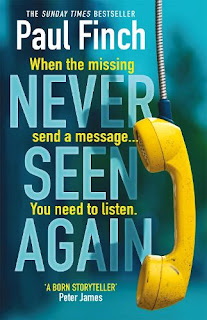
Surprise is often the response when I mention that my new novel, NEVER SEEN AGAIN, is about an investigative journalist rather than a police officer. That’s because I’m probably best known as an ex-cop. But not many are aware that when my cop days had ended I became a journalist, plying my trade on newspapers across Northwest England.

You moved from gamekeeper to poacher,” is a viewpoint I often hear.

It’s an oft-used term, of course, but it’s also an oversimplification.

It’s easy to think of the average cop as a law-enforcement robot who does the right thing because he or she is duty-bound, while the average journalist is a freebooter working both sides of the fence, driven by a moral compass that isn’t always consistent with everyone else’s.

I wouldn’t deny that in recent times we’ve seen some glaringly unprofessional journalism. We’re a politically divided nation, and many of our media outlets reflect this. But I’d contend that the basic journalistic instinct remains: report the news, present factual analysis, and if you must insist on taking sides, at least give the other side a right of reply. 

Ultimately, certainly in Britain, I’d argue that most investigative journalists, like most cops, seek an orderly and happy society, and set out to be the bane of the bad guys.

But there the similarities end.

To start with, and perhaps most obviously, journalists have no back-up. They possess no power of arrest, they can’t draw firearms, they don’t wield the might of Government. So, if they’re on the trail of belligerent people, it might turn risky.

From Elijah Parish Lovejoy back in 1837, to more recent heroes like Fritz Gerlich and Anna Politkovskaya, journalists have died on the job; Lovejoy at the hands of a pro-slavery mob who objected to his newspaper’s abolitionist stance, Gerlich on the Night of the Long Knives for exposing the realities of Nazi violence, Politkovskaya in 2006 when a contract killer cornered her in a Moscow lift after a career spent uncovering the wrongdoings of Putin’s government.

But perhaps the most palpable contrast between cop and journo is that, while both may seek to drive the cause of right, the cop works for the public sector, the journalist for the private. Even the most crusader-like reporting will have no impact if nobody reads it. And today, that news market is more crowded than ever, so the temptation to be sensational increases, the drive is on to get ever better stories, ever bigger headlines.

And this is the point at which people may decide they have a problem with journalism. At what stage does it become too scavenger-like? How can you respect a profession, which, though it produced such world-changing scoops as Woodward and Bernstein’s Watergate exposure can also show such shocking lapses of judgement as the News International phone-hacking scandal? 

Don’t get me wrong. Cops face dilemmas too. In many of my police novels, my heroes and heroines stray into and beyond ethical grey areas, but in those cases you could argue they are trying to remove some heinous and destructive elment from society. 

As a journalist, it’s harder to put such a positive spin on your indiscretions. Especially when, as the man in the street might say, “you’re trying to sell newspapers, mate”.

And this was the personal drama I sought to create at the heart of NEVER SEEN AGAIN. Where does it leave you when, in your efforts to expose villainy, but also to bump your sales and make yourself a star, the wheels come off so badly that it costs lives?

Where do you go when you’re used to being adored but now find yourself deservedly reviled? When the one thing you’re really good at is closed to you because no one will pay you to do it anymore?

It’s not too much of a spoiler to reveal that, in NEVER SEEN AGAIN, disgraced journo, David Kelman, gets a glimpse of redemption (though it’ll be the hardest road he’s ever taken). But it was his inner pain that I became most fascinated by.

How did I end up with such tunnel vision?

How did I not see the damage I was doing?

How did I become one of those callous monsters that I so enjoyed exposing?

I love a rollicking good thriller full of blood and thunder. But the human story is often equally (if not more) interesting. Whether I’ve managed to balance the two in NEVER SEEN AGAIN, only my readers can judge.

Never Seen Again by Paul Finch is published by Orion on 17 March in paperback, £7.99

A message no one was supposed to hear. Jodie Martindale's disappearance remains a mystery, unsolved to this day. A message that will change everything. David Kelman covered the story. But he made a huge mistake, which cost someone their life. A message from the missing. Now, he has evidence he shouldn't have. It's a message from Jodie - who has been missing for six years - but sent just two weeks ago...

More information about Paul Finch can be found on his website. You can also find him on Facebook and follow him on Twitter @paulfinchauthor

Monday, 27 December 2021

Books to Look Forward to From Orion Publishing

January 2022

The end is here. Jack West Jr has made it to the Supreme Labyrinth. Now he faces one last race - against multiple rivals, against time, against the collapse of the universe itself - a headlong race that will end at a throne inside the fabled labyrinth. An impossible maze. But the road will be hard. For this is a maze like no other: a maze of mazes. Uncompromising and complex. Demanding and deadly. A cataclysmic conclusion. It all comes down to this. It ends here - now - in the most lethal and dangerous place Jack has encountered in all of his many adventures. And in the face of this indescribable peril, with everything on the line, there is only one thing he can do. Attempt the impossible. The One Impossible Labyrinth is by Matthew Reilly. 

February 2022

The Goodbye Coast: A Philip Marlowe Novel is by Joe Ide. The seductive and relentless figure of Raymond Chandler's detective, Philip Marlowe, is vividly re-imagined in present-day Los Angeles. Here is a city of scheming Malibu actresses, ruthless gang members, virulent inequality, and washed-out police. Acclaimed and award-winning novelist Joe Ide imagines a Marlowe very much of our time: he's a quiet, lonely, and remarkably capable and confident private detective, though he lives beneath the shadow of his father, a once-decorated LAPD homicide detective, famous throughout the city, who's given in to drink after the death of Marlowe's mother. Marlowe, against his better judgement, accepts two missing person cases, the first a daughter of a faded, tyrannical Hollywood starlet, and the second, a British child stolen from his mother by his father. At the center of COAST is Marlowe's troubled and confounding relationship with his father, a son who despises yet respects his dad, and a dad who's unable to hide his bitter disappointment with his grown boy. Together, they will realise that one of their clients may be responsible for murder of her own husband, a washed-up director in debt to Albanian and Russian gangsters, and that the client's trouble-making daughter may not be what she seems.

Notes on an Execution is by Danya Kukafka. Ansel Packer is scheduled to die in twelve hours. He knows what he's done, and now awaits the same fate he forced on those girls, years ago. Ansel doesn't want to die; he wants to be celebrated, understood. But this is not his story. As the clock ticks down, three women uncover the history of a tragedy and the long shadow it casts. Lavender, Ansel's mother, is a seventeen-year-old girl pushed to desperation. Hazel, twin sister to his wife, is forced to watch helplessly as the relationship threatens to devour them all. And Saffy, the detective hot on his trail, is devoted to bringing bad men to justice but struggling to see her own life clearly. This is the story of the women left behind.

Marion Lane and the Deadly Rose is by T A Willberg. The envelope was tied with three delicate silk ribbons: "One of the new recruits is not to be trusted..." It's 1959 and a new killer haunts the streets of London, having baffled Scotland Yard. The newspapers call him The Florist because of the rose he brands on his victims. The police have turned yet again to the Inquirers at Miss Brickett's for assistance, and second year Marion Lane is assigned the case. But she's already dealing with a mystery of her own, having received an unsigned letter warning her that one of the three new recruits should not be trusted. She dismisses the letter at first, focusing on The Florist case, but her informer seems to be one step ahead, predicting what will happen before it does. But when a fellow second-year Inquirer is murdered, Marion takes matters into her own hands and must come face-to-face with her informer-who predicted the murder-to find out everything they know. Until then, no one at Miss Brickett's is safe and everyone is a suspect.

Was it an accident? Or was it murder? Marc Mercier appears to have it all - a successful business man with a loving family who has risen above his upbringing. So when he vanishes while on a hunting trip in the Atchafalaya Basin, the mystery appears to be nothing more than a tragic accident. But all is not what it seems in Marc Mercier's life. As detectives launch the investigation into his death, the picture of his perfect life begins to unravel. Family members begin to make accusations, his wife and best friend change their stories, and the police are left floundering as the secrets begin to pile up. The clock is ticking - can detectives Nick and Annie discover the truth before someone else ends up as a case number? Bad Liar is by Tami Hoag.

Disappeared is by Laura Jarrett. Let it burn. Let everything burn. One day Cerys walks out of her comfortable life, never to return. Standing on a hillside at night with no phone and no possessions, watching her car set alight, she believes this is the end. And then Lily walks into her life. Lily is desperate for a new start for herself and her child. More than that, she knows she has to disappear in order to keep them both safe. The two women strike a fierce bond, and are both running from things that soon threaten to catch up with them. Can these two women keep each other safe... Can they trust each other ? Or are the pasts they've escaped too much for either of them to bear?

In the dead of winter, even brothers become strangers... Running from a troubled childhood, Jack Devereaux left home as soon as he could and never looked back - until the day a stranger calls, begging him to return to his hometown of Jasperville, Quebec. Jack's brother Calvis - the little boy he left behind more than twenty years ago - has viciously attacked a man and left him for dead. Nobody knows why he did it, though Jack suspects it has something to do with the Jasperville girls who were lost all those years ago.  But as he begins the long journey home through the frozen, unforgiving landscape, Jack isn't wondering why his little brother lost his mind. He's wondering why it took so long . . .The Darkest Season is by R J Ellory.

March 2022

Hidden Depths is by Araminta Hall. Passenger... Lily is pregnant, travelling onboard the Titanic to her beloved family in the United States, hoping she can get there before her mind and body give up. For a long time now she's known her husband is not the man he's pretending to be and she's not safe. So, when she meets widower Lawrence she knows he's her last chance for help. Or Prisoner... But Lawrence knows he hasn't got time to save Lily. Lawrence is the only person on board the unsinkable ship who knows he will not disembark in New York. And the danger is much worse than either of them could imagine. Can Lily and Lawrence help each other to safety before it's too late?

For The Lost is by Lina Bengtsdotter. A missing child. In Karlstad, nine-month-old Beatrice is missing from her pram. Her parents are in shock and the media is in a frenzy. A personal struggle. DI Charlie Lager is struggling with her own demons when she's called to investigate, forced to push them aside as the case intensifies. A clock running down. As lead after lead goes nowhere, Charlie starts to feel like nobody actually wants the truth to come out about Beatrice as reluctant locals shut down in the face of her questions. And with each passing hour, the chance of finding Beatrice alive becomes less and less likely...

The Clockwork Girl is by Anna Mazzola. Paris, 1750. In the midst of an icy winter, as birds fall frozen from the sky, chambermaid Madeleine Chastel arrives at the home of the city's celebrated clockmaker and his clever, unworldly daughter. Madeleine is hiding a dark past, and a dangerous purpose: to discover the truth of the clockmaker's experiments and record his every move, in exchange for her own chance of freedom. For as children quietly vanish from the Parisian streets, rumours are swirling that the clockmaker's intricate mechanical creations, bejewelled birds and silver spiders, are more than they seem. And soon Madeleine fears that she has stumbled upon an even greater conspiracy. One which might reach to the very heart of Versailles...

Jodie Martindale and her boyfriend were kidnapped a decade ago. Her boyfriend was found dead the next week. Jodie was never seen again. Journalist David Kelman, once a hotshot but now washed up, illegally comes into possession of Jodie's brother's old phone. And on that phone is an unheard voicemail from two weeks ago. The voice is unmistakeably that of Jodie Martindale. The message begins an obsession for Kelman - which takes him down a rabbit hole of lies, to a dark and deadly truth... Never Seen Again is by Paul Finch. 

Sorry Isn't Good Enough is by Jane Bailey. 'The trouble is, we don't recognise every danger when we see it. And that's how Mr Man manages to creep into our lives.' It is 1966, and things are changing in the close-knit Napier Road. Stephanie is 9 years old, and she has plans: 1. Get Jesus to heal her wonky foot 2. Escape her spiteful friend Dawn 3. Persuade her mum to love her. But everything changes when Stephanie strikes up a relationship with Mr Man, who always seems pleased to see her. When Dawn goes missing in the woods during the World Cup final, no one appears to know what happened to her - but more than one of them is lying. May 1997, and Stephanie has spent her life trying to bury the events of that terrible summer. When a man starts following her on the train home from London, she realises the dark truth of what happened may have finally caught up with her.

April 2022

Paris Requiem is by Chris Lloyd. Paris, 1940. As the city adjusts to life under Nazi occupation, Detective Eddie Giral struggles to reconcile his job as a policeman with his new role enforcing a regime he cannot believe in but must work under. He's sacrificed so much in order to survive in this new world, but the past is not so easily forgotten. When an old friend and an old flame reappear, begging for his help, Eddie must decide how far he will go to help those he loves. He can remain a good man and do nothing, or risk it all in a desperate act of resistance...

June 2022

Complicit is by Winnie M Li. You know what it's like. A comment here, a closed door there, turning a blind eye to get ahead. My name is Sarah Lai. You won't have heard of me. A decade ago I was on the cusp of being a big deal. But that was a long time ago. Now, instead of working in Hollywood, I teach students about it. And these are the two most important lessons you need to know about the film industry: 1) Those with the money have all the power. 2) Those with the power get whatever they want. Ignore these rules and the whole system will crumble. Stick to the rules and you'll succeed. But at what cost? Ask yourself, what would you have done?

Keep your family safe whatever the cost. Jamie and Victoria are expecting their first baby. With a few weeks to go, they head off for a final weekend break in a remote part of the North Pennines. The small and peaceful guesthouse is the ideal location to unwind together before becoming parents. Upon arrival, they are greeted by Barry and Fiona, the older couple who run the guesthouse. They cook them dinner and show them to their room before retreating to bed themselves. The next morning, Jamie and Victoria wake to find the house deserted. Barry and Fiona are nowhere to be seen. All the doors are locked. Both their mobile phones and car keys have disappeared. Even though it's a few weeks early, Victoria knows the contractions are starting. The baby is coming, and there's no way out. The Guest House is by Robin Morgan Bentley.

July 2022

The Red Notebook is by Michel Bussi. Leyli Maal is a beautiful Malian woman, mother of three, living in a tiny apartment on the outskirts of Marseille. Her quiet life as a well-integrated immigrant is suddenly shaken when her beautiful eldest daughter, Bamby, becomes the main suspect in two murders linked to a lethal illegal immigration racket. Is Bamby really involved? And why is everyone desperate to get their hands on Leyli’s mysterious red notebook? 

On the worst night of her life, in the middle of nowhere, lonely Charlotte Wilderwood saves a runaway bride from falling to her death. Soon Maggie is staying in Charlotte's home, safely hidden from the man that she was so desperate to escape. The immediate bond between the two women eclipses anything they've ever known and before long they will go to extreme lengths to protect each other. But is Maggie the best friend Charlotte has always dreamed about, or the nightmare she never saw coming... The Woman on the Bridge is by Holly Seddon.

The Starlings is by Isabel Ashdown. They were perfect neighbours. Now they are prime suspects. Security, a sparkling sea view and the best kind of neighbours - The Starlings gated community has it all. The residents are like family to each other, in a place where doors are left open and children run free. But that all changes when an idyllic street party takes a dark turn. Who knows what really happened to him? And what answers are harboured within the old building, a former asylum?

The tiny outback town of Dead Tree Creek is a rough place - and the locals are even rougher - but they've never seen anything like this . . . When a man is found gruesomely murdered in the local pub, all fingers point to the backpackers working behind the bar that night - two American girls who skipped town before the body was discovered. Despite all the evidence against them, rookie cop Tara Harrison knows there must be more to this case than a pair of sorority sisters who couldn't take a joke. She's determined to uncover the truth, and is soon on the trail of a devastating secret that could tear her hometown apart. But sorority sisters Lauren and Beth have their own dark secrets and they've made an oath to take them to the grave - which they will, all too soon, unless Tara can stop it . . . Blood Sisters is by Cate Quinn.


Friday, 3 September 2021

Telos Commits to Crime Through Time


Telos Publishing have picked up a new crime anthology edited by USA Today Bestselling author Samantha Lee Howe

The book, titled Criminal Pursuits: Crimes Through Time, has been put together by Samantha Lee Howe to raise money for the charity POhWER which works to give a voice to those struggling with Human Rights issues in the UK.

'I am so pleased with the authors who stepped up and provided their amazing crime stories for this worthy cause,' said Howe. 'The tales we have assembled are cracking pieces of work, and cover all manner of criminal activity from the very first Caveman detective, to a woman who writes to the world’s worst killers. I'm proud to have curated such an amazing selection.'

The authors taking part are: A A Chaudhuri, Raven Dane, Caroline England, Paul Finch, Samantha Lee Howe, Rhys Hughes, Maxim Jakubowski, Awais Khan, Paul Magrs, Sandra Murphy, Amy Myers, Bryony Pearce, Christine Poulson and Sally Spedding.

Helen Moulinos, the CEO of POhWER, said 'Meeting Samantha Lee Howe in 2020 was a gamechanger. She helped me to see through fresh eyes how relevant POhWER’s work was not only to people living in the UK but globally. Samantha’s introductions to the writers in this book made this incredible charity project possible. This anthology helps us to expand our reach, help more people and further our work to serve millions who are slipping between the cracks of public services'.

Stephen James Walker from Telos Publishing said 'Telos Publishing is delighted to have this opportunity to raise money for the valuable work being done by POhWER to help  disadvantaged groups. Criminal Pursuits is a cracking collection of short stories by a group of top-notch authors, taking readers on a thrilling historical journey through the darker side of human nature while at the same time giving them the chance to support an excellent cause.'

Publication was agreed between Stephen James Walker from Telos Publishing, and Samantha Lee Howe.

CRIMINAL PURSUITS: CRIMES THROUGH TIME is published on 10 October 2021.


Thursday, 20 August 2020

Behind the Scenery by Paul Finch

While many of my previous crime novels have been set up and down the country, there’s always been a strong bias towards the North of England, and the Northwest in particular. 

This was always inevitable, I suspect. Not only was I born and raised there, but when I was a policeman and later, when I was a journalist, my hunting ground was Greater Manchester. I’ve never made any apologies for this because the Northwest, with its post-industrial landscape of depressed towns, derelict factories, and extensive, rubble-strewn spoil-land, makes an atmospheric backdrop for crime and thriller fiction that is almost second-to-none.

ONE EYE OPEN, though, will be very different. Because this new novel of mine is set in the border country between Essex and Suffolk, a pastoral landscape famous in the past for such practitioners of fine art as John Constable and Thomas Gainsborough, and well known today for its prosperous villages, scenic woodland walks and genial country pubs.

As settings for crime thrillers go, it’s a far cry from anywhere I’ve been previously. But there’s a story behind this.

I first became enamoured of this leafy corner of England because I have in-laws there. We’ve been visiting them more and more recently, slowly getting to know their friends and neighbours, and one summer day a couple of years ago, during a very genteel garden party, I was introduced to a chap who, like me, was a former copper. 
We chatted amiably, gradually comparing notes about the job. I confidently expected that mine would blow his out of the water. After all, rapes and murders were regular events on our patch. We’d had arson, aggravated burglaries, repeated gang violence, an armed robbery during which machine-guns were discharged. The Suffolk ex-copper’s recollections weren’t quite as lurid as mine, but he told me some fascinating tales all the same, making it quite clear that it wasn’t just poaching they had to cope with out there in the sticks. Okay, it wasn’t MIDSOMER MURDERS, but there was plenty going on behind the lovely scenery. 

Most interesting of all (certainly to me), rural Southeast England had allegedly become a retirement land for the London underworld. Apparently, this wasn’t something that even local people knew about widely. But the story was that gangland bigwigs who had been forced out of the game either through age or simply because they’d decided the time was right and didn’t fancy tangling with incoming syndicates from overseas (who by reputation were particularly deadly), had set up shop in secluded rural residences, some of them pretty extravagant, but nearly all hidden at the ends of long drives, or behind walls of privets or manicured shrubbery, where they were leading the lives of wealthy, law-abiding citizens.

I wasn’t quite sure how to take this, and my new pal was at pains to stress that it wasn’t happening everywhere, and that there’d never been a corresponding increase in local crime as most of these old lags were done with all that.

But I found the idea fascinating: that inner city crime, or the proceeds of it, could be flourishing unnoticed in England’s cosy heartlands, where the most dangerous thing that most visitors normally encounter are clumps of nettles or crumbling stone steps in idyllic country churchyards.

I checked with other guests, and while many were adamant that this wasn’t so, a couple advising that while there were lots of successful people locally, all had risen to prominence legitimately, some were more circumspect. 

It was a mixed bag of views, but by this time I’d been inspired.

I mean, is it really possible that a truly nefarious past can ever stay buried? I’d never considered organised crime as being like a village club, something you joined by paying a membership fee to and left by stopping paying. There is much mythology woven around the underworld, of course: that once you’re in, you’re in; that it never forgets; that by the nature of the beast, you are embroiled in activities from which you can never just walk away.

Whether any of this is real or not, or just a flight of imagination I’d gone on after a tipsy summer afternoon with a fellow ex-officer, I can’t say. But I knew I had the kernel of a new book.

And this one wouldn’t work so well in the smoky gloom of the North. Not when I had the garden of England as an alternative. 

A garden in which, in ONE EYE OPEN, serpents abound. 

One Eye Open by Paul Finch is published by Orion and is out now.
YOU CAN RUN
A high-speed crash leaves a man and woman clinging to life. Neither of them carries ID. Their car has fake number plates. In their luggage: a huge amount of cash. Who are they? What are they hiding? And what were they running from?
YOU CAN HIDE 
DS Lynda Hagen, once a brilliant detective, gave it all up to raise her family. But something about this case reignites a spark in her...
BUT YOU'LL ALWAYS SLEEP WITH... 
What begins as an investigation soon becomes an obsession. And it will lead her to a secret so dangerous that soon there will be nowhere left to hide.
ONE EYE OPEN

Friday, 7 April 2017

Paul Finch on 5 Bizarre Murder Weapons

It has probably not gone unnoticed that one of the main murderers in my new novel, ASHES TO ASHES, a nameless contract killer who enjoys his work to an inordinate degree, is known as ‘the Incinerator’ because he uses one of the most horrible weapons imaginable, a flame-thrower, to despatch his victims.

Just consider for one minute how hideous that would be.

We all know what flame-throwers are, and we’re well aware that they can be used for all kinds of benign purposes such as land-management, roofing, asphalt-laying and even snow-clearance. But we also know how truly terrifying they can be when utilised as weapons. For instance, during the two World Wars, when methods called upon to destroy enemies included poison-gassing and the eventual detonation of atomic devices, flame-throwers were seen as being so controversial that even the Axis powers called for them to be banned.

With ASHES TO ASHES, I anticipated from the outset that there’d be some debate on the matter, but thankfully it hasn’t reached any kind of fever pitch. Part of the reason for this, I suspect, is because in the hands of the world’s murderers – and I’m talking about real-life murderers here, not fictional ones – it seems that any kind of implement can and has been used to take away human life.

There are plenty of famous examples of this.

In 1940, Leon Trotsky was killed when his skull was split open with an ice-pick. In 2009/10, Bradford serial killer, Stephen Griffiths, earned himself the soubriquet ‘Crossbow Cannibal’ because he felled at least one of his female victims with – yes, you’ve guessed it – a crossbow. Between 1969 and 1971, deranged Connecticut preacher, Ben Miller, garrotted five women with their own brassieres.

In all these cases, the implements were originally designed for innocent purposes (though there might be an argument with the crossbow), but it’s easy to see how they could be adapted for more fiendish use. However, there are many other cases where much more mundane and unusual items were pressed into the service of bloodshed. Indeed, some of the world’s most grisly murders were committed by individuals who’d found themselves minus gun or knife, and instead made use of whatever they had to hand, no matter how unlikely it might have been.

Here are five of the weirdest and most gruesome:

1) Ramon Novarro, a Hollywood heartthrob of the silent era, and one of the original ‘Latin lovers’ – who starred in such iconic movies as Ben Hur (1925) and Across to Singapore (1928) – suffered a truly bizarre and quite ghastly death, when in 1968, at the age of 69, he was beaten in his own home by a pair of hustlers he’d invited round for sex, and was finally asphyxiated, or so the rumour tells it, when they forced him to swallow an Art Deco dildo, which had been given to him as a gift by Rudolph Valentino many years earlier.

2) In 1978, political dissident, Georgi Markov, living in London at the time and a constant critic of the communist government in his native Bulgaria, was assassinated when a tiny pellet fired into his leg from an umbrella, of all things, infected his system with ricin. No one was ever charged with the crime, but Russian defectors later arriving in the UK claimed that the assassination had been the work of the KGB and that the actual assassin, one Francesco Gullino, was still alive and well and living in the European Union.

3) In Texas in the 1930s, World War One veteran, bootlegger and career criminal, Joe Ball hit on a truly heinous method – not just of killing his victims, who were mostly women he had lured to his home, but for disposing of the evidence afterwards. He would throw them into a specially-constructed subterranean pool, which he had filled with alligators. By this MO, he allegedly accounted for at least 20 of them. If the story sounds too horrible to be true, indeed it may be. Ball’s crimewave owes almost as much to folklore as fact; he definitely existed, but as he committed suicide before arrest, it is not known whether he fed his victims to the voracious reptiles while they were still alive, or after they had died. 

4) In 1935, a notorious crime rocked Wise County in backwoods Virginia, when Edith Maxwell, a well-regarded local schoolteacher, murdered her own father by stabbing him in the head with her high-heeled shoe. It is difficult to imagine such an assault taking place, and again it may be that the shoe factor was a journalistic embellishment to sensationalise an otherwise tragic but humdrum tale. Maxwell was apparently dominated by her tyrannical parent, who objected to her going out after dark, and on this particular evening they fought – fatally. As reporting pressmen later described Maxwell as a blonde bombshell when she actually wasn’t, it’s also possible that the exotic murder weapon was somewhat more mundane in real life. In more recent times, a club or shoe-iron have been suggested.

5) During the golden age of American gangsterism, Harry ‘Pittsburgh Phil’ Strauss was one of the underworld’s most feared hitmen. A full-time assassin for Murder Inc. (the official enforcement arm of the US Mafia), he is estimated to have eliminated at least 100 targets during his career, and in all cases using non-traditional weaponry, never carrying a gun or blade in case he got arrested en route, and always improvising at the scene, selecting such simplistic tools as a broken bottle, a piece of wire, an old chair-leg and the like. Strauss met his own demise more straightforwardly in 1941, when he was electrocuted at Sing Sing.

Ashes to Ashes by Paul Finch is out now.  You can find out more information about Paul Finch and his writing on his blog.  You can also find him on Twitter @paulfinchauthor