Showing posts with label Faber & Faber. Show all posts

Thursday, 7 May 2026

The Enduring Mystery Of Shakespeare's Missing Play

I’ve always been shamelessly omnivorous when it comes to mysteries, and real-world literary puzzles and hijinks are my favourite kind. Give me long-lost documents hidden in a bank vault in Switzerland for decades before unexpectedly being uncovered by somebody’s unsuspecting great-niece. Give me a fraud, a forgery, an abandoned library, a dispute between antiquarians that turns vicious, scientific tests on the age of ink, millionaire art collectors who hoard Bibles or First Folios or (horror!) cut up priceless medieval tomes for the illuminations. Above all give me missing bibliographic treasures, things that appear to have vanished from everybody forever - or, perhaps, from almost everybody. There’s so much to be done with the gaps between.

When I first heard of a missing Shakespeare play based on Miguel de Cervantes’ Don Quixote, I thought it was a literary hoax. (People like doing those, too. Australia, where I’m from, specialises in them.) Surely we don’t lose Shakespeare plays. But sometimes, as it happens, we do.

We can start on solid ground. There’s credible evidence that Shakespeare collaborated with playwright John Fletcher on a play called The History Of Cardenio, based on an episode in Cervantes’ tale, in 1653. So far, so normal; Fletcher and Shakespeare had collaborated before. The play was performed by the King’s Men, but, unfortunately, no copy of it actually survives - as far as we know.

 There were many players in the drama that led the Don Quixote play to be lost, possibly found, and then lost again, but the most crucial for my purposes is Lewis Theobald. He was a writer in 18th century Britain, otherwise most famous for an ignominious feud with Alexander Pope. The History of Cardenio had vanished from view — and then Theobald suddenly threw his hat into the ring. In 1727, he released his own play, Double Falsehood, which he claimed was a restoration and ‘improvement’ on three editions of The History Of Cardenio he’d somehow found. (Found where? He didn’t say.) Academics have argued extensively over whether there’s any basis for this ‘improvement’ business or whether he just made it up to sell his own work. As of now, though, Double Falsehood has enough similarities to Shakespearean language that it’s been tentatively accepted as a part of the canon, though nobody knows exactly what’s Shakespeare, what’s Fletcher, and what’s Theobald.

What happened to this trio of plays Theobald supposedly had? Was it real? Where did it go, and why didn’t he do anything seemingly sensible with it, like publish it, or bequeath it to a university, or give it to the Crown? Alas, paper is vulnerable. Libraries burn down, mould gets into storage boxes, precious materials are invaded by time and worms. (One of my favourite facts about the Bodleian Library at the University of Oxford is that it uses old salt mines as storage, because they keep the books dry.) Even if Theobald had attempted to lock the thing up tight or preserve it for the ages, it may not have worked, and Shakespeare scholars might be left despairing with a handful of partly-eaten wet paper. As for publication, there could have been legal reasons, or Theobald may simply have been obstreperous. Infuriatingly, we may never know.

Fortunately, imagination forges into the breach left by history and fact. In Marked For Death, I made up an entirely new story for Shakespeare’s Cardenio, featuring a fictitious university crammed full of my favourite flawed academic types: egoists, fanatics, the pompous, crude, monomaniacal, aloof, overly romantic and just not sensible. (In detective fiction, there’s nothing so fun as a profoundly down-to-earth character meeting somebody who’s never had a sensible thought in their life.) It is a truth universally acknowledged by anybody who has spent time in academia that it attracts the passionate, and passionate people can tend towards extremes.

The world contains many lacunae. Some knots will never be fully and finally tied; there are voiceless parts, fragments, theories, but no concrete answers. Humans love an answer, so we strive to fill those ambiguities, and mystery novels carry that comfort: by the final page we will know. In reality, unfortunately. there are no such easy solutions, and the full History of Cardenio will likely be lost to us forever, without any sleuthing to save it. I do, however, live in hope that some enterprising researcher — or perhaps just a plumber exploring some pipes — will go into a basement and come up to the light holding a cobwebbed lockbox from the 1700s, with Theobald written across the top…

Marked for Death by R.O.Thorp (Faber & Faber) Out Now

A dead body and a missing Shakespeare play lead to a faculty of suspects in this modern murder mystery. Scientist Finn Blanchard is trying not to think about murder. The university administrator Nina Hussar may have fallen to her death down stairs she’d used for years, but the only mystery Finn wants to investigate is whether there’s a shark in the local lake. But when a professor’s sudden death unearths cryptic clues to a missing Shakespeare play, Finn is forced to admit his research isn't the fishiest part of university life. After all, as his detective ex-boyfriend says, there’s nothing more suspicious than a fall down some stairs. And if Finn can’t figure out who the killer is soon, the next blood in the water might be his own . . 

R O Thorp can be found on Instagram @r.o.thorp


Thursday, 12 February 2026

Sounds LIke Trouble Q & A with Pamela Samuels Young and Dwayne Alexander Smith

 Introduction:

Dwayne Alexander Smith is the author of Forty Acres, which is in development at Netflix, with Jay-Z attached to produce. Pamela Samuels Young has been widely published across genres, and Netflix is also developing her work, having optioned the first two books in her Vernette Henderson series. Both authors received NAACP Image Awards, for Forty Acres and Anybody’s Daughter respectively.

AO:     What brought the two of you together?  

PSY & DAS:   We’d known each other for a few years after becoming familiar with each other’s work. We’d see each other at book events from time to time and eventually became friends. Our writing styles are pretty similar, and we had discussed the idea of collaborating on a novel. Dwayne came up with the idea for the first book in the series, Sounds Lika a Plan. He shared it with Pamela and suggested they write it together, and she was all in.

AO:     Not only are you both novelists but you also have other jobs. How do you balance this with your writing.

PSY & DAS:   Pamela retired from the practice of law a few years ago and has been writing full time since then. Dwyane is still a full-time writer, focusing primarily on screenwriting. We both love writing and are luckily enough to be able to do it full time.

AO:     A lot of trust is needed for authors who collaborate, how do the two of you work together not only on the plot but the characters?

PSY & DAS:   We work from a pretty detailed outline. So once the writing process begins, we know exactly where the story is headed. Dwayne wrote the first chapter from Jackson’s POV and sent it to Pamela, who wrote the next chapter from Mackenzie’s POV. We went back and forth with that process until the book was completed. We pretty much stuck to the outline. It was a relatively smooth process, with very few hiccups. Because our writing style is pretty similar and because we both like each other’s solo work, it was a relatively smooth process.

AO:     When I read  Sounds Like Trouble, it brought back memories of other detecting duos for example Dashiell Hammet’s Nick and Nora Charles, Laurie R. King's Mary Russell and Sherlock Holmes, Jeffery Deaver’s Lincoln Rhyme and Amelia Sachs to name a few. What makes them work so well as a duo and was it intentional that they had to be a male and a female when for example you have duos such as Sherlock Holmes and Watson, Poirot and Hastings.

PSY & DAS:   Thanks for that amazing compliment. From the start we felt that the dynamic between Jackson and Mackenzie would click. Actually, we saw our two protagonists more like Bruce Willis and Cybill Shepherd in the TV show Moonlighting.  We wanted the same kind of humorous love / hate chemistry.

AO:     Are there any elements of yourselves in your main characters.

PSY & DAS:   We don’t like to admit it, but there are elements of Jackson that are very much like Dwyane and the same for Pamela and Mackenzie. Dwyane can be a little prima donna-like, and Pamela does have her uptight moments.

AO:     What sparked the idea for the current storyline featuring mobsters?

PSY & DAS:   Dwyane has a folder full of story ideas. He came up with the mobster’s storyline and when Pamela heard it, she was hooked. Dwyane is definitely the part of the duo who comes up with the outrageous car chases and action scenes.

AO:     How important is research and do you do a lot of research? In Sounds Like Trouble did you get to hang out with mobsters?

PSY & DAS:   Fortunately, we didn’t have to hang out with mobsters, LOL! We are both long-time fans of crime fiction. We just put our imaginations to work and went for it. We, of course, do research when there’s something we don’t have a lot of familiarity with. For instance, we researched what’s involved in picking a lock. We’ll also make sure the settings for our stories make sense. If we describe a building on a particular street, we make sure the architecture fits.

AO:     How difficult is it then to have storylines to ensure that they are realistic without going overboard.

PSY & DAS:   We work hard to present a realistic story, but as fiction writers, we do take some liberties when it’s necessary. For example, could the two PIs really sneak into a well-guarded cemetery where tons of famous people are buried? Maybe? We try to present each scenario in a way that the reader can at least accept it as a possibility.

AO:     How important is LA as a location in this series and did you consider setting it elsewhere.

PSY & DAS:   Location is very important for us. Local readers love reading about places they recognize. Hence, we give a great deal of thought to where the scenes take place. We want to make sure our LA-based readers can visualize the scene as they’re reading because they’ve visited that exact location. We’re both from L.A. and know the city well, so we never considered another location. That’s not to say we won’t take the story to another location at some point.

AO:     The book touches on themes of justice, loyalty, and morality when working for criminals. Was there a deliberate message that you were trying to convey about the characters' moral compasses, especially given the "offer they can't refuse”?

PSY & DAS:   We weren’t necessarily trying to make a moral statement. Instead, we wanted to create a story with lots of drama, action and conflict, where the stakes our main characters faced were constantly being raised. If that also encompasses a moral or social issue, so be it.

AO:     There is a lot of banter between your two main characters. How easy or difficult has it been to make sure that their relationship does not overwhelm the story.

PSY & DAS:   The banter was both easy and fun to write. That’s because if you eavesdropped on a conversation between Dwayne and Pamela, it might be much the same as the banter between Jackson and Mackenzie. We never feared their relationship would take over the story. Our major focus was always on the plot and making sure it engaged the reader from chapter to chapter.

AO:     Now that you have written two books in the series is there anything in hindsight you wish you could change about both your characters?

PSY & DAS:   No, not really. We were pretty happy with how we crafted our characters.

 AO:     A lot of action takes place.  Which is more important to you character or plot?

PSY & DAS:   Definitely plot! We both write commercial fiction and love a fast-paced, engaging mystery. That doesn’t mean we don’t want well-developed characters. But our primary focus is on our plot.

AO:     There are two types of crime writers those who meticulously plan before writing and those who jump straight in and find the story along the way. Which do you do?

PSY & DAS:   We are definitely meticulous plotters. Dwayne prepared a very detailed chapter-by-chapter outline of Sounds Like Trouble. Then we discussed it and made a few changes. Along the way, the story changed, but because we wrote this book together, it was crucial to have a well-developed outline from the start.

AO:     One could call this series a cross-genre book as it has not only elements of a thriller but that of a mystery and humour.  Was this intentional?

PSY & DAS:   Yes, all of that was intentional. The interplay between Jackson and Mackenzie was intended to be funny, since they have such different personalities. We had a lot of fun with those chapters. We also wanted to keep the reader guessing. If there’s one thing we both equally hate, it’s a predictable ending.

AO:     I believe that if you would like a good grounding in social history and social policy that one should read a crime novel.  How important was it for you to weave important topics into your books?

PSY & DAS:   While we also think that’s important, we didn’t necessarily start out planning to make any social statements. But when the opportunity presents itself, we’ll take it. For example, in the next book in the series, we’ll be delving into AI and the impact of social media on our lives.

AO:     What next for Jackson Jones and Mackenzie Cunningham.

PSY & DAS:   We truly enjoy breathing life into Mackenzie and Jackson and dreaming up adventures for them. We plan to write many more books in this series and are currently drafting the third book in the series.       

Sounds Like Trouble by Pamela Samuels Young and Dwayne Alexander Smith (Faber & Faber) £9.99 (Out Now)

Three mobsters. Two detectives. A deadly race against time. Jackson Jones and Mackenzie Cunningham – two of the best private investigators in the business – are presented with a case they aren’t allowed to refuse. The heads of L.A.’s three major crime families have tasked them with finding sensitive information hidden by a man in critical condition before he flatlines. Or else.  The pair can’t agree on how to furnish the office of their new joint venture, Safe and Sound Investigations, let alone the nature of their feelings for each other. But with a masked man on their tail, they are going to have to stick together if they are going to have any chance of solving the case.

More information about the authors can be found on their websites - www.pamelasamuelsyoung.com and Dwayne Alexander Smith

Dwayne Alexander Smith can also be found on Instagram @theamazin and on Facebook

Pamela Samuels Young can also be found on  X and Instagram @AuthorPSY and on Facebook


Sunday, 21 December 2025

Forthcoming Books from Faber and Faber

January 2026

My Inner Child Wants to Murder Mindfully is by Karsten Dusse. Lawyer turned murderer Björn wants to stop killing. Unfortunately, the prisoner in his basement is getting restless, the parents' committee at his daughter's preschool is clamouring for his attention, and to cap it all, he's also being blackmailed. To manage all this stress, he turns to a mindfulness coach to learn about the unmet needs of his inner child. As he begins listening to this inner child, he finds it doesn't just have needs, but solutions: creative ways he can solve his problems. All of them. The trouble is, they involve murder.


Two patients are fighting for their lives. Nina, the hospital nurse, reads their notes: Leroy: stab wound, gang member, police escort. Dev: stomach pain, artist, distraught mother. Nina is meant to treat all her patients equally: not to pick favourites, and not to judge. Except tonight, understaffed and overstretched, both patients need her. She makes a split-second choice - and leaves one man to die. And that's when she realises that on this busy hospital ward, no-one is exactly what they seem. The Good Patient is by Nilesha Chauvet.

February 2026

Sounds Like Trouble is by Pamela Samuels Young and Dwayne Alexander Smith Three mobsters. Two detectives. A deadly race against time. Jackson Jones and Mackenzie Cunningham - two of the best private investigators in the business - are presented with a case they aren't allowed to refuse. The heads of L.A.'s three major crime families have tasked them with finding sensitive information hidden by a man in critical condition before he flatlines. Or else. The pair can't agree on how to furnish the office of their new joint venture, Safe and Sound Investigations, let alone the nature of their feelings for each other. But with a masked man on their tail, they are going to have to stick together if they are going to have any chance of solving the case.

March 2026

Your baby is perfect. She sleeps through the night, even in this heat. You'll keep her cool. Open the window. Anything she needs. Anything. But when you wake up in the morning, Bella is gone. Recently-promoted DI Martha Allen is furious. Her career hinges on this missing baby case, and her boss and the circling media both want a quick solve - but her key witness is lying. Allen needs the truth. She's not going to stop until she gets it. No matter how long it takes. That detective is watching you. What have you done? What happened to your baby? Missing is by E A Jackson.

Murder at the Spirit Lounge is by Jess Kidd. Sharp-eyed former nun Nora Breen is back, as the latest attraction in Gore-on-Sea turns deadly . . . On a brilliant December morning, Nora finds her customary seaside walk rudely interrupted: she's been summoned, with Detective Inspector Rideout, to the home of Doreen Chimes, Gore-on-Sea's resident medium. Chimes would like to report a robbery - and to personally invite Rideout to that evening's private séance. It's an invitation he will regret accepting: the evening ends in a suspiciously spooky murder. And in the coming days, more of the attendees will find themselves in peril. Can Nora figure out who - or what - is behind these spectral killings before it's too late?

June 2026

Marked for Death is by R O Thorp. Scientist Finn Blanchard is trying not to think about murder. The university administrator Nina Hussar may have fallen to her death down stairs she'd used for years, but the only mystery Finn wants to investigate is whether there's a shark in the local lake. But when a professor's sudden death unearths cryptic clues to a missing Shakespeare play, Finn is forced to admit his research isn't the fishiest part of university life. After all, as his detective ex-boyfriend says, there's nothing more suspicious than a fall down some stairs. And if Finn can't figure out who the killer is soon, the next blood in the water might be his own . . .

It's Ife's dream wedding - until her new husband Ade is arrested for murder. His missing ex, Cynthia, has been found dead on the Dorset coast. Case closed: it's always the ex, right? But did Ade kiss, marry - and kill? One person hopes the truth never comes out. Kiss, Marry Kill is by Yemi Dipeolu.


Thursday, 12 October 2023

Richard Armitage on Writing Geneva

Hi everyone, 

Richard Armitage here introducing you to my Shots magazine guest post and my debut novel ‘Geneva’. Some of you might know me through my work as an actor on TV, Film and Stage, but also from the many recordings I have made for Audible which is how ‘Geneva’ came about. Audible asked me if I would be interested in writing a crime thriller; one of the genres which I was particularly enthusiastic about as one of their readers and I didn’t have to be asked twice; I jumped at the chance. There have been various doors which brought me to my work as an actor, but my love of literature was the driving force. Many of the roles I have played have been adaptations of novel; Tolkien's ‘The Hobbit’, ‘North and South’ by Elizabeth Gaskell, Harlan Coben's ‘The Stranger’ ‘Stay Close’ and Josephine Harts ‘Damage’ and many more. These authors have inspired me, and I’ve always loved working on drama that begins life as a book. Literature has played a crucial role in how I prepare a character; I always have a pile of research books for each person that I am examining.

Over the years I have acquired an obsession for the structure of storytelling. What makes us lean in? What makes the hairs on the backs of our necks stand up? What makes us rush home to watch the next episode or read the next chapter? I set out to find out the answers to these questions when I began work on ‘Geneva’.

I’ve always be curious about science and science fiction which is has its toes on the line of ‘science fact’. I had friends who's loved ones had been touched by dementia, and I was dreaming of this story at the end of the Covid pandemic, which gave me the seeds of an idea for a story. I had followed the work of Sarah Gilbert who was the virologist who headed up the Oxford Astra Zeneca vaccine program, so she became my foundation. Inspired by the films of Hitchcock and Orson Wells, and story tellers such as Agatha Christie and Ian Fleming, I set out to write a modern crime thriller with a central female character, Sarah Collier, who finds herself at the centre of a sabotage story and an unfathomable crime. At the heart of the tale is a once impassioned marriage which is now broken, a happy family decaying from the inside, but a dazzling opportunity presents itself which Daniel Collier, Sarah’s husband, believes will fix all of their woes. However, the course of events which unfold in Geneva are not quite what Sarah had anticipated. 

This was a debut novel for me so as I imagine most first attempts are, a big, exciting experiment of themes and ideas. I have worked closely in the past with screenwriters and producers on TV and Film scripts but have never fully held the reins of the story myself until now. It was a huge learning curve and one which I hope will serve me well for future stories. I started writing the story of ‘Geneva’ in a Winnebago up in Manchester on the set of ‘Stay Close’. My next stop was a hotel room just outside Seville on the set of ‘The Man from Rome’, another hotel in Madrid, and a third in Rome (what a life!!!), I wrote on the long-haul flight from New York to London as I came home for Christmas 2021. Another Winnebago on the set of the Netflix show, ‘Obsession’, as I did the final edits and then I decided to put the finishing touches to the novel from the city of Geneva itself. I toured the city and its environs, finding all the places in the novel that you might notice if ever you get to visit, I rented a car and travelled to the mountains of Chateaux D’Oex and Gsaadt, trying to make sure my geography was as accurate as possible. I found a potential site for The Schiller Institute and the place where Daniels car tumbles off the edge of a cliff (spoiler alert!). One might say I was on an early location scout for the TV adaptation… well all I can say is ‘watch this space’.

I really hope that you enjoy Geneva.

Geneva by Richard Armitage (Faber & Faber) Out Now 

Nobel Prize-winning scientist Sarah Collier has started to show the same tell-tale signs of the Alzheimer's disease as her father: memory loss, even blackouts. So she is reluctant to accept the invitation to be the guest of honour at a prestigious biotech conference - until her husband Daniel, also a neuroscientist, persuades her that the publicity storm will be worth it. The technology being unveiled at this conference could revolutionise medicine forever. More than that, it could save Sarah's life. In Geneva, the couple are feted as stars - at least, Sarah is. But behind the five-star luxury, investors are circling, controversial blogger Terri Landau is all over the story, and Sarah's symptoms are getting worse. As events begin to spiral out of control, Sarah can't be sure who to trust - including herself.

More information about his novel Geneva can be found on the website. You can find Richard Armitage on X @RCArmitage and on Instagram @richardcarmitage

Photograph - ©Kaitlyn Mikayla


Thursday, 16 February 2023

What happens next by Kate Hamer


In my debut novel ‘The Girl in the Red Coat’ (published in 2015) Carmel is kidnapped by a religious cult when she was just eight years old, as they believed she had healing powers. We follow her journey as she struggles to hang on to her sense of identity while under immense pressure to take on an identity that was not hers, while her desperate mother searches for her.

While I was writing the book I didn’t know if a anybody would ever read it, let alone that it might be published. The response was as unexpected as it was overwhelming. When it charted as a Sunday Times bestseller I had to face one of my greatest fears – being asked to appear in public! What I hadn’t realised is that with any book that does well there’s an audience wanting to meet the author in book clubs and festivals up and down the land. As someone who had been too shy to do a reading in the school assembly this was terrifying. The first one was Cheltenham Literary Festival, an event I’d been to as an audience member to soak up some of my favourite writers. Now, here I was. My legs wouldn’t stop shaking, I actually thought I was going to fall over on the steps on the way up to the stage. Yet, somehow with the help of my editor and a generous chair I got through it.

I was so glad I did, because if I’d given up at that first hurdle I’d never have got to meet the wonderful crime readers at events all over the country, not to mention fellow authors. I have heard whispers that the nicest authors are the crime writers and the more grisly the books the nicer they are. I’m not sure if this is true but it’s amazing how the panel often was great fun, and something miraculous happened – I started to enjoy these events! 

I soon realised that my very favourite bit was the audience questions at the end. It was always interesting and unexpected and it confirmed my belief that once a book is published and ‘out there’ in the big, wide world it really doesn’t belong to me anymore, it belongs to the readers. I’ve had questions about the writing process, about character’s lives ‘outside’ the book, about tiny details I’m amazed that anyone picked up on, but the most frequent question was, ‘Are you going to write a sequel?’ or even, ‘When are you going to write a sequel?’ 

Well, it took a long time. I wrote other books, ‘The Doll Funeral’ and ‘Crushed’. Yet somehow the seed planted by readers took root. The characters in that first book began clamouring again, especially one – a little girl called Mercy who has the briefest of all appearances in the first book – I felt emerge so powerfully, wanting to tell her story, wanting everyone to know what had happened to her.

So over two long years I wrote ‘The Lost Girls’ and now it’s here in glorious technicolour. In the book, after a five year long ordeal Carmel is returned to her mother Beth, but of course nothing can ever be the same again. The family might crave to return to normal but the longer Carmel is home the more she begins remembering, digging into what happened – despite the fact her that her traumatised mother is desperate to move on and never have to talk about it again. Carmel begins to remember dreadful things that make her blood run cold – and starts to ask herself the question: what happened to the other lost girls before her? The novel is her quest to find out. 

In fiction, we’re made to believe that the crime is resolved when the case is solved, but more and more I pondered on the aftermath. What about the effect of the crime, many years later on. How has it changed relationships, life paths? How has it blown people off course or make them take directions they never would have if the crime had gone uncommitted? That’s what I wanted to explore here, alongside Carmel turning detective herself, reclaiming her power and her own life story by exposing what happened to others.

I loved meeting the characters from the first book again, feeling them live and breathe once more and give a voice to others that seemed to be waiting in the wings in the first book. In fact, I think I may now be hooked on writing sequels!

The Lost Girls by Kate Hamer (Faber & Faber) Out Now

Lost, she narrowly escaped disaster. Beth is desperate to return to normality. After a years-long ordeal, her daughter is finally home and safe. But Carmel has questions she can't ignore about the cult that kidnapped her, and about the preacher who gave her another girl's name. Found, she must survive a miracle. Digging into her past, Carmel uncovers secrets which suggest that she wasn't the only lost girl - and which puts her in danger all over again. While her mother struggles to salvage the safety they've only just found, Carmel tries to come to terms with who she has become. One question, a mystery at the heart of her disappearance as a child, haunts her: What happened to the other lost girls?

You can find more information about Kate Hamer and her books on her website. You can also find Kate Hamer on Twitter @kate_hamer


Tove Alsterdal on Researching for You Will Never Be Found.

Until recently, far up north in Sweden there was a mining town called Malmberget. It was one of those places with a huge sense of pride; in the hard work in the iron ore mines, the ice hockey team, the sports hall, and the musicians who became famous. 

What it also had was a high rate of suicides among young men in the 1980's. By then the town had started to fall into the ground, literary. The main iron ledge passes beneath and bit by bit, houses were torn down and childhood memories fell into the expanding hole that split the society in two parts.

When I went back there to do research for my latest novel, You Will Never Be Found, Malmberget was almost abandoned. The whole town is now being demolished, apart from some houses of historical value that have been moved to new locations. 

The novel begins with a crime in one of those houses. When police investigator Eira Sjödin hears of it and draws parallels to a murder in her own region many miles south of Malmberget, the crime scene is already gone. It has been moved to a clearing in the forest, eight kilometers away.

Researching a place is so much more than walking the streets, it goes far beyond what my eyes can see. Even more important when I write about a place is to find the memories and stories of the landscape.

My main character Eira Sjödin was born and raised in a small town in an area called Ådalen (River Valley), by the High Coast in northern Sweden. This used to be the artery of the wood industry in Sweden for more than 200 years, now the remains of the era are scattered and overgrown in the forests, hidden on the bottom of the river, and fading in the memories of people. Luckily, I could give Eira the long memory of small towners. In her blood runs the stories her parents and grandparents told her, and their grandparents before them, so from her perspective every tree or bump in the road can hide a story from long before she was born.

In the research I of course read a lot; history, facts about birds and gunshot wounds and timber rafting, poetry, anything I can find about a place, but the best details might not yet have been written. So much only exist in the memories of people. When I hear those stories, it's like finding hidden treasures, they take me beneath and beyond the common clichés of the place.

I named my heroine after a victim of a shooting in Ådalen in 1931 - an event that shook Sweden and changed our modern history. Workers in the paper mills went on strike and scabs were brought in, the confrontations led to the death of five workers, shot by military forces. One of them was a 20-year-old girl, Eira. This is a well-known story in Sweden and the monument commemorating the event is now a tourist spot. A number of books, even PhD’s, have been written about it, but I recently came across an untold detail. Not far from the monument there is an overgrown stone. One of the victims were carried into a house nearby where he died on the sofa. The next day the mother of the house scraped the blood from the floor and buried it on the spot where the man had been shot. She told no one but their closest relatives, and one of her children told me and suddenly a story that had been told a million times over came to life again.

In the next book in the series that I’m working on now, The Deeper You Go, some divers will find an old body on the bottom of the deep river, among the hundreds of forgotten wrecks that remain there. I have taken a course in diving, dug deep into the heritage beneath the water surface and lots more, but when it comes to the time when the victim was alive there's no such source as those who remember. Where did they dance and fall in love, what music was played when it happened?

Even if the stories are fictional, they are closely linked to reality. I want to write about real places, places that have remain unsung. I want readers who live there to recognise themselves and those who don't, feel like they do for a moment.

But in the end, it's a novel. In You Will Never Be Found a man is found dead in the basement of an abandoned house in the forest. He was locked up and tried everything imaginable to survive. During autopsy an earthworm is still alive in his stomach.

"Would that be possible?" I asked the coroner.

"Well," she said, "the earthworm needs a damp environment so maybe it would feel like home. I can't say I'm sure, but on the other hand: Who would check?"

You Will Never Be Found by Tove Alsterdal (Faber & Faber) Out Now.

He was locked inside an abandoned house. But he's not the only one . . . When a dead man is found locked in the basement of an abandoned house, deep in the woods, there is no evidence of what happened beyond his name - scratched into the wall before he died. The regional police can't find anyone who knew him. But no-one knows the locals like tough, smart, and determined Detective Eira Sjoedin. When her expert knowledge of her home town is again called in, she knows one of them must have seen something. Then, a shock: before she can uncover the truth, someone close to her disappears. Has he fallen victim to the same criminal they've been chasing? And can Eira put the pieces together in time to save him? 


Wednesday, 29 June 2022

2022 CWA Dagger Awards Announced


Ray Celestin, Janice Hallett and Mark Billingham awarded 2022 CWA Daggers.

The winners of the 2022 CWA Daggers, which honour the very best in the crime writing genre, have been announced.

Ray Celestin takes home two Daggers for his novel Sunset Swing. Celestin was awarded the CWA Gold Dagger for the crime novel of the year as well as the Historical Dagger.

Sunset Swing is the closing act of Celestin’s City Blues Quartet set in Los Angeles at the end of 1967. Judges praised the novel for its cast of original characters that mingle with historical figures on a big and ‘evocative canvas’.

Maxim Jakubowski, Chair of the Crime Writers’ Association, said: “This is a book bursting with heart, soul and spirit, at once all-encompassing and intimate, superbly paced and immaculately constructed. It’s a testimony to this book that Ray has scooped not just one, but two CWA Daggers.

Past winners of the CWA Gold Dagger include John le Carré, Reginald Hill and Ruth Rendell.

The prestigious Crime Writers’ Association (CWA) Daggers are the oldest awards in the genre and have been synonymous with quality crime writing for over half a century.

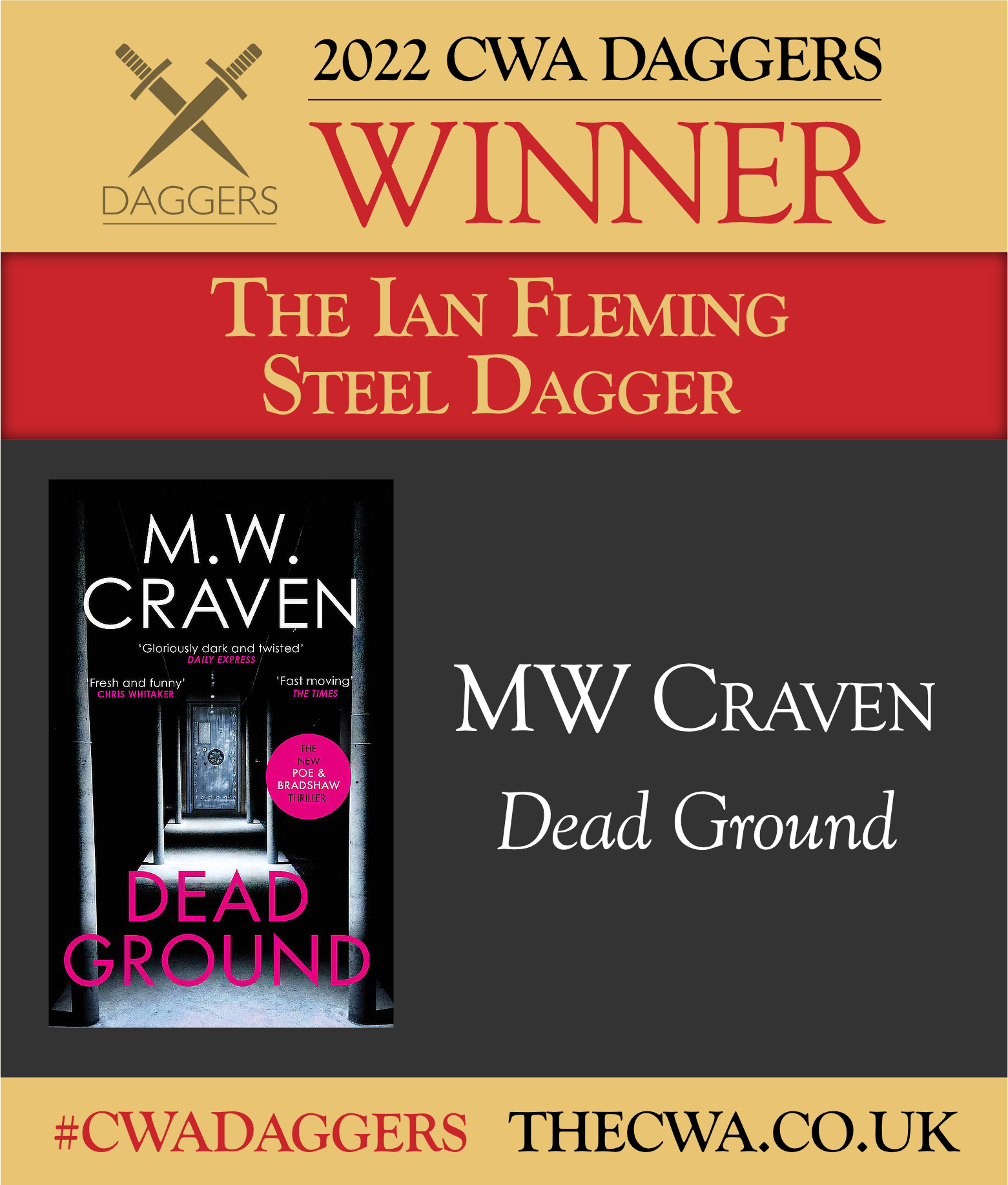
The winner of the Ian Fleming Steel Dagger is MW Craven for Dead Ground. Awarded for best thriller, the Dagger is sponsored by Ian Fleming Publications Ltd, the Fleming family-owned company that looks after the James Bond literary brand.

MW Craven credited the CWA Debut Dagger competition in 2013 for opening the door to his career as an author. He went on to win the CWA Gold Dagger in 2019 for The Puppet Show.

Dead Ground was praised by the judges for its complex characters and deftly constructed plot: “Once again Craven proves himself the master in the art of writing suspense and action.

The anticipated John Creasey (New Blood) Dagger highlights the best debut novels.

This year the accolade goes to Janice Hallet for The Appeal, which was a Sunday Times Crime Book of the Year, praised as a “dazzlingly clever cosy crime novel”.

The ALCS Gold Dagger for Non-Fiction goes to Julia Laite for The Disappearance of Lydia Harvey: A True Story of Sex, Crime and the Meaning of Justice, a poignant account of the short life of a New Zealand woman trafficked as part of the burgeoning sex trade at the start of the twentieth century.

This is the first year the Crime Fiction in Translation Dagger has been sponsored by the CWA Chair, Maxim Jakubowski, in honour of his wife Dolores Jakubowski, now suffering from Alzheimer’s, who was a translator and university lecturer, and a great friend to the crime-writing community. Maxim will sponsor the Dagger in her honour in perpetuity.

This year the Crime Fiction in Translation Dagger 2022, sponsored in honour of Dolores Jakubowski, goes to Simone Buchholz for Hotel Cartagena, a tense hostage drama set in a hotel in Hamburg.

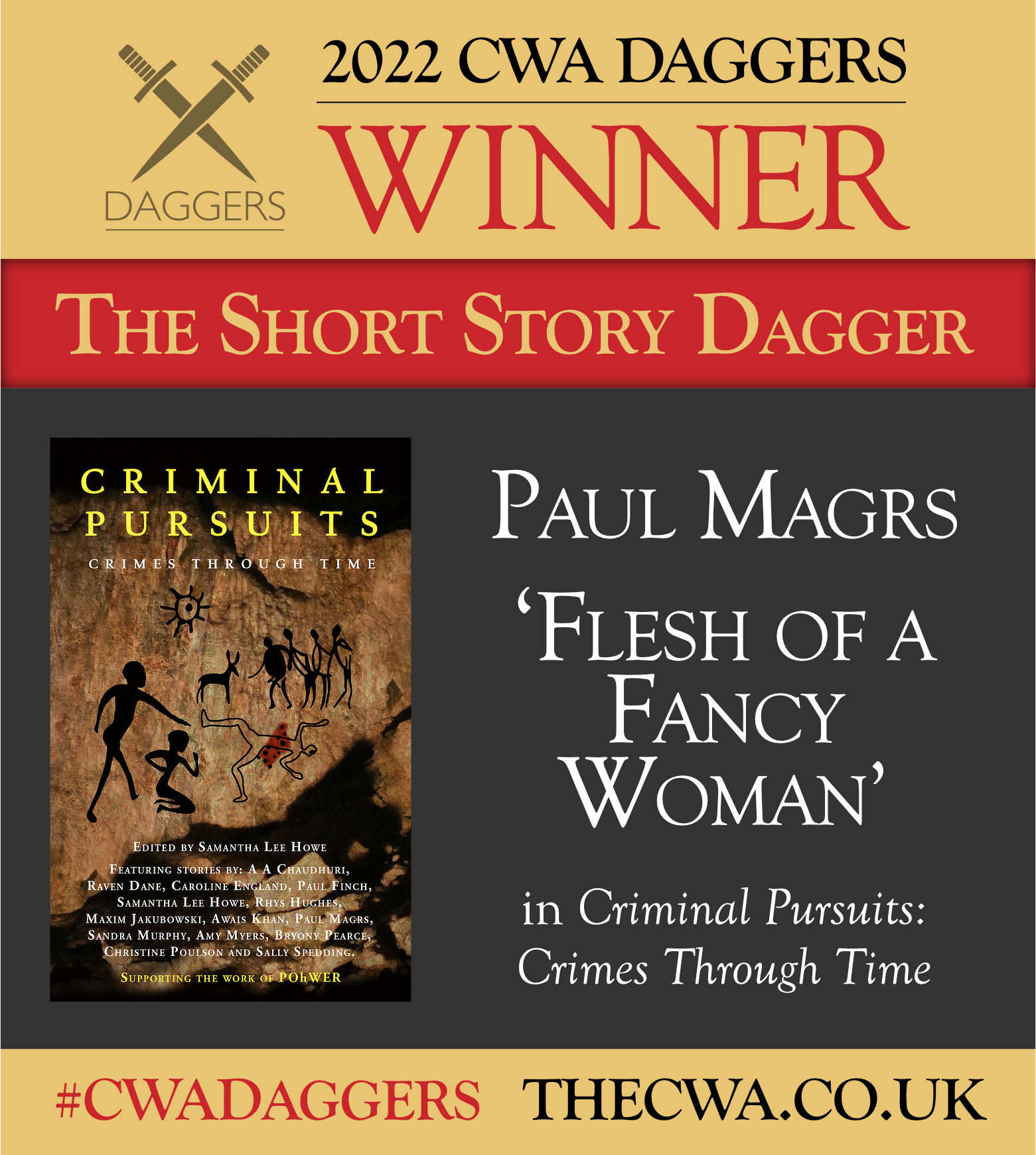
The CWA Daggers are one of the few high-profile awards that honour the short story. Paul Magrs scoops the award for ‘Flesh of a Fancy Woman’, praised as “a wonderfully evocative mix of the Dickensian and the Ealing black and white films.

The Dagger in the Library is voted on exclusively by librarians, chosen for the author’s body of work and support of libraries. This year it goes to Mark Billingham. After a career as an actor and stand-up comedian, Billingham published his first crime novel in 2001. He’s best known for his London-based detective Tom Thorne, which series was adapted by Sky TV starring David Morrissey. His latest book is Rabbit Hole.

This year the chair of the Dagger in the Library judges, Sue Wilkinson MBE, sadly died. At the event the CWA paid tribute to Sue for her passion for reading and her hard work, and thanked Ian Anstice for assuming the role of Acting Chair.

One of the anticipated highlights of the annual Daggers is the Debut Dagger competition, open only to uncontracted writers. The competition can lead to securing representation and a publishing contract – corporate and associate members of the CWA can access the shortlisted entries and often go on to make offers to the writers.

This year, the winner of the Debut Dagger 2022 sponsored by ProWritingAid is Anna Maloney, who has written for TV and works as a script consultant. Her novel, The 10:12, is about a train hijacking and the woman who leads a counter attack, and the aftermath.

The Dagger for the Best Crime and Mystery Publisher, which celebrates publishers and imprints demonstrating excellence and diversity in crime writing, goes to Faber & Faber. The shortlist is selected by a representative group of leading book reviewers, booksellers, agents and journalists.

The CWA’s Red Herring, for services to crime writing and the CWA, was awarded posthumously in memory of Thalia Proctor, who died this year aged 51, and was highly regarded in publishing circles. Maxim said: “Thalia endeared herself to everyone and will be sadly missed.” Her family were present to collect the award.

The CWA Diamond Dagger, awarded to an author whose crime-writing career has been marked by sustained excellence, is announced in early spring each year and in 2022 it was awarded to CJ Sansom, author of the acclaimed Matthew Shardlake series set in Tudor times, as well as standalones such as alternative history Dominion.

On the night, the previous two winners of the Diamond Dagger, Martina Cole in 2021 and Martin Edwards in 2020, were also celebrated after the hiatus of the pandemic.

The winners were announced at a Gala Dinner at the Leonardo City Hotel on Cooper’s Row in London on Wednesday 29 June. The ceremony was compered by genre expert and author, Barry Forshaw, and bestselling author Victoria Selman. CWA Booksellers Champion and bestselling author Elly Griffiths was the after-dinner speaker.

Maxim said: “It’s always an honour to be part of the annual Dagger awards. This year feels extra special as it’s the first time we’ve gathered to celebrate the best in crime writing since 2019. I’d like to congratulate not only all the winners, but also all those shortlisted. It’s a terrific achievement.

One of the UK’s most prominent societies, the CWA was founded in 1953 by John Creasey; the awards started in 1955 with its first award going to Winston Graham, best known for Poldark.

Dagger Winners 2022

CWA GOLD DAGGER

Sunset Swing by Ray Celestin (Macmillan; Mantle)

CWA IAN FLEMING STEEL DAGGER

Dead Ground by MW Craven (Little, Brown; Constable)

CWA JOHN CREASEY (NEW BLOOD) DAGGER

The Appeal by Janice Hallett (Profile Books; Viper Books)

CWA HISTORICAL DAGGER

Sunset Swing, by Ray Celestin (Pan Macmillan; Mantle)

CWA ALCS GOLD DAGGER FOR NON-FICTION

The Disappearance of Lydia Harvey: A True Story of Sex, Crime and the Meaning of Justice by Julia Laite (Profile Books)

CWA CRIME FICTION IN TRANSLATION DAGGER sponsored in honour of Dolores Jakubowski

Hotel Cartagena by Simone Buchholz and translated by Rachel Ward (Orenda Books)

CWA SHORT STORY DAGGER

Flesh of a Fancy Woman’ by Paul Magrs in Criminal Pursuits: Crime Through Time edited by Samantha Lee Howe (Telos Publishing)

CWA DAGGER IN THE LIBRARY

Mark Billingham

CWA PUBLISHERS DAGGER

Faber & Faber

CWA DEBUT DAGGER sponsored by ProWritingAid

The 10:12 by Anna Maloney

THE CWA RED HERRING for services to crime writing and the CWA

In memory of Thalia Proctor


Tuesday, 17 May 2022

Partners in Crime by Nicola Upson

There was something a while back on Twitter that got me thinking - one of those polls where you put contrasting crime writers together to see what a collaboration of their work might look like. Although it wasn’t listed as one of the options, the combination that instantly sprang to mind was Josephine Tey and Margery Allingham - now that’s a book I would love to read. 

Tey and Allingham admired each other’s work and were roughly contemporary, with their first detective novels appearing a year apart: Allingham’s The White Cottage Mystery in 1928 and Tey’s The Man in the Queue (published under her Gordon Daviot pseudonym) in 1929. As far as I’m aware, the two never met in real life, although Tey spent a lot of time in Essex, where Allingham lived. But that’s the beauty of fiction - things that you wish for can happen, and although they don’t go as far as collaborating on a novel in Dear Little Corpses, a chance meeting starts a lasting friendship, and they attempt to solve a crime that touches them both. I really can’t remember a time when I’ve had such fun in bringing two characters together.

They are, of course, very different writers, with contrasting styles - although both write beautifully. Their heroes - Albert Campion and Alan Grant - are much loved but very different men; and whereas Tey often referred in letters to periods of unashamed idleness, Allingham came from a ‘fiction factory’ of professional writers and had published more than eight million words by the time she was thirty-five. But the things they have in common are even more obvious: a deep love of the English countryside, expressed so tellingly in their books; an excitement for London and a passion for theatre (they could easily have met over a gin and tonic in the foyer of the Old Vic); and a fascination with crimes from real life, which filter into novels like The Franchise Affair, The Daughter of Time and The China Governess

Most importantly, though, Tey and Allingham share a wit and humanity which is very present in their work: part of the reason we love their books, I think, is because we love them. In each case, the voice that springs so vividly from these pages is wonderful company, and their books reward continued rereading in a way that very few crime novels do. I’m often asked how this series started, and the simplest answer is probably this: I wanted to get to know Tey better, to spend time with her beyond that small but perfectly formed collection of eight crime novels - nine if you count Kif.

And that’s another thing that she and Allingham have in common - they each addressed a world war through a book that was out of character with the rest of their work. Kif (also published in 1929 as Daviot) is Tey’s unflinching account of a boy’s struggle to find his place in society when he returns from fighting in the trenches. The Oaken Heart - Allingham’s only work of non-fiction, published in 1941 - is the story of an English village during the early days of the second world war. The village in question is Tolleshunt D’Arcy in Essex (more famous now for the Bamber murders at White House Farm, which lies on its outskirts) and the book has a cast of characters every bit as rich as Allingham’s novels. As much as I love her fiction, The Oaken Heart is my favourite of her books, and its candour and insight were a huge influence on Dear Little Corpses. She gave me my title, too, which is taken from one of her letters, quoted in Julia Jones’s wonderful biography, The Adventures of Margery Allingham.

At the time this book is set, Tey and Allingham still had their finest work ahead of them. I have no doubt that they’ll team up again further down the series, and I’m looking forward to it already.

Dear Little Corpses by Nicola Upson is published by Faber. (Out Now)

It takes a village to bury a child.1 September, 1939. As the mass evacuation takes place across Britain, thousands of children leave London for the countryside, but when a little girl vanishes without trace, the reality of separation becomes more desperate and more deadly for those who love her. In the chaos and uncertainty of war, Josephine struggles with the prospect of change. As a cloud of suspicion falls across the small Suffolk village she has come to love, the conflict becomes personal, and events take a dark and sinister turn.


Friday, 18 February 2022

“Stumbling My Way to Mystery” by Wiley Cash

Although When Ghosts Come Home is my fourth published novel, in many ways it marks a number of firsts for me. It’s the first novel I began writing after losing my father, and it’s also the first novel I began writing after having two daughters. And although I have always written about the state of North Carolina, this is my first novel set on the coast, where I’ve lived since 2013. Finally, this is the first mystery I’ve written.

Now, I’ve been accused of writing mysteries before, but I’ve always disagreed. My previous novels were mysteries inasmuch as the characters were kept in the dark about what would happen and how. In terms of those novels, the reader always knew the score. They always knew who was evil and who was innocent. But something – please forgive me – mysterious happened while writing When Ghosts Come Home: a mystery revealed itself to me, and I essentially wrote the novel to solve it. 

The book opens as a local sheriff is awakened in the middle of the night by the sound of a large, low-flying airplane on the coast of North Carolina. He climbs out of bed and drives to the small municipal airport to see if an aircraft has made an emergency landing. What he finds changes not only his life, but the life of his small community forever. An empty WWII transport plane has been abandoned and left sitting sideways at the end of the runway. In the grass nearby lies the body of a local man, shot dead and left behind. Who flew this aircraft? Who shot this man?

I didn’t know the answers to those questions until I finished writing the book. Unlike my other novels, this story did not reveal itself until it was finished. There is a first time for everything, and I hope readers are as surprised as I was. 

When Ghosts Come Home by Wiley Cash is published by Faber (£14.99 hardback)

An abandoned plane. A dead body. A small town threatening to explode. 'A searing, thunderous, heartbreaking thriller. Wiley Cash has talent to burn.' Chris Whitaker Winston did not hear it so much as feel it as it passed over their house and into the trees across the waterway. The sheriff struggling for re-election and haunted by his past. The mystery plane which crash-lands on his island. The daughter returning home to hide from her troubles. The FBI pilot sent in to help. As the mystery of the abandoned plane and the dead body stokes long-simmering racial tensions, a moment of reckoning draws ever closer for the town of Oak Island.