“
You caught me because we’re very much alike. Without our imaginations, we’d be like all those other poor dullards. Fear is the price of our instrument".Hannibal Lecter delivered those lines to Special Agent Will Graham while supposedly helping him to catch a serial killer (and actually trying to get him and his family killed by said killer. Classic.)
What Hannibal engages in here is some textbook psychopathic manipulation. He begins by telling Will that they are they are different and special, with their own bond. He gives Will the ultimate compliment in telling him he is a psychopath like him. He must be, because it takes a psychopath to imagine how another’s mind might work.
But Lecter’s comment says more than this, too. It sums up, neatly, the particular draw that the psychopath has on all of us. They provide a vividness and imagination that is anything but dull. Time spent with one is, at first at least, addictive and enthralling and enlivening. It throws everything else into the shade – but it comes at a cost.
In fiction, that cost can range from the small – like having to live with someone who might just decide to kill you – to the major. We’ll call this worst option “They kill everyone you know and then either kill you, or frame you.”
For some reason, despite the obviousness of this cost, we can’t get enough of psychopaths. From Villanelle in Killing Eve to Amy Dunne in Gone Girl; from Tom Ripley and all his talents, to Moriarty in Sherlock Holmes. From the Marquise and Visconte in Liaisons Dangereuses, to the dark antics of Dexter: we are fascinated by them. And of course there’s Hannibal himself, the most-quoted psychopath of them all, and the reason Antony Hopkins rarely gets invited to kids’ parties.
It isn’t just that we like to watch them do their evil misdeeds. It is, I think, more profound than that. We crave their insight, because they have an ability to cut through all the layers of social conditioning and say piercing truths that none of us are willing to. They are, in literature at least, always profoundly smart.
And there’s a small part of us that wants them to be redeemable, too. We are desperate for them to turn out to be the charming, likable version of themselves that they put forward when it suits them (usually right at the beginning or just as you are about to tell them “no”). We want them to genuinely see the main character as special in the way that they claim, and to go out of their way to save them from harm.
I was certainly conscious of all this when writing Keely, my very own psychopathic young woman, in Little Sister. She is someone who seems to have been willing to sacrifice anything to get what she wanted, including her own younger sister Nina, and in the early chapters, sits opposite DCI Jonah Sheens, telling him that he needs to play her game or never see Nina alive again.
The problem for Jonah is that, like so many of those who encounter a psychopath, he doesn’t know whether to believe what she is telling him; or to treat her as you might a snake. And every sudden rush of belief in her as human comes up against her biting sarcasm – or against what seems to be cold, hard reality.
So why does Jonah keep trying, and why do all of us want to hang in there, too?
Intellect without empathy
The strange thing about our belief in psychopaths is that we look to them for an understanding of human nature. It’s strange because these people lack empathy, the one quality necessary to really understand the people around us. In its place, psychopaths have (in fiction at least) pure intellect, which has allowed them to learn how to manipulate people. They may not have always grasped complex emotions, but they have recognised what ordinary peoples’ grubbier desires are and how to control them. And though they lack any morality, they are quite happy to use other people’s desire to be moral for their own ends. It immediately gives them a starting bonus. Think Iago in Othello, mocking his superior for his “foolish honesty” and using it to destroy him.
And yet, in spite of their lack of empathy, these villainous psychopaths so often deliver exactly the kind of insight that makes us feel like they’re voicing all the thoughts we’ve had but not been able to put into words. Take, for example, Amy Dunne’s glorious rant about “cool girls” in Gone Girl.
“Men always say that as the defining compliment, don’t they? She’s a cool girl. Being the Cool Girl means I am a hot, brilliant, funny woman who adores football, poker, dirty jokes, and burping, who plays video games, drinks cheap beer, loves threesomes… Men actually think this girl exists. Maybe they’re fooled because so many women are willing to pretend to be this girl… You are not dating a woman, you are dating a woman who has watched too many movies written by socially awkward men who’d like to believe that this kind of woman exists and might kiss them.”
If you’re anything like me, it’s impossible to read that as a woman and not feel as though Amy Dunne has cut to the heart of your own discomfort with this kind of woman: a woman held up as an ideal, but who is acting with only the male gaze in mind. It’s wonderful to have that behaviour exposed. Liberating.
The same can be said for the Marquise de Merteuil’s reflections on the status of women in Les Liaisons Dangereuses:
“I already knew that the role I was condemned to, namely to keep quiet and do what I was told, gave me the perfect opportunity to listen and observe… I became a virtuoso of deceit. It wasn't pleasure I was after, it was knowledge. I consulted the strictest moralists to learn how to appear, philosophers to find out what to think, and novelists to see what I could get away with. And in the end, I distilled everything to one wonderfully simple principle: win or die.”
Like Amy, she rages against how society is attempting to make her and other women behave, and chooses another path. But such observations are also part of the psychopath’s toolkit. By revealing them to us, we’ve been drawn into a feeling of fellowship with Amy, and with the Marquise. We feel that we might sympathise with her. We might even like her.
These thoughts may also, perhaps, not be quite true. Just like Lecter’s reflections on Will or Clarice, those harsher thoughts of ours about “cool girls” – those tired-and-fed-up judgements that she is echoing – may be no more the right answer than the ones wrapped in social norms and empathy. People are complex, after all. They might like the things they claim to like more than Amy Dunne understands. And the Marquise’s thoughts about being condemned to “shut up and do as she was told” are perhaps belied by the way other clever women of her generation lived their lives.
I had Keely Lennox paint a similarly harsh portrait of human nature. She tells Jonah:
“We all have the same savage possibility in us. I know I do. Mine got stripped pretty bare by everything. To find my sister, you have to look in the mirror, and actually see what’s there. Have a good delve into all the dark places. At all the times you’ve chosen your own interests over someone else’s. All the petty or selfish things you’ve done.
Isn’t it weird how, with all those things, you can still hold it all together and tell yourself you’re a good person? That’s because you didn’t have the same pressure I did. You know, I’d probably be a lot like you if all the bad stuff had happened later. It wasn’t really child-appropriate, any of it. The trouble is, nobody’s overseeing this stuff, and life just does its thing. It has basically no respect for ratings.”
It’s persuasive and engaging, and like Hannibal Lecter’s words to the officers who come to see him, it puts Jonah and Keely on a level to a certain extent. But is it honestly true?
In both Amy and the Marquise’s cases, there were other courses of actions open to them than the destructive ones they took. Amy might simply have exposed her husband’s affair, instead of framing him for murder. The Marquise might have sought a partner who saw her as an equal and gathered like-minded people around her. But that was never their game.
Playing nicely wasn’t Keely’s game, either. But it isn’t clear to Jonah or his team whether that happened out of choice – or out of necessity. And I won’t spoil the surprise here by revealing all…
The hope of redemption
And so we come on to the other incredibly appealing side to the psychopath: that strange hope in all of us that the bad will be redeemed. It is a trope seen over and over again in literature: most commonly in the bad boy turned good, but only because of the love of a particular person, or the friendship of another.
It is this trope that underlies the draw of The Silence of the Lambs, and still more so the Hannibal TV spin-off. We have seen Will Graham and then Clarice Starling finally get to Hannibal. They have each of them become a soul-mate. An equal. Someone with a bond that goes beyond the normal. Instead of simply voicing a recognition of them in order to manipulate, Hannibal has in each case become emotionally entangled with the investigating officer. It is never more clear than when, in the series, Hannibal asks Will Graham, “Do you think you can change me as I’ve changed you?” We know that Will is right when he replies that he already has.
We see it clearly in Villanelle’s relationship with Eve, where the psychopathic assassin is suddenly drawn to care for and protect the woman she becomes besotted with. And once again, this obsessive care is reserved for Eve and Eve only. Her husband and friends are no more than collateral.
We see it in the development of Joe Goldberg in Caroline Kepnes’s You series, and even in Humbert Humbert in Lolita. We see it in Amy Dunne’s bloody return to Nick after he calls to her on-air in Gone Girl; and in the Visconte Valmont’s respect and love for Madame de Tourvel in Les Liaisons Dangereuses - while he continues to treat Cecile Volanges as though she is worthless.
The fascinating side to all of this is that we all of us appear to identify with the main character in these scenarios. We take satisfaction from seeing the psychopath not only become to a very limited extent good, but more importantly, besotted. Even when the psychopath still treats others with as little care as ever, and perhaps almost because they still do, we find ourselves drawn to them and this new close relationship.
There’s a real question to ask, here, about what makes this so fascinating. The answer seems, to me, clear. We’re all of us, when becoming absorbed in these books or films, seeing ourselves in those main characters. And that means that we have been singled out as special by the psychopath. That manipulative, charming man or woman with their promise that we meant something has suddenly decided that we really did mean something. This hardest of people to please and reach has actually come to like and respect us.
And somehow, this is the very best prize of all.
Little Sister by Gytha Lodge is published on 28th April by Penguin Michael Joseph.
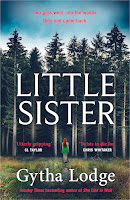 Two sisters went missing. Only one of them came back... Detective Jonah Sheens is enjoying a moment of peace and quiet, when a teenage girl wanders out of the wood. She's striking, with flame-red hair and a pale complexion. She's also covered in blood. She insists she's fine. It's her sister he needs to worry about. Jonah quickly discovers that Keely and her sister, Nina, disappeared from a children's home a week ago. Now, Keely is here - but Nina's still missing. Keely likes to play games. She knows where her sister is - but before she tells, she wants Jonah's full attention. Is she killer, witness, or victim? And will Jonah find out what Keely's hiding, in time to save Nina?
You can follow Gytha Lodge on Twitter @theGyth. You can also find her on Facebook


