Showing posts with label Hannibal Lecter. Show all posts

Friday, 29 April 2022

Why We Listen to Psychopaths: The compelling testimony of the smartest, coldest figures in literature

“You caught me because we’re very much alike. Without our imaginations, we’d be like all those other poor dullards. Fear is the price of our instrument".

Hannibal Lecter delivered those lines to Special Agent Will Graham while supposedly helping him to catch a serial killer (and actually trying to get him and his family killed by said killer. Classic.) 

What Hannibal engages in here is some textbook psychopathic manipulation. He begins by telling Will that they are they are different and special, with their own bond. He gives Will the ultimate compliment in telling him he is a psychopath like him. He must be, because it takes a psychopath to imagine how another’s mind might work. 

But Lecter’s comment says more than this, too. It sums up, neatly, the particular draw that the psychopath has on all of us. They provide a vividness and imagination that is anything but dull. Time spent with one is, at first at least, addictive and enthralling and enlivening. It throws everything else into the shade – but it comes at a cost. 

In fiction, that cost can range from the small – like having to live with someone who might just decide to kill you – to the major. We’ll call this worst option “They kill everyone you know and then either kill you, or frame you.” 

For some reason, despite the obviousness of this cost, we can’t get enough of psychopaths. From Villanelle in Killing Eve to Amy Dunne in Gone Girl; from Tom Ripley and all his talents, to Moriarty in Sherlock Holmes. From the Marquise and Visconte in Liaisons Dangereuses, to the dark antics of Dexter: we are fascinated by them. And of course there’s Hannibal himself, the most-quoted psychopath of them all, and the reason Antony Hopkins rarely gets invited to kids’ parties. 

It isn’t just that we like to watch them do their evil misdeeds. It is, I think, more profound than that. We crave their insight, because they have an ability to cut through all the layers of social conditioning and say piercing truths that none of us are willing to. They are, in literature at least, always profoundly smart. 

And there’s a small part of us that wants them to be redeemable, too. We are desperate for them to turn out to be the charming, likable version of themselves that they put forward when it suits them (usually right at the beginning or just as you are about to tell them “no”). We want them to genuinely see the main character as special in the way that they claim, and to go out of their way to save them from harm. 

I was certainly conscious of all this when writing Keely, my very own psychopathic young woman, in Little Sister. She is someone who seems to have been willing to sacrifice anything to get what she wanted, including her own younger sister Nina, and in the early chapters, sits opposite DCI Jonah Sheens, telling him that he needs to play her game or never see Nina alive again.

The problem for Jonah is that, like so many of those who encounter a psychopath, he doesn’t know whether to believe what she is telling him; or to treat her as you might a snake. And every sudden rush of belief in her as human comes up against her biting sarcasm – or against what seems to be cold, hard reality. 

So why does Jonah keep trying, and why do all of us want to hang in there, too?

Intellect without empathy

The strange thing about our belief in psychopaths is that we look to them for an understanding of human nature. It’s strange because these people lack empathy, the one quality necessary to really understand the people around us. In its place, psychopaths have (in fiction at least) pure intellect, which has allowed them to learn how to manipulate people. They may not have always grasped complex emotions, but they have recognised what ordinary peoples’ grubbier desires are and how to control them. And though they lack any morality, they are quite happy to use other people’s desire to be moral for their own ends. It immediately gives them a starting bonus. Think Iago in Othello, mocking his superior for his “foolish honesty” and using it to destroy him. 

And yet, in spite of their lack of empathy, these villainous psychopaths so often deliver exactly the kind of insight that makes us feel like they’re voicing all the thoughts we’ve had but not been able to put into words. Take, for example, Amy Dunne’s glorious rant about “cool girls” in Gone Girl. 

“Men always say that as the defining compliment, don’t they? She’s a cool girl. Being the Cool Girl means I am a hot, brilliant, funny woman who adores football, poker, dirty jokes, and burping, who plays video games, drinks cheap beer, loves threesomes… Men actually think this girl exists. Maybe they’re fooled because so many women are willing to pretend to be this girl… You are not dating a woman, you are dating a woman who has watched too many movies written by socially awkward men who’d like to believe that this kind of woman exists and might kiss them.”

If you’re anything like me, it’s impossible to read that as a woman and not feel as though Amy Dunne has cut to the heart of your own discomfort with this kind of woman: a woman held up as an ideal, but who is acting with only the male gaze in mind. It’s wonderful to have that behaviour exposed. Liberating.

The same can be said for the Marquise de Merteuil’s reflections on the status of women in Les Liaisons Dangereuses: 

“I already knew that the role I was condemned to, namely to keep quiet and do what I was told, gave me the perfect opportunity to listen and observe… I became a virtuoso of deceit. It wasn't pleasure I was after, it was knowledge. I consulted the strictest moralists to learn how to appear, philosophers to find out what to think, and novelists to see what I could get away with. And in the end, I distilled everything to one wonderfully simple principle: win or die.”

Like Amy, she rages against how society is attempting to make her and other women behave, and chooses another path. But such observations are also part of the psychopath’s toolkit. By revealing them to us, we’ve been drawn into a feeling of fellowship with Amy, and with the Marquise. We feel that we might sympathise with her. We might even like her. 

These thoughts may also, perhaps, not be quite true. Just like Lecter’s reflections on Will or Clarice, those harsher thoughts of ours about “cool girls” – those tired-and-fed-up judgements that she is echoing – may be no more the right answer than the ones wrapped in social norms and empathy. People are complex, after all. They might like the things they claim to like more than Amy Dunne understands. And the Marquise’s thoughts about being condemned to “shut up and do as she was told” are perhaps belied by the way other clever women of her generation lived their lives. 

I had Keely Lennox paint a similarly harsh portrait of human nature. She tells Jonah:

“We all have the same savage possibility in us. I know I do. Mine got stripped pretty bare by everything. To find my sister, you have to look in the mirror, and actually see what’s there. Have a good delve into all the dark places. At all the times you’ve chosen your own interests over someone else’s. All the petty or selfish things you’ve done. 

Isn’t it weird how, with all those things, you can still hold it all together and tell yourself you’re a good person? That’s because you didn’t have the same pressure I did. You know, I’d probably be a lot like you if all the bad stuff had happened later. It wasn’t really child-appropriate, any of it. The trouble is, nobody’s overseeing this stuff, and life just does its thing. It has basically no respect for ratings.”

It’s persuasive and engaging, and like Hannibal Lecter’s words to the officers who come to see him, it puts Jonah and Keely on a level to a certain extent. But is it honestly true?

In both Amy and the Marquise’s cases, there were other courses of actions open to them than the destructive ones they took. Amy might simply have exposed her husband’s affair, instead of framing him for murder. The Marquise might have sought a partner who saw her as an equal and gathered like-minded people around her. But that was never their game. 

Playing nicely wasn’t Keely’s game, either. But it isn’t clear to Jonah or his team whether that happened out of choice – or out of necessity. And I won’t spoil the surprise here by revealing all…

The hope of redemption

And so we come on to the other incredibly appealing side to the psychopath: that strange hope in all of us that the bad will be redeemed. It is a trope seen over and over again in literature: most commonly in the bad boy turned good, but only because of the love of a particular person, or the friendship of another. 

It is this trope that underlies the draw of The Silence of the Lambs, and still more so the Hannibal TV spin-off. We have seen Will Graham and then Clarice Starling finally get to Hannibal. They have each of them become a soul-mate. An equal. Someone with a bond that goes beyond the normal. Instead of simply voicing a recognition of them in order to manipulate, Hannibal has in each case become emotionally entangled with the investigating officer. It is never more clear than when, in the series, Hannibal asks Will Graham, “Do you think you can change me as I’ve changed you?” We know that Will is right when he replies that he already has.

We see it clearly in Villanelle’s relationship with Eve, where the psychopathic assassin is suddenly drawn to care for and protect the woman she becomes besotted with. And once again, this obsessive care is reserved for Eve and Eve only. Her husband and friends are no more than collateral. 

We see it in the development of Joe Goldberg in Caroline Kepnes’s You series, and even in Humbert Humbert in Lolita. We see it in Amy Dunne’s bloody return to Nick after he calls to her on-air in Gone Girl; and in the Visconte Valmont’s respect and love for Madame de Tourvel in Les Liaisons Dangereuses - while he continues to treat Cecile Volanges as though she is worthless. 

The fascinating side to all of this is that we all of us appear to identify with the main character in these scenarios. We take satisfaction from seeing the psychopath not only become to a very limited extent good, but more importantly, besotted. Even when the psychopath still treats others with as little care as ever, and perhaps almost because they still do, we find ourselves drawn to them and this new close relationship.

There’s a real question to ask, here, about what makes this so fascinating. The answer seems, to me, clear. We’re all of us, when becoming absorbed in these books or films, seeing ourselves in those main characters. And that means that we have been singled out as special by the psychopath. That manipulative, charming man or woman with their promise that we meant something has suddenly decided that we really did mean something. This hardest of people to please and reach has actually come to like and respect us.

And somehow, this is the very best prize of all.

Little Sister by Gytha Lodge is published on 28th April by Penguin Michael Joseph. 

Two sisters went missing. Only one of them came back... Detective Jonah Sheens is enjoying a moment of peace and quiet, when a teenage girl wanders out of the wood. She's striking, with flame-red hair and a pale complexion. She's also covered in blood. She insists she's fine. It's her sister he needs to worry about. Jonah quickly discovers that Keely and her sister, Nina, disappeared from a children's home a week ago. Now, Keely is here - but Nina's still missing. Keely likes to play games. She knows where her sister is - but before she tells, she wants Jonah's full attention. Is she killer, witness, or victim? And will Jonah find out what Keely's hiding, in time to save Nina?


You can follow Gytha Lodge on Twitter @theGyth. You can also find her on Facebook


Wednesday, 17 July 2019

The Rules For Eight Perfect Murders


With the 2019 Theakstons Crime Writing Festival, almost upon us I started to think about the allure of crime and thriller fiction, becoming the biggest selling genre in UK fiction publishing. Crime and thriller narratives deal with the darkest areas of the human experience – namely murder, so why the appeal?

While enjoying an early preview of Peter Swanson’s 2020 novel, thanks to John Grindrod writer and marketeer at iconic British Publisher Faber and Faber - we got into discussion about Murder, and its appeal to readers as well as film viewers. Some would consider it amoral to read about the killing of others, so why do so many read about these fictions? Surely the world is filled with enough real-life horror and murder without writers [and their publishing entourage] having to conjure up killings for the amusement of others?

One reason for the appeal of reading about fictional murder, is just that – it is a fiction; an escape from the reality of the human situation, where murders actually happen around us, viewed on our flat screens and in our palms, via our Television sets, our phones and in our newsprint. The novels that fictionalise murder can be an escape, a comfort from the harsh reality that surrounds us; as well as helping us understand the motivations and situations that can arise, leading to a killing.

So, with this in mind, as John Grindrod knew of my love of crime novels, especially those that feature murder and amorality as themes - here’s my eight favourite classic crime novelists and their work, that feature murders that could be considered, perfect.


PATRICIA HIGHSMITH

Of course we could discuss the perfect murder at the centre of Highsmith’s debut STRANGERS ON A TRAIN or the antics of Tom Ripley in THE TALENTED MR RIPLEY [and the further ‘adventures’ of this interesting character] but instead I’ll pick 1964’s THE GLASS CELL, a tough little novel that details the murder of a lawyer, by an educated and cultured man - wrongly imprisoned for fraud. Incarceration and torture in a penitentiary changes Philip Carter. The Glass Cell shares themes from Fyodor Dostoevsky’s CRIME AND PUNISHMENT, but is not judgmental as to the actions of its protagonist; so typical of Patricia Highsmith’s work, she once proclaimed “I don’t think my books should be in prison libraries.”

Read More HERE

IRA LEVIN

With an interesting body of work, it is Levin’s thought-provoking debut 1953’s A KISS BEFORE DYING, awarded the Edgar from the Mystery Writer’s of America [MWA] that is my selection. It details the ruthless pursuit of ambition that powers Bud Corliss to commit murder. Filmed twice in America, its plot was reworked later in Bollywood. Levin’s debut is a disturbing look at what naked (and unrestrained) ambition can do, and how it can overcome all things, including taking the life of another person in the ruthless pursuit of a goal.


THOMAS HARRIS

It would be the escape of Dr Hannibal Lecter from his holding cell in Baltimore that would give the 1988 novel THE SILENCE OF THE LAMBS a perfect murder, a bloody locked-room mystery that claimed the life of two prison guards [filmed with panache in 1991].
Many literary commentators have remarked that Thomas Harris’ Dr Hannibal Lecter’s precursor was Patricia Highsmith’s Tom Ripley, an amoral murderer but also a man of culture and taste.

Read more HERE


JOHN DICKSON CARR

A writer that is credited as the master of the Locked-Room Mystery, though he also crafted narratives under pennames, such as Carter Dickson, Carr Dickson and Roger Fairbairn. Though it would be his character Dr Gideon Fell, that brought great appeal. In the novel The Three Coffins, Dr Fell speaks of a "locked room lecture", in which he delineates many of the methods by which apparently locked-room [or impossible-crime] murders might be committed. In the course of his discourse, he states, off-handily, that he and his listeners are, of course, characters in a book, participants, witnesses in a Perfect Murder.
The British Library’s publishing wing are reissuing golden-age classics including J D Carr, and well worth adding to your shelves.

It would be Thomas Harris paying a homage to John Dickson Carr, that would see Harris’ own singular creation Dr Hannibal Lecter deploying the identity of Dr Fell in 1999’s Hannibal.

Read More Here

DAME AGATHA CHRISTIE

With a vast canon of work, it would be the 1934 novel MURDER ON THE ORIENT EXPRESS that I select as a perfect murder. Though at the time of publication, the US title Murder in the Calais Coach was used to avoid confusion with the 1932 Graham Greene novel Stamboul Train which had been published in America as Orient Express.

A perfect murder occurs onboard the eponymous train when it becomes snowbound during Hercule Poirot's return to London from the Middle East.
Filmed twice, it also features a locked room mystery.


SIR ARTHUR CONAN DOYLE

Arguably the most renowned outing for Sherlock Holmes and Dr John Watson, THE HOUND OF THE BASKERVILLES is my selection. I can add little to the extensive commentary to this tale of a perfect murder, which was first serialised by Strand Magazine in 1901.

Often filmed, it is the Basil Rathbone and Nigel Bruce adaptation from the 1940s that remains a firm favourite of many of us, and it can be viewed HERE


JIM THOMPSON

A writer who elegantly exposed the darker desires inherent in flawed people. It would be the Texan deputy sheriff Lou Ford in Thompson’s 1952 THE KILLER INSIDE ME that I would select for this listing of perfect murders. It details sexual sadism as an undercurrent to the horrors Thompson exposes. Even decades on, it packs a powerful reading experience. Filmed initially in 1976 with Stacy Keach; it would be the 2010 adaptation directed by Michael Winterbottom and starring Casey Affleck and Jessica Alba that would court controversy, with many [myself included] feeling nauseous over the notorious ‘punching’ scene. 

Read more HERE


JAMES M CAIN

Between James M Cain’s THE POSTMAN ALWAYS RINGS TWICE and DOUBLE INDEMNITY, I pick the latter for this selection of tales of perfect murders.  Published in 1943, it details an insurance man Walter Huff falling in love with married Phyllis Nirdlinger who wants to kill her husband - in an insurance scam; complete with a bleakness that is hard to match, it was adapted for screen in 1944 by Billy Wilder and Raymond Chandler [who also worked on the script for Patricia Highsmith’s Strangers on a Train for Alfred Hitchcock].


But I could go on, and on about these books and several others, but with packing for the upcoming Theakstons’ Crime Writing Festival 2019 which commences tomorrow; let me leave you with an anecdote from the festival, a few years ago, an anecdote that features murder.


It was late and we found ourselves in conversation with crime writer, biographer and journalist Andrew Wilson. There was a group of us huddled in a circle, drinking Gin (well I was) - so I asked everyone 'if you had to, and I mean really HAD TO murder another person, knowing your own nature, what would be your chosen motive for a perfect murder?'
So, we went in the circle; we had Revenge, we had Hate, we had Money, Blackmail we had Love, we had Random event, we had Self-Defence, you get the drift. I was last, and had posed the question - I grew nervous, as all the usual motives were taken, so I attempted to change the subject; however Andrew Wilson, Crime Writer, Journalist and Biographer of Patricia Highsmith in his definitive BEAUTIFUL SHADOW - had other ideas and asked 'so enough with the excuses Ali, what would be your Motive for a perfect Murder?'
I had to answer. I had to reveal, so I did.

'Boredom. If I met someone sufficiently boring, I think I could commit murder' and we laughed, and we talked talked about Tom Ripley and the attraction of the amoral.

Coming full circle, anticipation awaits readers for Peter Swanson’s Eight Perfect Murders / Rules for Perfect Murders, so let’s look back at his earlier work and also a little background to those yet to experience his narratives, tales of fractured lives and flawed characters.

Here’s a little tease of what to expect from Rules for Perfect Murders / Eight Perfect Murders, the story of a bookseller who finds himself at the centre of an FBI investigation because a very clever killer has started using his list of fiction’s most ingenious murders.

Years ago, bookseller and mystery aficionado Malcolm Kershaw compiled a list of the genre’s most unsolvable murders, those that are almost impossible to crack—which he titled “Eight Perfect Murders”—chosen from among the best of the best including Agatha Christie’s A. B. C. Murders, Patricia Highsmith’s Strangers on a Train, Ira Levin’s Death Trap, A. A. Milne's Red House Mystery, Anthony Berkeley Cox's Malice Aforethought, James M. Cain's Double Indemnity, John D. Macdonald's The Drowner, and Donna Tartt's A Secret History.

But no one is more surprised than Mal, now the owner of the Old Devils Bookshop in Boston, when an FBI agent comes knocking on his door one snowy day in February. She’s looking for information about a series of unsolved murders that look eerily similar to the killings on Mal’s old list. And the FBI agent isn’t the only one interested in this bookseller who spends almost every night at home reading. There is killer is out there, watching his every move—a diabolical threat who knows way too much about Mal’s personal history, especially the secrets he’s never told anyone, even his recently deceased wife.
To protect himself, Mal begins looking into possible suspects . . . and sees a killer in everyone around him. But Mal doesn’t count on the investigation leaving a trail of death in its wake. Suddenly, a series of shocking twists leaves more victims dead—and the noose around Mal’s neck grows so tight he might never escape.

Peter Swanson’s debut novel, The Girl With a Clock for a Heart (2014), was described by Dennis Lehane as ‘a twisty, sexy, electric thrill ride’ and was nominated for the LA Times book award. His second novel The Kind Worth Killing (2015), a Richard and Judy pick, was shortlisted for the Ian Fleming Steel Dagger and named the iBooks Store’s Thriller of the Year, and was followed by three more critical and commercial hits, Her Every Fear (2017), All the Beautiful Lies (2018) and Before She Knew Him (2019). He lives with his wife and cat in Somerville, Massachusetts.

And here’s a recording of Peter from Portland talking about his work.


Peter Swanson’s new work is tentatively titled EIGHT PERFECT MURDERS coming March 2020 from Faber and Faber in the UK and Ireland and tentatively titled RULES FOR PERFECT MURDERS for US and Canada from the William Morrow imprint of HarperCollins in March 2020.

Whatever the title, it is available for pre-order, and rumour has it that those wonderful people at Faber and Faber will have a limited number of Proof / Review copies to issue at this years’ Theakstons’ Crime-Writing Festival in Harrogate.

Now time to pack, and see you in Yorkshire.


 Images used are copyrighted to the publishers and film companies as appropriate 


Thursday, 16 May 2019

Cari Mora by Thomas Harris


Finally, the book reviewers can speak, for the world-wide launch of the 6th novel by Thomas Harris was hosted by Goldsboro books, in London on Tuesday 14th of May, a few days ahead of the UK and Irish release today Thursday 16th of May 2019, by William Heinemann. It is released a few days later on 21st of May in US and Canada from Grand Central Publishing. 


I was joined by Ayo Onatade and Barry Forshaw [among many others] to celebrate the release of this long-awaited book. The event was managed by Charlotte Bush with Jason Arthur of that iconic PenguinRandomHouse imprint.


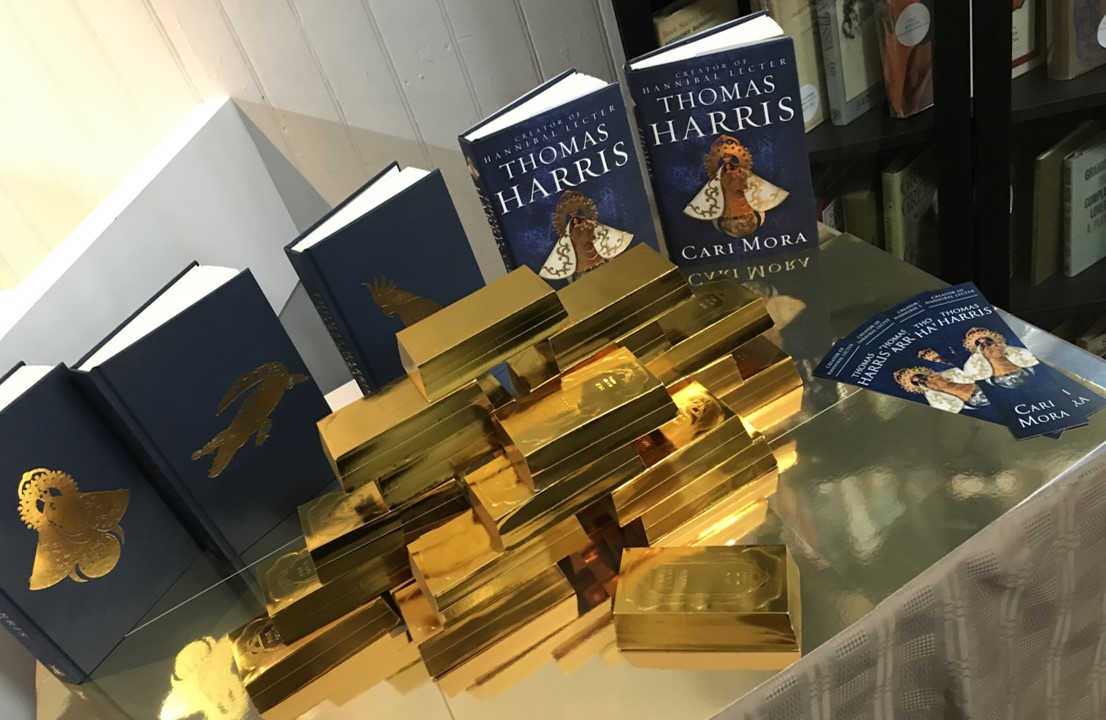
Part of the launch included details of a nationwide Treasure Hunt, for Gold Bullion, mirroring the narrative of Cari Mora – the prize being a unique ‘Gold’ Edition of the Thomas Harris novel – details from The Bookseller HERE

So we were welcomed by wine and nibbles as Publisher Jason Arthur took to the microphone, which we recorded HERE and embedded below in a six-minute clip filmed in angular gonzo-vision –


And after writing peripheral information, such as this HERE, the few literary critics who were sent the book for an opinion are now able to publish their thoughts, as the embargo was lifted, today the 16th of May 2019.

So, what were my thoughts?


And presented with no spoilers -

Despite this eagerly anticipated novel being unusually concise, as it would take no more than an afternoon curled up on a sofa to consume - it cannot be labelled with that axiom “one-sitting-read”. Like a bottle of Amarone della Valpolicella (that has been aged at least ten years), it needs to be sipped slowly, as the arrangement of words to tell a story (to paint pictures in the reader’s mind) is extraordinary. However, the horrors revealed as this narrative unfurls are troubling. The story cuts jaggedly into the mind like the obsidian-edged scalpel wielded by Hans-Peter Schneider; leaving a scar, one that reverberates inside the mind like an echo, one that doesn’t decay like the ones we screamed into those caves we explored as children. The cries and horrors from this book will remain contained within the caverns of our mind, troubling us from time to time, whenever we recall being exposed to this narrative.

Read the full review from Shots Magazine HERE


I found myself shocked at many of the events that unfold, and repelled at some actions of the antagonists but it is written so well, so adroitly edited that as a reading experience it is as exceptional, as it is hypnotic.

Though dark, and very scary it has moments of great insight, but at its core it is a thriller, one that made my pulse pound and I would urge readers to look out for it, because it is so damned fine.

Though, at times I was scared as it is so very dark.

During the reading, at moments I wondered why some of us are attracted to read of such terrible things, of humans pushed into the darkest of situations. I thought of the magnetic attraction of the car crash. Sometimes we view the hidden terrors contained in existence to be thankful; other times it’s because we wish to be at the epicentre of vicarious thrills, viewed safely, existentially, from the mind.

A line from Thomas Harris’ 1999 thriller, HANNIBAL is apt.

“The exposition of Atrocious Torture Instruments could not fail to appeal to a connoisseur of the worst in mankind. But the essence of the worst, the true asafoetida of the human spirit, is not found in the Iron Maiden or the whetted edge; Elemental Ugliness is found in the faces of the crowd.”

As Dr Hannibal Lecter when visiting the exhibition in his Dr Fell disguise gained his pleasure not from viewing the exhibits, but derived it from the faces in the crowd.

I have admiration for Thomas Harris, for what he wrote in the last paragraph of his acknowledgements, his thanks to others, for when you read Cari Mora, you will understand 

“Most of all, my thanks to this place – Miami – savory and beautiful, an intensely American City built and maintained by people who came from somewhere else, often on foot.”

We present a few photographs from the launch, and would pass our thanks to David Headley and his team at Goldsboro Books for hosting the launch party, as well as Charlotte Bush for allowing us an early read, and her colleagues for fronting the launch party.


Wednesday, 15 May 2019

The Silence of the Book Reviewer


It’s been unbearable.

Anyone that knows me, understands my talkative nature but there is a book I am not able to publish a review until Thursday 16th of May, due an embargo reinforced by punitive legal restrictions.

The book is Cari Mora by my favourite novelist, the former journalist with the Associated Press, Mr Thomas Harris.

It’s been unbearable not being able to discuss this book, but tomorrow the restriction is lifted, and so I will be publishing my review, and seeing the opinions of others.

Last week, while walking in the rain in Covent Garden, my mind would not give me peace, as my cognition constantly revolved around the exposure to that manuscript, Cari Mora, the 6th novel by Thomas Harris. I got a fright when I walked, lost in thought - which I wrote about HERE


Last weekend’s Crimefest was hard for me, as I was only able to relay the information made public by Wm Heinemann HERE and the extract made public via Charlotte Bush of PenguinRandomHouse, which can be read HERE while all the while I wanted to discuss the book with others, but was unable to do so, due to the ‘Non-Disclosure-Agreement’ in place – the silence of the reviewers.

During the weekend in Bristol, I enjoyed the company many but of particular joy was chatting to the awarding writer, biographer and journalist Ruth Dudley-Edwards and the wonderful, and equally well-read Kathryn Kennison. I am fortunate to have known these two important figures in the Crime Fiction Genre for many years. We even shared a table during the Crimefest Awards Gala Dinner. It was amusing that when I got talking about my love of the work of Thomas Harris, Kathryn thought I was referring to Robert Harris. Which made both of us laugh. It was somewhat surreal that the three of us found we were all wearing Green, on the close of Crimefest on Sunday. Coordinated by fluke.

Anyway, I digress, as ever.


While making my way to Goldsboro Books, in Covent Garden for the world launch of Thomas Harris’ Cari Mora – I was again lost in thought, contemplating the book that lay heavy on my mind when again - I found my name being shouted on the street, which again startled me. This time I noticed that it was from a group of women who called me over from a pavement cafe. Surreally it was from Ruth and Kathryn who had spotted me. They were seated outside a café, sipping coffee on a very sunny London evening, with friends when they noticed me walking by.

I stopped to talk to the group, though Thomas Harris was heavy on my mind. I reminded Kathryn about us confusing Robert and Thomas Harris at Crimefest, and said mischievously that all it would take now, is for Ruth to think we were talking about Irishman Richard Harris, at which point we all laughed and sang the chorus to this song.


I had to say my farewells quicker than I would have liked, for I needed to make my way to the launch of Cari Mora, and I didn’t wish to be late.

As I walked, I thought of my love of this former journalist’s work, and how the writers with the darkest imaginations make the nicest of people.

Age and Reflection

I’m coming up to 56, and revelling in a very rare moment. The release of a novel by a writer who marks my life.

Thomas Harris is a writer who combines a very dark imagination with such an amazing ability in terms of story-telling. Thomas Harris uses words so carefully selected, configured in such a manner weaving a narrative that deploys such economy, sheer elegance. I spoke with his British Publisher Jason Arthur and his Publicity Director Charlotte Bush, telling them that as he’s aged, he cuts back the words. Cari Mora is his Sixth novel, but what a book.

Each of his novels, in my opinion have got better, sharper and more disturbing. Or perhaps a better word would be distressing.

But, more on Thursday.

“Reading his prose is like running a slow hand down cold silk.”
Stephen King in 2019

"The best popular novel published since The Godfather"
Stephen King in 1981


I have pre-ordered the abridged reading as my May download from Audible. Jason Arthur of William Heinemann (PenguinRandomHouse UK) told me an amusing anecdote about Mr Harris getting his voice into character for Cari Mora.

Of all my audiobooks, the abridged readings by the author rank as my favourites, he’s a great narrator that acts as he reads. He uses accents just a tad above his native American South, Mississippi twang.


I know in vivid detail, these moments in my life, the release of a book by Thomas Harris decorates my memory, making everything vivid, and marked into retrievable memory; moments to return too, to think back at who I was at that time.

The clueless 17-year-old kid in 1981 buying Red Dragon in Hardcover purely on Stephen King’s recommendation, of all places SPCK, Chester. Surreally a Christian Book Store.

I was aged 25, a marine chemicals surveyor in 1988, and nearly screaming at London Heathrow, spotting an ‘early / advance’ copy of THE SILENCE OF THE LAMBS in the airport bookstore. It was my second trip to the Arabian Gulf (for a six-week tour of duty), it made the flight memorable as well as that Six Weeks. I read the novel four times, back to back. I remember that time like it was yesterday.

I was 36 and a senior executive in a German Chemical Engineering company. I queued at Maxim Jakubowski’s MurderOne in Charing Cross, London on 7-8th June 1999, with a hotel Room Booked, and a bottle of Amarone waiting for HANNIBAL, and the first in the queue, for this book.

In 2006, I was 43 and under a huge burden setting up a complex business that was in its infancy, those difficult years. Thankfully after 15 years, it all came good. And my reading of HANNIBAL RISING helped me cope with the adverse camber of setting up a business, and watching it so very closely, because a business is like a flower, it can be crushed or wilt without close, close management especially in those early days.

I’m now 55, and CARI MORA arrives tomorrow, which I cannot publish a review until then, Thursday 16th May, 2019, so I will be keen to see what others make of this writer’s 6th novel.

My review is written, and I have photos from last night, as well as video – which I will upload tomorrow when the embargo and legal restrictions are lifted – and my silence [and that of others] will be broken, because Thomas Harris’ narratives have decorated my mind, and the minds of others.

And thanks to Wm Heineman’s Charlotte Bush, there is an extraordinary competition, for which details are available from The Bookseller HERE  to coincide with this books launch, and Goldsboro Books have special slip-cased signed first editions on sale now. 

Speak tomorrow, the 'Avid Fan'


Ali Karim 15 / 5 / 2019