Sunday, 26 August 2012

Jen Forbus's Book To Die For - L.A Requiem by Robert Crais


Jen Forbus blogs at the Anthony Award nominated blog Jen'sBook Thoughts.  Before coming to the crime fiction community she taught high school English, wrote technical manuals for a computer software company and developed online training for professionals in the college store industry.  These days she's combining her love of the technical and the literary by working with a web design company that specializes in author websites.  Jen also dabbles in other freelance work including reviewing for Crimespree Magazine and Shelf Awareness for Readers.  When her nose isn't stuck in a book or a computer, she is at the beck and call of her two chocolate labs and four rescue cats.  The stork dropped her mistakenly in Northeast Ohio and try as she might, she hasn't escaped it yet.

Private investigator Elvis Cole and his long-time partner, Joe Pike, are summoned to investigate the murder of Pike’s ex-girlfriend, the daughter of a prominent L.A. businessman.  Through the course of the investigation, Pike’s history with the L.A. Police Department surfaces and old wounds are scratched open, threatening to destroy the fiercely loyal partners.

L.A. Requiem is the book I most often suggest people read when they ask for recommendations.  Whether they’re new to the genre or crime fiction fans, if they haven’t read it, I send them post haste to the nearest bookstore or library.  I also have a rather worn paperback that I allow people to borrow, but it’s not likely to last much longer.  Note to self: replace the loaner copy of L.A. Requiem.

I believe L.A. Requiem was pivotal in creating the modern crime genre.  By definition genre is a set of rules or expectations, but Robert Crais proved that genre is also a living entity.  It has room to grow and morph without becoming a completely different creature.

Elvis Cole embodies many of the characteristics of the classic private investigator character.  Crais’ novels with Cole followed the traditional first person narrative up to Indigo Slam, and then he just leapt off the cliff with L.A. Requiem.  Crais took the silly putty that is genre and said, if I push this little corner a bit in this direction, I still have my silly putty – it didn’t break – but by gosh, I think this shape works better for the story I need to tell.  And therein lies the key, it is the story he needed to tell, rather than the rules he needed to follow.

In L.A. Requiem Crais explores a depth in his characters that demands the audience not only read the book but also be a part of it, invest in it, bring their own experiences to the table, and in essence give a part of themselves to the book.  The relationships of the characters to one another compound that effect.

L.A. Requiem is a book that demands multiple readings.  There are so many layers to the plot, so much significance in every small element, that to fully appreciate it, one has to read it several times.  I’m also an advocate for listening to someone else read it aloud.  The first time I heard an audio version of L.A. Requiem I heard a new voice (not the one in my own head) and a new interpretation.  Suddenly I was asking myself new questions.

Robert Crais has influenced and continues to influence modern crime fiction writers, and I would argue that he has done that more so with L.A. Requiem than any of his other novels, so to appreciate the genre as whole as it is in the 21st Century, a fan should appreciate the evolution that brings it to where we are now.  L.A. Requiem is a part of that evolution.

L.A. Requiem is also standing the test of time.  Does it reflect the 1990s when Crais was writing the novel?  Absolutely.  But it isn’t dependent on that period; it’s dependent on concepts that are timeless: murder, betrayal, love, friendship, loyalty. 

And if that rationale seems too hoity-toity then how about, “people just freaking love this book every time I recommend it.”  I have converted many a person to the chapel of the Craisies with L.A. Requiem.  It’s a drug that’s nearly, if not impossible to resist.  L.A. Requiem made me a crime fiction fan and it still tops my list of favourite books within or outside the genre.

Saturday, 25 August 2012

Mike Ripley's Book To Die For - SS-GB by Len Deighton

Len Deighton (Left) and Mike Ripley

MIKE RIPLEY used to be an award-winning crime writer.  From 1989-2008 he was the crime fiction critic for the Sunday Telegraph, the Daily Telegraph and the Birmingham Post, reviewing over 950 crime novels.  He has also written on crime fiction for The Observer, The Times and The Guardian and has taught a course in Creative Crime Writing at Cambridge.  He currently writes the monthly ‘Getting Away With Murder’ column for Shots Magazine and is the editor for both the Ostara Crime and Top Notch Thrillers imprints.

With the publication of The Ipcress File fifty years ago in 1962, Len Deighton broke the mould of British spy fiction at a time when the mould needed breaking, introducing us to down-to-earth professional spies who were light years away from the high-living, licensed-to-kill ‘special agents’ then on the scene.  He quickly established himself as a major force in the genre and then went on to show himself to be an accomplished military historian as well.  In SS-GB, he showed his skill as a thriller writer and his attention to military detail and, just to make life more interesting, added an outrageous twist on history itself.  For any serious student of crime/thriller writing, this one is a must.


Himmler’s got the King locked up in the Tower of London”.

If the title and the iconic Raymond Hawkey dust jacket with its twopenny-halfpenny British stamp featuring Hitler’s head and its 14 November 1941 postmark have not already indicated that this is no ordinary thriller, then that first sentence should seal the deal.

In fact, Len Deighton’s SS-GB is a remarkable thriller, starting as a whodunit, morphing into a spy story and then a conspiracy thriller with global implications, but ultimately it is a novel about a decent man trying to do good job of upholding the law even as his world crumbles around him.  And what a world!  The Battle of Britain is lost, the Nazis have invaded and control most of the country, Churchill is dead (executed in Berlin by firing squad), King George VI is a prisoner in the Tower and Hitler has taken the salute at a Victory parade down Whitehall on his 52nd birthday on 20th April 1941 – there’s even a photograph on the back of the dust jacket to prove this.  But even in defeat and under occupation, life in London carries on and so, of course, does death.    

The murder of a scientist in his seedy rooms in Shepherd’s Market seems like a case for Scotland Yard’s finest detective Douglas Archer, whose pre-war record of solving high-profile crimes has already earned him the tag of ‘Archer of the Yard’.  His now German superiors seem keen for Archer to work the murder case – suspiciously keen, given that a clear power-struggle is taking place between the SS and the regular German army, the Wehrmacht, for control of occupied Britain.  The situation is further complicated (well, this is by Len Deighton after all) with the arrival in London of Dr Oskar Huth of the SD (the Nazi intelligence service) who has his own agenda at the top of which is replacing the jovial SS General Kellerman, Archer’s boss at the Yard.  When Archer discovers that the murdered scientist was working on atomic research in a secret facility in Devon, the stakes are immediately raised and the plot turns positively Byzantine as Americans, the German army’s intelligence service the Abwehr and the British Resistance (a motley mix of aristocrats, Old School Whitehall mandarins, shady black-marketers and frustrated, patriotic Londoners) become involved in a conspiracy the ultimate aim of which is to deny the Nazis the atomic bomb and to bring (neutral) America into the war. Tied up in the plot is the fate not only of honest cop Archer, who finds himself smack in the middle of the deadly rivalry between the SS and the Wehrmacht (and between the SS and the SD), but also of the imprisoned King George.

At the dark heart of SS-GB, Len Deighton does what Len Deighton does best.  His spy stories have always been boardroom dramas of squabbling intelligence agencies – office politics at their most lethal – rather than of the car-chase-shoot-’em-up school.  That is not to say the book lacks tension or action, for there are vivid and memorable scenes where Archer is attacked by a knife-wielding assassin on the escalator at Piccadilly Circus tube station, where the Highgate Cemetery grave of Karl Marx is blow up during a celebration of the Nazi-Soviet Pact, where the King is rescued from the Tower and smuggled across fog-bound London in a wheelchair, and in the tragic commando raid on the atomic research plant.  There is also a really chilling casual reference to a concentration camp for Jewish prisoners having been built ‘on Wenlock Edge’, a brilliantly sour choice for the cynical Nazis, given its pastoral English connotations  in the poetry of A.E. Houseman and the music of Vaughn Williams.

It should not be forgotten that Deighton is a Londoner, knows it like the back of his hand and has always had an eagle eye for its topography even when he imagines it under German occupation:         

And yet even a born and bred Londoner, such as Douglas Archer, could walk down Curzon Street and, with eyes half-closed, see little or no change from the previous year.  The Soldatenkino sign outside the Curzon cinema was small and discreet, and only if you tried to enter the Mirabelle restaurant did a top-hatted doorman whisper that it was now used exclusively by Staff Officers from Air Fleet 8 Headquarters, across the road in the old Ministry of Education offices.  And if your eyes remained half-closed, you missed the signs that said ‘Jewish Undertaking’ and effectively kept all but the boldest customers out.  And in September of that year 1941, Douglas Archer, in common with most of his compatriots, was keeping his eyes half-closed.

There, in a few sentences, Deighton shows how nothing much seems to have changed yet everything has; but even in defeat the ‘spirit of the Blitz’ is still evident.  During a frightening German army raid on a school, as innocent teachers and older pupils are loaded on to trucks to be taken away for questioning, they begin to sing “If you’re happy and you know it, clap your hands” to keep their spirits up.  And when a subsequent mass arrest and round-up lasting three days follows the Highgate Cemetery explosion, Londoners label it “the night of the buses”.

Deighton’s research into matters military is, of course, spot-on and his imagination is in top gear when it comes to the minutiae of civilian life in a defeated country under occupation: the dusty tea leaves, the watered-down beer, the black market operated on the Vauxhall Bridge Road, the rationing of coal and wood for heating fuel, the small cubes of margarine which are labelled as ‘a token of friendship from German workers’, the former proprietor of Samuels’ West End restaurant reduced to selling fried turnip pieces from a roadside stall while wearing a yellow star.

There is so much military and social history in SS-GB that it seems unfair to label it a novel of “What If?” because the reader is convinced that it really did happen here.
But never forget this is a thriller and some of the iciest thrills can creep up and blindside the unwary.  There is one particular scene, without dialogue, where ‘Archer of the Yard’ finds himself on a stationary train in the fog-bound marshalling yards at Nine Elms and realises that the man in the next compartment is Heinrich Himmler.

If the hairs on the back of your neck do not stand up then, they never will.

Friday, 24 August 2012

2012 CWA Dagger Shortlist and Specsavers Awards are announced


The Specsavers Crime Thriller Awards Shortlists 2012 has been announced.  The winners of 12 Awards will be announced at The Specsavers Crime Thriller Awards on Thursday 18 October at the Grosvenor House Hotel.

The awards include –
 The CWA Gold Dagger for the Best Crime Novel of the Year,
The CWA Steel Dagger for the Best Thriller of the Year,
The CWA John Creasey (New Blood) Dagger for the Best New Crime Writer of the Year,
The Specsavers Bestseller Dagger and Film and TV-based Daggers.

The CWA Gold Dagger (sponsored by Constable and Robinson)
Vengeance in Mind by N.J. Cooper (Simon and Schuster)
The Flight by M.R. Hall (Mantle)
The Rage by Gene Kerrigan (Harvill Secker)
Bereft by Chris Womersley (Quercus)

The CWA John Creasey (New Blood) Dagger (sponsored by Goldsboro Books)
Heart-Shaped Bruise by Tanya Byrne (Headline)
Land More Kind than Home by Wiley Cash (Bantam)
Good People by Ewart Hutton (Blue Door)
What Dies in Summer by Tom Wright (Canongate)

The CWA Ian Fleming Steel Dagger – sponsored by Ian Fleming Publications
Dare Me by Megan Abbott (Picador)
A Foreign Country by Charles Cumming (HarperCollins)
The Fear Index by Robert Harris (Hutchinson)
Reamde by Neal Stephenson (Atlantic Books)


The Specsavers Awards are as follows -

The Specsavers Bestseller Dagger which is by public vote.
This award honours the success of authors throughout their careers, and is chosen by the reading public.  Readers can register their vote for their favourite bestselling author online hereThe winner will be presented with the Bestseller Dagger at the awards ceremony on the 18 October, after all the votes are counted on 12 October.  The nominees are –


Specsavers TV and Film Daggers:

The Film Dagger
Drive (Icon)
The Dark Knight Rises (Warner Bros)
The Girl With The Dragon Tattoo (Sony)
The Guard (Optimum)
Tinker Tailor Soldier Spy (Studio Canal)

The TV Dagger
Appropriate Adult (ITV Studios/ITV1)
Line of Duty (BBC/BBC2)
Sherlock: Series 2 (Hartswood Films/BBC1)
Wallander (Left Bank Pictures, Yellow Bird/BBC1)
Whitechapel: Series 3 (Carnival/ITV1)

The International TV Dagger
Boardwalk Empire: Season 2 (HBO/Sky Atlantic)
Dexter: Season 6 (Showtime Networks, John Goldwyn Productions, TheColleton Company, ClydePhillips Productions/FX)
Homeland (Teakwood Lane Productions, Showtime Productions, Cherry Pie Productions, Keshet Media Group, Fox 21/Channel 4)
The Bridge (Danmarks Radio, Sveriges Television/BBC4)
The Killing II: Forbrydelsen (Arrow Films/BBC4)

The Best Actress Dagger
Brenda Blethyn for Vera (ITV Studios/ITV1)
Claire Danes for Homeland (Teakwood Lane Productions, Showtime Productions, Cherry Pie Productions, Keshet Media Group, Fox 21/Channel 4)
Sofie GrĂĄbøl for The Killing II (Arrow Films/BBC4)
Sofia Helin for The Bridge (Danmarks Radio, Sveriges Television/BBC4)
Maxine Peake for Silk (BBC/BBC1)

The Best Actor Dagger
Kenneth Branagh for Wallander (Left Bank Pictures,Yellow Bird/BBC1)
Steve Buscemi for Boardwalk Empire (HBO/Sky Atlantic)
Benedict Cumberbatch for Sherlock (Hartswood Films/BBC1)
Damien Lewis for Homeland (Teakwood Lane Productions, Showtime Productions, Cherry Pie Productions, Keshet Media Group, Fox 21/Channel 4)
Dominic West for Appropriate Adult (ITV Studios/ITV1
  
The Best Supporting Actress Dagger
Frances Barber for Silk (BBC/BBC1)
Kelly Macdonald for Boardwalk Empire (HBO/Sky Atlantic)
Archie Panjabi for The Good Wife (Scott Free Productions, King Size Productions, Small Wishes, CBS Productions/More 4)
Sarah Smart for Wallander (Left Bank Pictures, Yellow Bird/BBC1)
Una Stubbs for Sherlock (Hartswood Films/BBC1)

The Best Supporting Actor Dagger
Alun Armstrong for Garrow’s Law (Shed Media/BBC1)
Alan Cumming for The Good Wife (Scott Free Productions, King Size Productions, Small Wishes, CBS Productions/More 4)
Phil Davis for Silk & Whitechapel (Silk: BBC/BBC1)(Whitechapel: Carnival/ITV1)
Laurence Fox for Lewis (ITV Studios/ITV1)
Martin Freeman for Sherlock (Hartswood Films/BBC1)

‘Best Detective Duo’ by Public Vote
The British public will also have the chance to vote for their favourite detective duo by phone vote. The phone lines open at 12:00pm on 7 September 2012.
The shortlist is as follows:
DCI Banks – DCI Alan Banks & DS Annie Cabbot – Call 090 16 16 14 01
Above Suspicion – DC Anna Travis & DCS James Langton – Call 090 16 16 14 02
Scott and Bailey- DC Jane Scott & DC Rachel Bailey – Call 090 16 16 14 03
Lewis – DI Robbie Lewis & DS James Hathaway – Call 090 16 16 14 04
Whitechapel – DI Joseph Chandler & DS Ray Miles – Call 090 16 16 14 05
Vera – DCI Vera Stanhope & DS Joe Ashworth – Call 090 16 16 14 06

J. Kingston Pierce’s Book to Die For -- The Eighth Circle by Stanley Ellin


J. Kingston Pierce is the editor of the crime-fiction blog The Rap Sheet, which has won the Spinetingler Award and been nominated twice for an Anthony Award. He also writes the book-design blog Killer Covers and serves as senior editor of January Magazine. Pierce is the author of more than half a dozen non-fiction books, including San Francisco: Yesterday & Today (2009), Eccentric Seattle (2003), and America’s Historic Trails with Tom Bodett (1997). He lives in Seattle, Washington.


I’m always surprised when I get to talking with committed detective-fiction fans, and I ask them whether they have read Stanley Ellin’s The Eighth Circle ... and almost invariably, the answer is “no.” In fact, I can count on the fingers of one hand the number of people who’ve actually said “yes” to that question.

How is it that The Eighth Circle, which was first released back in 1958 and a year later won the Edgar Allan Poe Award for Best Mystery Novel, could be so roundly forgotten? Well, it doesn’t help that it hasn’t been reissued much over the ensuing decades; the last edition appears to have come out in Britain in 2004. Certainly the handsomest and probably the most coveted version, however, is the Dell paperback from 1959 (shown below), which features a Robert McGinnis cover illustration. I like that edition so much, I’ve purchased a handful of copies over time and now pass them out to readers who seem especially deserving of an introduction to this remarkable tale.

The Eighth Circle ranks as a standout because it doesn’t try to jam in all of the conventions of the genre, and even endeavors to play against a few. Yes, this is a private-eye novel with a certifiable member of that breed as its protagonist: Murray Kirk, the son of a New York City grocer, who, after an unsuccessful stint practicing law, answered an advertisement to join Frank Conmy’s upscale Manhattan investigations firm and was hired on the spot. And yes, it boasts a plot filled with dire possibilities: Kirk, who’s now risen to become the suave head of the firm, and has even taken over the late Mr. Conmy’s elegant Central Park-side apartment, is hired to save the bacon of Arnold Lundeen, a policeman attached to the Vice Squad, who’s been caught up in a huge corruption scandal linked to a city-wide betting ring. But there’s no classic femme fatale in these pages, unless you imagine schoolteacher Ruth Vincent, Lundeen’s black-haired and long-lashed fiancĂ©e, to be more dangerous than she ever lets on. Furthermore, there are no bloody demonstrations of fisticuffs here, or even a gun drawn until well into Ellin’s story--and that weapon turns out to contain no bullets.

Ellin, who’s said to have studied several P.I. firms before sitting down to pen The Eighth Circle, offers here what at least seems to be a more realistic portrayal of the mid-20th-century sleuthing biz. Complete with officious secretaries. And plenty of paperwork and accounting responsibilities. And some boredom besides--because really, no modern enterprise exists independent of the periodically mundane, does it?

What ultimately propels this novel’s plot and keeps the reader hooked is the ethical quandary in which Murray Kirk finds himself. Despite his much-studied air of professional distance, he winds up falling hard for cop Lundeen’s unflashy but warm-hearted betrothed. In fact, he reasons that if he could get Lundeen out of the way--somehow reveal or manufacture the man’s guilt without leaving too many of his own fingerprints behind--he could have Ruth Vincent all to himself. The problem is, the more Kirk works on this case and tries to redirect things to his advantage (something that isn’t entirely lost on his veteran employees), the more clearly he recognizes the innocence of his client and the consequent hopelessness of his heart’s pursuit of darling Ruth.

It’s only too bad that Ellin abandoned Murray Kirk after The Eighth Circle (though he did go on to compose other P.I. novels, including 1979’s Star Light, Star Bright). As the exemplar of a less-disheveled, more-businesslike and morally divided gumshoe, he could really have been a contender in this genre.

Thursday, 23 August 2012

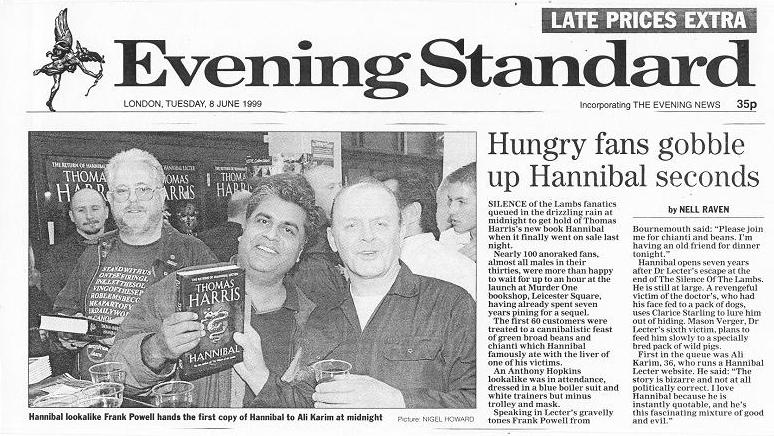
Ali Karim's Silence To Die For - The Silence of the Lambs by Thomas Harris


Ali Karim is Assistant Editor at Shots eZine, a contributing editor at January Magazine & The Rap Sheet and writes for Crimespree Magazine, Deadly Pleasures. He is an associate member of The Crime Writers Association [CWA], International Thriller Writers [ITW] and the Private Eye Writers of America [PWA]. Karim contributed to ‘Dissecting Hannibal Lecter’ ed. Benjamin Szumskyj [McFarland Press] a critical examination of the works of Thomas Harris; The Greenwood Encyclopedia of British Crime Fiction [ed. Barry Forshaw] and the Edgar and Anthony Award nominated ITW 100 Thriller Novels ed David Morrell and Hank Hagner [Oceanview Publishing]. In 2011 at the Anthony Awards held at Bouchercon St Louis, he was presented with the 2011 David Thompson Memorial Award for Special Services to the Crime and Thriller Genre.

Ali Karim is also the programming chair for Bouchercon 2015 in Raleigh, North Carolina, USA.

When Ayo Onatade asked me to write about John Connolly and Declan Burke’s Books To Die For, she remarked that she didn’t need to guess which featured book and essay I would chose. She was right, despite the massive array of masterful essays from some of our leading writers commenting on novels that appear at the apex of the genre, there will always be one book, and one writer that I would die for.

Firstly, I have to admit my love and hatred of books like this, having contributed to them myself. The love of these peer reviews / appreciations comes from my own reading compulsion, and reading extensively allowing me to learn about life and the “world / reality” I see before me through the eyes of others. The hate comes from my knowledge that I am far from as ‘well-read’, as I consider myself, though this is tempered by using tomes such as this, in seeking out books and writers that I have overlooked, or perhaps cajoling me to re-read a particular work due to someone else noticing something or aspects writing, that I had missed. Much of this comes from my understanding of the aging process in a reader. Some books that knocked ‘me for six’, when I was a teenager, when I re-sampled them later in middle age, have not stood the test of time. Others however appear much more complex than my teenage mind understood at the time I first cracked their spines. You see, the books [per se] have not changed [unless they are redux versions, like Stephen King has done with ‘The Stand’ releasing it a decade later with additional text that was edited out in the first release]. Though what has changed is the reader [and his/her mind]. Age [and life] alter ones thinking and cognition and therefore changes aspects of the book, when re-read many years later with a more mature mind.

I have to applaud the Irish writers Connolly and Burke for producing such an interesting and hefty tome; an audacious idea soliciting erudite and passionate essays from some of the worlds greatest writers about books that enthused them. For what is life without passion and enthusiasm? And who best to select such milestones in the crime and thriller genre than the writers who plough that dark road themselves. The contributors are a “who’s who” of contemporary fiction, and to list them all would be a feat itself, and proves what a herculean task Connolly and Burke have achieved. Speaking in hyperbolic terms, the novel and essay that Ayo Onatade guessed would be the one I would write about is of course Kathy Reichs’ essay on Thomas HarrisThe Silence of the Lambs.

Reichs’ essay is filled with insights, that start with Harris’ precursor, the 1981 Red Dragon and Harris’ reoccupation with the injustices of God, as viewed by Lecter and Harris’ own Southern Baptist past. As a scientist, Reichs indicates the layered authenticity in the narrative from Harris’ own journalistic background as a crime reporter, but special mention is made on the characterization, how Harris carves the protagonists and antagonists as if deploying the skills of a master sculptor. Writing about such a well known work of the genre is a tricky assignment, though Reichs’ excels at showing the importance of secondary characters such as the Smithsonian entomologists Pilcher and Roden and how the scenes that flow from the narrative owe more to Poe than Ludlum. She uses the term ‘unsettling’ in her examination of Harris’ novel and how this atmosphere bleeds into the narrative, making the reader as edgy as one of Buffalo Bill’s victims. Naturally mention of the examination of the relationship between Lecter and Starling is shown as being pivotal to the proceedings. The critical point in the examination of Harris’ Silence of the Lambs rests in the opening from the editors “Harris maintains a low media profile and is reputed to find the process of writing intensely difficult: he has published only five novels in thirty-seven years”. This indicates that to produce something as definitive as Silence of the Lambs is hard, hard work, something that is shared with the novels dissected in this wonderful book.

Kathy Reichs’ last line ‘His writing greatly influenced mine’ shows the respect she has for this genre-shaping novel; a work that is as unsettling as it is insightful. Reading it makes one feel what it is like, to be that rabbit hypnotized and paralyzed by the headlights of that oncoming car, the self same metaphor that Harris uses in the first chapter. The Silence of the Lambs is not a book that you walk away from without your worldview being shaken, like a bullet wound, when you close the covers, it remains inside you, reminding you what the dark end of the street feels like.

Continuing the hyperbolic theme, Books To Die For is probably the most important work chronicling the novels and writers that make the crime and thriller genre the most interesting part of fiction-publishing. Any enthusiast who does not have this volume on their bookshelf is depriving themselves of the most enlightening glimpse of what the vertigo-inducing heights that crime and thriller fiction can scale. Reading it is like going back into a time machine, as you get flooded with memories of ‘what and who you were’ when you read some of these magnificent novels; because they scar your psyche.

Bravo Mr John Connolly and Mr Declan Burke for producing such a treat, and one that will endure and one that I hope to see in the non-fiction award nominations for 2012.  

And Ayo, you guessed right, it will always be The Silence of the Lambs for this reader, as Thomas Harris has produced a monster of a novel, and one that Kathy Reichs’ essay does justice to.

Wednesday, 22 August 2012

Sander Verheijen's Book To Die For - Wicker by Kevin Guilfoile


Sander Verheijen (1974) is the chief editor and founder of Crimezone.nl, the number one review and reader’s site for Crime Fiction & thrillers in The Netherlands and Belgium.  The site started in 2002. He left the thriller site in 2005 and worked several years as an editor for crime fiction and later on as a marketing manager at large publishing houses (2005-2010) and started his own graphical design studio.  In 2010, he returned to Crimezone.nl as chief editor and reviewer.  Verheijen has interviewed a large number of national and international crime writers, designed many book covers and works as a columnist for a Dutch men’s magazine.

When I was asked to name that one book to die for, I knew I would suffer some nights thinking about it.  I am a huge fan of the genre for almost 25 years, and working “in it” for the last ten.  Of course, I read many, many thrillers, but to make such a decision was hard.

One book to die for.  I could easily say “Presumed Innocent” by Scott Turow and “The Wire in the Blood” or “A Place of Execution” by Val McDermid, and of course Harlan Coben’s “Tell no one” or “Gone for Good”.  They would all end high in my personal list of books to die for.  If there was a list...  Not one. ONE book to die for, was my mission.  Just one...  That one book had to be a special one.  One you could possibly never forget, even if you wanted to.

That one book to die for me is a book that was published seven years ago by Knopf in New York.  A debut novel, written by Kevin Guilfoile, and titled “Cast of Shadows”.  In the UK, it was named “Wicker” and published by Penguin.

For me it started with that one sentence on the shiny red cover of the American hardback edition: ‘How far would you go to look into the face of your daughter’s murderer’.

It was this book on the pile on my new desk that got my immediate attention.  I had just started working as an editor for a Dutch publishing house.  It was the first book I read from an editor’s point of view, and not with the eyes of the reviewer, I had been the years before.

Wicker” begins with the heartbreaking story of Dr. Davis Moore, a fertility doctor in Chicago specialising in reproductive cloning, a controversial and closely regulated new practice.

In a time that the clinic he works for is subject on many discussions and violent and life-threatening protests, Moore’s seventeen-year-old daughter is brutally raped and murdered.  The case is investigated but never solved.  A year later, Moore retrieves her belongings from the police, and finds among them a vial containing the killer’s DNA.  Tormented by grief, Moore entertains a monstrous thought: the possibility of cloning not his daughter but the man who killed her.

To discover the murderers identity Moore decides - against all rules, regulations, and moral concerns - to use the DNA sample for one of his new clients, knowing that the baby will once be an identical copy of his daughter’s rapist and killer.

Goosebumps already?  The moral dilemmas Dr. Moore faces are terrifying real.  Especially when you know that, it takes many years to see the results, assuming the killer was an adult.

Part two of the book starts when Justin, the cloned kid, is fourteen years old.  America is under the spell of Shadow World, an online role-playing game.  An online environment, very similar to “Second Life”.  When there is a serial killer active in the real, as well in the virtual world, Justin has a more than average interest in this case.  From that moment on, we follow the two main characters, Justin and Dr. Moore, in their own search for justice, leading to a climax that gives you shivers and will not be easily left behind. 

It is not often that I read a book that made such a huge impact on me as a reader, and as an editor.  Of course, I bought the translation rights and we published it a year later.  It did gain very good reviews but unfortunately, it did not become the success I thoroughly hoped for.  Now, seven year later, I am very happy to see that Kevin Guilfoile got his well-deserved second chance in The Netherlands with this wonderfully written and thoroughly composed psychological thriller.  Brought by a new publishing house, with a new title and a new cover.  I do not think it will be a huge bestseller now, but it is another possibility for crime fiction readers here to discover this one book to die for. 


Tuesday, 21 August 2012

Peter Rozovsky's Book To Die For - Roses, Roses by Bill James


Peter Rozovsky writes the Detectives Beyond Borders Blog. He has written essays and introductions for Following the Detectives: Real Locations in Crime Fiction and The Cultural Detective: Reflections on the Writing Life in Thailand. He reviews international crime fiction for the Philadelphia Inquirer. He is a newspaper subeditor, a freelance writer and crime-fiction editor, and the father of Noir at the Bar.

Some of us remember where we were when John F. Kennedy was shot or World War II ended; I remember where I was when I first read Bill James. I was having coffee and a scone and passing the time of day at my local secondhand bookshop when the owner said, "Hey, you might like this" and handed me Roses, Roses, tenth novel in James' Harpur & Iles series.

Two pages in, I was Siddhartha Gautama under the Bodhi tree. I was Hugh Hefner at that magical moment when his mother said, "Hugh! Stop studying so much. Go find a nice girl." I read a third of the book, brushed the crumbs from my upper lip, and said: "I'll take it."

What makes Bill James so much fun to read? Here is part of what James told me in an interview: “I tend to get bored reading books where the dialogue is very sequential and reasonable.”

The same goes with James’ narration. Here is a snippet from I Am Gold, Book 27 in the series:

"Harpur thought the greeting, regreeting, fizzled with emptiness and formula. Naturally it did. It came from the manual — Besieging for Dummies, or something like. And, just as naturally, this boy, this boy `John' in there could recognize smooth-textured bullshit. Very likely these calls would contain nothing but. In fact, perhaps ultimately there'd be so much he would get disorientated by it, half smothered by it, gently and mercilessly chinwagged into collapse and surrender by it. But, maybe he recognized this hazard and left the phone dead for spells while he got his breath back."

That’s not a take on hostage negotiations one is likely to find in most crime novels.


What makes the series great, other than James’ ability to make routine passages deliciously funny? Its delicious looks at the upward aspirations of its gangsters. Its funny, touching takes on family life. It’s teaming of the vain, violent, ungovernable ACC Desmond Iles and his partner, DCI Colin Harpur, who sometimes deflects and sometimes slyly returns Iles' insults, yet who is capable of betrayals of his own. Its "brilliant combination of almost Jacobean savagery and sexual betrayal with a tart comedy of contemporary manners," according to John Harvey, who ought to know a thing or two about crime fiction. And the gorgeous prose:

"If you knew how to look, a couple of deaths from the past showed now and then in Iles' face."

That's from In Good Hands, and it's haunting and beautiful. James can also be laugh-out-loud funny while remaining just as haunting, as in, the opening of The Detective is Dead:

"When someone as grand and profitable as Oliphant Kenward Knapp was suddenly taken out of the business scene, you had to expect a bloody big rush to grab his domain, bloody big meaning not just bloody big, but big and very bloody. Harpur was looking at what had probably been a couple of really inspired enthusiasts in the takeover rush. Both were on their backs. Both, admittedly, showed only minor blood loss, narrowly confined to the heart area. Both were eyes wide, mouth wide and for ever gone from the stampede."

The series hits its stride around its seventh book and becomes a kind of grand and cracked portrait of Britain's shifting urban and social landscape at the end of the twentieth century, of the murky boundaries between police and criminals, of suburban social climbers who happen to be killers and drug dealers, of the strange ways people build families in changing times. The books are violent, dark, and often very funny. And their author just may be the best prose stylist who has ever written crime fiction in English.

Monday, 20 August 2012

Barry Forshaw’s Book To Die For - The Ministry of Fear by Graham Greene


The first of our blogger/reviewers take on Books to Die For is Barry Forshaw.

British critic Barry Forshaw is a writer and journalist whose writing career covers a number of genres.  He is the acknowledged expert on Scandinavian crime fiction and the author of numerous work on films and crime fiction.  He has done documentaries on crime fiction for a number of television stations.  His work includes The Rough Guide to Crime Fiction, British Crime Writing: An Encyclopaedia.  He is also the editor of the well-regarded online crime fiction magazine Crime Time.  His most recent book is Death in a Cold Climate - A Guide to Scandinavian Crime Fiction and his latest book, which is due out in September, is British Crime Film: Subverting the Social Order.  A former Vice-Chair of the Crime Writers’Association.  He also wrote the first UK biography on Stieg Larsson – The Man Who Left Too Soon.


Had Graham Greene (1904-1991) not written the 'serious' novels (such as A Burnt Case and The Heart of the Matter) which marked him out as one of the greatest of all English writers, his ‘entertainments’ (as the author rather dismissively described them) would constitute a body of crime and thriller fiction almost without equal in the field.  Early in his career, Greene introduced an element of the spy story into The Confidential Agent (1939), in which D, the agent of a Latin government (Republican Spain in all but name), figures in a narrative that was clearly influential on such later writers as John le CarrĂ©.  The latter has long acknowledged Greene’s considerable influence on his work.  Greene's most celebrated crime novel, of course, is Brighton Rock (1938, with its psychotic young antihero Pinkie), which the author decided to move out of his ‘entertainments’ category.  This sometimes slippery shifting of genres by the author was always a rather arbitrary endeavour: the moral concerns of the thrillers were often precisely those of the more serious books, while the pursuit narratives of the serious books (such as the whisky priest on the run in The Power and the Glory, 1940) had precisely the same visceral trajectory as the thrillers.  However, all the books have that dark and sardonic view of existence, which quickly became identified as ‘Greeneland’, a queasy admixture of the seedy, the surrealistically funny and the dangerous.  Two other crucial ingredients need to be identified in the Greene mix: the author’s uneasy relationship with Catholicism (he converted under the influence of his wife's piety, but was never an unquestioning believer after the fashion of his correspondent and colleague Evelyn Waugh, who chastised Greene for his doubts).  Greene’s work is also distinguished by its frank and realistic depiction of the sexual relations between men and women – not, that is to say, in any graphic fashion, but with an unblinking assessment of the joys and despair concomitant with sexual passion.


Which novel is the best of his thrillers?  Brighton Rock, with its brilliantly realised picture of a violent seaside underworld, is as strong a starting point for those new to Greene as anything he wrote, but my personal choice, on balance, is the superbly honed thriller The Ministry of Fear (1943), which demonstrates an authority and mastery of the narrative form that makes most practitioners look mere journeymen.  London in the Blitz is brilliantly conjured by the author in this dazzling piece.  This is an ‘entertainment’, but the moral issues here are as rigorously handled as anything tackled by Greene in his more ambitious novels.  Arthur Rowe, full of guilt after the death of his sick wife, is plunged into a dangerous world of murderous, shadowy figures.  The Ministry of Fear is possibly the author’s most sheerly enjoyable novel in the ‘thriller’ vein.  (Fritz Lang made a creditable stab at The Ministry of Fear for the cinema.)

Saturday, 18 August 2012

Being Sworn to Secret by Amanda Jennings!


Today’s guest blogger is Amanda Jennings whose debut novel Sworn Secret is published today.

I knew I wanted to write a book about sisters.  I have a sister and also three daughters, so the concept of sisters is close to my heart. As I was playing around with ideas I thought about what it might have been like to have lost my sister in childhood and how that would have affected my life. It was a quick progression to imagining how I would cope if something happened to one of my girls, and it was the vivid emotions I felt that convinced me this was the area I wanted to explore.

Writing the book meant I had to trawl through some pretty dark imaginations. As a mother my worst nightmare is something happening to one of my daughters, and by happening I mean the kind of thing that makes a parent stop dead in their tracks and wince at the thought. Sworn Secret begins with the death of a teenage girl, and one year on her family is still struggling to cope with their loss. Their daughter was hiding something from them, something disturbing and shocking, which not only leads them to question the circumstances of her death, but compromises their emotional recovery further. It was heartbreaking to sit at my desk and have to think about how I’d feel if my own teenage daughter was killed. I would often find myself in tears as I wrote certain passages and would leave my study feeling shattered. A few people have asked how I was able to write about dealing with the death of a child without having experienced this directly myself. My first response is that as a writer this is my job, to use my imagination and empathy to evoke emotional responses in the reader so they can connect with the characters. But I also think that as a parent one is naturally moved by the plight of other parents who suffer the tragic loss of a child. Every parent expects their child to outlive them; this is the way of the world, the natural order of things. When you learn of a family whose child has died you immediately – and without much difficulty – put yourself in their place. You feel a vast amount of sympathy, but at the same time there’s an element of grateful relief. Thank god that’s not me. Thank god that’s not my child. You might suddenly grab your son or daughter and hug them, or slip upstairs to check them while they sleep; wondering for a painful moment how on earth you would cope.


I wonder if writing about these feelings, these fears, is a way of trying to protect myself, perhaps hoping that if the worst did happen I’d somehow be prepared for it. But of course, nothing could prepare you. Worrying about our children is perfectly normal and is a sure-fire way of reminding us how precious the here and now is.

More information about Amanda and her work can be found on her website.