Showing posts with label Len Deighton. Show all posts

Tuesday, 17 March 2026

Len Deighton a personal appreciation by Mike Ripley


Have Pencil, Will Write.

They say you should never meet your heroes. Well, they are wrong.

One of the proudest moments of my life was when, as a student, I had an essay, on the economic policies of fascist states in Europe in the 1930s, returned from the tutor who had marked it with the added comment: Stop trying to write like Len Deighton! (Despite, or perhaps because of this, I got a good mark.)

Even earlier in my academic career, I had reason to be grateful to Len Deighton. As a teenage schoolboy I treated myself to the first hardback novel I ever bought, Billion Dollar Brain in 1966 (it cost 21 shillings). During a lesson with a notoriously sarcastic English master, we were asked to name the novel we had read most recently and I was immediately accused of lying as I could not have read Billion Dollar Brain because ‘it’s not out in paperback yet’. When I claimed I had the hardback first edition, and could bring it to school, the master said: ‘Can I borrow it?’ He did, and I got excellent marks for the rest of the term.

I have written extensively on the impact Len’s debut novel, The Ipcress File (1962), had on me and the whole spy-fiction genre and it is certainly the novel I have read more times than any other and for me, the anonymous hero of Ipcress, Horse Under Water, Funeral In Berlin and Billion Dollar Brain (‘Harry Palmer’ in the films) is an icon of the Sixties. With advancing age, I have come to realise that I belong to the early generation of Deighton fans, as there is a younger generation which believe his massive contribution to spy fiction began in the Eighties with his triple trilogy featuring the world-weary spy Bernard Samson. I’m sticking to my guns. Much as I enjoyed the Samson saga (and its background novel Winter) I think those first four books were Deighton’s greater achievement.

But they were not his only achievement. He had already established himself as a graphic artist (and noted designer of book covers) and combined this skill with a natural talent for cooking in his famous ‘cookstrips’ which even the most culinary illiterate male could follow. He also found time to be a film producer. At the end of the Sixties he broke new ground writing his WWII novel Bomber with the aid of a word-processor, gaining a reputation as a keen adopter of new technology, especially when it was reported that he had a personal telex machine and one of the first radio car telephones. I did once ask Len if it was true about the car phone and he replied with a cheeky grin: ‘And the first call I took on it was Bertrand Russell asking if I knew how to contact The Beatles…’ 

He put his interest in WWII to good use, establishing himself as a military historian of the conflict who had clearly considered and research the German side, in which he was assisted by his wife Ysabele and her fluency in numerous languages. The war was to feature in his fiction in novels such asiXPD, City of Gold and Goodbye Mickey Mouse, which he once told me was his favourite book, and spectacularly in his ‘alternate history’ SS-GB.

I first met Len in The Travellers’ Club in London, where he researched the background to the opening of his novel Winter – specifically New Year’s Eve 1899 in Vienna. Although we had corresponded via email through our mutual friend Harry Keating we had never actually met and Len must have sensed my nervousness, for he quickly set me at my ease and offered me his basic rules when attending any sort of business meeting: ‘Have a clean shirt, wear a tie and always be polite.’ I think he appreciated my reply: ‘Well two out of three ain’t bad’.

From then on we would meet for lunch whenever he was in London, and damn fine lunches they were even without alcohol. (I only ever saw Len drink once, a single glass of champagne at a lunch he hosted in Knightsbridge.) He introduced me to the cuisine of Anton Mosimann (and Anton himself) while I introduced him to the cooking of Marcus Waring, and though the food was good, it was the table talk which always made the occasion. 

At one lunch in a Japanese restaurant a discussion about the economy of Renaissance Florence somehow turned into an explanation (by Len) of how stolen money could be 'laundered' into US dollars in Vichy France. A month or so later, I asked him if I could use his idea as the basis of a plot. He agreed and it became the backbone of my novel Mr Campion's War.

On another occasion, I told him of a recent poll on Radio 5 to find the ‘best Bond villain’ and whilst Blofeld, Goldfinger, Oddjob, etc. all scored highly, one person voted for film producer Kevin McClory. I knew Len had known McClory, and worked with him on various Bond projects, and would be amused by the poll. He was, and immediately penned an eBook, James Bond: My Long and Eventful Search for his Father.

His stories about the film world and publishing in the Sixties were always entertaining, often self-depreciating and (almost) never rancorous. Although when published, Ipcress File was touted as the ‘anti-Bond’ and the media of the time would have loved a Fleming/Deighton confrontation. But Ian Fleming chose Ipcress as his book of the year for The Sunday Times and Deighton has credited the boom in spy stories in the 1960s to the success of the Bond films. He has always maintained that there were two strands: he wrote spy fiction, Ian Fleming (with many others aping him) wrote spy fantasy.

It was that definition which I used as a basic thesis in my history of British thrillers, Kiss Kiss Bang Bang, which I dedicated to Len Deighton. For that I remain eternal grateful, as well as for the many books he urged me to read (which I did) and the authors I should champion – Ted Allbeury being a case in point. And, of course, for the casual advice about writing and being an author which passed across those many tables.

I especially remember him going suddenly serious and asking if I ever suffered from ‘writers’ block’. When I said ‘no’, he seemed relieved and dismissed the idea as ‘the blank wall we secretly know is incompetence’. He scoffed at associating writers’ block with technology, from electric typewriters to word processors to laptops. ‘The only implements needed to write book are pencil and paper, everything else is luxury.’

Len Deighton wrote a lot over thirty non-stop years and I thought, as a long-time fan, I had read it all, but I discover one piece which I have missed, his editing of Drinkmanship in 1964, which sounds right up my street.

What a hero!


Tuesday, 17 October 2023

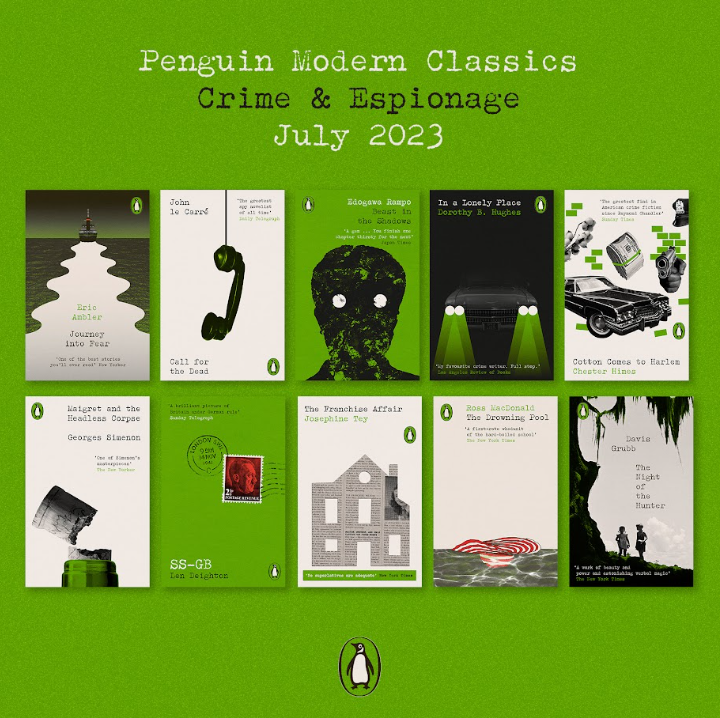
The Return of Penguin Greens

From the 1930s onwards crime novels published by Penguin had covers using a lot of green ink. This led to a clear distinction between two different kinds of novel – effectively all other novels (orange) and crime novels (green). This had the unintended effect of implying that these were different reading experiences or had different statuses when, of course, some ‘crime’ novels are simply among the best novels of any kind whereas orange novels came to seem more middle- to-upper brow even if they might be in practice be much less well written, ambition and plausible than novels by Dorothy M. Sayers, say, or Raymond Chandler. 

Famously it was on returning from a visit to Agatha Christie that Allen Lane, standing on a platform at Exeter station, had the idea for Penguin paperbacks and in the 1950s he once celebrated Christie’s birthday by printing in one go a million copies of her books (10 different novels x 100,000).

Crime of every description has therefore, from the most horrific to the most genteel, always stood at the heart of the entire Penguin enterprise. For reasons not now clear in the 1980s it was decided to drop the green spine and publish all fiction with an orange spine. Then design moved on again, often restricting the Penguin element to the bird logo itself and only keeping hints of Penguin orange. Around the same time light blue Pelicans were also dropped, with the Penguin colour schemes restricted to the black-spined Penguin Classics or the various shades of eau-de-Nil and grey for Penguin Modern Classics.

I have published various series as a Penguin employee over the years—Great Ideas, Little Black Classics and others—and it is really almost with a sense of embarrassment that it has taken until 2023 to realize that one of the most potent and fun traditional Penguin colour codes was simply lying around waiting to be reused: Green for Crime. I mention this because it is at some level shameful that it should have taken so many years to come up with something so straightforward that it barely qualifies as a concept or an idea: why didn’t we do this a decade ago? Two decades?

Lurking within Penguin Modern Classics we already published some of the greatest crime writers – Dorothy B. Hughes’s sensational In a Lonely Place, Eric Ambler’s great pre-War thrillers, Chester Himes’s wonderful, frenzied fantasies of Harlem, Ross Macdonald’s novels of southern California’s squalor lurking under the pretty surface. I am myself responsible at Penguin for the backlist of two great writers in the genre, John le Carré and Len Deighton, and yet had not noticed until very recently that these could be assembled into a matchless series of the greatest crime writers.

Once, very belatedly, we decided to proceed with the idea it seemed a shame not to add other writers. We already published Georges Simenon’s extraordinary books, of which he wrote so many (and at such a consistent level of excellence) that it would make sense to showcase a couple simply to give readers a way into his enormous oeuvre. Josephine Tey’s novels had just come out of copyright, so this provided the opportunity to publish her superb, unsettling The Franchise Affair and Brat Farrar. We also had C.S. Forester’s wonderfully nasty little shocker Payment Deferred about a murderous South London miser (written long before Forester became famous for the Hornblower novels).

For the series to be fresh though it needed some new discoveries and a lot of time was spent reading sometimes terrible books (please do not read anything by Peter Cheyney!) but also books which had just aged badly. I was particularly sorry that Helen MacInnes now seemed so lacklustre as my parents had loved her novels of international espionage when they were published – but now they seemed to consist predominantly of people endlessly walking around, having meals and checking into hotels, with very occasional outbursts of unengaging and tasteful violence.

Battling through some quite neither-here-nor-there stuff though made it much easier to spot wonderful things. Many recent crime novelists remain in print because of Kindle editions or print-on-demand versions, but it was very exciting to find two giants of British thriller writing from the 1970s and 1980s, Anthony Price and Michael Gilbert, available to be discovered. Both giants in their day, their work still has an ingenuity and excellence which has in no way dated – so Price’s Other Paths to Glory and Gilbert’s Game Without Rules joined the list. And I was tipped off to try Dick Lochte, whose 1985 debut Sleeping Dog is a classic, extremely funny piece of neo-noir with the simple but useful advice: if you are a jaded private investigator in L.A. and a girl on roller-skates asks you to help her find her missing dog, don’t say yes. The other great find was the Japanese writer Edogawa Rampo (real name Tarō Hirai – his pen name derives from the Japanese pronunciation of Edgar Allen Poe). Between the wars he wrote a number of thrilling and disturbing classics, some with a wonderful Tintin-like flavour (Gold Mask and The Black Lizard) and others with the depravity dialled up (Beast in the Shadows). All three of these are in the series. 

We are now finishing work on a third set of ten, including some just wonderfully recommendable stuff! Shirley Jackson’s We Have Always Lived in the Castle, Ian Fleming’s From Russia with Love, Anthony Price’s The Labyrinth Makers and John le Carré’s The Night Manager. Best of all (but of course they are all best) is a long forgotten classic of New York City noir, The Deadly Percheron by John Franklin Bardin, set in a gloomy wartime Manhattan and Coney Island. The fate of its decent psychiatrist hero as he unwillingly wades deeper and deeper into an inexplicable, surreal and truly horrible urban underbelly has to be experienced to be believed.

Here are the three sets, with the third not published until June 2024:

  1. Davis Grubb NIGHT OF THE HUNTER
  2. Edogawa Rampo BEAST IN THE SHADOWS
  3. Dorothy B. Hughes IN A LONELY PLACE
  4. Josephine Tey THE FRANCHISE AFFAIR
  5. Eric Ambler JOURNEY INTO FEAR
  6. John le Carré CALL FOR THE DEAD
  7. Georges Simenon MAIGRET AND THE HEADLESS CORPSE
  8. Len Deighton SS-GB
  9. Ross Macdonald THE DROWNING POOL
  10. Chester Himes COTTON COMES TO HARLEM
  11. Dick Lochte SLEEPING DOG
  12. Raymond Chandler THE BIG SLEEP & FAREWELL, MY LOVELY
  13. Anthony Price OTHER PATHS TO GLORY
  14. Michael Gilbert GAME WITHOUT RULES
  15. Georges Simenon MAIGRET’S REVOLVER
  16. C.S.Forester PAYMENT DEFERRED
  17. Edogawa Rampo THE BLACK LIZARD
  18. Eric Ambler THE MASK OF DIMITRIOS
  19. Josephine Tey BRAT FARRAR
  20. John le Carré TINKER TAILOR SOLDIER SPY
  21. Anthony Price THE LABYRINTH MAKERS
  22. Chester Himes A RAGE IN HARLEM
  23. John le Carré THE NIGHT MANAGER
  24. Edogawa Rampo GOLD MASK
  25. Ian Fleming FROM RUSSIA WITH LOVE
  26. Georges Simenon NIGHT AT THE CROSSROADS
  27. John Franklin Bardin THE DEADLY PERCHERON
  28. Ross Macdonald THE UNDERGROUND MAN
  29. Shirley Jackson WE HAVE ALWAYS LIVED IN THE CASTLE
  30. Cornell Woolrich I MARRIED A DEAD MAN

Any suggestions anyone might have for unfairly out-of-print crime and espionage classics would be warmly received!

Simon Winder is the Publishing Director at Penguin Press. 


Wednesday, 26 April 2023

Penguin Modern Crime Announcement

 Penguin Modern Classics

CRIME & ESPIONAGE

Published by Penguin Modern Classics | 13 July 2023 | Paperback £9.99

First published 75 years ago, the iconic green Penguin Crime paperbacks have long held a special space in every crime lovers heart and bookshelf, as CrimeTime puts it: “If the Golden Age of Crime has a colour, it’s bottle green. And, if it has a smell, it’s the caramel of old paper. Nothing sums up crime fiction between the ages of flappers and flares quite so well as the classic Penguin Crime editions.” As one of our most popular imprints, the Penguin Crime series encompassed stories from Agatha Christie to Dashiell Hammett, and everything in between, expanding the horizons of crime readers with thrilling new discoveries in a familiar, trusted, and instantly recognisable green jacket. 


This summer, Penguin Modern Classics are thrilled to be reviving this beloved collection with our new Crime and Espionage series, celebrating the endless variety and enduring appeal of one of fiction’s great genres. Combining a careful selection of the very best from Penguin Classics’ extensive archives, including John le Carre, Josephine Tey, and Chester Himes, with exciting forgotten treasures which are well overdue a rediscovery, such as Edogawa Rampo and Davis Grubb, the first tranche of ten titles takes us from a sunshine soaked, yet bullet ridden California to a macabre Tokyo flat, through English country estates to the streets of Harlem. Transporting the reader through time and space, these novels can be outrageously entertaining but also chilling, filled with the darkest politics, vices, and betrayals.

The series, which will be released in ten-book tranches and continue to grow, is carefully curated by author and Penguin Press publishing director Simon Winder,  A long-time editor at Penguin and reader of crime, the revival of Penguin Crime and Espionage has seen Simon dig deep into the archives, reading hundreds of books to determine which of our existing titles should make the list, and which titles, previously not published by Penguin, should have been included years ago:

“Penguin Modern Classics is one of the great publishers of crime and suspense fiction.  I thought it would be enjoyable to pick out some highlights, add some new titles and revive the wonderful green livery Penguin used to use for all its crime fiction. 

These books are united by atmosphere, anxiety, a strong sense of time and place, and an often appalling ingenuity, both on behalf of the authors and their characters.  They have also all aged very well, gaining an additional pleasure from shifts in manners, clothes, wisecracks, politics, murder weapons and potential alibis.

The novels were designed to be entertainments, albeit sometimes of a very dark kind, and they all plumb extremes.  Fear of fascism or communism; fear of the anonymous city or of a fetid swamp; fear of vast global conspiracies or of just one rather odd family member with a glint in his eye….”

For lifelong crime lovers, who will no doubt be as excited as we are for the return of the bottle-green jackets as well as the previously unpublished titles, to new readers unsure where to start with the formidable back catalogues of Georges Simenon, Eric Ambler, or Len Deighton, the Penguin Crime and Espionage series is a collection of gems showcasing the best of the Golden Age of Crime.


Thursday, 12 January 2023

Penguin Modern Classics to publish three Eric Ambler novels

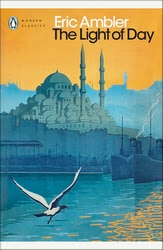
On 26th January 2023, Penguin Modern Classics will publish three wildly enjoyable novels from the father of the spy thriller, Eric Ambler: Passage of Arms, The Light of Day and A Kind of Anger. Ambler is often said to have invented the modern suspense novel, and his disciples include John le Carré, Alfred Hitchcock, Graham Greene and Len Deighton. These are a must-read for fans of the genre.

Eric Ambler (1909-98) was born in London to parents who were part-time entertainers. He studied engineering but left college without taking a degree and became a copywriter in the advertising industry. Between 1937 and 1940, he published his great anti-fascist spy thrillers: Uncommon Danger, Epitaph for a Spy, Cause for Alarm, The Mask of Dimitrios, and Journey into Fear. In 1940, he joined the Royal Artillery and was later transferred to the army film unit. After the war he worked as a screenwriter in England and Hollywood and married his second wife, a leading Hollywood producer. Passage of Arms, The Light of Day and A Kind of Anger are his post-war novels.

A Kind of Anger

The last time anyone saw Lucia Bernardi, she was driving at top speed away from a Swiss villa - leaving the body of her murdered Iraqi lover behind. Now she has vanished, along with a potentially explosive set of papers, and disgraced journalist Piet Maas has been sent to follow her trail to the South of France. But finding her is just the start of his problems. Soon, amid a cast of con men, secret agents and revolutionaries, he must decide whether to land the scoop of his lifetime - or follow Lucia into ever more dangerous waters.

A Passage to Arms

An Indian clerk, Girija Krishnan, sees the opportunity of his lifetime when he stumbles on an abandoned cache of arms hidden in the Malayan jungle. If he can sell the weapons, he will be able to achieve his lifelong dream of owning a bus company - although the penalty for gun-running is death. Soon his decision becomes the catalyst for a chain of events involving an entrepreneurial Chinese family, a corrupt Colonel and, finally, a naïve couple of American tourists who find themselves horribly out of their depth.

The Light of Day

Small-time hustler Arthur Abdel Simpson ekes out a living in Athens by robbing gullible tourists. But when an attempted theft backfires, he finds himself out-smarted and blackmailed into driving a highly suspicious car across the border to Istanbul. Then the Turkish secret police get involved, and Simpson becomes embroiled in something far deeper, and more dangerous, than he could imagine. Featuring a heart-stopping jewel heist, this compulsive, morally complex thriller became the basis for the classic filmTopkapi.


Saturday, 16 October 2021

Flying Solo? Mike Ripley on writing his latest ‘Albert Campion’ mystery.

When I was first tempted to continue the adventures of Margery Allingham’s famous detective Albert Campion, almost ten years ago now, I had at least the starting point of a couple of introductory chapters written by her first ‘continuation author’, her husband, Pip Youngman Carter, who died in 1969, three years after Margery.

Asked to continue the series, placing an ageing, quintessentially ‘Golden Age’ sleuth in the Swinging Sixties (or thereabouts), I started Mr Campion’s Fox from scratch, saying that I hoped ‘to fly solo with, and do justice to, a great fictional character.’

With the publication of my ninth ‘Campion’ this month, which contains several flying scenes, it struck me that I have never really flown ‘solo’ with these stories.

For a start, thanks to Margery Allingham, I had wonderful, ready-made, resident cast of characters, notably Campion himself; Amanda, his wife of thirty years (in my timeframe); that solid and dependable policeman Charles Luke; the retired spymaster L.C. Corkran; and, of course, Magersfontein Lugg, that most magnificent of indestructible sidekicks. There was also Rupert, Campion’s son, who was coming of age and available to do some of the heavy lifting - or the ‘running, jumping and shooting’ (as Margery put it) which may be now beyond an elderly gentleman detective. And in one of his continuations, Youngman Carter had given Rupert a girlfriend, Perdita Browning, whom I made his wife, which opened the possibility of a ‘next generation’ of Campions.

Given such a repertory company, I could hardly be said to be flying solo when it came to creating characters. All I had to do was come up with a few plots, research the period I was writing about and stay on track with those much-loved characters, and none of that was done ‘solo’.

To keep faith with Margery’s characters, I had fabulous sources I could call on, the most important being Margery’s own Campion novels and short stories, and to avoid mistakes or fill in any gaps, I had the members of the Margery Allingham Society, who were far more versed in the Campion canon than I was. In addition, I had access to the Allingham archives now lodged in the Albert Sloman Library at Essex University, which gave me a fund of ideas and plot points, including, cheekily, allocating Margery’s passport number to an East German spy!

At work in the Allingham archive at Essex University

In an attempt to recreate the flavour of the original books, I decided to have, as often as possible, maps of the locations - mostly found (roughly) in Margery’s beloved East Anglia - mentioned in the story. There I was supremely fortunate in tapping in to the skills of Roger Johnson, an Allingham Society stalwart and a noted Sherlockian scholar, who has done fantastic work illustrating the topography in eight of the nine novels so far. Between us we have tried to capture the geography of Margery’s fictional world, though we might have invented extra parts of Suffolk..


Roger Johnson’s map for Mr Campion’s Fox.

And when it comes to basic plot ideas, especially on Mr Campions Wings, I had, literally, a flying lesson from my long time ‘technical advisor’ (i.e. on anything which remotely involves anything mechanical), research scientist and inventor, Tim Coles. Actually, more than just a flying lesson. 

Tim and I go back a long way, having met in Cambridge in 1971 whilst both of us worked vacation jobs in Joshua Taylor, the city’s poshest department store. (I think Tim was in ‘Electricals’ and I was in ‘Pots, Pans and Glassware’). His family home was on Barton Road - and the house features in the book - and he had a private pilot’s licence, hence the flying lessons. He had even, in a previous life when I was writing my ‘Angel’ series, taught me how to con my way into a local flying club and hotwire a light aircraft; purely for literary purposes, of course.

On one of our regular hook-ups, Tim said he had come up with a method of murder in an engineering workshop, though he was not sure how to get away with it. He was also keen on a Cambridge setting and, being a city of bicycles, had also thought up a bizarre form of velocipede (it’s in the book) which would have certainly appealed to Margery Allingham’s sense of the ridiculous. Given that Margery had decided, back in the 1930s, to give Amanda Campion (née Fitton) a career in aeronautical engineering and that Cambridge had been a kindergarten for spies, I was sure I could cook up something from these ingredients and the year 1965, for various reasons, virtually chose itself and fitted my Campion timeline perfectly.

But I still wasn’t quite ready to fly solo. There was one particular aspect of aircraft design and development in the 1960s I needed help understanding - an aspect which would be of interest to spies and worth murdering for.

Naturally I turned to another old pal, one who knew about both aircraft and spying, Len Deighton.

Now this wasn’t the first time I had picked the encyclopaedic brain of Mr Deighton. Some years ago, over lunch, our conversation had somehow ranged from the economic history of Florence under the Medicis to a currency scam in Vichy France during World War II and the basic plot of Mr Campion’s War began to take shape.

Ripley and Deighton plotting over lunch.

When I explained to Len what I was after, and the help I needed on (very) technical aspects of jet engines and aircraft design, he politely demurred, saying he was not up to speed on such things - however, he knew a man who was, his son Antoni, an aeronautical engineer in America. Antoni turned out to be an enthusiastic and incredibly patient teacher, answering my idiotic questions about hi-bypass engines and teaching me more about air-flow and wing design than I ever thought possible. 

I have made sure that Tim Coles and Antoni Deighton received advance copies of Mr Campion’s Wings (Severn House, 28th October), to give them plenty of time to discover all the mistakes I made despite their expert advice.

All of which goes to prove that when writing a novel, no-one ever flies solo and in my case, especially not with Margery Allingham looking over my shoulder.

                                                                                      Margery Allingham 1904-1966

Mr Campion's Wings by Mike Ripley (Severn House) Published 28 October 2021 £20.99

A gruesome discovery at an aircraft hanger leads Albert Campion into a turbulent mystery set in Cambridge in the middle of the Cold War. "I have often said that my wife is a constant surprise to me." Cambridge, 1965. The honorary doctorate ceremony for Albert Campion's wife takes a dramatic turn when Lady Amanda is arrested by Special Branch for breaking the Official Secrets Act. Never before having taken much interest in his wife's work in cutting-edge aircraft design, Mr Campion sets out to discover more about the top-secret Goshawk Project in which Amanda is involved. He quickly realizes he is not the only one keen to learn the secrets of the project. When a badly mutilated body is discovered at the Goshawk Project's hangar - the result, it would appear, of a bizarre accident - Campion is drawn into a turbulent mix of industrial espionage and matters of national security. And as he attempts to get to the bottom of the deadly goings-on, it seems that the bicycles and punts are almost as dangerous as the aircraft . . .


Monday, 18 February 2019

Happy birthday Len Deighton

Happy birthday to Len Deighton who is celebrating his 90th birthday today! For many of us Len Deighton has provided readers with hours of enjoyment with his brilliantly written spy novels.

Who can forget his debut novel the Ipcress File which introduced readers to a nameless protagonist as far back as 1962.  The Ipcress File was followed by Horse Under Water (1963) Funeral in Berlin (1964), Billion Dollar Brain (1966), An Expensive Place to Die (1967), Spy Story (1972), Yesterday’s Spy (1975), and Twinkle, Twinkle, Little Spy (1976) all featuring his nameless protagonist.  Of course in the 1965 film the nameless protagonist is called Harry Palmer who is played with aplomb by Michael Caine.

Over on the Shots Ezine Mike Ripley Of GWAM (Getting Away with Murder) fame did an appreciation for the 50th anniversary of The Ipcress File which can be read here. 
Len Deighton & Mike Ripley
Whilst the Ipcress File is undoubtedly amongst his best known books, there are also a number of others for example SS-GB, the Bernard Samson series of novels which include Berlin Game (1983) Mexico Set (1984), London Match (1985), Spy Hook (1988), Spy Line (1989) and Spy Sinker (1990) to name a few and of course the Len Deighton Action Cookbookthat are certainly worth reading.  His last published book which was also an e-book was James Bond: My Long and Eventful Search for His Father (2012) 

A comprehensive place to find all things Len Deighton is on the Deighton Dossier Website which has all the information one could want on Len Deighton’s books.

Tuesday, 5 December 2017

Spooks, spies and private eyes. Why I chose to write about the secret world by Caroline Carver

As a child, I’d pretend I was a spy.  I dreamed of having a powerful secret that nobody else knew about, that would help save my family and eventually save the world.  Even then I knew that secrets were incredibly powerful and it’s that word “secret” that drew me to write about the spying world.

It’s not just keeping secrets or giving them away, selling them or trading, it’s the danger it can put you or someone else in.  The stakes in the spying game are huge, because the consequences if you get caught ranges from being fired to being executed.  It’s a terrifying place.

Being a very open, straight-talking person, I know I’d struggle being a spy myself.  I share too much, for a start.  Yes, I’m imaginative, curious and open-minded (all good traits for an author) but to be honest, I’m the Labrador who bounces in the room, wagging their tail.  Spies are the quiet Spaniel in the corner, lying there with one eye open, ready to be called upon at any time, but generally unobserved.

Most people will never know when they’ve met a spy.  They could be chatting to a member of the SIS in their local deli, at a party, on the train, oblivious that this apparently “normal” individual leads a double life and it’s this duplicity that I find fascinating.  How to be genuine, flexible and confident under pressure.  How to keep your integrity, which is probably one of the most important of all attributes needed.  Lives will be at stake, and those trusted with our nation’s secrets must be above reproach.  If my character is struggling in this area it can create a fantastic conflict within the book.

Even more importantly, the officers and their agents have to keep safe.  I’m very careful about the information I impart on the page, whether it’s a new weapon being developed by QinetiQ or SIS trade craft.  Careless talk costs lives.  Any knowledge I pick up from my sources I get checked before publication to make sure I’m not giving anything vital away.

Spies are the unsung heroes in our wars.  They risk their lives for their beliefs, for what they think is right.  Their handlers weep if they get caught.  The emotions are as high as the risks.  A spy may be a heroic myth, an urban legend, but I’m addicted to them.  That’s the good ones I’m referring to, of course.  The good spooks.

I was brought up on a diet of Eric Ambler, Le Carré, Ian Fleming, Len Deighton, so I guess it’s not surprising all this led me to create Dan Forrester, ex-MI5 officer, who now works for a private firm that gets hired to do the jobs that governments don’t want to give their spies.  He’s a larger than life character with extraordinary skills that help him get out of some really dangerous situations.  He’s taciturn and quietly reserved, nothing like me, let alone anyone I know, which is why I rather like him.


Know Me Now by C J Carver Published by Bonnier Zaffre
A murder. A conspiracy. Digging up the past can be deadly. . . A thirteen-year-old boy commits suicide. A sixty-five-year old man dies of a heart attack. Dan Forrester, ex-MI5 agent, is connected to them both. And when he discovers that his godson and his father have been murdered, he teams up with his old friend, DC Lucy Davies, to find answers.  But as the pair investigate, they unravel a dark and violent mystery stretching decades into the past and uncover a terrible secret. A secret someone will do anything to keep buried. 

Sunday, 9 July 2017

New Book Series on Espionage and Culture

For anyone interesting in various aspects of espionage, surveillance we have launched a new series with Routledge and are looking for proposals for monographs and edited collections.

‘Routledge Studies in Espionage and Culture’ is a major new books series, which seeks to investigate representations of the intelligence world and how we interact with it. The scope of the series is international and it seeks to blend several disciplines including cultural studies, history, literature and film studies. 


The new book series seeks to generate new insights into the connections between espionage and culture. During the second half of the twentieth century the public became aware of the importance of the role of espionage and security services. Television, radio and print news reported shocking events including the defection of Soviet moles like Kim Philby, Guy Burgess and Donald McLean; the Profumo scandal of 1963 that exploded when the British Secretary of State for War, John Profumo, had an affair with a woman who was in contact with the Soviet security services; and the state censorship of Peter Wright’s memoir Spycatcher (1987). Whilst the news sparked the public interest popular culture soon followed and the 1950s and 60s saw the resurgence of spy books, films and television series.

The James Bond franchise of books and films began in 1953 with the publication of the book Casino Royal. Bond achieved mass popularity in 1962 with the cinematic release of Dr No. Over the coming decades twelve authors have written James Bond novels or shorts stories and he has been played by seven actors with the books and films enjoyed by millions. Other authors such as John Le Carré and Len Deighton released bestsellers which were adapted for film and television and brought an often more realistic version of spying to an international public.

More information about the series can be found here.

For details on how to propose a book for Routledge Studies in Espionage and Culture please contact one of the series editors, Nick Barnett nicholas.barnett@plymouth.ac.uk or Laura Crossley lcrossley@bournemouth.ac.uk