Showing posts with label Crime Fiction. Crime Books. Show all posts

Saturday, 1 August 2026

How I remember my hometown in my books by Katy Massey

My books are set in Leeds, Yorkshire, in the late 1970s and early 1980s, when this part of the North of England was struggling. My latest novel, The Burning Fears, is set int the latter part of this period – 1982 – when the country was still in shock as the extent of the Yorkshire Ripper’s crimes came to light. 

At the same time, wide-spread de-industrialisation across the north saw job losses on a massive scale. It was a city far from the renaissance it enjoyed in the 1990s and 2000s. A visitor to Leeds now, clean and shiny and remade with glass and steel, would not recognise the city from my descriptions. 

And this is deliberate.

I believe that readers connect with a story when it is written with love and sense of connection to a place, real or fictional. For fans of crime fiction, the setting where the crimes take place is another, important character. And a story’s setting is just as vital to the substance of the stories as the choice of detective (amateur or professional?) and their characterisation (dour or humorous?). 

Importantly, the locale of a book provides an important through line in a crime series. For example, few would argue with the fact that Ann Cleeves’ DI Vera Stanhope’s novels gain much of their atmosphere from the moorland, villages and coastal landscape of Northumberland. Her Shetland novels are similarly evocative.

So, my stories are informed by the dust and industrial grime of a city on the slide. In The Burning Fears, the city’s elite, whose families became rich through the City’s heyday between the late nineteenth and mid twentieth century come face to face with the limits of their power and influence.

This is a story of political corruption and the sexual exploitation of minors. Themes which is our society are sadly evergreen. It begins with Lynda, a notorious local sex worker and procurer, lying dead in the snow, apparently the victim of a hit and run driver. 

My detecting duo finds themselves entangled with her death when her daughter turns up, now motherless and homeless. This duo is Maureen, Leeds’s leading Madam and owner of Rio’s sauna, and her friend and protector Mick, a middle-age cop worn out and sidelined because of the botched Yorkshire Ripper investigation. 

Lynda and her daughter’s story collide in unexpected ways with a corrupt local politician and the other members of The Leeds Club, a city centre establishment where the great and good congregate.

The luxury of the Leeds Club (a real private members’ club which stood in the centre of Leeds until the 1990s) contrasts starkly with my portrayal of Leeds as a dirty, damp and poverty-riven place. 

This image reflects the seediness of the characters at the heart of the story. By contrast, Peter Robinson’s DCI Banks series is set in the town of Eastvale in the Yorkshire Dales, is almost the mirror image of industrial, West Yorkshire. 

However, Robinson and I, along with a surprising number of crime-writing colleagues, don’t live in the places we write about. Robinson spent his career mostly living in Canada. And I relocated to Brighton over a decade ago. So, why write about our hometowns when we don’t even live there? 

Robinson is on record declaring that he first wrote Banks as an outlet for his homesickness. However, I grew up in Leeds during the 1970s and 1980s a time of extreme deprivation. Unemployment was rife. The Ripper’s crimes and the inept police investigation had led to a perception of Leeds as a violent city where the police and local authority had lost control. Crime rose sharply, fuelled by both need and greed.

I was a young child then, and don’t clearly remember these privations. And, for me, the reason I write about Leeds is not sentimental. It’s rather because perceptions of Yorkshire became captured by a rural, market town aesthetic.

But the Leeds of my memory is not Last of the Summer Wine, or All Creatures Great and Small, or even the city’s thriving nineteenth century industrial pomp. For me Leeds is a city of the grand Victorian buildings, like the Civic Hall and Leeds’s Market in its centre, rendered black and dirty from grim and dust and the droppings of a million starlings shrieking from their perches on the ornate building’s stone ornamentation. 

It is abandoned warehouses running along the River Aire and the Leeds-Liverpool canal, both filthy in my day, full of rubbish and supermarket trollies. Still, as a child I caught tiny fish from this midden in a net on a pole and took them home for my mother to admire.

This was my Leeds; one in which life, criminal, marginal but with its own vitality and fascination, thrived within the filth and merk of a community tainted by grooming and exploitation. There is nothing hopeless about the people in The Burning Fears. There is always a kind of redemption in this city – if the inferno doesn’t claim you first.

The Burning Fears by Katy Massey. (Little Brown) Out Now

Leeds 1982. As a city struggles to break free of the past, evil finds a new place to hide.DS Mick Hunniford, tired and tainted by the botched Yorkshire Ripper investigation, is yesterday's man, his career hanging by a thread.Maureen, owner of Leeds's leading brothel, struggles to recover from a horrendous attack three years before. When notorious escort Lynda Brown is killed in front of Maureen's eyes, she and Mick find themselves drawn together once more. The pair must face a new killer, with new appetites, one which dwells among the city's elites. Can they put the past behind them once and for all, even if this investigation proves to be their last?

More information about the author can be found on her website. She can also be found on Insagram @katymassey80, on X @TangledRoots1 and on Facebook.

Saturday, 11 November 2023

The Unexpected Star of the Show by Sharon Bolton

In July 2015, a car veered off the road near Stirling in Scotland. The driver was killed on impact; his passenger, a young woman, was trapped in the car, badly injured, for three days. She died in hospital shortly after police, finally, found the vehicle. It’s a dreadful story, one that remained with me for a long time. We expect, on our relatively small island, that when we need them, emergency services will be there. On this occasion, something went badly wrong.

Books often begin with a simple, if disturbing, idea and trying to imagine what the poor woman went through as she waited for help to arrive was the start of The Fake Wife. In my story, Olive Anderson, dining alone in a north-eastern hotel shortly before Christmas, is surprised by the arrival of a glamorous stranger who joins her, pretending to be her wife. What starts as an alluring game quickly turns dangerous and Olive is forced to leave the hotel with the stranger, driving into a heavy snowstorm. A split-second’s loss of concentration and the car leaves the road; both women are hurt and snow quickly covers their tracks. 

I like to think of The Fake Wife as my Russian Dolls book: each mystery unfolds to reveal another, deeper puzzle and only as we learn more about the characters at its heart – Olive, her MP husband Michael, the Stranger, Michael’s first wife Eloise, and the elusive and mysterious Maddy, do we start to glimpse the deadly game these people are playing. 

Well, that’s how the book should have panned out. Pretty soon, though, something else kicked in…

The Fake Wife was conceived as a thriller packed full of puzzles, psychological, but with plenty of pacy action along the way. What it wasn’t supposed to be was a police procedural. And yet, as all writers will know, sometimes characters grab a hold of a story and make it their own. As The Fake Wife took shape, gaining flesh on its bones, it became apparent that a character I hadn’t intended to play any sort of leading role was finding himself, increasingly, in the limelight. 

Garry Mizon, a nondescript traffic cop in his mid-thirties, who hates his job and is bored with his life, was supposed to be nothing more than a factotum: a means of getting my narrative from a to b. Garry was there to fill in the gaps, to let my real main characters – Olive, Michael, Eloise and Maddy – shine through. 

And yet, almost from the first chapter, Garry took charge. His personality – awkward, painfully shy but, ultimately, true as steel – shone through. In his clumsy, unassuming, anxious way, he began to dominate the page. He became the character I felt most invested in, the one I loved above all others. Full disclosure now: the team at Orion weren’t sure at first; wasn’t he a bit too – incompetent? Too much of a bozo? I toned him down a bit but clung on to what made this man essentially Garry and as the first proofs went out, I was vindicated. The most frequent feedback comment we got back was, “I love Garry!” Far from merely serving the narrative’s purpose, Garry became the book’s star. (As I write this, proofs are going out to key influencers along with a Garry Mizon winter survival pack and his ‘driving in winter conditions’ Spotify playlist.) 

Frankly, I should have known this would happen. After all, The Fake Wife is not my first rodeo. I should have remembered that when you pack a book with twisty, unsavoury characters, the readers need someone firmly in their corner. Garry is the story’s Everyman, the character with no interesting secrets, shady past or burning ambition. He isn’t particularly good at anything, especially not being a police officer. He has no superpower, no great skill (actually, he has a couple, but being Garry, he discounts both.) In Garry, I guess, we see ourselves, the ordinary man or woman caught up in something extraordinary. Garry’s doubts are our doubts, his insecurities and lack of confidence reflect our own. 

I lost track of this as I set out on the story that became The Fake Wife, concentrating far too much on the ‘glamourous’, much less likeable characters. Had I succeeded, the story would probably have failed. But the muse took charge and the book sorted itself out. 

How does this happen? The truth is, I don’t know. I’m just glad it does. 


The Fake Wife by Sharon Bolton is published by Orion on 9th November 2023. 

You're not who you say you are. But neither is she. Olive Anderson has accepted that tonight she'll be dining alone, without her husband. So when a beautiful stranger appears at Olive's dinner table, telling the waiter she's her wife, Olive is immediately unsettled.  But the stranger wants to talk, and isn't this what Olive wants on this lonely winter night? To vent to a perfect stranger? She's too ashamed to tell her real friends the truth - six months into the marriage they all warned her against, her life is a living nightmare. Perhaps Olive should have asked the fake wife who she's really married to. Perhaps she should have known this chance encounter had something to do with her secretive husband. Because there is a string of missing women connected to Mr Anderson, and by the morning, Olive will be the latest...

More information about the author and her books can be found on her website. You can also find her on X @AuthorSJBolton and on Facebook.


Monday, 11 May 2020

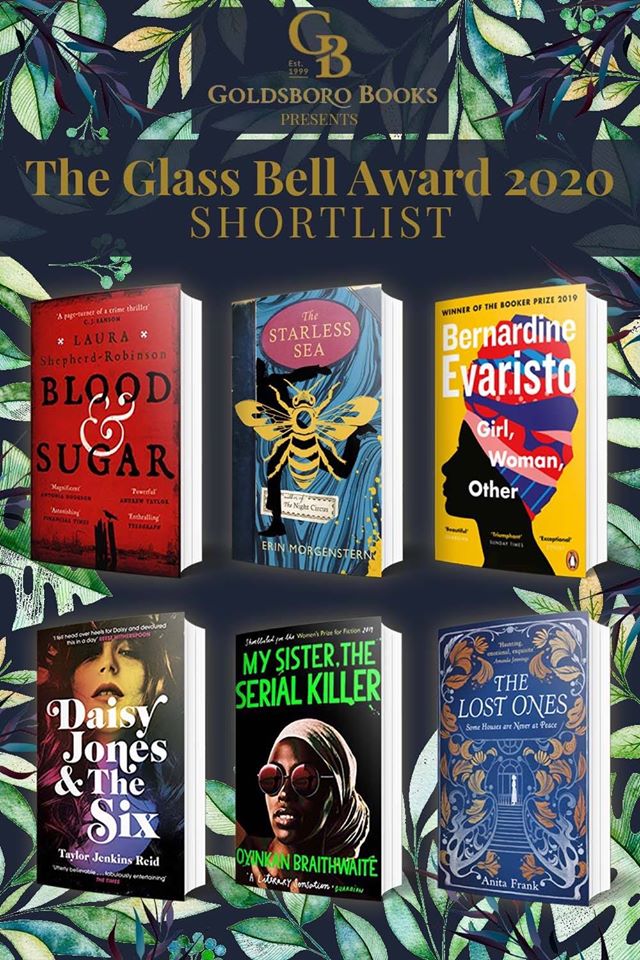
2020 Goldsbsoro Books Glass Bell Award Shortlist

DEBUTS, BESTSELLERS AND A BOOKER WINNER: ALL-FEMALE SHORTLIST ANNOUNCED FOR THE 2020 GOLDSBORO BOOKS GLASS BELL AWARD

A Booker-winning story of intergenerational black womanhood, a serial boyfriend killer thriller, a historical novel about the slave trade, a fantastical tale of a secret library, a post-war ghost story and a tale of rock and roll excess are in contention for the 2020 Goldsboro Books Glass Bell Award, announced today (Monday, 11th May).

Bernardine Evaristo and New York Times #1 bestseller Erin Morgenstern have both made the shortlist – Evaristo for her award-winning Girl, Woman, Other, an exploration of what it means to be a black British woman, and Morgenstern for her long-awaited second book The Starless Sea, an enchanting and immersive fantasy novel.

They are accompanied by three critically acclaimed debuts, Oyinkan Braithwaite’s darkly comic My Sister, the Serial Killer, about a woman who must cover up her younger sister’s habit of killing her boyfriends; Blood & Sugar by Laura Shepherd-Robinson, a historical thriller about the horrors of the slave trade; and the haunting and beguiling ghost story The Lost Ones by Anita Frank.

Rounding off the list is the critically acclaimed Daisy Jones and The Six by Taylor Jenkins Reid, written as the fictionalised oral history of a 1970s rock and roll band called The Six.

David Headley, Goldsboro Books co-founder and MD, and founder of the Glass Bell, says: ‘Losing yourself in an incredible story is one of the greatest comforts available to us in these trying times – and each of these stories construct very different but equally immersive worlds for readers to inhabit. This shortlist highlights six of the best writers of fiction around today – who all happen to be women! I’m looking forward to our judging discussions – there’s so much to be said about each one of these remarkable novels, and choosing a winner will be difficult but very rewarding.’

Judged by David and his team at the bookshop, the prize rewards ‘compelling storytelling with brilliant characterisation and a distinct voice that is confidently written and assuredly realised’ in all genres. The winner — announced on Thursday, 2nd July — will be awarded £2,000 and a beautiful, handmade, engraved glass bell.

2020 SHORTLIST
My Sister the Serial Killer by Oyinkan Braithwaite (Atlantic Books)
Girl, Woman, Other by Bernardine Evaristo (Hamish Hamilton)
The Lost Ones by Anita Frank (HQ)
Daisy Jones and the Six by Taylor Jenkins Reid (Cornerstone)
The Starless Sea by Erin Morgenstern (Harvill Secker)
Blood & Sugar by Laura Shepherd-Robinson (Mantle)


Wednesday, 11 July 2018

Books to Look Forward to From Europa Editions


-->
August 2018

A long, rainy, deadly Autumn in Naples.  That Autumn it seemed the rain in Naples would never stop, and Commissario Ricciardi found himself having to face not only a homicide but long-buried feelings that have grown thick roots inside him.  It’s been over fifteen years since Vinnie Sannino left on a ship for America without telling anyone. There Vinnie found fame, success, and wealth as a boxer, becoming the middleweight champion of the world. But that all came to a terrifying halt when his last opponent died in the ring and Vinnie lost his desire to fight.  Now, he’s back in Italy in search of the woman he left behind, Cettina, the love of his life. But Cettina has moved on. She’s now a married woman. Or, she was until recently. Her husband, a wealthy businessman, has been found murdered. There’s no murder weapon to speak of. He was killed with a single blow to the head, not unlike the blow that felled Vinnie’s opponent in the ring on that fateful night in America.  Nameless Serenade is by Maurizio De Giovanni


September 2018

In the night of Rome, nothing is what it seems.  It’s all change in Rome. The new Pope, determined to bring radical reform to the Vatican, proclaims an extraordinary Jubilee year of Mercy. A new centre-left government replaces its disgraced predecessor, and sets about to rejuvenate the language of politics. And with crime lynchpin Samurai in jail, his protégé Sebastiano Laurenti attempts to establish himself as his designated successor. But he must reckon not only with a new generation of enterprising gangsters and racketeers—out to carve for themselves a slice of the profits and opportunities offered by the major public works planned for the Jubilee—but also with ambitious newly elected politician Chiara Visoni, and his own heart. Betrayals, alliances forged and broken, ambushes and infighting will inevitably alter the fragile political balance. As the sharks circle and the street-dogs fight, some tenuous hope endures, in the unlikely alliance of an incorruptible politician of the old left, all but forgotten, and a young bishop who refuses to play the Vatican’s power games. But it remains to be seen whether the long night of Rome can make room for redemption. Sharp and fast-paced, dark and taut, The Night of Rome is by Carlo Bonini and Giancarlo De Cataldo and is fiction that sails dangerously close to the wind of current events.


October 2018

Most of the remaining population of Vienna—a city scarred by World War I in which the grandeur of the Habsburg Empire is a fading memory—is surviving by its wits, living hand to mouth in a city rife with crime, prostitution, and grotesquely wounded beggars. There are shakedowns on every street corner, the black market is the only market, and shortages of vital goods create countless opportunities for unscrupulous operators.  Into this cauldron of vice comes Inspector August Emmerich, a veteran himself, whose ambitions lead him to break the rules when necessary and whose abiding wish is to join the Viennese major crimes unit. When a corpse is found in the woods outside the city and immediately labeled a suicide, Emmerich, convinced it was nothing of the sort, sees a chance to prove his mettle. His investigations will reveal an insidious and homicidal urge lurking in the city.  The Second Rider is by Alex Beer