Showing posts with label Georges Simenon. Show all posts

Saturday, 15 August 2026

Back to the Future with Jack Jewers

There are some novels that go beyond a purely reading activity, these rare books immerse the reader so they become an experience. Books that fully engage the reader so that he/she feels irritated when away from the pages, or distracted [thinking about the characters and narrative] at idle moments – are even rarer than they were before - due the erosion of our attention spans, coupled to the plethora of other media [streaming TV, online distractions of social media et al] - and always accompanied by the ping-ping of smart phone notifications. So when you stumble upon a totally engrossing novel, one of significant heft – it is natural to want to inform others; as reading is good for our mental well-being.

Recently my mind has been taken over by Seething Lane by Jack Jewers, featuring a fictionalised Samuel Pepys, the infamous London diarist that wrote about his London adventures, including mixing the events surrounding the great fire, his bawdy exploits and much, much more. Seething Lane is an extraordinary novel, as it is best described as a dark “Swashbuckling Adventure-cum-Detective Whodunit-cum-Historical Thriller”.

When a strange young man turns up at his office on Seething Lane asking for help, Samuel Pepys is too distracted to take him seriously. Nell Gwyn is about to make her scandalous return to the stage and he wouldn’t miss it for all the world.

But in the cold of a winter’s dawn, tragedy strikes. Called upon to investigate the brutal murder of a libertine aristocrat, Pepys discovers that the dead man is connected to his mysterious visitor in the most shocking way possible.

A trail of secrets leads Pepys from the backstreets of London to the glamorous world of the theatre, where nothing is quite as it seems. But whatever the dangers, he may find that the deadliest threat lies closer to home…

Reimagining one of Britain’s greatest historical figures through a 21st century lens, Seething Lane sees the return of infamous diarist Samuel Pepys, complete with his trademark audacious wit, keen eye for observation and gripping historical adventure.

Seething Lane though released on the 3rd of September is available for pre-order. And like its precursor The Lost Diary of Samuel Pepys, the unabridged audiobook is read adroitly by actor Gareth Armstrong.

I was fortunate to have lived through it last week and my thoughts -

During the course of the novel, one of the author’s characters states “I ain’t being no drudge. All I want is a bit of adventure in my life.” To which the fictionalised Sam Pepys replies with a smile “Oh, my dear girl. You have no Idea.” This exchange sums up this glorious narrative perfectly. Seething Lane is an immersive experience for the reader in which A.D. 1670 London never felt so evocatively menacing. When contrasted against the political machinations of contemporary times, this deftly researched historical narrative is as cautionary as it is prescient about the dark side of human nature. The link between humanity, and how [in some quarters] the inherent cruelty in seeking [or protecting] power leads to unthinkable acts [and consequences] is ‘same as it ever was’.

Like its theatrical base, there is criminal horror, there is adventure, there is pathos [and regret] culminating in an exploration of what striates human nature – like the melancholic opening monologue from William Shakespeare's pastoral comedy As You Like It – the theatrical production of which acts metaphysically as the tent-pole that supports Jewer’s extraordinary narrative.

“All the world's a stage,

And all the men and women are merely players;

They have their exits and their entrances,

And one man in his time plays many parts.”

The memory of experiencing this work will sit jaggedly in the reader’s mind for a long, long time.

I’d be surprised if Seething Lane is not featured in the key literary awards for 2026.

Read the full Shots Magazine Review HERE

The book trailer for Seething Lane is available HERE

I had prepared myself for Seething Lane by reading its precursor The Lost Diary of Samuel Pepys, for which I wrote “……Rarely has historical fiction become as thrilling as this opening volume of the adventures of Samuel Pepys. The author provokes deep-thought with judiciously researched period detail striated into a truly ‘edge-of-the-seat’ narrative….”

Read the full review HERE

When I put Seething Lane down I had questions, so I was delighted when the author Jack Jewers kindly answered my queries, which we present for our readers.

As I detail in my footnote, getting engaged in a novel which has ‘Heft’ is remarkably beneficial to counter the stresses of contemporary life, and Seething Lane is one such book - a historical novel - after reading, we come back to the future, refreshed, reinvigorated and de-stressed because it is a thought-provoking distraction to the pace of modern life with all its anxieties.

Stephen King once said “life is not a support system for art, it’s the other way around”.

Please pardon my enthusiasm for reading books.

Ali Karim: Welcome to Shots Magazine.

Jack Jewers: Thanks so much, Ali! It’s great to be here.

Ali: So the first question is, what attracted you to creating Samuel Pepys into a fictional adventurer-cum-detective?

Jack: It was a collision of two things, really. First, I was searching about for an idea. Several people encouraged me to write a book, and I had actually said no to agents on a couple of occasions – which I fully recognise was a very privileged position to be in, the literary equivalent of headhunted. I was certainly very flattered, but I just wasn’t sure I could do it. I felt that there were aspiring authors out there who deserved it more than me. And besides, I didn’t (yet) have a good idea.

At around the same time, I discovered the diaries of Samuel Pepys. They were like catnip to me! So rich in historical detail – moving, funny, sad, salacious, and just plain fascinating. The full volumes run to well over a million words, but my gateway was the edited audiobook version, read by Kenneth Branagh. They’re highly recommended. Along with Gareth Armstrong, who narrates my audiobooks, he’s just the perfect voice for Pepys.

The diaries finish in the summer of 1669, when Pepys was 36. But I was surprised to learn that he actually lived for a long time after that – over 30 years, in fact. The little bits we know about Pepys’ life paint a picture of a man whose adventures (and misadventures) were just getting started. He was accused of treason, for example – a charge that was clearly bogus, but led to his imprisonment in the Tower of London. He spent time in the Moroccan city of Tangier. He was even embroiled in a piracy scandal at one point. How incredibly frustrating, then, that he failed to keep a diary during this time too. Unless, of course, he did… And just like that, I had my idea! I’m a huge lover of historical crime, so making him a reluctant detective just seemed like the natural next step.

Ali: As you are a renowned film maker, were your initial written works destined for the screen or for books?

Jack: You’re very kind to say renowned! That was certainly the creative field in which I became most established – and am lucky enough to have received a certain amount of attention. But I also wrote lots of screenplays, so there was always crossover.

Earlier in my career I spent some time as a jobbing writer of non-fiction. At one point I even had a job reviewing pubs for a London magazine. Which sounds like a dream job, but honestly, after about the first dozen, it was so tedious! In retrospect, however, it was actually quite good training for historical fiction, because it forced me to look for creative ways to avoid saying the same things over and over again. And that often meant delving into the history of these places to find good stories – which in a place like London, are never far away.

Ali: So I take it you have always enjoyed reading? And beyond Historical fiction and non-fiction what other genres, sub-genres do you enjoy?

Jack: I have always enjoyed reading, yes – but to be totally honest with you, Ali, it wasn’t always easy for me. I struggled with dyslexia as a teenager, which wasn’t identified until after I left secondary school. I remember how frustrated my teachers would be, never able to comprehend why I understood literature so well without being able to express my thoughts clearly on the page. Classic dyslexia, as it happens – but this was in the nineties, so just on the cusp of things like that being well understood. It left me with a certain intimidation when it came to long, chunky reads. But then, in my twenties, I was given a book called Sovereign by CJ Sansom, and I can honestly say it changed my life. I devoured it – and kept going with all the historical detective fiction I could lay my hands on. It was as if the spell was broken. So while I am a voracious reader today, the truth is that I became one later than expected.

Outside of historical fiction, my go-to genre is classic crime, particularly the Golden Age authors – Agatha Christie, Georges Simenon, Dorothy L. Sayers, people like that. Although you know what one of my most fun discoveries has been recently? Collins Crime Club novels from the eighties. I picked one up at a bookshop in Harrogate a couple of years ago, during the crime writing festival. It had a rather lurid cover, so it was a slightly ironic purchase, but I was surprised to discover just how good it was! Now I have a little game on the go, which is that when I finish one, I pick another from the ‘Readers May Also Enjoy’ selection on the back cover and track it down, like a relay of half-forgotten thriller writers. I’ve discovered some real gems that way – people I’d never even heard of before, such as Roy Lewis, M.R.D. Meek, and Jeffrey Ashford. A new one just arrived today, in fact. So that’s my weekend sorted!

Ali: Can you tell our readers a little about your childhood and what were the first books you enjoyed?

Jack: My childhood was quite bohemian, but with a very hardworking mother. I was raised in a single parent family and my mother was (is – sorry Mum, she’s 86 but will kill me if I say was), an actress, so I sort of grew up backstage at theatres across the country. This is one big reason why my new book, Seething Lane, takes place in the world of Covent Garden theatres. Although it’s set hundreds of years in the past, there’s much about an actor’s life then that’s pretty timeless. So I was writing something I knew. Aspects of the characters in the book are inspired by real actors I’ve known – both as a child, and later, professionally, as an adult – and while many of them are larger than life, I hope they’re honest portrayals. I certainly didn’t want to fall back on the lazy cliché of actors being unserious people – quite the opposite, in fact, as Pepys is firmly told at one point in the book.

As to the books I enjoyed as a child, more than anything I loved fantasy, with a hint of the supernatural. And a smattering of sci-fi. I had an extremely over-active imagination. When I was about twelve, I became convinced I was going to have a career cracking UFO cases (as you do), so I would max out my library card borrowing books with titles like ‘World of the Unknown’ and ‘Above Top Secret.’ The truth was definitely out there, but, to be fair, so was I.  

Ali: And your education?

Jack: I did reasonably well at school, despite the problems I mentioned, and then became a bit of a tearaway at college. I was clever but quite rebellious, and that was definitely reflected in my grades, which were appalling. Right up until the last minute, I had no plans to go to university, then a wonderful man called John Hefin – a retired film director and ex-head of drama at BBC Wales, who had taken up teaching – offered me a place to study film at the University of Wales. I didn’t even have the necessary grades, but he recognised something in me, and, three years later, I left with a first-class degree. I’ll forever be grateful to him for that. Although I shudder at the amount of debt young people have to get into now in order to have a university education. It took me about fifteen years to pay off my student loans, and that’s when the fees were much smaller than they are today. I’m honestly not sure I’d be able to do it now.

Ali: Without wishing to pry……I guess being married to fellow novelist Ava Glass must be ‘interesting’, so can you tell our readers what the married life of two novelists is like?

Jack: It is the greatest gift! Although we’re very different writers, we make each other better at every stage. We’re each other’s first readers and, by necessity, harshest critics – we have to be, it’s part of the deal. Ideas are discussed over coffee and tricky plot points hammered out during long walks with the dog. I’m in awe of Ava’s productivity. After the agony of coming up with an idea and a synopsis is over, she can usually turn around a first draft in three months. Three months! Seething Lane took me five years. The absolute barefaced cheek. I’m livid. In fact, I take back everything I said, how dare she be so talented.

Ali: Going back to your own writing, I appreciated the bibliography and historical notes that your Samuel Pepys novels contain, so tell us how selective you had to be in traversing the research required for ‘Seething Lane’?

Jack: The trick with historical fiction is that you have to research, and research, and research, and research, and research, and then just put it all away and write the damn book. Once you’ve done so much reading – of history books, primary sources, letters, diaries, you name it – the temptation is to put it all on the page. You want to share it all, but then you’re in real danger of bogging down the story.

I once read an historical thriller in which a chase scene was paused for a detailed description of how a street looked at a particular point in time. And while I totally understand that urge as a writer, as a reader I found it very frustrating. My goal with research is to allow me to fashion a bygone world that is immersive – and that needn’t even mean sticking to the letter of history, because truth and accuracy are not always the same thing.

At the end of the day, it’s the job of historical fiction writers to transport our readers back in time by making them feel like they’re there. It’s no good having your characters swan around, talking like they’re taking part in historical events the whole time, when really to them it’s just Wednesday. 

Ali: I found the historical insights into late 1600s London [contained in ‘Seething Lane’] fascinating, especially the vivid geography of the city. Did you walk around the area[s] / regions of London to gain a flavour of the locations? And how did that inform your writing?

Jack: Definitely. Seething Lane is at the epicentre of the book – it’s right there in the title! It’s a real place, just north of the Tower of London, and I find it very atmospheric. You get a palpable sense of history, which is curious, as most of the buildings there are quite modern. Only St. Olave’s Church remains from Pepys’ day, and even that was rebuilt after the Blitz. There are other real-life locations in the book that called for more imagination, because they’re almost entirely lost to time. One of these is the Palace of White Hall, which burned down in 1698. It was absolutely vast, but only small pieces remain. One of them is the Banqueting House – where a teenage Samuel Pepys skived off school to watch King Charles I have his head cut off!

Ali: The insights into the London Theatre [post-Cromwell], Shakespeare, and Drury Lane etc [that plays such a key aspect to the plot of ‘Seething Lane’] brings the novel to life – so are you regular theatre goer?

Jack:  I am definitely a regular theatre goer, although less so than Samuel Pepys, who often went several times a week. His diaries are filled with reviews of plays he saw, good and bad. (His review of A Midsummer Night’s Dream, for example, was “the most insipid, ridiculous play I ever saw.”) I mentioned that I grew up in theatres, but I also grew up going to see plays, often over my own objections. I vividly recall being dragged to see Ian McKellan in Richard III at the National – one of the great theatre productions of the late twentieth century, as it happened, though I was far too young. Nonetheless, it made a huge impression on me. Now I probably get to go to the theatre about four or five times a year. The best thing I’ve seen on the London stage recently is Ava Pickett’s 1536, which is about the downfall of Anne Boleyn seen through the eyes of some ordinary women in an Essex village. Only it’s not really about that at all, it’s about the social contagions of misinformation and misogyny. As historical fiction, it’s brilliant – and frighteningly timely.

Ali: ‘Seething Lane’ contains a large array of characters, many with small roles in the proceedings, but their inclusion is written with a flourish that makes them distinct – so what were you like [as a person] juggling such a large cast?

Jack: I’m so glad that you’ve said that, because my approach to small characters is that there basically aren’t any – this just happens not to be their story. Nobody is a cypher. So I kept track with a cast list, including key traits I needed to know. And I don’t just mean basic things like hair and eye colour, but full backstories. I know where most of the characters were born, what their childhoods were like, the big events in their life, and so on. A lot of this stuff doesn’t make it into the book, but it helps complete them as characters. It makes them feel more real. That said, there were several I had to cut, as the book just got too unwieldy. It pained me to have to lose characters such as feisty Betty Martin – successful London businesswoman and one-time mistress of Samuel Pepys, who appears frequently in some of the more osé passages of the real diaries. But maybe if there’s a book three…

Ali: Particular mention must be made of the strength of your female characters from Elisabeth Pepys, Nell Gwyn and an array of Minor [but important figures] such as Lady Castlemaine, Hannah Godwinstone, Emily Wrekin, Mistress Abby [of Billingsgate ] et al – so despite Samuel Pepys’ …….historical roguish reputation around women…… your novels have strong and vividly realised female characters often the equal to the womanising diarist […..even in The Lost Diary of Samuel Pepys, he is saved by the actions of Charlotte de Vere and her ‘hidden league’ of women] – would you care to comment?

Jack:  I’m very glad that you say that about the women in my books, thank you. It was very important to me, particularly as the real Pepys had a rather dubious record when it comes to women. It was never going to be believable for me to miraculously turn him into a first wave feminist, but I could at least put him in situations where he has his prejudices challenged. 

Characters such as Elisabeth Pepys, Nell Gwyn and Lady Castlemaine were real people, with fascinating (and, in the case of Elisabeth, under-told) life stories. Nell, in particular, was irresistible. Here was a woman who rose from abject poverty – she was literally abandoned on the streets of Covent Garden as a little girl and had to survive, alone, by whatever wits she could – to become the king’s mistress and the world’s first true, celebrity actress. She was sassy, potty mouthed, and very, very funny. I’m not sure I’ve ever had as much fun writing a character as I did her.

Elisabeth Pepys was also a clever woman, whose wit and personality shines through the pages of Pepys’ diaries, even though they had a difficult relationship. What I find particularly interesting about Elisabeth is that we had an incomplete picture of her for such a long time, due to censorship. She suffered from some very painful medical conditions – some of which you’ll know about if you’ve read Seething Lane – but, because they were considered indelicate, they were edited out of the published editions until as late as the 1970s. So behaviours that might once have come across as petulant and immature, took on a whole new light when we had the full picture. Telling more of her story was really important to me.

Ali: And finally, what [a] books have passed your reading table that you have recently enjoyed? And [b] what films have you recently enjoyed?

Jack: I recently read The Three Musketeers by Alexandre Dumas and absolutely loved it. Rip-roaringly good fun from start to finish, with the sole downside that lodged the theme from Dogtanian became lodged in my head for the two weeks it took me to get through it.

Going back to my love of classic crime, I’ve just finished Death in Dark Glasses – a pacey and surprisingly brutal thriller from 1952 by George Bellairs, who I’d not heard of until recently. He was a bank manager who wrote detective thrillers in his spare time – dozens of them, it seems, so I’ll be looking out for more. I’ve also started dipping my toe into Ellis Peters’ Brother Cadfael books. I found the TV series offputtingly clean and twee, but her books are great – much grittier. Plus, it’s a new (to me) historical crime series to get my teeth into. Praise be!

Film-wise, I loved Christopher Nolan’s The Odyssey. There was a certain amount of debate about whether it did the source material justice, all of which was perfectly justified, but I did rather feel that some of the criticism lost sight of the fact that it’s a film first, and an adaptation second. What ends up on the screen is always the only way to judge a film, and I thought it was a great achievement.

On the other end of the epic scale, I recently saw Richard Linklater’s Nouvelle Vague. It’s a tiny, black-and-white indie movie that tells the story of the making of Jean-Luc Godard’s Breathless, the film which propelled the French New Wave into the stratosphere. It’s huge fun and I’m not sure I’ve ever seen such an achingly cool film in my life.

Ali: Thank you for your time, insight and patience.

Jack: It’s my absolute pleasure. Thank you, Ali!

Shots Magazine would like to thank Tory Lyne-Pirkis and Moonflower for organising this interview and to Jack Jewers for his time and insight.

If you are new to the work of Jack Jewers, the following links maybe useful -

Jack Jewers Website > https://www.jackjewers.com

Moonflower Books Website > https://www.moonflowerbooks.co.uk/jack-jewers

Jack Jewers film work > https://inversefilms.co.uk/about

Jack Jewers essay on research > http://www.shotsmag.co.uk/feature_view.aspx?FEATURE_ID=498

Footnote

In the increasingly stressful reality, reading novels help combat the inherent anxiety of our times, and Seething Lane by Jack Jewers is one such novel in my opinion.

According to research carried out by Mindlab International at the University of Sussex, reading for only 6 minutes reduces stress levels by 68%, making it more effective than listening to music 61%, having a cuppa 54%, taking a walk by 42%, or playing video games 21%. Dr. David Lewis, a cognitive neuropsychologist who conducted the study agrees that reading a book is the ultimate relaxation but goes further to say, “This is more than merely a distraction but an active engaging of the imagination as the words on the printed page stimulate your creativity and cause you to enter what is essentially an altered state of consciousness.”

Researchers believe that the concentration required for reading has a physiological effect on the brain, engages the imagination and stimulates creativity, all contributing to a shutdown of the emergency fight or flight response. As the stress hormones dissipate, the fear centre of the brain becomes less active and the rationalisation areas of the brain take over. This shift in the brain makes you feel calmer and more in control.

Read More from Newcastle University HERE

Thursday, 25 April 2024

10 new additions to the Penguin Green Crime Classics.

Penguin have announced 10 new additions to their Penguin Green Classics. The books are due to be published on 6 June 2024. Two specific new additions in particular have been out of print in the UK for quite some time. These are - 

The Chinese Gold Murders by Robert Van Gulik

An intricate, puzzle-like murder mystery set in Imperial China, featuring the indefatigable Judge Dee. A fantastically enjoyable tale by the master of the Tang dynasty mystery! Judge Dee is about to step into the shoes of a dead man…Most people would refuse the job of Magistrate at the lonely port town of Peng-lai – especially as the last occupant of the post has been found poisoned in his library, his papers missing. But Judge Dee is not most men. He arrives ready to get to the truth, only to find his life complicated even further by a missing bride, a vanished artisan, a man-eating tiger and an evil conspiracy. 

Robert Van Gulik was a Dutch orientalist, diplomat, musician, and writer, best known for the Judge Dee historical mysteries, the protagonist of which he borrowed from the 18th-century Chinese detective novel Dee Goong An.

I Married a Dead Man by Cornell Woolrich

 A wild and wildly compelling noir novel about a train crash and a case of a mistaken identity. What if you woke up to discover everyone thought you were somebody else? Pregnant and abandoned, all Helen Georgesson has is five dollars and a one-way ticket to San Francisco. Then she is involved in a train crash, and regains consciousness only to discover that she has given birth – and, in a bizarre twist of fate, has been mistaken for somebody else. Helen decides to claim this opportunity to make a new life for herself and her son. But eventually her past will catch up with her, in terrible ways…

Cornell Woolrich (1903-68) was one of the most admired and influential of all 20th century American crime writers. His work inspired many films, including most famously The Leopard Man, Phantom Lady, Rear Window, The Bride Wore Black, Mississippi Mermaid and Union City. He led a strange and often very unhappy life, latterly as a recluse in a Manhattan hotel.


The list of ten new titles is as follows for the new Penguin Green Crime Classics 

The Deadly Percheron by John Franklin Bardin

From Russia with Love by Ian Fleming

I Married a Dead Man By Cornell Woolrich

The Labyrinth Makers by Anthony Price

The Gold Mask by Edogawa Rampo

The Underground Man by Ross Macdonald

We Have Always Lived in a Castle by Shirley Jackson

The Night Manager by John Le Carre

Night at the Crossroads by Georges Simenon

The Chinese Gold Murders by Robert Van Gulik


Tuesday, 17 October 2023

The Return of Penguin Greens

From the 1930s onwards crime novels published by Penguin had covers using a lot of green ink. This led to a clear distinction between two different kinds of novel – effectively all other novels (orange) and crime novels (green). This had the unintended effect of implying that these were different reading experiences or had different statuses when, of course, some ‘crime’ novels are simply among the best novels of any kind whereas orange novels came to seem more middle- to-upper brow even if they might be in practice be much less well written, ambition and plausible than novels by Dorothy M. Sayers, say, or Raymond Chandler. 

Famously it was on returning from a visit to Agatha Christie that Allen Lane, standing on a platform at Exeter station, had the idea for Penguin paperbacks and in the 1950s he once celebrated Christie’s birthday by printing in one go a million copies of her books (10 different novels x 100,000).

Crime of every description has therefore, from the most horrific to the most genteel, always stood at the heart of the entire Penguin enterprise. For reasons not now clear in the 1980s it was decided to drop the green spine and publish all fiction with an orange spine. Then design moved on again, often restricting the Penguin element to the bird logo itself and only keeping hints of Penguin orange. Around the same time light blue Pelicans were also dropped, with the Penguin colour schemes restricted to the black-spined Penguin Classics or the various shades of eau-de-Nil and grey for Penguin Modern Classics.

I have published various series as a Penguin employee over the years—Great Ideas, Little Black Classics and others—and it is really almost with a sense of embarrassment that it has taken until 2023 to realize that one of the most potent and fun traditional Penguin colour codes was simply lying around waiting to be reused: Green for Crime. I mention this because it is at some level shameful that it should have taken so many years to come up with something so straightforward that it barely qualifies as a concept or an idea: why didn’t we do this a decade ago? Two decades?

Lurking within Penguin Modern Classics we already published some of the greatest crime writers – Dorothy B. Hughes’s sensational In a Lonely Place, Eric Ambler’s great pre-War thrillers, Chester Himes’s wonderful, frenzied fantasies of Harlem, Ross Macdonald’s novels of southern California’s squalor lurking under the pretty surface. I am myself responsible at Penguin for the backlist of two great writers in the genre, John le Carré and Len Deighton, and yet had not noticed until very recently that these could be assembled into a matchless series of the greatest crime writers.

Once, very belatedly, we decided to proceed with the idea it seemed a shame not to add other writers. We already published Georges Simenon’s extraordinary books, of which he wrote so many (and at such a consistent level of excellence) that it would make sense to showcase a couple simply to give readers a way into his enormous oeuvre. Josephine Tey’s novels had just come out of copyright, so this provided the opportunity to publish her superb, unsettling The Franchise Affair and Brat Farrar. We also had C.S. Forester’s wonderfully nasty little shocker Payment Deferred about a murderous South London miser (written long before Forester became famous for the Hornblower novels).

For the series to be fresh though it needed some new discoveries and a lot of time was spent reading sometimes terrible books (please do not read anything by Peter Cheyney!) but also books which had just aged badly. I was particularly sorry that Helen MacInnes now seemed so lacklustre as my parents had loved her novels of international espionage when they were published – but now they seemed to consist predominantly of people endlessly walking around, having meals and checking into hotels, with very occasional outbursts of unengaging and tasteful violence.

Battling through some quite neither-here-nor-there stuff though made it much easier to spot wonderful things. Many recent crime novelists remain in print because of Kindle editions or print-on-demand versions, but it was very exciting to find two giants of British thriller writing from the 1970s and 1980s, Anthony Price and Michael Gilbert, available to be discovered. Both giants in their day, their work still has an ingenuity and excellence which has in no way dated – so Price’s Other Paths to Glory and Gilbert’s Game Without Rules joined the list. And I was tipped off to try Dick Lochte, whose 1985 debut Sleeping Dog is a classic, extremely funny piece of neo-noir with the simple but useful advice: if you are a jaded private investigator in L.A. and a girl on roller-skates asks you to help her find her missing dog, don’t say yes. The other great find was the Japanese writer Edogawa Rampo (real name Tarō Hirai – his pen name derives from the Japanese pronunciation of Edgar Allen Poe). Between the wars he wrote a number of thrilling and disturbing classics, some with a wonderful Tintin-like flavour (Gold Mask and The Black Lizard) and others with the depravity dialled up (Beast in the Shadows). All three of these are in the series. 

We are now finishing work on a third set of ten, including some just wonderfully recommendable stuff! Shirley Jackson’s We Have Always Lived in the Castle, Ian Fleming’s From Russia with Love, Anthony Price’s The Labyrinth Makers and John le Carré’s The Night Manager. Best of all (but of course they are all best) is a long forgotten classic of New York City noir, The Deadly Percheron by John Franklin Bardin, set in a gloomy wartime Manhattan and Coney Island. The fate of its decent psychiatrist hero as he unwillingly wades deeper and deeper into an inexplicable, surreal and truly horrible urban underbelly has to be experienced to be believed.

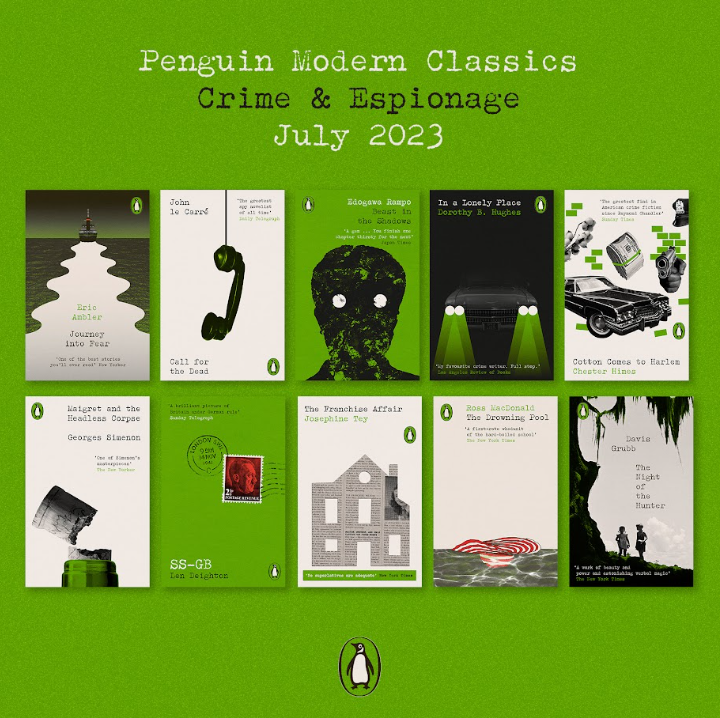
Here are the three sets, with the third not published until June 2024:

  1. Davis Grubb NIGHT OF THE HUNTER
  2. Edogawa Rampo BEAST IN THE SHADOWS
  3. Dorothy B. Hughes IN A LONELY PLACE
  4. Josephine Tey THE FRANCHISE AFFAIR
  5. Eric Ambler JOURNEY INTO FEAR
  6. John le Carré CALL FOR THE DEAD
  7. Georges Simenon MAIGRET AND THE HEADLESS CORPSE
  8. Len Deighton SS-GB
  9. Ross Macdonald THE DROWNING POOL
  10. Chester Himes COTTON COMES TO HARLEM
  11. Dick Lochte SLEEPING DOG
  12. Raymond Chandler THE BIG SLEEP & FAREWELL, MY LOVELY
  13. Anthony Price OTHER PATHS TO GLORY
  14. Michael Gilbert GAME WITHOUT RULES
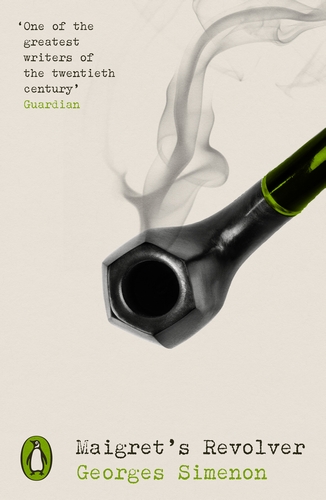
  15. Georges Simenon MAIGRET’S REVOLVER
  16. C.S.Forester PAYMENT DEFERRED
  17. Edogawa Rampo THE BLACK LIZARD
  18. Eric Ambler THE MASK OF DIMITRIOS
  19. Josephine Tey BRAT FARRAR
  20. John le Carré TINKER TAILOR SOLDIER SPY
  21. Anthony Price THE LABYRINTH MAKERS
  22. Chester Himes A RAGE IN HARLEM
  23. John le Carré THE NIGHT MANAGER
  24. Edogawa Rampo GOLD MASK
  25. Ian Fleming FROM RUSSIA WITH LOVE
  26. Georges Simenon NIGHT AT THE CROSSROADS
  27. John Franklin Bardin THE DEADLY PERCHERON
  28. Ross Macdonald THE UNDERGROUND MAN
  29. Shirley Jackson WE HAVE ALWAYS LIVED IN THE CASTLE
  30. Cornell Woolrich I MARRIED A DEAD MAN

Any suggestions anyone might have for unfairly out-of-print crime and espionage classics would be warmly received!

Simon Winder is the Publishing Director at Penguin Press. 


Wednesday, 6 September 2023

Penguin Classic Crime & Espionage -- 2nd tranche coming soon!

Reviving the iconic green Penguin Crime paperbacks, first published 75 years ago, this new series celebrates the endless variety and unique appeal of one of fiction’s great genres. The series, which continues to grow, is a careful selection of the very best from Penguin Classics’ extensive archives, combined with new discoveries unearthed from the golden age of crime and well overdue a new readership. The first tranche of titles, released in Summer 2023, took us from a sunshine soaked, yet bullet ridden California to a macabre Tokyo flat. Now the second tranche is here to take us through to Autumn with the best fireside reading for armchair detectives.

The series is carefully curated by author and Penguin Press publishing director Simon Winder, who is available for publicity: “These books are united by atmosphere, anxiety, a strong sense of time and place, and an often-appalling ingenuity, both on behalf of the authors and their characters. They have also all aged very well, gaining an additional pleasure from shifts in manners, clothes, wisecracks, politics, murder weapons and potential alibis.”

‘I needed a drink, I needed a lot of life insurance, I needed a vacation, I needed a home in the country. What I had was a coat, a hat and a gun. I put them on and went out of the room’

Farewell, My Lovely by Raymond Chandler

The Big Sleep & Farewell, My Lovely | Raymond Chandler | 1939 & 1940

There are no streets meaner than those of L.A.'s underworld - but luckily one detective has more than his fair share of street smarts. Here, in the first two novels featuring the immortal creation Philip Marlowe, we see the cynical sleuth taking on a nasty case of blackmail involving a Californian millionaire and his two devil-may-care daughters; then dealing with a missing nightclub crooner (plus several gangsters with a habit of shooting first and talking later).

Raymond Chandler was born in Chicago in 1888 but moved to England with his family when he was twelve. During the Depression era, he seriously turned his hand to writing, and his first published story appeared in the pulp magazine Black Mask in 1933, followed six years later by his first novel, The Big Sleep. 

Game Without Rules | Michael Gilbert | 1967

In a peaceful Kent village, Mr Behrens lives with his aunt at the Old Rectory, where he plays chess and keeps bees. His friend Mr Calder lives nearby with Rasselas, a golden deerhound of unnatural intelligence. No one would suspect that they are in fact working for British Intelligence, carrying out the jobs that are too dangerous for anyone else to handle - whether it's wiping out traitors, Soviet spies or old Nazis - in these gloriously entertaining stories.

Michael Gilbert was born in Lincolnshire in 1912. He worked as a lawyer and wrote his novels exclusively when commuting by train, 500 words a day in 50-minute stints. He was made a CBE in 1980, awarded a Diamond Dagger for the Crime Writers Association for lifetime achievement, and named a 'grandmaster' by the Mystery Writers of America in 1988. 

Maigret’s Revolver | Georges Simenon | 1952

Inspector Maigret receives a call from his wife to say he has a visitor at their apartment. But when he gets home, the young man has already gone, along with Maigret's prized Smith and Wesson .45. The trail to find the culprit - and the woman who may become his victim - takes Maigret across Paris and all the way to the Savoy Hotel in London. But getting to the truth may be even more complicated than he had first imagined.

Georges Simenon was born in Liège, Belgium, in 1903. He is best known in Britain as the author of the Maigret novels and his prolific output of over 400 novels and short stories have made him a household name in continental Europe. He died in 1989 in Lausanne, Switzerland, where he had lived for the latter part of his life.

Sleeping Dog | Dick Lochte | 1985

Leo Bloodworth, 'the Bloodhound', is a world-weary L.A. gumshoe with a reputation for finding anything - and a low tolerance of precocious teenagers. Serendipity Dahlquist is a precocious teenager. When the headstrong, roller-skating fourteen-year-old asks Bloodworth to help track down her lost dog Groucho, it leads this oddest of odd couples into the dark criminal underworld of the Mexican mafia, and into more trouble than they'd bargained for.

Dick Lochte's first novel, Sleeping Dog was published to enormous acclaim. He was a columnist for the Los Angeles Times for several decades, and formerly president of both the American Crime Writers League and the Private Eye Writers of America. Born in New Orleans, Lochte now lives on the West Coast.

Brat Farrar | Josephine Tey | 1949

Twenty-one-year-old Brat Farrar is an orphan, alone in the world without friends or family. So when he is offered the unexpected chance to impersonate Patrick Ashby, the long-lost heir to a vast fortune on a country estate, he agrees. Brat is the spitting image of Patrick, who disappeared years ago. At first it seems Brat can pull off this incredible deception, until he starts to realise that he is in far greater peril than he ever imagined.

Josephine Tey began to write full-time after the successful publication of her first novel, The Man in the Queue (1929), which introduced Inspector Grant of Scotland Yard. It wasn't until after the Second World War that the majority of her crime novels were published. Born in Inverness, Tey died in 1952, leaving her entire estate to the National Trust.

Tinker Tailor Soldier Spy | John le Carré | 1974

George Smiley, formerly of the Secret Intelligence Service, is contemplating his new life in retirement when he is called back on an unexpected mission. His task is to hunt down an agent implanted by Moscow Central at the very heart of the Circus - one who has been buried deep there for years. The dogged, troubled Smiley can discount nobody from being the traitor, even if it is one of those closest to him.

John le Carré was born in 1931. For six decades, he wrote novels that came to define our age. After a peripatetic childhood, a spell of teaching at Eton led him to a short career in British Intelligence (MI5&6), during which he published his first novel. He gained a worldwide reputation for his subsequent books. Le Carré died in December 2020. 

The Black Lizard | Edogawa Rampo | 1934

They call her the 'Dark Angel'. Queen of Tokyo's underworld, Mme Midorikawa is famed for her beauty, her jewels and the tattoo of a black lizard on her arm. Crime is so easy for her that she warns her victims in advance. When a wealthy jewel merchant receives letters saying his precious daughter Sanae is about to be kidnapped, he entrusts the renowned detective Akechi Kogoro to protect her. But he may have met his deadliest adversary yet...

Edogawa Rampo was the pseudonym of Taro Hirai, generally viewed as the greatest of all Japanese suspense and mystery authors. He was a prolific novelist and short story writer. Much influenced by writers such as Conan Doyle, Chesterton and Wells, his pseudonym is a Japanese transliteration of Edgar Allen Poe's name. Many of his works have been made into films. 

Payment Deferred | C.S. Forester | 1940

Bank clerk William Marble is facing financial ruin - until a visit from a wealthy young relative, a bottle of Cyanide and a shovel offer him an unexpected solution. But there is no such thing as the perfect murder. Gradually Marble becomes poisoned by guilt and fear, and his entire family corrupted. Sooner or later his deed will catch up with him, as events spiral out of control in the most unpredictable of ways...

C. S. Forester was born in 1899 in Cairo, where his father was a government official. On the outbreak of the Second World War, he entered the Ministry of Information. As well as the famous Horatio Hornblower series, his novels include The African Queen, adapted into the famous film, and crime novels Plain Murder and The Pursued.

The Mask of Dimitrios | Eric Ambler | 1939

English writer Charles Latimer is travelling in Istanbul when a police inspector tells him about the infamous master criminal Dimitrios, long wanted by the law, whose body has just been fished out of the Bosphorus. Immediately fascinated, Latimer decides to retrace Dimitrios' steps across Europe to gather material for a new book, but instead finds himself descending into a terrifying underworld of international espionage, Balkan drug dealers, unscrupulous businessmen and fatal treachery - one he may not be able to escape.

Eric Ambler was born in London. He studied engineering but left college and became a copywriter in the advertising industry, before publishing his great spy thrillers and working as a screenwriter. His profound influence on the espionage genre has been acknowledged by writers including Ian Fleming and John le Carré.

Other Paths to Glory | Anthony Price | 1974

Paul Mitchell is a young military historian whose life is changed forever when two men, Dr Audley and Colonel Butler of the MOD, visit him with a fragment of a German trench map - and a lot of questions. Then somebody tries to kill him. Paul, his life now in danger, agrees to go underground on a mission to solve a dangerous mystery: what really happened during the battle of the Somme in 1916? And why does somebody want to keep it secret?

Anthony Price was born in Hertfordshire. He began as a crime reviewer on the Oxford Mail and ending as editor of the Oxford Times. He won the Crime Writers' Association Silver Dagger for his first novel The Labyrinth Makers, and the Gold Dagger for Other Paths to Glory, which was later shortlisted for the Dagger of Daggers Award for the best crime novel of the last 50 years.


Wednesday, 26 April 2023

Penguin Modern Crime Announcement

 Penguin Modern Classics

CRIME & ESPIONAGE

Published by Penguin Modern Classics | 13 July 2023 | Paperback £9.99

First published 75 years ago, the iconic green Penguin Crime paperbacks have long held a special space in every crime lovers heart and bookshelf, as CrimeTime puts it: “If the Golden Age of Crime has a colour, it’s bottle green. And, if it has a smell, it’s the caramel of old paper. Nothing sums up crime fiction between the ages of flappers and flares quite so well as the classic Penguin Crime editions.” As one of our most popular imprints, the Penguin Crime series encompassed stories from Agatha Christie to Dashiell Hammett, and everything in between, expanding the horizons of crime readers with thrilling new discoveries in a familiar, trusted, and instantly recognisable green jacket. 


This summer, Penguin Modern Classics are thrilled to be reviving this beloved collection with our new Crime and Espionage series, celebrating the endless variety and enduring appeal of one of fiction’s great genres. Combining a careful selection of the very best from Penguin Classics’ extensive archives, including John le Carre, Josephine Tey, and Chester Himes, with exciting forgotten treasures which are well overdue a rediscovery, such as Edogawa Rampo and Davis Grubb, the first tranche of ten titles takes us from a sunshine soaked, yet bullet ridden California to a macabre Tokyo flat, through English country estates to the streets of Harlem. Transporting the reader through time and space, these novels can be outrageously entertaining but also chilling, filled with the darkest politics, vices, and betrayals.

The series, which will be released in ten-book tranches and continue to grow, is carefully curated by author and Penguin Press publishing director Simon Winder,  A long-time editor at Penguin and reader of crime, the revival of Penguin Crime and Espionage has seen Simon dig deep into the archives, reading hundreds of books to determine which of our existing titles should make the list, and which titles, previously not published by Penguin, should have been included years ago:

“Penguin Modern Classics is one of the great publishers of crime and suspense fiction.  I thought it would be enjoyable to pick out some highlights, add some new titles and revive the wonderful green livery Penguin used to use for all its crime fiction. 

These books are united by atmosphere, anxiety, a strong sense of time and place, and an often appalling ingenuity, both on behalf of the authors and their characters.  They have also all aged very well, gaining an additional pleasure from shifts in manners, clothes, wisecracks, politics, murder weapons and potential alibis.

The novels were designed to be entertainments, albeit sometimes of a very dark kind, and they all plumb extremes.  Fear of fascism or communism; fear of the anonymous city or of a fetid swamp; fear of vast global conspiracies or of just one rather odd family member with a glint in his eye….”

For lifelong crime lovers, who will no doubt be as excited as we are for the return of the bottle-green jackets as well as the previously unpublished titles, to new readers unsure where to start with the formidable back catalogues of Georges Simenon, Eric Ambler, or Len Deighton, the Penguin Crime and Espionage series is a collection of gems showcasing the best of the Golden Age of Crime.