Showing posts with label dennis lehane. Show all posts

Friday, 25 July 2025

Talking with Whyte Python’s author Travis Kennedy


Very rarely have I enjoyed reading a debut novel [that contained such an absurd plot] as I did last week with The Whyte Python World Tour by Travis Kennedy.

It kept me reading with my hands glued to the cover as if my life depended upon reaching the end.

It provoked thought and reflection, while it constantly made me smile and at several points - laugh out loud. It also made my eyes moist as I considered [and contextualised] my own life.

In a crazy world that depresses me and fills me with anxiety whenever I view the TV News – The Whyte Python World Tour – became an antidote as it made me feel good – it put a big smile on my face as it held me in its grip.

Without going totally hyperbolic – this debut novel was / is life-affirming.

I was first made aware of this extraordinary debut by Publisher Rowland White during the Michael Joseph Crime Party, held in February [Crypt at St Martins-in-the-Fields Trafalgar Square in London].

This year [2025] marks the 90th anniversary of the formation of Penguin Publishing.

Michael Joseph was a bestselling author before he turned publisher in 1935 – the same year Penguin paperbacks were launched. In 1985, exactly half a century after their mutual founding, Michael Joseph became the commercial imprint of Penguin Books. And now, it forms an important part of the PenguinRandomHouse Global Publishing Conglomerate.

Read More HERE

So what is The Whyte Python World Tour all about?

Set in the late 1980s, the author weaves the collapse of the Soviet Bloc into the era of peak heavy metal with the rise of a fictitious Los Angeles rock band Whyte Python. The band consists of four weird misfits - on Vocals Davy Bones (aka Lawrence Barkly), on Bass Guitar Spencer Dooley, on Lead Guitar (Robert) Buck Sweet and finally on Drums Richard Henderson aka Rikki Thunder.

Whyte Python is managed by the wimpy British producer Kirby Smoot for Andromeda Records and unbeknownst to the band, manipulated by the American Central Intelligence Agency’s Asian Intelligence Division [AID].

It appears that the Deputy Director of the CIA Ed Lonsa is reluctantly tasked to orchestrate a Cold War Psychological Operation against the Soviet Bloc. The Psy-Ops entitled Operation Facemelt is born, peopled by agents undergoing ‘disciplinary process’ though only three of them are aware that they are in this process. Firstly we have Amanda Price [aka Shawna Peppers] who works under the identity of rock and roll journalist Tawny Spice who is tasked with manipulating Drummer Rikki Thunders [from his band Qyksand] into joining Whyte Python. The other CIA agents being the insubordinates Catherine Stryker and Daryl Boone with the more conformist Bradford Mancuso.

As a thriller it is outstanding.

When I put the book down, I sat in silent contemplation and then downloaded the audio book narrated by Wil Wheaton as I wanted to revisit this crazy world again.

Read More HERE

After I put the book down, I had a few questions for the author Travis Kennedy, who kindly agreed to answer my queries.

I smiled during our dialogue, because it was little surprise to discover that I share the author’s enthusiasm for reading, including a passion for the works of Dennis Lehane - which I was unaware of when I read the book – and which may help [in part] to explain my own admiration for Travis Kennedy’s writing ability.

Ali: Welcome to Great Britain’s Shots Magazine.

Travis: Thank you for having me!

AK: We’re excited to introduce you to our readers, as this novel took over my life for two days as I read it over two sittings – is this really your first published work?

TK: Well, yes and no. It’s my first traditionally published novel, but I’ve had several short stories placed over the last dozen years or so - and I have been writing for my whole life. For many years, my career in public service demanded all of my creative energy, and I had to take a break from writing for myself. I was able to find my way back about twelve years ago, beginning with short stories and humour pieces. Believe it or not, this is chronologically the third complete novel that I have written.  My team made a decision to lead with THE WHYTE PYTHON WORLD TOUR, in part because of the speed of development on the film adaptation - but you will see the others!

AK: From your acknowledgements I see you come from a family that values books, libraries and reading. So would you care to tell us a little about your childhood and your reading?

TK: Oh, absolutely. Reading has been coded deeply into my personality since I was four years old. It’s the hobby that I love to do most. It makes my brain happy! My parents recognized this trait in me very early – especially my father, who I inherited it from. When I was very young, my family lived on a lake in New Hampshire. In many pictures from that era, you can see my parents and brothers playing in the water while I’m off in the distance, happily sitting under a tree with my nose in a book. When I was six years old, we moved to southern Maine, just outside of the City of Portland; and that first week, before all of the bags were unpacked, my father brought me to the Portland Public Library and signed me up for a library card. “There,” he said. “You’re home.”

What’s remarkable to me now as a dad myself is seeing the same quality in my own kids. My daughter is nine years old as I write this, and she is just like me. She reads relentlessly. Her school backpack is very heavy, because she never has fewer than two novels stuffed in between her lunchbox and schoolwork. Needless to say, she is delighted that her dad works in the publishing business now. She travels with me to book stores when I go in to sign stock, and she keeps a record of each store and what she found special about it. My son is six, and so he’s less impressed by Dad’s new line of work; it’s not strange or exciting to him at all, it's just what I do for a living. But reading came to him even more naturally than it did for me. Our house is absolutely littered with books.

AK: And of that time can you tell us which novels / stories were you favourites and why?

TK: I was an absolute book vacuum. I loved books across all genres, and had countless favourites. But I gravitated the strongest toward storytelling that put kids in the middle of adventures with genuine stakes. I probably loved Roald Dahl’s books the most. I read CHARLIE AND THE CHOCOLATE FACTORY at least a dozen times throughout my childhood – in one instance, three times in a row. There’s a real ominous feeling in his work, that the little heroes actually might not make it out okay. I loved the film The Goonies for the same reason. Stories that took their child heroes seriously.

AK:….But what books was/were the one[s] that made you want to pick up a pen / pc and write yourself?

TK: Jumping ahead to the modern era: think the two biggest inspirations for me as an adult to really GO FOR IT and dedicate myself to writing were Elmore Leonard and Dennis Lehane. When reading Elmore, you always get the feeling that he was smiling on the other side of his typewriter. There’s so much charm to his work, a sense that he’s enjoying himself. Elmore made it clear to me that you’re allowed to have fun with writing, and to let that sense of fun and joy in the exercise make its way onto the page. And then I picked up A DRINK BEFORE THE WAR by Dennis Lehane, and that voice just grabbed me with both hands in the first chapter and wouldn’t let me go. He was rewriting my own inner monologue in Patrick Kenzie’s sly Boston accent. I had to try to do that, too. I got such joy from reading both of those writers’ work, and I felt a kinship with them in how my own mind likes to tell stories, and together they pushed me into going for it.

AK: Who do you read now days?

TK: I’m still a vacuum! I still bounce around from genre to genre, fiction to non-fiction and back. I love great crime thrillers that break the standard mold. Every Michael Koryta book is a must-read for me. There’s a great writer who is also from Maine named Ron Currie Jr, who wrote an amazing crime fiction book called THE SAVAGE, NOBLE DEATH OF BABS DIONNE that has that grand, operatic feeling of Dennis Lehane and Don Winslow’s work. But I read everything. On the other end of the spectrum, I loved ATMOSPHERE by Taylor Jenkins Reid. John Scalzi’s WHEN THE MOON HITS YOUR EYE. Chris Whitaker, Fredrik Backman, Benjamin Stevenson, Richard Osman, Stephen King. I love Percival Everett. The book about Lorne Michaels was great.

AK: So onto The Whyte Python World Tour…..the central premise is what could be described as ‘Cherry’ - the CIA using a Heavy Metal band in the 1980s to influence disaffected East Europeans fed of Soviet Oppression…where did this weird idea come from?

TK:   Good question! I’ve had a longtime fascination with that specific era of music called “glam metal,” the party-themed rock anthems played by so-called “hair bands” of the 1980s. I was just a kid when they were on top of the world, and so they were really comical in my eyes. Like feral real-life muppets, wearing leather and spandex with makeup and wild hair and singing these infectious, harmless anthems. About twenty years ago, I started to read autobiographies of some of the big stars from that time – Slash, Motley Crue, Poison, etc – and I discovered that more often than not, the rock Gods on stage often came from challenging childhoods and were misfits until they found each other through music. They were overlooked and underappreciated, and then playing in these bands unlocked their superpowers. It seemed like there was a fun story in that; the idea that they had these secret identities that you only saw when the stage lights came on.

Then five years ago, I listened to a podcast called “Wind of Change,” produced by the very talented investigative reporter Patrick Radden Keefe. He was chasing a pervasive rumour that the CIA wrote the song “Wind of Change” for the hit German metal band The Scorpions, as a psyop to usher the Eastern Bloc’s youth into democracy at the end of the Cold War through the power of soft metal. He couldn’t prove it, of course; and I suspect that it isn’t true. But the concept married perfectly with the theme I had been chewing on, on and off, for almost twenty years about the glam metal guys having secret powers. This was it! And as a fiction story, divorced from any responsibility to tell the truth, I could make it whatever I wanted. 

AK: And so did you plot extensively or run with the idea until you had a narrative that could be licked into shape? And end-to-end how long did it take to physically write the novel?

TK: Before I wrote a word, I wrestled with the idea of how to tell the story. I wanted it to be a first-person narrative, like you’re reading a rockstar’s autobiography; but I also wanted the readers to understand pretty quickly what was going on, unbeknownst to our hero, Rikki Thunder. I didn’t really let myself think about the arc of the story until I figured out how to tell it, which took a little time. Once the solution came to me that the correct way to write this book is to break all narrative rules – it can be first person sometimes, and third person sometimes, and occasionally told through music montage – the book poured out of me as fast as I could keep up with it. Because breaking all the rules is metal! The unique format didn’t just allow me to tell the story how I wanted to tell it; it made it FEEL more like a frenzied, rule-breaking hair band video. The first draft took about three months. But that being said, I’ve worked more on this book than anything I’ve done in my life. There were, easily, twenty rounds of revisions; the first several by me alone, then a bunch with my agent and more again with my editor at Doubleday. So, while the first draft happened fast, the book took a little over two years to truly complete.

AK: I consider a major strength in the narrative are the [very] minor characters, who you define so very deftly, but yet they sit up straight on the page, such as Bass Guitarist Spencer Dooley’s [possibly] imaginary friend ‘Kevin’ or the East Berlin shopkeeper Josef Weidermann, or the Plumber Ben Pratt and Rikki’s old school friend Ron……less is more….would you care to comment?

TK: First, thank you! That compliment means a lot to me, because there is definitely some risk in introducing a large cast of characters in a novel and asking your readership to try to keep them all arranged in their minds. I’m glad to hear it worked for you. I think if you’re going to create a character, you owe it to them to make them unique and feel lived-in, and cared about. I think the old writing adage of “show, don’t tell” is CRITICAL when you’re creating minor characters who still need to feel real; we don’t need to know everything about Ron and his personal backstory, but we feel like we know it anyway only because of how he looks and dresses and moves. Same with Ben Pratt; the minor details (clean shirt, soft voice, big, pawlike hands) tell us he’s a gentle giant, and give us the warm feelings toward him that Rikki feels and remembers. That should be enough for the reader to get an imprint without feeling smothered by description about someone they’re not going to spend much time with, especially because I’m going to ask you to keep track of a lot of supporting characters more thoroughly.

AK: Are you a follower of Heavy Metal yourself? And if so, which bands do you rate form that genre?

TK: I am – but not at all exclusively. Music is very much like books to me – I love it if it’s done well, and spend time in whatever genre that matches my mood. I’ve mellowed quite a bit in my 40s now, but writing the book has been a really fun exercise in reconnecting with these musical roots from my youth! The fun thing about “metal” or “glam metal” or “hair bands” is that they’re all such flexible terms, and a lot of music aficionados love to fight over your exact question:

what qualifies? Because Poison is so different from Guns N’ Roses, which is so different from Van Halen or Motley Crue, or Def Leppard, or Iron Maiden, or Motorhead or Metallica or Bon Jovi and so on. Fans of all of that music – which is an enormous spectrum of sound – love to fight over this. I think that when we think of the era, we qualify bands with these titles (metal, glam, hair, etc) based on the look and the attitude, more than the melodies and the themes. We see massive hair, defying gravity thanks to cans of Aquanet; and ripped jeans, and spandex, and makeup, and we say “that’s metal.” It’s a time and a place and a vibe, more than a uniform style of music.

AK: So what’s next for Travis Kennedy?

TK: Lots! I’m plotting out a new novel now – it’s not in the world of Whyte Python, but I have a strong feeling that those muppets will be back eventually. I’m also supporting the work of the film adaptation of the book, and I have a few other film projects in various stages of development. I’m incredibly fortunate to be able to write full-time now, and it feels like I finally have time for all of the ideas that have been scrambling over each other to get to the front of the line. It’s a very exciting time!

AK: Thank you your time and insight.

TK: Truly, it’s my pleasure. Thanks for reading!

Shots Magazine would like to thank Publisher and Senior Editor Rowland White and from Publicity Lily Evans at Michael Joseph imprint of PenguinRandomHouse UK

For more information > https://whytepython.com/ and https://traviskennedy.com/

Promotional Photos / Images are © Brian Fitzgerald / Fitzgerald Photo / Travis Kennedy / PenguinRandomHouse / Little Brown Publishing / Ali Karim / Audible

Saturday, 31 August 2024

Barry Awards 2024


The Barry Awards 2024. The Barry Awards are awarded by Deadly Pleasures Mystery Magazine. The winners in each category were announced at the Opening Ceremonies of the Nashville Bouchercon on 29th August 2024. 

Best Mystery or Crime Novel
Small Mercies by Dennis Lehane (Harper)

Best First Mystery or Crime Novel
The Peacock and The Sparrow by I.S. Berry (Atria)

Best Paperback Original Mystery or Crime Novel
Who The Hell is Harry Black by Jake Needham (Half Penny)

Best Thriller
The Secret Hours by Mick Herron (Soho Crime)

Congratulations to all the nominated authors

Friday, 19 July 2024

The Strand Critics Awards nominees

The Strand Magazine has announced its list of nominees for the annual Strand Magazine Critics Awards.

Authors S.A Cosby, Laura Lippman, and Dennis Lehane headline this year’s nominees for the Best Novel Award, while Jonathan Karp of Simon & Schuster receives the Publisher of the Year Award. Kathy Reichs and Max Allan Collins are both honored with Strand Lifetime Achievement awards.

Recognizing excellence in the field of mystery fiction and publishing, The Strand Critics Awards are judged by an ever-changing group of book critics and journalists. This year’s judges were chosen from Los Angeles Times, National Public Radio, USA Today and The Associated Press.

The 2023 Strand Critics Awards nominees for Best Mystery Novel and Best Debut Mystery are …


BEST MYSTERY NOVEL

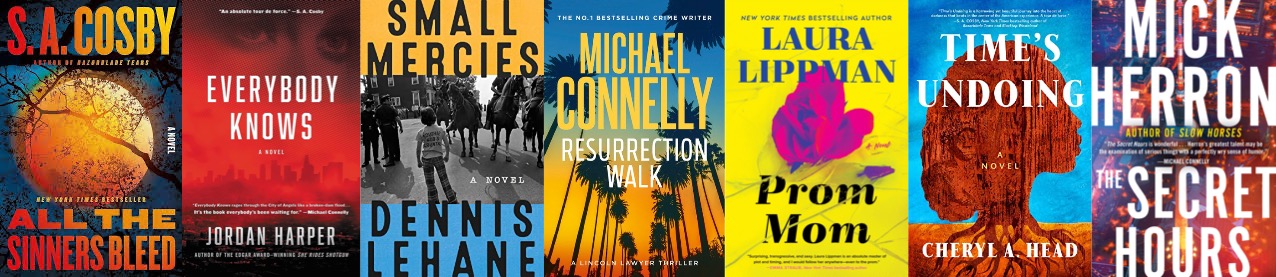
All the Sinners Bleed by S.A. Cosby (Flatiron Books)

Everybody Knows by Jordan Harper (Mulholland Books)

Small Mercies by Dennis Lehane (Harper)

Resurrection Walk by Michael Connelly (Little, Brown and Company)

Prom Mom by Laura Lippman (William Morrow)

Time’s Undoing by Cheryl A. Head (Dutton)

The Secret Hours by Mick Herron (Soho Crime)


BEST DEBUT MYSTERY

Fadeaway Joe by Hugh Lessig (Crooked Lane Books)

Mother-Daughter Murder Night by Nina Simon (William Morrow)

The House in the Pines by Ana Reyes (Dutton)

Don’t Forget the Girl by Rebecca McKanna (Sourcebooks Landmark)

Adrift by Lisa Brideau (Sourcebooks Landmark)

The Peacock and the Sparrow by I.S. Berry (Atria Books)

Past recipients of Strand Critics Awards include Jane Harper, Attica Locke, Angie Kim, Alex Michaelides, Megan Abbott, Michael Connelly, and Laura Lippman.

Strand Lifetime Achievement and Publisher of the Year Awards

It’s always the highlight of the year when the nominees are announced, and I can’t think of a more deserving group than the writers on this year’s list,” said Andrew F. Gulli, managing editor of The Strand Magazine. “Jonathan Karp, who receives this year’s Publisher of the Year Award, has created a culture at Simon & Schuster that is so supportive of authors and their works, and throughout his career has had an amazing knack for knowing just what to publish. I also have to say that both Kathy Reichs and Max Allan Collins have contributed so much to the genre. They are among the nicest and most professional people I have worked with, and they are so deserving of the Strand Lifetime Achievement awards.”


Kathy Reichs and Max Allan Collins Take Home Strand Lifetime Achievement Awards

I am honored and delighted that Strand Mystery Magazine has selected me as a recipient of its Lifetime Achievement Award,” said Reichs. “And I am humbled. To have my name included in the gallery of literary masters who have previously been recognized is astonishing and rewarding. I couldn’t be more pleased.

This is a lovely honour from the last magazine of its kind, much as I am part of a passing pulp breed,” said Collins. “My heroes included Chester Gould, Mickey Spillane, and Donald E. Westlake, later my mentors and friends. My love of movies culminated in the filming of my Road to Perdition. Nathan Heller, Quarry, and Ms. Tree are evidence of my love for detective fiction, much as the Antiques books written with my wife Barbara are of my love for her. I am lucky and blessed to make my living telling elaborate lies about humans at their best and worst.


Jonathan Karp of Simon and Schuster Wins Strand Publisher of the Year Award

This year’s recipient of the Strand Magazine’s Publisher of the Year Award is Jonathan Karp, CEO, publisher, and president of Simon & Schuster. Throughout his time at Simon & Schuster, Karp has overseen an amazing boost in revenue, consolidated several imprints, and managed to navigate the world of digital publishing while ensuring that print books are still at the forefront of so much that S&S does. During his career he has frequently taken chances on books he believes in — that other editors might have passed up — and, more often than not, those chances have paid off in the form of critically acclaimed books that are also commercially successful.

I’m grateful to the Strand for this honour, and to all of the great publishers who have taught me through the years, especially Kate Medina, Ann Godoff, Harry Evans, Jamie Raab, and Carolyn Reidy, as well as the authors who have made this work so satisfying, for so long,” says Karp.

Past recipients of the Strand Publisher of the Year Award include Dan Smetanka, Tom Doherty, Morgan Entrekin, Josh Stanton, and Bronwen Hruska.


Sunday, 2 June 2024

International Thriller Writers Thriller Awards 2024


The 2024 International Thriller Writers Thriller Award winners are:-

BEST HARDCOVER NOVEL 

All the Sinners Bleed by S.A. Cosby (Flatiron Books) 

 BEST AUDIOBOOK 

The Last Orphan by Gregg Hurwitz (Macmillan) Narrated by Scott Brick 

BEST FIRST NOVEL 

The Peacock and the Sparrow by I.S. Berry (Atria) 

BEST PAPERBACK ORIGINAL NOVEL 

The Paleontologist by Luke Dumas (Atria) 

BEST SHORT STORY 

Unknown Caller by Lisa Unger (Amazon Original Stories) 

BEST YOUNG ADULT NOVEL 

Stateless by Elizabeth Wein (Little, Brown & Co.) 

BEST E-BOOK ORIGINAL NOVEL 

The Killing Room by Robert Swartwood (Blackstone Publishing) 

***


ThrillerMaster Award Recipients: 

Tess Gerritsen and Dennis Lehane

Silver Bullet Award Recipient: 

Louise Penny

Thriller Legend Award Recipient

Audible

ThrillerFan Award Recipient: 

Ayo Onatade


Friday, 10 May 2024

2024 CWA Dagger Short lists announced


The 2024 shortlists for the prestigious Crime Writers’ Association (CWA) Dagger awards, which honour the very best in the crime-writing genre, have been announced.

Created in 1955, the world-famous CWA Daggers are the oldest awards in the genre and have been synonymous with quality crime writing for over half a century.

 The shortlist for the Gold Dagger, which is awarded for the best crime novel of the year, includes the debut novel Black River from Nilanjana Roy. She is up against stalwarts of the genre, Mick Herron for The Secret Hours, and Dennis Lehane, with Small Mercies. 

The bestselling children’s author Maz Evans also makes the list with her debut adult novel, Over My Dead Body. As does the Irish-American author Una Mannion, with her haunting second novel, Tell Me What I Amand the Chinese-Indonesian author, Jesse Sutanto, with Vera Wong’s Unsolicited Advice for Murderers.

Past winners of the prestigious Gold Dagger, include Ian Rankin, John le Carré, Reginald Hill, and Ruth Rendell.

The Ian Fleming Steel Dagger, sponsored by Ian Fleming Publications Ltd, showcases the thriller of the year.

The shortlist sees relative newcomer Jordan Harper, with his second thriller, Everybody Knows, up against TJ Newman, the former flight attendant who became a Hollywood sensation, with her latest thriller, Drowning, and Japanese author Kotaro Isaka for The Mantis; Kotaro is best-known for Bullet Train, which was adapted into a Brad Pitt movie. 

They’re joined on the Fleming shortlist by SA Crosby, Eli Cranor, and Femi Kayode.

The much-anticipated John Creasey (New Blood) Dagger highlights the best debut novels.

Among the rising stars of 2024 is Jo Callaghan with her BBC Between the Covers Book Club pick, The Blink of an Eye; and the Victorian gothic, The Tumbling Girl from Bridget Walsh. The shortlist also includes Amy Chua’s The Golden Gate, Kate Foster with The Maiden, Dan McDorman’s West Heart Kill and Go Seek by Michelle Teahan.

The Historical Dagger shortlist sees Voices of the Dead by Ambrose Parry in contention with A Bitter Remedy by Alis Hawkins. 

They’re joined by Lucy Ashe with Clara & Olivia, Louise Hare’s Harlem After Midnight, Jake Lamar’s Viper’s Dream, and Scarlet Town by Lenora Nattrass.

The ALCS Gold Dagger for Non-Fiction shortlist sees Nicholas Shakespeare’s Ian Fleming: The Complete Man, up against The Art Thief by Michael Finkel, the true story of the world’s most prolific art thief who accumulated a collection worth over $1.4 billion. 

Also in the Non-Fiction category are Matt Johnson and John Murray for No Ordinary Day, Jennifer McAdam with Douglas Thompson for Devil’s Coin, Alex Mar’s Seventy Times Seven and How Many More Women? by Jennifer Robinson and Keina Yoshida.

The shortlist for the Crime Fiction in Translation Dagger includes The Prey from the Icelandic author Yrsa Sigurðardóttir’s, translated by Victoria Cribb, and Maud Ventura’s My Husband, translated by Emma Ramadan, which was a sensation in France, likened to Patricia Highsmith and Gone Girl

They’re joined by the Spanish journalist and author, Juan Gómez-Jurado, Sweden’s Âsa Larsson, French author Cloé Mehdi, and Korea’s Im Seong-sun. 

Maxim Jakubowski, Chair of the CWA Daggers’ committee, said: “Once again, our independent judges across all the Dagger categories have come up trumps. Their selections feature well-established authors and new faces, a refreshingly diverse palette highlighting the talent of writers from all origins and publishers large and small, and a steadfast affirmation of how healthy the crime and mystery field is right now. We at the CWA couldn't be prouder.”

 The CWA Daggers are one of the few high-profile awards that honour the short story.

This year sees the bestselling juggernaut Lee Child with his story Safe Enough. He’s up against Mia Dalia, J Benedict Jones, Sanjida Kay, Ambrose Parry, and FD Quinn.

The Dagger in the Library nominees are voted by librarians and library users, chosen for the author’s body of work and support of libraries. This year sees firm favourites from the genre on the shortlist: Louise Candlish, MW Craven, Anthony Horowitz, Cara Hunter, and LJ Ross.

The Best Crime and Mystery Publisher of the Year Dagger, which celebrates publishers and imprints demonstrating excellence and diversity in crime writing, pits big publishing houses Headline (Hachette), Michael Joseph (Penguin Random House), Simon & Schuster, and Pushkin Vertigo (Pushkin Press) against independent publishers Joffe Books and Canelo Crime. 

The CWA Diamond Dagger, awarded to an author whose crime-writing career has been marked by sustained excellence, is announced in early spring and in 2024 it was jointly awarded to Lynda La Plante and James Lee Burke.

The CWA Dagger shortlists were announced on 10 May at the UK’s largest crime fiction convention, CrimeFest, hosted in Bristol.

The winners will be announced at the award ceremony at the CWA gala dinner on July 4.


The Shortlists in Full:


GOLD DAGGER

Over My Dead Body by Maz Evans, Headline

The Secret Hours by Mick Herron,  Baskerville (John Murray)

Small Mercies by Dennis LehaneAbacus (Little Brown)

Tell me What I Am by Una Mannion, Faber & Faber

Black River by Nilanjana Roy, Pushkin (Vertigo)

Vera Wong’s Unsolicited Advice for Murderers, by Jesse Sutanto  HQ (Harper Collins)


IAN FLEMING STEEL DAGGER

All the Sinners Bleed by S A Cosby , Headline (Hachette)

Ozark Dogs, by Eli Cranor  Headline (Hachette)

Everybody Knows by Jordan Harper, Faber & Faber

The Mantis, by Kotaro Isaka Harvill Secker (PRH) 

Gaslight, by Femi Kayode Raven Books (Bloomsbury)

Drowning by T J NewmanSimon & Schuster


ILP JOHN CREASEY (NEW BLOOD) DAGGER

In The Blink of An Eye by Jo Callaghan Simon & Schuster UK

The Golden Gate by Amy ChuaCorvus (Atlantic Books)

The Maiden by Kate Foster, Mantle (Pan Macmillan)

West Heart Kill by Dann McDorman, Raven Books

Go Seek by Michelle Teahan, Headline Publishing Group

The Tumbling Girl by Bridget WalshGallic Books


HISTORICAL DAGGER

Clara & Olivia by Lucy AsheMagpie (Oneworld Publications)

Harlem After Midnight by Louise Hare, HQ (HarperCollins)

A Bitter Remedy by Alis HawkinsCanelo

Viper's Dream by Jake Lamar, No Exit Press

Scarlet Town, by Leonora Nattrass Viper (Profile Books)

Voices of the Dead by Ambrose Parry, Canongate Books


CRIME FICTION IN TRANSLATION DAGGER

 Red Queen by Juan Gómez-Jurado  (translated by Nick Caistor,) Macmillan

The Sins Of Our Fathers by Ã‚sa Larsson, (translated by Frank Perry), Maclehose Press

Nothing Is Lost by Cloé Mehdi (translated by Howard Curtis), Europa Editions UK

The Consultant by Im Seong-Sun, (translated by An Seong Jae) Raven Books

The Prey by Yrsa Sigurdardottir (translated by Victoria Cribb), Hodder & Stoughton

My Husband by Maud Ventura, (translated by Emma Ramadan), Hutchinson Heinemann


ALCS GOLD DAGGER FOR NON-FICTION
 

The Art Thief by Michael Finkel, Simon & Schuster

No Ordinary Day by Matt Johnson with John Murray, Ad Lib Publishers

Devil’s Coin by Jennifer McAdam with Douglas Thompson  Ad Lib Publishers Ltd

 Seventy Times Seven, by Alex Mar Bedford Square Publishers

How Many More Women? by Jennifer Robinson & Keina Yoshida  Endeavour

Ian Fleming: The Complete Man by Nicholas Shakespeare  Vintage


SHORT STORY DAGGER

Safe Enough by Lee Child from An Unnecessary Assassin, edited by Lorraine Stevens, Rivertree

The Last Best Thing by Mia Dalia from Bang!:An Anthology of Modern Noir Fiction, edited by Andrew Hook, Head Shot Press

The Also-Rans by Benedict J Jones from Bang!:An Anthology of Modern Noir Fiction edited by Andrew Hook, Head Shot Press

The Divide by Sanjida Kay from The Book of Bristol edited by Joe Melia and Heather Marks, Comma Press

The Spendthrift and the Swallow by Ambrose Parry, Canongate Books

Best Served Cold by FD Quinn  from An Unnecessary Assassin edited by Lorraine Stevens, Rivertree

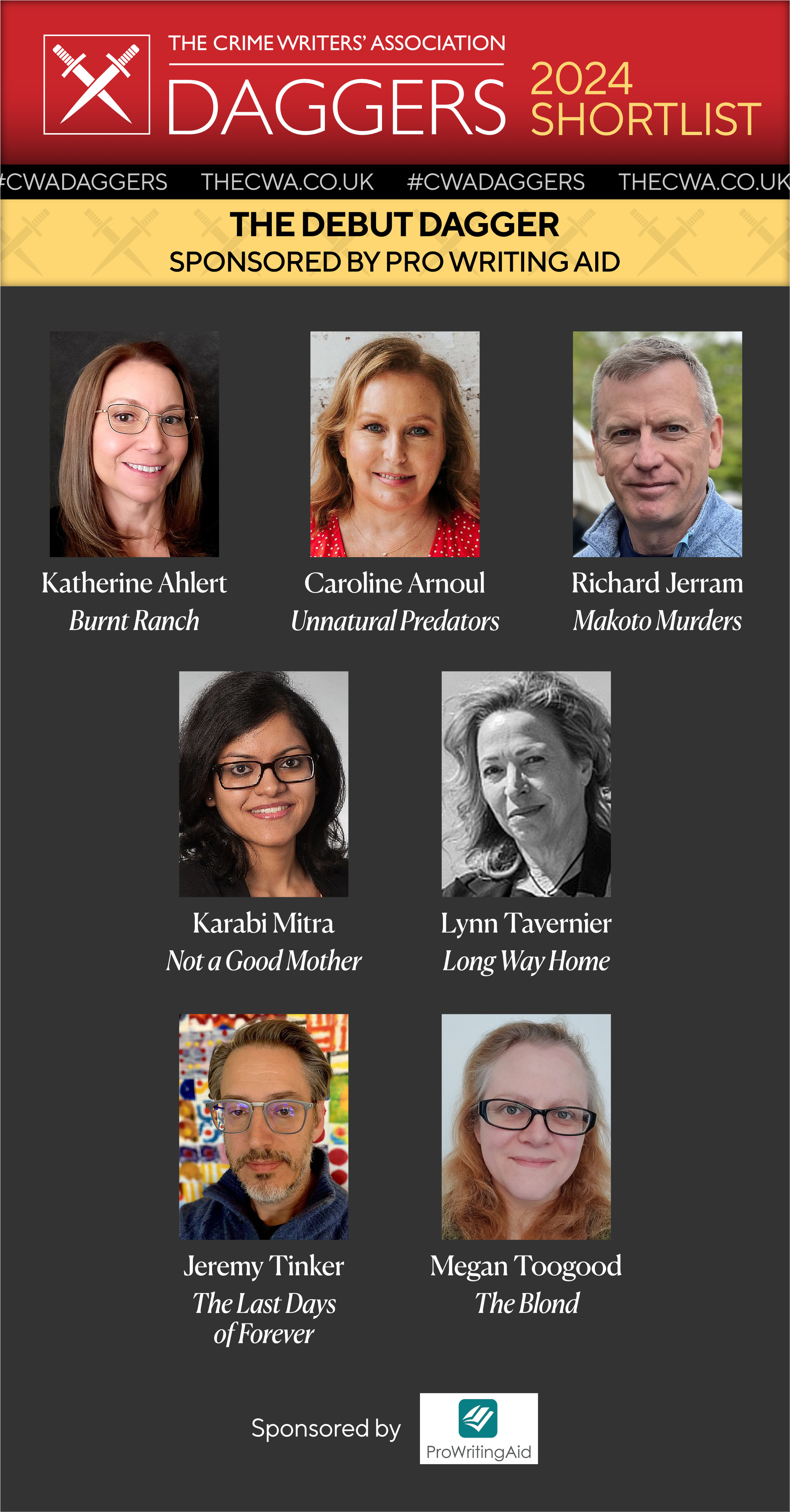
 DEBUT DAGGER

Burnt Ranch by Katherine Ahlert

Unnatural Predators by Caroline Arnoul

Makoto Murders by Richard Jerram

Not a Good Mother by Karabi Mitra

Long Way Home by Lynn McCall

The Last Days of Forever by Jeremy Tinker

The Blond by Megan Toogood


DAGGER IN THE LIBRARY

 Louise Candlish 

MW Craven

Cara Hunter

Anthony Horowitz

LJ Ross 


PUBLISHERS’ DAGGER


Canelo

Headline (Hachette)

Joffe Books

Michael Joseph (PenguinRandomHouse)

Pushkin Press

Simon & Schuster