Showing posts with label Spy Fiction. Show all posts

Wednesday, 1 April 2026

Ian Fleming announcement: Charlie Higson Returns with King Zero


Ian Fleming are excited to announce King Zero, a blockbuster new adult James Bond novel from multi-million copy bestselling Young Bond creator, Charlie Higson. It will be published in the UK on 24th September 2026 by Penguin Michael Joseph.

Beginning with the murder of an agent in Saudi Arabia by a weapon never before seen by the Secret Service and spanning the globe in an epic race against time to avert global catastrophe, the novel brings the literary Bond squarely into the twenty-first century, where the old world that made him is crumbling and a terrifying new order emerges while a dangerous villain – the most distinctive since Goldfinger – moves in the shadows. Higson explores themes of power, technology, and international tensions over resources in an extraordinarily timely story.

Having warmed up with my Young Bond series, and the short story, On His Majesty’s Secret Service, I’m beyond excited to be writing my first full blown adult Bond adventure. 20 years after first writing “The name’s Bond, James Bond,” it still sends shivers down my spine every time I type it. I’m having a blast with this new novel, which is absolutely set in the modern world, and I hope will sit comfortably on the airport bookshelves alongside other contemporary thrillers. It embraces the worlds of both the literary Bond and the cinematic Bond, and my bad guy has all the elements we expect from a classic Bond villain, with a twist that’s not been done before.” – Charlie Higson

We are delighted to be working with Penguin Michael Joseph on the publication of King Zero. Charlie Higson’s return to James Bond follows his outstanding success with On His Majesty’s Secret Service, commissioned for the King’s Coronation, and we are delighted to be working with Charlie again, bringing the next chapter of Bond to fans.” – Amanda Douglas, Managing Director of Ian Fleming Publications Ltd.

There’s no character in all of fiction quite like James Bond, and since Ian Fleming’s passing no-one has captured him quite so distinctively as Charlie Higson. We were swept away by Charlie’s vision for Bond which will delight old fans and new, and we can’t wait to make this the coolest, classiest publication of the year.” – Joel Richardson, Publisher at Michael Joseph


Thursday, 26 March 2026

Writing the Power of Spies by Ava Glass

I’ve written three novels from the perspective of spies. In these books we get inside the spies’ heads, and we see normal people at a kind of distance – as if spies are separate from our world in some way. Which they are. You and I don’t factor much in spies’ thoughts. They are entirely focussed on terrorists, foreign spies, international governments, illegal activity, and war. In a perfect world, those of us who don’t fit any of those descriptions would never knowingly encounter someone from their world. But just now and then because of fate or very bad luck, normal people do find themselves stepping through that looking glass. And when our world collides with that of the spies, trouble often follows.

Part of the problem is their disproportionate power. When you think about it, spies have access to infinite information. They know everything about us, and we don’t even know their real names. Because of that, they can manipulate us with ease. I know this personally because, for five years I worked with spies in counter-terrorism communications. I had no background in espionage at all – I’d been a crime reporter before that. An acquaintance had offered me the government job at just the right moment, and I took it. But back then I didn’t fully understand what working with spies would mean. But I would soon learn.

The first thing that happened was I met a young woman in the office who was new, like me. We kept running into each other in the coffee shop and on the bus, and naturally began hanging out together. The office building was huge and lonely, and I was pleased to have made a friend. She was funny and quick, and asked a lot of questions about my family and my past. I happily chatted away. Until, after a couple of weeks, she disappeared. Her email didn’t work, her phone rang out. No one in the office seemed ever to have met her. It was as if I’d been friends with a ghost. Months went by before someone told me the truth: she had been part of my background security check. Just one last test to make sure I was who I said I was. I’d thought myself quite sophisticated, and yet she’d played me like a child.

In The Hiding Season, I wanted to look at what that felt like. That encounter was my first inspiration. My second inspiration came from an old friend. A few years ago, she’d worked at a private ski resort in the American state of Montana. Like all such resorts, this one had a range of slopes, ski lifts, ski patrols, a cafĂ© at the top of the highest peak… everything you might expect, save for one thing – it was solely for the use of the 45 families who owned very expensive lodges on the mountain.

During the ski season, the resort was busy, but that’s only two months every winter. For the rest of the year it was empty. My friend often spent her entire day up on the mountain without seeing another person. At 8,000-feet elevation, her mobile had no signal. She was entirely cut off.

I used to tell her it would be an amazing place to commit a murder – there would be no witnesses and the body wouldn’t be found for weeks. But at a resort like that, a murder victim is bound to be someone important – someone with power and influence. And anyone who kills someone with that much power will be very determined never to be found. That sort of killer wouldn’t allow the sole witness to survive.

Combining those two things – the power of spies and the power of wealth – I came up with The Hiding Season. It’s a book about what happens when we are overpowered. And how to know whether it’s time to run. Or to fight back.

The Hiding Season by Ava Glass (Penguin, £16.99) Out Now

Maya Landry is in desperate need of a fresh start. Alone and heartbroken, she finds work as a caretaker at an exclusive ski resort for the elite in the mountains of Montana. Quiet and empty in the summer months, it's the perfect escape. All Maya wants is to be alone. But she's not alone on the mountain. Someone else is there. A killer with his next victim in his sights. After Maya finds a body, she must run for her life. One man tells her that he can save her. But can she trust him? Is he everything he claims to be? Only one thing is certain: the killer will stop at nothing. And Maya is the only witness to their crime. 

The Hiding Season is available to buy here.

More information about Ava Glass and her books can be found on her website.

You can also find her on Instagram and Facebook @avaglassbooks


Tuesday, 17 March 2026

Len Deighton a personal appreciation by Mike Ripley


Have Pencil, Will Write.

They say you should never meet your heroes. Well, they are wrong.

One of the proudest moments of my life was when, as a student, I had an essay, on the economic policies of fascist states in Europe in the 1930s, returned from the tutor who had marked it with the added comment: Stop trying to write like Len Deighton! (Despite, or perhaps because of this, I got a good mark.)

Even earlier in my academic career, I had reason to be grateful to Len Deighton. As a teenage schoolboy I treated myself to the first hardback novel I ever bought, Billion Dollar Brain in 1966 (it cost 21 shillings). During a lesson with a notoriously sarcastic English master, we were asked to name the novel we had read most recently and I was immediately accused of lying as I could not have read Billion Dollar Brain because ‘it’s not out in paperback yet’. When I claimed I had the hardback first edition, and could bring it to school, the master said: ‘Can I borrow it?’ He did, and I got excellent marks for the rest of the term.

I have written extensively on the impact Len’s debut novel, The Ipcress File (1962), had on me and the whole spy-fiction genre and it is certainly the novel I have read more times than any other and for me, the anonymous hero of Ipcress, Horse Under Water, Funeral In Berlin and Billion Dollar Brain (‘Harry Palmer’ in the films) is an icon of the Sixties. With advancing age, I have come to realise that I belong to the early generation of Deighton fans, as there is a younger generation which believe his massive contribution to spy fiction began in the Eighties with his triple trilogy featuring the world-weary spy Bernard Samson. I’m sticking to my guns. Much as I enjoyed the Samson saga (and its background novel Winter) I think those first four books were Deighton’s greater achievement.

But they were not his only achievement. He had already established himself as a graphic artist (and noted designer of book covers) and combined this skill with a natural talent for cooking in his famous ‘cookstrips’ which even the most culinary illiterate male could follow. He also found time to be a film producer. At the end of the Sixties he broke new ground writing his WWII novel Bomber with the aid of a word-processor, gaining a reputation as a keen adopter of new technology, especially when it was reported that he had a personal telex machine and one of the first radio car telephones. I did once ask Len if it was true about the car phone and he replied with a cheeky grin: ‘And the first call I took on it was Bertrand Russell asking if I knew how to contact The Beatles…’ 

He put his interest in WWII to good use, establishing himself as a military historian of the conflict who had clearly considered and research the German side, in which he was assisted by his wife Ysabele and her fluency in numerous languages. The war was to feature in his fiction in novels such asiXPD, City of Gold and Goodbye Mickey Mouse, which he once told me was his favourite book, and spectacularly in his ‘alternate history’ SS-GB.

I first met Len in The Travellers’ Club in London, where he researched the background to the opening of his novel Winter – specifically New Year’s Eve 1899 in Vienna. Although we had corresponded via email through our mutual friend Harry Keating we had never actually met and Len must have sensed my nervousness, for he quickly set me at my ease and offered me his basic rules when attending any sort of business meeting: ‘Have a clean shirt, wear a tie and always be polite.’ I think he appreciated my reply: ‘Well two out of three ain’t bad’.

From then on we would meet for lunch whenever he was in London, and damn fine lunches they were even without alcohol. (I only ever saw Len drink once, a single glass of champagne at a lunch he hosted in Knightsbridge.) He introduced me to the cuisine of Anton Mosimann (and Anton himself) while I introduced him to the cooking of Marcus Waring, and though the food was good, it was the table talk which always made the occasion. 

At one lunch in a Japanese restaurant a discussion about the economy of Renaissance Florence somehow turned into an explanation (by Len) of how stolen money could be 'laundered' into US dollars in Vichy France. A month or so later, I asked him if I could use his idea as the basis of a plot. He agreed and it became the backbone of my novel Mr Campion's War.

On another occasion, I told him of a recent poll on Radio 5 to find the ‘best Bond villain’ and whilst Blofeld, Goldfinger, Oddjob, etc. all scored highly, one person voted for film producer Kevin McClory. I knew Len had known McClory, and worked with him on various Bond projects, and would be amused by the poll. He was, and immediately penned an eBook, James Bond: My Long and Eventful Search for his Father.

His stories about the film world and publishing in the Sixties were always entertaining, often self-depreciating and (almost) never rancorous. Although when published, Ipcress File was touted as the ‘anti-Bond’ and the media of the time would have loved a Fleming/Deighton confrontation. But Ian Fleming chose Ipcress as his book of the year for The Sunday Times and Deighton has credited the boom in spy stories in the 1960s to the success of the Bond films. He has always maintained that there were two strands: he wrote spy fiction, Ian Fleming (with many others aping him) wrote spy fantasy.

It was that definition which I used as a basic thesis in my history of British thrillers, Kiss Kiss Bang Bang, which I dedicated to Len Deighton. For that I remain eternal grateful, as well as for the many books he urged me to read (which I did) and the authors I should champion – Ted Allbeury being a case in point. And, of course, for the casual advice about writing and being an author which passed across those many tables.

I especially remember him going suddenly serious and asking if I ever suffered from ‘writers’ block’. When I said ‘no’, he seemed relieved and dismissed the idea as ‘the blank wall we secretly know is incompetence’. He scoffed at associating writers’ block with technology, from electric typewriters to word processors to laptops. ‘The only implements needed to write book are pencil and paper, everything else is luxury.’

Len Deighton wrote a lot over thirty non-stop years and I thought, as a long-time fan, I had read it all, but I discover one piece which I have missed, his editing of Drinkmanship in 1964, which sounds right up my street.

What a hero!


Saturday, 31 January 2026

David McCloskey on The Persian

I’d originally envisioned my new novel, The Persian, to be about a joint CIA-Mossad operation in Iran, but as I tinkered with that it became clear that the more daring and, importantly, kinetic the operation became, the less likely it was that CIA would be involved. For example, when Mossad ran a targeted killing program aimed at Iranian nuclear scientists, the CIA stayed out of the fray. Most often CIA did not even know these operations were underway.

So this just wasn’t a CIA story. In fact, I was beginning to feel the CIA might not have a role in it at all. This was a novel about the secret shadow war playing out between the intelligence services of Israel and Iran. Why complicate it by injecting an inauthentic American presence? So the CIA went by the wayside for this novel, and what emerged was a rich tapestry of Israelis and Iranians, all of whom are in desperate conflict, all of whom think they are doing what’s best for their families and their countries. 

My starting point is always to get the setting right, and then let the characters and plotlines grow from there. When I began writing The Persian, I tried to nail the current dynamics of the Israel-Iran relationship and how their intelligence services fight in secret. Where might the plot take me from there? I hope this approach gives the book a dose of authenticity and the ability to speak to something true in the present, wherever the headlines may go. 

My principal characters in The Persian – as in my other novels – are intelligence officers and agents, so to depict them authentically I need to deal authentically with their craft, which means getting the tradecraft right, whatever the geopolitical or technological environment. This involves a lot of research. It means drawing on my experience working for the CIA, certainly, including in Stations around the Middle East. It means extensive time spent interviewing former case officers and CIA Chiefs of Station. Discussions with former Mossad officers. A lot of time spent with Iranians. Sessions with former Delta Force operators about special operations and asymmetric warfare. Studying technical drawings and specs for next generation UAVs. Even sitting for a week-long course on what we call the ‘Ubiquitous Technical Surveillance’ environment – how tradecraft can be adapted to operate in a world of phones, cameras, sensors, biometrics, cheap data storage, and AI-powered analytic tools. It’s fun, it’s a lot of work, and it’s all in service of the characters. 

In some ways you might think a dentist, Kamran Esfahani, a Persian Jew living out a dreary existence in Stockholm is an unlikely main character for a spy novel. He’s not an intelligence officer, and he’s certainly not a character in the mould of the Hollywood Superhero Spy. But he’s exactly the sort of person who might get a look from an intelligence service such as the Mossad, because he can move in and out of Iran, fly under the radar (he’s a dentist, after all), and, at a deeper level, he’s got cracks in his heart and soul that make him a viable recruitment target. He’s a dentist, but he’s the perfect dentist to turn into a productive support asset. He’s exactly the sort of nondescript but fascinating player who’s rolling the dice in the spy game. Spies can have a loose relationship with the truth, and Kam’s confession is written in the first person for exactly this reason: he’s been keeping a secret. Throughout the novel we wonder if he is being truthful, or if he’s lying, or if he is plying the borderlands between.

I’m often asked how research for my novels and for The Rest is Classified podcast, which I do with Gordon Corera, inform one another? Because I am attempting to write authentic espionage novels, and because the podcast deals with true spy stories, the two streams are complementary. In particular, I’ve found that the podcast provides a great deal of grist for the novels, everything from ideas for characters, to tradecraft, to the spytech. Turns out the real world of espionage contains a host of wild stories a spy novelist might draw from. 

And I draw inspiration from other writers. I’m a longtime reader of the espionage genre, so the list is long. Le CarrĂ© of course. Charles McCarry (who I consider the American answer to le CarrĂ©). Graham Greene. David Ignatius, Jason Matthews, Daniel Silva, Tom Clancy, Martin Cruz Smith (though he’s perhaps more of a mystery / crime writer). Dozens of others. Outside the genre the list is even longer, but one of the writers is Quentin Tarantino. I like stories that accelerate madly toward the end, and that usually go out with a bang.

And finally, for those of you worried about Artemis Aphrodite Procter, CIA case officer, five foot ball of ruthless spy craft and inspired profanity, and feature of my first three novels, do not fear. She will return. Her adventures are far from over though, though she may need to dial down her drinking if she wants to stay healthy enough to keep having them…


The Persian by David McCloskey.(Swift Press)

What happens when a spy is forced to reckon with the consequences of his deception? Kamran Esfahani, a Persian Jewish dentist from Stockholm, dreams of starting afresh in California. To finance his new life, he agrees to spy for Mossad in Iran, working with a clandestine unit tasked with sowing chaos and sabotage inside the country. When he’s captured by Iranian security forces, Kamran is compelled to confess his experiences as a spy, in a testimonial dealing not only with the security of nations, but also with revenge, deceit, and the power of love and forgiveness in a world of lies. Mixing suspense with strikingly cinematic action, David McCloskey takes readers deep into the shadow war between Iran and Israel, delivering propulsive storytelling and riveting tradecraft.

David McCloskey's new novel The Persian is published as a £20 hardback on 29 January by Swift Press.

More information about David McCloskey and his books can be found on his website. He can also be found on Facebook, on X, Instagram and Tik Tok @mccloskeybooks, 

David is also co-hosts The Rest is Classified Podcast.


Tuesday, 19 August 2025

Spymasters Book Prize 2025: Shortlist Announced

Six novels have been announced for the inaugural Spymasters book prize. 

The Peacock and the Sparrow by IS Berry

Gabriel’s Moon by William Boyd

Spy Hunter by HB Lyle

Honour Among Spies by Merle Nygate

Midnight in Vienna by Jane Thynne

Shadow of Poison by Peter Tonkin


The winner will be announced at a special prize-giving event on the evening of 3rd September 2025.

Tuesday, 1 July 2025

The Spymasters Book Prize


Aspects of History have announced their longlist for their Inaugural SpyMasters Book Prize.

Spy Hunter by HB Lyle

The Old Fox by Robert Perkins

Paying in Blood by Karen Haden

Committed by Chris Merritt

Second Skin by Dugald Bruce-Lockhart

The King Street Affair by Jon Sealy

Shadow of Poison by Peter Tonkin

The Borodino Sacrifice by Paul Phillips

Out in the Cold by Steve Urszenyi

Soldier Spy by Rosemary Hayes

The Violin & the Candlestick by David Jarvis

Mr Campion’s Christmas by Mike Ripley

Honour Among Spies by Merle Nygate

The Peacock and the Sparrow by IS Berry

Foxtrot Mike Lima by Cat Connor

Operation Nightfall by Karl Wegener

Death of a Princess by R.N.Morris

With Prejudice by Roger Price

Midnight in Vienna by Jane Thynne

Found by Will Erikson

Gabriel’s Moon by William Boyd

The award is open to any spy novel, published in hardback or paperback, in 2024. They accepted both historical and modern spy thrillers

A cash prize of £500 will be awarded to the winning author. Aspects of HIstory will also interview the winner on the SpyMasters podcast. A shortlist of six titles will then be announced on 1st September 2025.

The winner will be announced at a special event in September, at which the longlist and special guests will be invited. Congratulations to all the nominated authors.


Thursday, 15 May 2025

Move Over Marta Hari - Here comes the Middle Aged Spy by M J Robotham

Breathless, the KGB man stumbles onto the crowded train platform, the prickling of his skin signalling that he hasn’t yet escaped the shadowy figures on his tail. He scans rapidly for any likely spooks in the sea of faces: the middle-aged man in a mac, head buried in the evening newspaper; the woman dressed to the nines for an evening date and applying more lipstick with the aid of her compact; the brightly-dressed juggler heading home after a day’s toil in street theatre. Our KGB boy sweats. Experience says it could be any one of them. But which will give the signal to out him as an enemy of the British state and curtail his freedom for good?

Behind all three candidates, a sweet old dear on a bench pack away her knitting into a tired holdall, stands and totters unsteadily across the platform, forcing First-Lieutenant Petrov to remember his ingrained manners and step aside.

‘Thank you, young man,’ the old woman rasps quietly as she passes, ‘but I’m afraid you’ve been made, Alexei.’   

Fact, fiction or somewhere in between? Popular culture would have us believe that female members of the spy world are more often that woman dressed to impress: young, slim, and lithe – think The Avengers feisty Emma Peel, Goldfinger’s Pussy Galore (plus a whole troop of ‘Bond girls’ thereafter), and even Scarlett Johannson’s modern take in Marvel’s Black Widow. They pack a punch but are, first and foremost, sexy and alluring for the screen. In day-to-day espionage, however, I’d argue the leather catsuit has a tendency to stand out a tad. Far better that your furtive member of the Security Service is of average height and weight, with non-descript features and a wardrobe from Marks & Spencer. Someone you wouldn’t glance at twice at, let alone clock their motive or the secret camera tucked in their shopping bag.

As a huge fan of spy fiction and a newbie author in this genre with Mrs Spy, I thought long and hard about what the covert world demands. My own creation of MI5 Watcher Maggie Flynn is no spring chicken: 45, slightly squat, and even on a good day would benefit from a visit to the hairdresser. At all times, she lugs around several hats and at least one half-finished knitting project, making her nigh-on invisible amid the kaleidoscopic London of the 1960’s. No-one can recall the dowdy ‘ole biddy click-clacking away in the background.

Maggie is my fiction, but she is not – as it happens - too far from reality. While history and myth have painted the celebrated Mata Hari as the archetypal female spy in her belly-dancing garb, she is in the minority. As far back as the first world war, British intelligence employed a swathe of older women to place themselves next to German railway tracks. While gossiping and knitting, they were quietly logging every troop movement or military carriage in their complex stitch pattern. The subsequent ‘coded’ sweaters were sent back to England for analysis as a bizarre form of Morse. Post-war, the East German secret police – the infamous Stasi – employed thousands of older women as ‘block monitors’, spying on residents while sweeping apartment corridors in a bid to flush out enemies of the communist ideology.

And individually, it seems, dowdy aligns with the devious. Short and stout, Daphne Park was likened by colleagues to Miss Marple and even described herself as ‘a fat missionary-type.’ She was also one of MI6’s most successful overseas spies, running agents in Hanoi, Moscow, Zambia, and the politically incendiary Congo throughout her long career, once hiding a dissident in the boot of her ancient Citroen CV. Her effectiveness was put down to her open and unassuming manner, a million miles from a sultry siren.

Similarly, eighty-seven-year-old Briton Melita Norwood caused a media frenzy when she was exposed as the Soviet’s longest-serving spy in 2017, having passed atomic secrets in the 1930’s and beyond. Later dramatized in the film, Red Joan, Melita’s shocked neighbours in her suburban street admitted they didn’t suspect a thing from the benign-looking grandmother. The list doesn’t end there: ‘mumsy’ American TV cook Julia Childs worked for the CIA, and the US’s illustrious wartime agent Virginia Hall went as far as knocking out several teeth in disguising herself as an old peasant woman, successfully dodging capture in Nazi-occupied France.

Where life leads, fiction often follows among John Le Carre’s most memorable characters in his iconic Smiley series is Connie Sachs, an ageing, eccentric alcoholic, and expert on Soviet intelligence. Brilliantly brought to life on screen by Beryl Reid and Kathy Burke, Sachs is said to be modelled on a real-life MI6 Watcher Millicent Bagot.

Inspired by this army of unassuming spooks, Mrs Spy sees my own Maggie Flynn waging her war against infiltration from both east and west, proving once again that ordinary trumps outlandish in the murky world of espionage.

Take a leaf out of Maggie’s book: if you want to blend in, be more bag lady!


Mrs Spy by M J Robotham, is published on May 15th by Aria/Head of Zeus, available in hardback, digital and audio. 

Maggie Flynn isn’t your typical 1960s mum. She’s a spy, an unsuspecting operative for MI5, stalking London’s streets in myriad disguises. Widowed and balancing her clandestine career with raising a Beatles-mad teenage daughter, Maggie finds comfort and purpose in her profession – providing a connection to her late husband, whose own covert past only surfaced after his death. But Maggie’s world spins out of control when a chance encounter with a mysterious Russian agent triggers a chilling revelation: he knew her husband. And what’s worse, the agent suspects someone on home soil betrayed him. As Maggie searches for answers, she’ll question everyone – and everything – she thought she could trust. In the murky and perilous world of espionage, can she outsmart those determined to keep her silenced?

M J Robotham can be found on Instagram @Robothammandy and on X @mandyrobothamuk 

Thursday, 12 January 2023

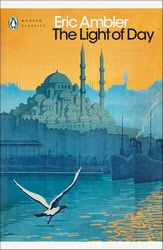
Penguin Modern Classics to publish three Eric Ambler novels

On 26th January 2023, Penguin Modern Classics will publish three wildly enjoyable novels from the father of the spy thriller, Eric Ambler: Passage of Arms, The Light of Day and A Kind of Anger. Ambler is often said to have invented the modern suspense novel, and his disciples include John le Carré, Alfred Hitchcock, Graham Greene and Len Deighton. These are a must-read for fans of the genre.

Eric Ambler (1909-98) was born in London to parents who were part-time entertainers. He studied engineering but left college without taking a degree and became a copywriter in the advertising industry. Between 1937 and 1940, he published his great anti-fascist spy thrillers: Uncommon Danger, Epitaph for a Spy, Cause for Alarm, The Mask of Dimitrios, and Journey into Fear. In 1940, he joined the Royal Artillery and was later transferred to the army film unit. After the war he worked as a screenwriter in England and Hollywood and married his second wife, a leading Hollywood producer. Passage of Arms, The Light of Day and A Kind of Anger are his post-war novels.

A Kind of Anger

The last time anyone saw Lucia Bernardi, she was driving at top speed away from a Swiss villa - leaving the body of her murdered Iraqi lover behind. Now she has vanished, along with a potentially explosive set of papers, and disgraced journalist Piet Maas has been sent to follow her trail to the South of France. But finding her is just the start of his problems. Soon, amid a cast of con men, secret agents and revolutionaries, he must decide whether to land the scoop of his lifetime - or follow Lucia into ever more dangerous waters.

A Passage to Arms

An Indian clerk, Girija Krishnan, sees the opportunity of his lifetime when he stumbles on an abandoned cache of arms hidden in the Malayan jungle. If he can sell the weapons, he will be able to achieve his lifelong dream of owning a bus company - although the penalty for gun-running is death. Soon his decision becomes the catalyst for a chain of events involving an entrepreneurial Chinese family, a corrupt Colonel and, finally, a naĂŻve couple of American tourists who find themselves horribly out of their depth.

The Light of Day

Small-time hustler Arthur Abdel Simpson ekes out a living in Athens by robbing gullible tourists. But when an attempted theft backfires, he finds himself out-smarted and blackmailed into driving a highly suspicious car across the border to Istanbul. Then the Turkish secret police get involved, and Simpson becomes embroiled in something far deeper, and more dangerous, than he could imagine. Featuring a heart-stopping jewel heist, this compulsive, morally complex thriller became the basis for the classic filmTopkapi.


Sunday, 15 May 2022

In The Lyme Crime Spotlight: Charlotte Philby

Curtis Brown Collective

Name: Charlotte Philby

Job: Author

Website: http://www.charlottephilby.com

Twitter: @PhilbyWrites 

Introduction:

Charlotte Philby is a former editor, reporter and columnist. Her grandfather was Kim Philby. Her debut novel Part of the Family was Waterstone's Thriller of the month in May 2020 Her second novel A Double Life was not only one of the New York Post's best book for the summer 2021 but also the Time's book 2020 and The Observer's thriller of the month. The Second Woman, her third book was a Mail on Sunday best new fiction book as well as being a Time's thriller of the month pick. Her most recent book is Edith and Kim

Current book? 

An Olive Grove in Ends by Moses McKenzie. It is a powerful, original and beautifully written fictional account of one young man's life growing up in Stapleton Road, in Bristol - it's a debut novel about masculinity, love, friendship, loyalty and betrayal, and it's so impressive I cannot believe the writer is only twenty-three years old.

Favourite book

Too many to choose from but Alex Garland's The Beach is seminal for me because of where I was at in my life when I read it.

Which two characters would you invite to dinner and why?

Edith Tudor-Hart and Kim Philby - the two characters from my novel Edith and Kim, which reimagines the lives of my grandfather (Kim), and the woman who recruited him to the Soviet cause (Edith) - so that I could grill them on all the questions I was trying to answer when writing the book.

How do you relax?

Going for walks with my kids and the dog we share with my mum (although the dog runs off and refuses to come back and the kids generally spend the whole time shouting in glee or protest, so it's rarely very relaxing), More likely, watching television and drinking red wine. My favourite comfort watches include Inspector Morse and Bosch, or if the children are still awake, Brooklyn 99, which is the only thing we all agree on as a family.

What book do you wish you had written and why?

Victoria Selman's forthcoming Truly, Darkly, Deeply because it's a fresh and genius take on the traditional serial killer story. Or The Girls by Emma Cline because I was obsessed with the Mansons as a teenager and love how she managed to bring a well-trodden crime story to life in a new and brilliant way.

What would you say to your younger self if you were just starting out as an author?

Don't rush, you don't have to do everything at once. And never read your reviews.

Why do you prefer to write standalone books as opposed to a series and would you consider writing a series.

I am easily bored so I worry I would tire of writing the same character again and again. But then I do tend to be fascinated by recurring themes - women leading duplicitous lives, familial betrayal, love - and subverting traditionally male stories by placing women at the centre of the narrative. My first three novels are all stand-alone but very much connected, and best read in chronological order!

What are you looking forward to at Lyme Crime?

Seeing some of the best writers in the business descend on my adopted home-city. Watch out now...

Edith and Kim by Charlotte Philby (HarperCollins) Out Now

To betray, you must first belong...In June 1934, Kim Philby met his Soviet handler, the spy Arnold Deutsch. The woman who introduced them was called Edith Tudor-Hart. She changed the course of 20th century history. Then she was written out of it. Drawing on the Secret Intelligence Files on Edith Tudor-Hart, along with the private archive letters of Kim Philby, this finely worked, evocative and beautifully tense novel - by the granddaughter of Kim Philby - tells the story of the woman behind the Third Man.

You can also find Charlotte Philby on Instagram @Charlottte_Philby

Tickets can be bought here :- https://www.lymecrime.co.uk/tickets--contact.html

Saturday, 19 February 2022

Saturday, 16 May 2020

John Lawton on What Sparked The Storyline

In which I persuade John Lawton to reveal what was the idea that sparked the storyline.

Ayo — that’s a difficult question but only a literary gonif would refuse to attempt an answer.

I have always known where my Troy character came from.

Firstly a job tending an orange grove in Spain about forty years ago — there were not many English language books around, but one of them was Martin Cruz Smith’s Gorky Park (1981). Still unbeatable, my favourite detective story bar none. It led to a rush of Russia-set thrillers … but I wasn’t tempted. I needed an elliptical relationship to Gorky Park not a slavishly literal one.

Secondly, seeking to avoid an Eng Lit degree that might have left me drowning in Jane Austen. Marooned in a BBC costume drama, the like of which I cannot watch — ‘La, Mr D’Oily, the foxhound just farted’ — I signed up for the only undergraduate course in the UK in ‘American Literature’. Tennessee, Twain, Vonnegut, Vidal … Myra Breckinridge not Emma Woodhouse! … alas this was the sixties — the home decade of ‘bad’ behaviour. I got slung out. ‘Slung out’ is posh for rusticated.
John Lawton circa 1968

By the time I had worked my psych ticket (Thank you, Corporal Klinger) all the courses had changed and rather than revert to the drawing room and the farting hounds I opted for pre-Soviet Russian Lit, with a year’s Russian language thrown in for good measure. And I emerged steeped in axe-wielding Russian maniacs sometime in the seventies. I’m not wholly sure what the seventies were — I was looking the other way when they happened.

Out of this unholy combination — Russia X 2 — came Frederick Troy.

Joe Wilderness. 

Oh hell.

I am not a Londoner. I’m not even a southerner. London was a place I passed though without stopping. But, ’round about 1980 I was teaching in a London University college — ‘Othello and the Incredible Hulk’ and ‘Robert Browning at the Hotel California’ being my most notable lectures. You may imagine I did not last long … but I lived in Stepney. In 1980 Stepney was old London, ungentrified. The Indian settling of Brick Lane was under way, but the presence and influence of the previous wave of immigrants could still be felt — the Jews. I found the East End, the descendants of the pogrommed refugees, fascinating. I could walk into my local pub and overhear conversations in Yiddish. Also, the presence of the East End’s most notorious villains could still be felt. The Krays had been in prison about ten years at this point.

Sooner or later a Stepney kid was going to surface as the central character in a novel. That became Joe Wilderness — of no particular ethnicity, but born to a family of thieves, rogues and hookers. I housed him in what is probably the East End’s most famous street, Sidney Street, where a young(ish) Winston Churchill personally supervised an armed raid on a bunch of Russian anarchists circa 1910, and where Peter the Painter met his end, or not … depending in which version you believe.

The plot matter was ‘how to get Joe out of Sidney Street?’

I could not leave him there. I had no wish to write an East End gangster novel — quite enough of those around as it is.

Russia came to my aid once more.

Sgt.Maj Loudbutthick: “Right, you useless fuckers! You can spend the next six months square-bashin’ or you can go to Cambridge and learn Russian! Nah, wossit gonna be?”

Some choice … so they both became ‘spies’ … monitoring Russian broadcasting and communiquĂ©s.

That was Joe’s route out of the East End, my storyline — or perhaps that should be plural — a highly intelligent Cockney drafted into the RAF (the only branch of UK Armed Forces that had an IQ test for draftees), who becomes fluent in Russian, a valuable asset to MI6 … but … but inside he remains the East End rogue of his youth …. a thoroughly likeable, deeply dishonest spook who cannot get by without ‘something on the side.’

Two of my tutors in Russian Government, being too young for WW2 had been drafted into the RAF about the time of the Korean War.

My first Wilderness novel, Then We Take Berlin, sees him as a smuggler of coffee, as valuable a commodity as cigarettes in the late 1940s, from West Berlin to East Berlin. But, as a reviewer helpfully pointed out (I had not noticed) Joe never really profits, money runs though his fingers like grains of sand.


In the second, The Unfortunate Englishman, it is truckload of vintage Claret.


And in my current novel, Hammer to Fall, illegally-distilled Finnish vodka, which he smuggles into a thirsty Soviet Union, via a ‘hole-in-the-fence’ in Murmansk.


Every time I write a novel, it is an end in itself. Reviewers said of Then We Take Berlin ‘weird ending. He must be planning a sequel.’ I wasn’t. That really was where Wilderness ended.


Then, the home team … agents, publishers, girlfriends, say … ‘Well would it kill you to write a sequel?’


So, I do.


And The Unfortunate Englishman was also the last of Wilderness. One of the few happy endings I have ever written. (‘Happiness is for losers.’ F. Nietzsche 1897).


Cue home team. Repeat the process. Offer me money.


And … I was not at all sure I could write a third Wilderness. Could he not just stay happy in Hampstead with his wife and daughters?


No, he bloody well couldn’t.

What changed?

For one thing I had started isolating myself to write at the bottom of a deep valley in Southern Tuscany — a fourteenth century watermill, surrounded in mist, bollock-freezing cold and beautiful.

One of the neighbours — well, not that isolated after all — is the Finnish musician Anna-Riikka Santapukki. So, I learnt something of Finland just in the course of conversation, and pursued it in research, in particular its struggle to stay neutral during the Cold War and its thousand-mile, heavily-defended frontier with the USSR — not a country anyone would choose as a neighbour. And I learnt that in an effort to remain neutral it had, sometime in the early sixties, both kicked out the CIA and denied Russia use of military bases. This country, population under five million, had balls, and in the absence of the CIA I saw a role and a plot for Joe Wilderness. And, of course, Finland distils hooch in greater quantities than the backwoods of Kentucky. ’Nuff said.

I could not and did not leave Joe in Finland. The needs of plot called for more action … and a the next ‘big thing’ in the Cold War loomed ominous and obvious — the Warsaw Pact invasion of Czechoslovakia in August 1968.


Any more would be what I believe is termed a ‘spoiler.’ 


Hammer To Fall by John Lawton (Published by Grove Press)
It's London, the swinging sixties, and by rights MI6 spy Joe Wilderness should be having as good a time as James Bond. But alas, in the wake of an embarrassing disaster for MI6, Wilderness has been posted to remote northern Finland in a cultural exchange program to promote Britain abroad. Bored by his work, with nothing to spy on, Wilderness finds another way to make money: smuggling vodka across the border into the USSR. He strikes a deal with old KGB pal Kostya, who explains to him there is a vodka shortage in the Soviet Union - but there is something fishy about Kostya's sudden appearance in Finland and intelligence from London points to a connection to cobalt mining in the region, a critical component in the casing of an atomic bomb. Wilderness's posting is getting more interesting by the minute, but more dangerous too. Moving from the no-man's-land of Cold War Finland to the wild days of the Prague Spring, and populated by old friends (including Inspector Troy) and old enemies alike, Hammer to Fall is a gripping tale of deception and skulduggery, of art and politics, a page-turning story of the always riveting life of the British spy.