Showing posts with label Welsh Noir. Show all posts

Tuesday, 22 March 2022

“Snowdonia, the perfect backdrop for Welsh Noir” by Simon McCleave


It was winter and the rugged hills, valleys and lakes of Snowdonia were snowbound and bleak. This was a landscape that beat to the drum of Arthurian legend. The pounding heart of ancient Wales – a land of folklore and of myth … Llyn Llydaw was dark, deep, and utterly still. Carved into the flanks of Snowdon, the lake was long and thin and had formed in a cwm, a glaciated valley, about one third of the way up the mountain. The valley was believed to be the final resting place of Arthur, King of Britons. The site where a weary, dying King Arthur instructed Sir Bedevere to throw Excalibur to the porcelain hand of the Lady of the Lake. An area of immeasurable power and myth.”

(Excerpt From: Simon McCleave’s The Snowdonia Killings, the first book in the DI Ruth Hunter Crime Thriller Book series)

As a native South Londoner, I’m often asked, ‘Why do you write about Snowdonia?’ It’s a fair enough question. As environments go, South London and Snowdonia couldn’t be more contrasting. But in my Detective Ruth Hunter crime series, that’s the point. 

Before I go any further, I should point out that I do have some credentials here. Twenty years ago, I married a beautiful Welsh girl, and after a few years of London life, we moved to North Wales to raise our family. That was over a decade ago. Snowdonia is now quite literally on my doorstep and, as I planned a series of crime novels, it was a landscape that cried out to be the backdrop to these stories. In fact, it was so apt that I had to check several times to make sure it hadn’t already been used. Luckily, I found it to be a blank canvas.

Like all great settings for storytelling, Snowdonia has become a character in its own right. As a landscape it has it all. The ominous ridges of snow-dusted mountains that touch the sky. Vast lakes formed at the last ice age, and rocky, stormy beaches that border the Irish sea. Added to this, it boasts a mystical atmosphere where folk-tales and history merge to provide a dark and powerful narrative for the 900 square miles of Britain’s largest national park. The Mabinogion, a collection of Snowdonian legends, mythology and the supernatural, are over a 1,000 years old. And so, as a backdrop that is dramatic in mood and loaded with meaning, Snowdonia perfectly fits the distinguishing traits and traditions of noir fiction. 

Entering this landscape is Detective Inspector Ruth Hunter, a native South Londoner (ah, yes there is a biographical element!), who is suffering from burn-out after decades of dealing with the murder and mayhem in the high-rise, concrete jungles of Peckham. Snowdonia had been the destination of many blissful childhood holidays. Ruth transfers from the London Met to the North Wales Police force confident that her days will be filled with nothing more taxing than sheep rustling or tractor theft. Of course, nothing could be further from the truth. Crimes in rural North Wales are as brutal, harrowing and complex as anywhere else. And it wouldn’t be much of crime series with nothing more dramatic than an expired shotgun licence. 

Just as I had preconceptions of what life in North Wales would be like, so does DI Ruth Hunter. She soon realises that the CID team she now leads are a far cry from the parochial hicks that she had first imagined. The detectives are as sharp, intuitive, and caring as any she had encountered in the London Met. More so, in many ways. And much as I did, Ruth soon relishes the warm, friendly people most of whom value honesty, family and community over pretention, status and the need for skinny, de-caff lattes and smashed avocado on sourdough!

Released in 2020, The Snowdonia Killings has sold over 250,000 copies and reached No. 1 in the Amazon Chart. A television series based on the book is in development and set to start shooting in 2023. 

The latest novel in the Snowdonia series is ‘The Lake Vyrnwy Killings,’ and the first in Simon’s new series, set in Anglesey, The Dark Tide is published by Avon in May.
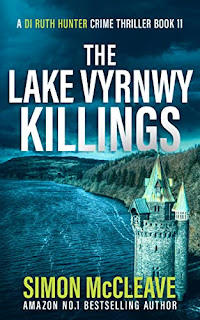
The Lake Vyrnwy Killings by Simon McCleave (Out Now)

Detective Inspector Ruth Hunter lives with the pain of her partner’s mysterious disappearance, but despite trading in the crime-ridden streets of London for rural Snowdonia, her life has been anything but peaceful… A missing husband. A gruesome discovery. Are the two events linked? When DI Ruth Hunter and DS Nick Evans are called to a gruesome discovery at beautiful Lake Vyrnwy, they have little to go on to identify the grisly remains. When a local man is reported missing, it seems that his links to a Merseyside gang might explain his disappearance. But when the missing man is spotted at various locations, Ruth and Nick must discover if he is on the run and hiding, or if a darker manipulation could explain the sightings.

More information about Simon McCleave can be found on his website. You can also find him on Facebook and on Instagram.


Monday, 19 November 2018

Nordic Noir vs. Welsh Noir.


Massive thanks to Ayo Onatade for inviting me to write a guest post for Shotsmag about the first in my new historical crime series. It’s a huge honour to appear on such an influential crime fiction blog.

As None So Blind is set in mid-nineteenth century Cardiganshire, you could categorise it as Welsh Historical Noir, a sub-genre that (as far as I’m aware) currently comprises… None So Blind. So it came as a bit of a relief when I realised that it also appears to fit in to a much better known genre: Nordic  Noir.
I can hear the questions…
What now?
When did Wales become one of the Nordic Countries?
Clearly, it’s not. But Nordic Noir isn’t entirely defined by where it’s set.

Let me explain. As writer of crime fiction, I follow blogs and podcasts devoted to the subject. One of my favourite podcasts is the excellentA Stab in the Dark’ from UK TV Crime, and it was there that I heard journalist and crime fiction critic, Paul Hirons, talking about Nordic Crime. He wanted to find out whether there was something specific that defined crime fiction from the Nordic countries and he interviewed a lot of famous names in order to find out.


Anne Holt, bestselling crime fiction author, lawyer and former Norwegian Minister for Justice (who should, therefore, have a real insight here) felt that, though Nordic writers produce crime fiction across many sub-genres, there was definitely a certain something that bound them all.

Yrsa Sigurðardóttir, Queen of Icelandic Crime, agreed and, for her, one of those things is the way in which Nordic writers are always looking to gain an insight into some social issue and use the investigation of a crime as a means to do so. Paul Hirons described this as ‘the second story’ in Nordic crime novels.

Ragnar Jonassen, a fellow Icelander, identified a second key factor – location. For him, the unique landscape of the northern countries becomes almost a character in its own right. And not just the landscape but the weather. He spoke about how TV crime series Trapped – in which a town and its residents are snowed in after severe weather - first introduced many Brits to Icelandic noir and, simultaneously, to the notion that weather is key. As Ragnar said, in a nation which has, historically, depended on the sea and fishing for its entire survival, the weather is not a trivial talking point but a matter of life and death.

So, Nordic Noir has a ‘second story’ which burrows in to some contemporary social issue and a deeply-felt sense of place which plays more than a cosmetic part in the unfolding of the story. Those things are true of the Teifi Valley Coroner series, so it must follow that I also write Nordic Noir. Right?

 It sounds flippant but I don’t think it is. Unlike much contemporary crime and thriller fiction which focuses entirely and narrowly on the interplay of characters, my detective duo – functionally blind ex-barrister Harry Probert Lloyd and his assistant, solicitor’s clerk John Davies –  are working on a larger stage. Their investigations have to take into consideration the wider social context in which deaths occur. And it’s only in understanding that context that they can hope to understand why and how any particular death (murder, suicide, manslaughter or misadventure) has taken place. In None So Blind that larger context is the Rebecca Riots – a series of tollgate riots which took place in West Wales between 1839 and 1843 and which had huge social and political ramifications. In subsequent books, other contemporary social issues (which also have twenty-first century resonance) come under the spotlight.

And the other defining feature of Nordic Noir, landscape, is also important in None So Blind. Topographical constraints impact directly on Harry and John as, in nineteenth century West Wales, travelling around on horseback took time. Roads were inadequate, bridges few and hills many. And the woods in which None So Blind’s central death occurs are key to the unfolding story. The death couldn’t have happened anywhere else, for reasons which gradually become clear, and, had it happened anywhere else, the mystery would have been insoluble.

The Teifi Valley – that ‘tangle of wooded river valleys’ as Harry calls it – is a place like no other and it has given rise to a unique society, one moulded by landscape and weather and distance from the centre of government; a society overseen by a landowning class that does not understand its tenants, a police force that is so scattered as to be ineffectual and a magistracy so keen to save money that inquests are rarely held to investigate sudden death.

It’s an absolute gift of a setting for a crime author because, at that time and in that place, people were literally getting away with murder.

And Harry Probert-Lloyd, soon to be Teifi Valley Coroner, is determined to stop them.

[If you’d like to know more about the social context in which the death of Margaret Jones is investigated, please read earlier guest posts on my blog tour at Books Of All Kinds and Hair Past A Freckle.]

None So Blind by Alis Hawkins (Published by Dome Press)

West Wales, 1850. When an old tree root is dug up, the remains of a young woman are found. Harry Probert-Lloyd, a young barrister forced home from London by encroaching blindness, has been dreading this discovery. He knows exactly whose bones they are. Working with his clerk, John Davies, Harry is determined to expose the guilty. But the investigation turns up more questions than answers. The search for the truth will prove costly. But will Harry and John pay the highest price?