Showing posts with label spartan. Show all posts

Sunday, 23 October 2011

White moves back to Penguin

We recently reported that Selina Walker had moved within the Random House UK imprint Transworld Publishers to Century and Arrow Imprints, and now we heard that Publishing Director of the new Swordfish Imprint at Orion Publishing, and military writer Rowland White is moving back to Penguin UK as reported by The Bookseller

White said: "Orion provided me with a wonderful opportunity and I've enjoyed working there alongside some very talented publishers. The invitation to return to Michael Joseph was impossible to turn down and I realised that Penguin was where my heart lay."

Moore added: "I am truly delighted that Rowland is coming back to Michael Joseph. The team here has missed him and his commercial publishing skill—his return will be hugely welcomed by all."

White joined Orion from Michael Joseph in January 2010, this year launching his commercial non-fiction imprint there called Swordfish, which began publishing this summer. The Bookseller understands the future of the imprint is currently under discussion, with White's end date at Orion and start date at MJ still to be confirmed.

Read More Here

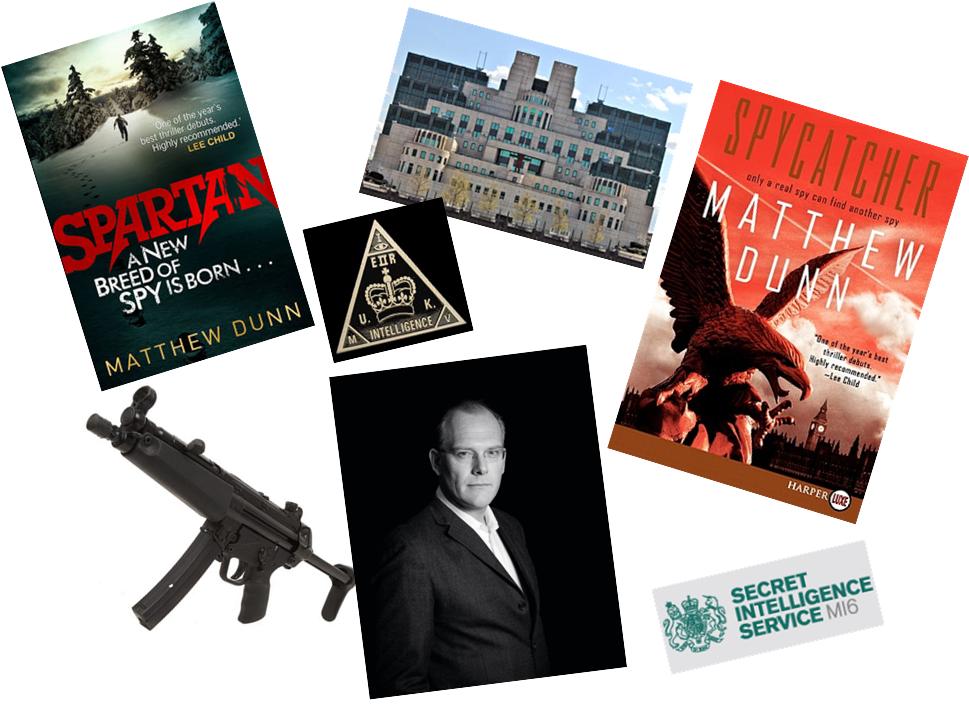
We were delighted with Rowland’s first Swordfish acquisition – Matthew Dunn’s Spartan [aka ‘Spycatcher’].

Last week, The Telegraph featured an interesting interview with former MI6 Field Operative turned Thriller Writer – Matthew Dunn

Dunn was born in London, the son of a merchant seaman turned photographer. Educated at a state school, he read politics and economics at the University of East Anglia before taking a PhD in international relations at Cambridge. It was there that a tutor raised the matter of his future.

“There was a discussion about doing something academic. Part of me was attracted to that but I also had fire in the belly. I mentioned the diplomatic service and at some point he said there was another aspect of the service that might be of interest, also involving travel and complex situations. We knew what we were talking about.”

Six months of selection followed, involving tests of mental agility, role playing, repeated interviews and intrusive vetting. Five of the dozen people on his course were women, the successful ones a cross-section of society.

“MI6 is not some elitist club. The officer has to able to interact with any kind of person. You can’t have people who have lived only in a gentlemen’s club environment. It’s not like joining the Household Cavalry.”

What bound the new recruits? “We all felt anything was possible. You don’t enter with the mindset that 'this is impossible’. You just have to think of a way to do it. One of the questions in interview was, 'Who do you look up to?’ My response was, 'Frankly, nobody’. A degree of self-confidence is required, but not arrogance.”

Part of the selection process was conducted at Fort Monckton, the MI6 training establishment near Portsmouth. Candidates were sent into the naval town to test their ability to extract information.

“They might ask you to come back with 10 passport numbers,” says Dunn. “I had to sit in the pub and ingratiate myself with a group of strangers, getting as many personal details as I could. I did OK – some did tarot card readings or magic tricks to get details.”

A black tie dinner at Monckton marked Dunn’s formal acceptance into SIS. It was 1995 and he was 27. He was to find himself at the sharp end of SIS operations. “The Directorate of Requirements and Production is the operational side of the service. Officers operating in particularly hazardous areas were those who had excelled in the paramilitary side of training. I worked with the Increment, the SAS unit attached to SIS.

They provided back-up for anything that might be extremely dangerous. I was trained in close quarter and unarmed combat. I was good at it, I enjoyed it. Yes, there is an element of James Bond. There were no watches that could burn holes through walls but you might have a letter with explosives in it that could blow off a door.”

Dunn’s first job was with a team targeting rogue states. Officers are eased into operations – non-lethal ones first – often shadowing experienced colleagues. Dunn became an agent runner, responsible for about 20 in all. Some of those he recruited would have been tortured and executed if exposed.

Read More from The Telegraph here

Monday, 5 September 2011

Dunn in Holland

You may have noticed my recent enthusiasm for ex-MI6 field operative’s debut thriller Spartan [aka Spycatcher US title]. Following an interview at The Rap Sheet, speaking to the mysterious Dunn some of you may wish to know what this ex-Intelligence man looks like in the flesh, so I was delighted to see this little clip from Dutch TV where Dunn speaks about the recent Libyan situation, being well versed in geo-politics.


sitestat


If the Video doesn’t load in your browser – click here


Though the program is in Dutch, Dunn’s section is in English with Dutch Subtitles, and a good insight into the man behind the most interesting political thriller I have read this year.

Read More Here

Monday, 15 August 2011

Catching ‘Spartan’

I have been rather enthused by a debut thriller novel entitled ‘Spartan’ [aka ‘Spycatcher’ in the US] which was released last week. It excited me so much that I lost a night’s a sleep as the powerful journey was relentless. I have no hesitation in proclaiming it as the best thriller debut I’ve read this year. I have Spartan / Spycatcher featured in a review at January Magazine thanks to my editors Jeff Peirce and Linda Richards; and here's an extract -


My favorite section of this yarn focuses on the storming of a German terror cell. It nicely illustrates the differences between how the Brits and Americans now want to look at torture (as an alternative means of extracting information from thuggish anarchists), and the more liberal German way of enforcing human rights, even for terrorists. This dichotomy poses a problem, when Cochrane wants to keep one of the terrorists alive for “enhanced interrogation.” The Germans forbid it, saying their security team was operating under strict orders to ensure that the terrorists were all killed in the operation; if there are survivors, there will be human-rights implications and media questions that pose political problems back home. The sheer drama of this scene, coupled with the political and ethical issues involved, makes for excruciating tension. And Dunn’s bold, hard and logical writing style made me feel I was actually there, attacking the building.


Will saw a body lying on its side. It was rocking back and forth. A hand clutched to one leg. Will checked the surroundings but could see no weapon. He moved closer and put the muzzle of his Glock against the body’s neck before slowly pulling it onto its back. A woman looked up at him. Will glanced down at her leg and saw that she had been shot in the thigh. Her trousers were torn and covered in blood. The bullet had clearly done severe damage.


Will bent to the woman’s face and said loudly, “Who sent you?”
The woman’s eyes blinked rapidly. She looked terrified. Tears were streaming across her face, and they were clearly caused by pain, fear, tear gas, or all of those. She looked very young.
“Who sent you?” he asked her.


The woman began coughing, and the sound instantly told Will that she had gas in her throat and lungs. He knew that he could not allow her to suffer like this. He ripped off his respirator and fixed it over the woman’s head.


He said to her, “It’s okay. I’m going to get you out of this place.”


The real cat-chasing-mouse part of Spartan/Spycatcher begins as Cochrane enlists a quartet of tough sidekicks to help him protect Lana, while they dangle her enticingly in front of Megiddo. A series of letters sent back and forth between Lana and Megiddo serves to lure the prey, and leads to assorted varieties of surveillance games. I was delighted by Dunn’s conscious chapter-length planning, as he measured out just enough plot to keep you hooked -- not the James Patterson-like chapters of one or two pages, nor 30-page Eric Ambler chapters, but something in between.


Read More and I urge you to seek this debut out

I have an upcoming interview with Matthew Dunn coming shortly; and asked him to tell Shots Readers a little about his life and how an ex-SIS / MI6 Field Operative moved to the ruthless world of thriller writing -

Matthew Dunn: Reading, Writing & Spying

I grew up in a peaceful, semi-rural, and largely uneventful part of England. My childhood couldn’t have been happier, though I craved escape and adventure and became a voracious reader of obscure novels about 18th and 19th century sea-faring adventures and early 20th century spies. These books helped fuel the fire in my belly to the extent that reading is largely responsible for my subsequent employment as a British intelligence operative.

I was talent spotted to join MI6 while at university, though I positioned myself to be noticed by the spooks. I wanted to live the adventures and lives of the characters I had read about in my books. But the real world of MI6 turned out to be quite different. When I was a spy, not one day passed when I did not feel the incredible weight of responsibility on my shoulders and the importance of the work that I and other officers did. Missions were sometimes ferociously rapid, sometimes agonizingly protracted, always intense, but never playful. And in the real world of espionage, real people die. For me, being a spy never felt like an adventurous escapade. Instead, I was in a relentless war.

Spies operate in a secret world that is all around us but can only be seen by those who are trained to spot it. When I was on missions overseas I would move through cities and other locations with the confidence of an experienced predator. And when I was at home in London I would walk in its streets, eat in its restaurants, drink in its cafés and bars, but all of the time look at people around me. I had nothing in common with them because my world was not their world. I had, to some extent, become detached from humanity. The only people I could relate to were my fellow officers, and my secret foreign agents.

When I left MI6 I was a very hard man, a million miles away from the innocent wonderment of my youth. I knew that I should try to reintegrate back into the normal world but did not know how to do so because once you’ve operated in the secret world that place stays around you forever. Most people who leave MI6 are high-achievers who go in to top jobs in industry, commerce, government, or the arts. But all of us struggle to adapt. We’ve seen and done too many unusual things.

For ten years after leaving British intelligence, I walked a solitary path between the secret world that I could still see but no longer touch and the normal world which seemed foreign. But then I started writing Spartan and the process resulted in something unexpected – I regained the same desire for adventure that I had when I was a boy. In tandem, I felt that I was weaving aspects of the secret world into the normal world. I now live and write in the place where they are interwoven.

My novel’s protagonist, Will Cochrane, is wholly fictional. However, his character, decision-making, and actions, are inspired by the man that I used to be. Happily, I am no longer someone like Will Cochrane. But it is great to write about him.

© 2011 Matthew Dunn