Tuesday, 9 December 2014

The Wolfe Pack Barks

During its Black Orchid Banquet, held 6th December 2014, in New York City, the Nero Wolfe/Archie Goodwin fan organization, The Wolfe Pack, announced that the winner of its 2014 Nero Award is Murder as a Fine Art, by David Morrell (Mulholland). This commendation is given out annually “for the best American mystery written in the tradition of Rex Stout’s Nero Wolfe stories.”

Morrell’s historical thriller beat out four other novels to capture this year’s Nero: Ask Not, by Max Allan Collins (Forge); Three Can Keep a Secret, by Archer Mayor (Minotaur); A Study in Revenge, by Kieran Shields (Crown); and A Question of Honor, by Charles Todd (Morrow).

Also the Black Orchid Novella Award was presented to K.G. McAbee for “Dyed to Death.” The Black Orchid is sponsored jointly by The Wolfe Pack and Alfred Hitchcock Mystery Magazine.


For more information on Murder is a Fine Art, click on Ali Karim's report.


Hat tip: The Rap Sheet


Monday, 8 December 2014

Chris Simms talks Sleeping Dogs with Nick Quantrill

Chris Simms is the acclaimed author of the Manchester-based DI Spicer series, and more recently, the DC Khan series, set in the same city.  Chris was named as one of Waterstone’s 25 authors of the future.  His novels continue to win awards and gather critical acclaim.  Chris talks to Nick Quantrill about his work.  Nick Quantrill is a Hull based author whose Joe Geraghty novels are published by Caffeine Nights.

Nick - “Sleeping Dogs” is your seventh in the DI Spicer series.  Can you tell us a little about it?

Chris - The action is split between Jon Spicer’s stomping-ground, Manchester, and a community out in the wilds of Galway, Ireland.  Events are sparked by the appearance of a huge fighting dog in Spicer’s local park.  Only the intervention of the family’s pet Boxer, Punch, saves Jon’s young daughter from being horrifically mauled.

Jon then finds evidence of a link to Ireland and realises the attack had been carefully planned by people who know exactly where he lives.  It’s every policeman’s worst nightmare.
In previous Spicer novels, I’ve built up Jon’s back-story – including the fact his great grandfather, Padraig, was an Irish navvy who fought his way out of the slums of 19th century Manchester through bare-knuckle fighting.  I wanted to explore Jon’s family history in Sleeping Dogs – and disturbing long-buried secrets seemed the ideal way to do it. 

Nick - Was taking Spicer out of his home city of Manchester a deliberate decision to test
him even more that you have previously?  His personal life, always a strength of the series, seems to be particularly tested.

Chris - Yes, I purposefully took him out of his comfort zone to see how he fared in a foreign country with all sorts of cultural issues to contend with.  What I didn’t want to do is take the easy option and give his enemies paramilitary links: it had to be more subtle – and personal – than that.

Nick - After setting the first six books in the series in Manchester, did you find it a challenge to write about a different place, or did it enable you to find new aspects of Spicer’s character?

Chris - The part of Ireland Spicer ends up in is rugged and raw.  I love landscapes like these and, during the course of the novel, found myself painting parallels between the terrain and Spicer.  Galway’s coast is regularly battered by vicious storms; Spicer gets similar treatment at one point from the locals he’s tangling with. 

Nick - You’ve published “Sleeping Dogs” yourself, but Severn House publishes your latest series starring DC Iona Khan.  Are you officially a hybrid author?

Chris - I suppose so – though it wasn’t planned this way.  Until recently, the publishing industry giveth, and the publishing industry taketh away.  As an author, you did as you were told if you wanted to keep writing.  Now, if an author and publisher don’t see eye-to-eye, the author has the option of going it alone.  I knew “Sleeping Dogs” was a cracking read – possibly the best Spicer yet – so I couldn’t bear to abandon it.  That’s why, for me, the emergence of independent publishing has been a lifeline.  Only a few years ago, “Sleeping Dogs” would never have seen the light of day.  Obviously, this all represents a huge loss of power for publishers. 

Nick - What were the challenges and pleasures of publishing “Sleeping Dogs” yourself?

Chris - Being with a publisher is like having a security blanket.  Things, you like to believe, are all being taken care of.  Whip that blanket away and you feel exposed.  It’s just you.  But you know what?  It was just me when I wrote my first novel over 12 years ago.  Gritting my teeth and sending if off to agents.  Waiting for weeks, then seeing the rejection slips trickle in.  Gritting my teeth and sending if off to more agents.

Independent publishing lets you rediscover all of that.  It’s hugely exciting.  Yes, it forces you to do things like marketing and publicity you previously hoped the publisher was attending to.  Yes, you have to agonise over what price to charge.  But unlike publishers, I’m not trying to protect my book printing business: so my eBooks cost just £2.99.  What’s so liberating is that more people are buying copies of my eBooks now than ever before.  As a result, I’ve been able to bring out print copies too.   

Nick - What’s next for Spicer?  Can we expect more of his investigations, or is his race run?

Chris - I’ve given up trying to predict events in this game!  “Sleeping Dogs” ends with the door wide open for more DI Spicer.  DC Khan - as a female struggling in the macho environment of the Counter Terrorism Unit - continues to intrigue me.  But I’ve also written a novel-length ghost story; “Sing Me To Sleep” launches soon – and it combines the pace of a crime novel with the suspense of a supernatural thriller.  Ideally, I’ll find a way to continue with all three types of book.

More information about Chris Simms and his books can be found on his website.  You can also find him on Facebook.


Sleeping Dogs is available now at Amazon.  For more information, see www.chrissimms.info

Sunday, 7 December 2014

Past Tense with Elly Griffiths

Today’s guest blog is by author Elly Griffiths who is the author of the Ruth Galloway series.  In 2012 and 2014 she was shortlisted for the CWA Dagger in the Library.  Her novel The Crossing Places won the Mary Higgins Clark Award in 2011.  The novel was also Shortlisted for the Theakstons Old Peculier Crime Novel of the Year.  Her novel The House at Sea’s End was shortlisted for the Barry Award for best British Crime Novel.  Her latest novel is Zig Zag Girl.

She looks.  The man is still watching her.  She waits.  He’s still there.  Should she take her chance?  She runs.

In some ways the present tense seems the obvious choice for crime fiction.  It’s immediate, it’s compelling, and it has the added advantage of not giving anything away.  As soon as you use the past tense, you are removing the reader from the action.  It’s like that fantastic first-person essay you wrote when you were 12.  The one where the narrator dies horribly and your teacher says, ‘So who was telling the story then?’  With the past tense there’s always the implication that someone was left alive, like Horatio in Hamlet, to tell the story.

When I wrote The Crossing Places, my first crime novel, I had already ready published four books under my real name Domenica de Rosa (I know it sounds made-up).  These books fell into that vague category that ranges between ‘chick lit’ and ‘women’s fiction’ and they were all written in the present tense, which seems the norm for the genre.  Not one critic ever commented on this.  Mind you, not many critics read the books.  It is almost impossible to get reviews for women’s fiction.  I used to wonder if anyone, apart from my close family, ever read the books.  Looking at the sales figures, the answer is probably no.

When I started The Crossing Places, it seemed natural to write in the present tense.  I didn’t at first realise I was writing a crime novel and there is certainly a ‘women’s fiction’ element to the book.  But, if I had thought about it, I would have thought that the present tense was ideal for crime.  ‘She looks, she gasps, she runs etc etc’.  However, when the book came out, I was astonished to see that many of the reviews mentioned the present tense.  Actually, I was astonished to see reviews at all.  That’s the lovely thing about crime; you know people are reading it.  There are bloggers and reviewers – people who are extremely knowledgeable and enthusiastic about the genre – who actually read books by new authors.  It’s amazing.  Anyway, a lot of these people mentioned how unusual it was to read a crime novel written in the present tense.  Most people liked it but there were some reviewers on Amazon who boasted that they were unable to read more than a page written in this outlandish style.  This didn’t stop them giving the book a one star review though.

I was surprised by the reaction to the tense (but delighted that so many people seemed to like Ruth, the protagonist).  I wondered if I should switch to the past for the next book.  Because that’s the other lovely thing about crime readers, they like a series.  But, in the end, I was worried that I wouldn’t be able to get the tone right if I changed tenses.  But, six Ruth books later, when I decided to write something different, I made a decision.  This book would be set in the past and it would be written in the past tense.

The Zig Zag Girl is set in the theatrical world of the 1950s.  Writing a historical novel (even
one set in the fairly recent past) involves a complete change of mind-set: no mobile phones, no computers, and very few private cars, wireless instead of television.  Using the past tense seemed to suit this new way of thinking and it reflected the slightly melancholy mood of the book.  Because, with the present tense, you can never say things like, ‘And now, years later, he was tormented by the fact that he could not remember whether she ever said ‘I love you’ back.’ With the past tense you can look back with the benefit of hindsight and that’s a lot of fun for a writer.

Do I prefer the past or the present?  I’m not sure.  The present is dramatic and it allows you to differentiate easily between action and flashback.  The past is more elegant, it allows you to muse and ponder, to reflect on the ironies of life.  It can be exhausting to read a book written in the present tense, like being endlessly buffeted by waves, no time to draw breath, always the danger of slipping under the water.  But the present tense makes you feel involved.  I sometimes wonder if is it part of the reason why people have taken Ruth to their hearts.  We share Ruth’s experiences in real-time, they are not filtered back to us by the forgiving past tense.

So, for the moment (the present moment, that is), I’ll stick to the present for Ruth and the past for Edgar and Max.  Because that’s another wonderful thing about the world of crime fiction – there’s room for everyone.

More information about Elly Griffiths and her books can be found on her website.  You can also follow her on Twitter @ellygriffiths and on Facebook.

------
Zig Zag Girl

Brighton, 1950.

When the body of a girl is found, cut into three, Detective Inspector Edgar Stephens is reminded of a magic trick, the Zig Zag Girl.

The inventor of the trick, Max Mephisto, is an old friend of Edgar’s.  They served together in the war as part of a shadowy unit called the Magic Men.

Max is still on the circuit, touring seaside towns in the company of ventriloquists, sword-swallowers, and dancing girls.  Changing times mean that variety is not what it once was; yet Max is reluctant to leave this world to help Edgar investigate.  But when the dead girl turns out to be known to him, Max changes his mind.


Another death, another magic trick: Edgar and Max become convinced that the answer to the murders lies in their army days.  When Edgar receives a letter warning of another ‘trick’, the Wolf Trap, he knows that they are all in the killer’s sights…

Friday, 5 December 2014

2014 Dagger in the Library winner

Barry Forshaw & Alison Joseph (Chair CWA)
On Thursday 4 December at Waterstone's Bookshop, Piccadilly, London the 2014 winner of the Dagger in the Library was announced. All five shortlisted authors - Sharon Bolton (Transworld), Elly Griffiths (Quercus), Mari Hannah (Pan), James Oswald (Michael Joseph) and Mel Sherratt (Thomas & Mercer) were on attendance.

Unlike most most other literary prizes, the Dagger in the Library honours an author's body of work to date, rather than a single title and an author must have published three books to be eligible  for the award.

As part of the evening's entertainment a crime fiction quiz took place with Barry Forshaw as quiz master and Lynsey Passmore organising the questions.  It was a lively affair.

After a brief introduction by Alison Joseph the current Chair of the CWA the quiz took place.
Mobeena Khan (Chair, Dagger in the Library Judges)
 Before the announcement of the winner of the quiz the winner of the Dagger in the Library was announced.  Mobeena Khan the Chair of the Dagger in the Library Judges gave a wonderful speech in which she praised libraries. 


This year, for the first time, readers compiled the longlist as crime lovers everywhere were invited to vote online for their three favourite authors. The most popular ten writers formed the longlist. This was then whittled down to five shortlisted authors by a panel of judges, including previous winner Steve Mosby, CWA Director Lucy Santos and a group of UK librarians.

Sharon Bolton
The 2014 Dagger in the Library was awarded to Sharon Bolton who is the author of eight books as well as the Lacey Flint series.

Congratulations to all the nominated authors and to Sharon Bolton for becoming the latest winner of the Dagger in the Library.  She joins authors such as Mo Hayder, Steve Mosby, Belinda Bauer, Peter Robinson and Craig Russell.


Photographs © Ayo Onatade

Monday, 1 December 2014

Bob Randisi moves into MCKENNA'S HOUSE


I have followed the tales of The West by the prolific Robert Randisi as well as our editor Mike Stotter for many years. Perhaps these two writers are better known for their work in the crime fiction genre; Bob being the originator of The Private Eye Writers of America [PWA] – administering the prestigious Shamus Awards, during the Annual Bouchercon weekend. While Mike Stotter apart from his own writing is an equally busy dude, as co-Director of Piccadilly Publishing, CWA Dagger Liaison officer, Editor-in-Chief of Shots Ezine as well as penning his own westerns – where do they find the time?

I was delighted to learn that some of Bob’s work is being published by Piccadilly Publishing – while back in the US, he has a very interesting new work out entitled MCKENNA’S HOUSE, not a Western, but a mystery tale, perfect for a winter's night, huddled by a roaring fire and a glass of Gin - so what’s in store for our insurance investigator?

After the death of his estranged father, middle-aged insurance investigator Lazarus McKenna leaves Chicago and moves into his father's house—the house he grew up in—and establishes his business in Omaha, NE. Eventually, his lonely life is invaded by a young woman and a small boy who may or may not be on the run. Finding them in a bus station, he takes them into his care—and home—on a cold winter night, hoping to discover what their trouble is so he can help them with it. At the same time he is hired by a woman to discover whether or not her murdered husband was cheating on her at the time of his death. McKenna's once boring, quiet life is shattered as both cases turn deadly. 


MCKENNA’S HOUSE is available to download from Shots via Amazon kindle here as well as from Smashwords platform here

If you’ve not read these writers tales of the West, then these links should give you an introduction

The Work of Robert J Randisi

The Work of Mike Stotter

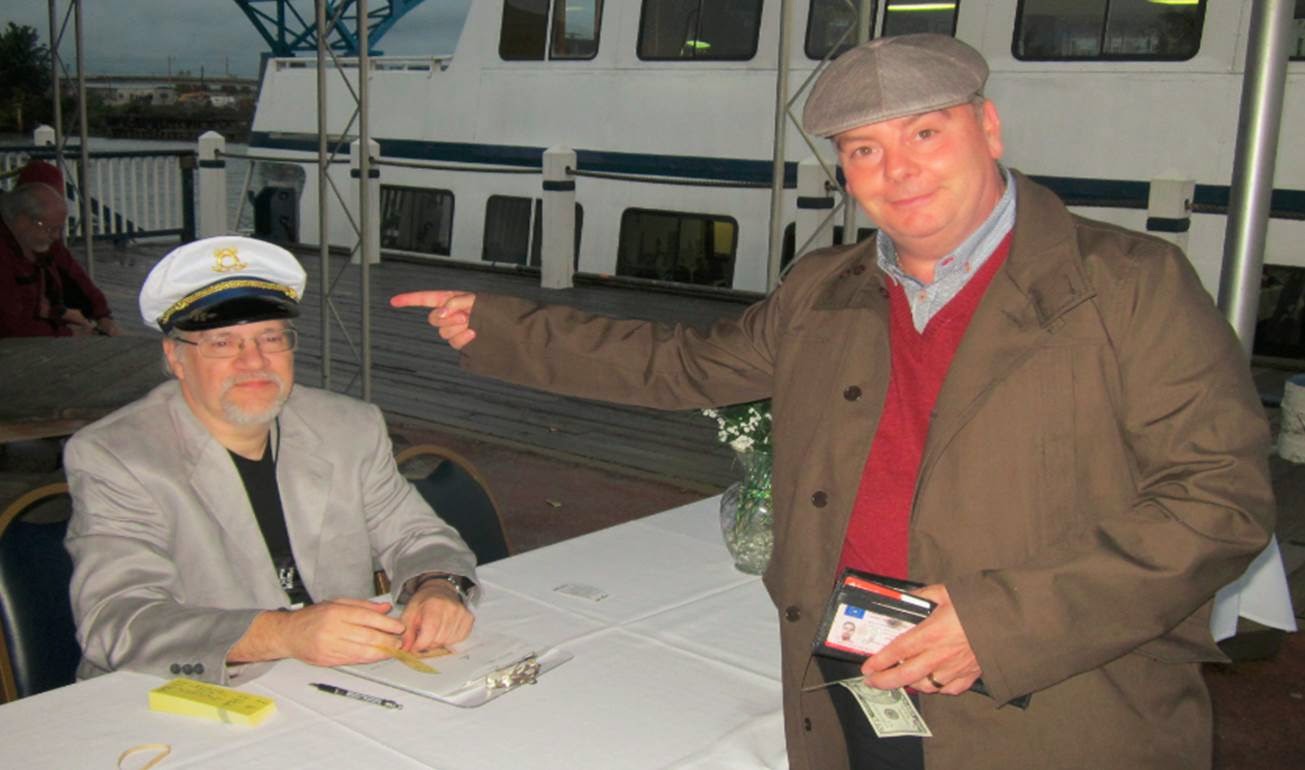
Top Photo (c) 2012 A Karim
"Bob Randisi and Mike Stotter attending the 2012 PWA Shamus Awards [held at sea] in Cleveland, Ohio during Bouchercon"