Showing posts with label Medieval. Show all posts

Thursday, 16 March 2017

Call For Papers - Criminal Heritage: Crime, Fiction, and History


TUESDAY 5 SEPTEMBER 2017, LEEDS BECKETT UNIVERSITY
The simultaneous awareness of past and present evident in historical crime fiction seems to offer a means of gaining a new perspective on the present through the past.” – John Scaggs (2005: 134)

Confirmed Keynote: Dr Heather Shore (Leeds Beckett University)

Confirmed Keynote: Frances Brody (Author)

As Michel Foucault acknowledged, crime and its investigation are uniquely tied to their social context: crime is a violation of the law, and ‘the law represents the will of the sovereign.’ When crime is narratised in the form of history, or as historical fiction, there is a fresh dynamic. The structures of the past and the present will inform its presentation, and surrounding ethical concerns.

The past few years have seen an unprecedented rise in the production and consumption of historical crime fiction and drama. However, it is not a new phenomenon: from the revisionist histories of Edgar Allan Poe, through Josephine Tey’s The Daughter of Time, and the contemporary success of Frances Brody, Carola Dunn, and Kerry Greenwood, crime fiction has always been concerned with the past. The continued success of period crime dramas on the screen – from nostalgic detective narratives such as Foyle’s War to the BBC’s Ripper Street and renewed interest in organised criminal gangs, such as the Kray twins –  is matched by a self-referential streak in crime writing that interacts with its own generic traditions.

In addition, historical true crime narratives – mined for dramatic potential and social relevance – have come to the fore of Anglo-American culture. From the surprise popularity of Kate Summerscale’s non-fiction novels exploring Victorian and Edwardian crimes to the global success of such television productions as American Crime Story and Making a Murderer, there is more interest now than ever in historical crime as entertainment.

This interdisciplinary conference aims to explore, analyse, and debate the relationship between crime, narrative, and history. We invite proposals of 200 words for 20-minute papers relating to the conference theme. We welcome proposals for traditional presentations and those which approach the theme in an innovative way. Possible topics include but are not limited to

Historical crimes

Nostalgia

Crime fiction as history

The figure of the detective

The figure of the criminal

Gangs and underworlds

Morality and deviance

Gender, sexuality and queerness

Generic tropes and development – e.g. the country house

Haunted crimes and revelations – anniversary events, cold cases, secrecy, psychological trauma

Time travel

Medieval mysteries

Sensation fictions

The Newgate Calendar

Neo-Victorianism

The roaring 1920s

Pastiches, parodies and rewritings

Crime and history on-screen

Alternative histories

Non-fiction novels

National heritage and heritage in law

Publication technologies and reading habits

Please send abstracts and a brief biographical note to Fern Pullan and Dr Jamie Bernthal at criminalheritage@gmail.com by Friday 30 June 2017.


Thursday, 2 June 2016

Good friends are hard to find .........

Today's guest blog is by Susanna Gregory who has written 22 books in the series in the Matthew Bartholomew series. 

When I wrote A Plague on Both Your Houses in the early 1990s, I did it just for fun and personal satisfaction, never expecting it to reach a literary agent, much less be published. Therefore, I certainly had no idea that more than twenty additional books featuring Matthew Bartholomew and Brother Michael would follow. Nor, in those early stages, did I anticipate that the pair of them would grow to be such good friends. Although I carry out a great deal of historical research for my books, I don’t plan each and every aspect of the storyline in advance, so in a sense their friendship was just something that developed virtually of its own accord.

To begin with, Michael was just a useful foil for Bartholomew’s thoughts – someone to bounce ideas off, and to accompany him as he hunted the many killers that darkened the streets of medieval Cambridge. In Plague, Michael wasn’t a particularly important character, and Bartholomew might just have easily have gone on to partner up with someone else. But there was something appealing about a portly monk with a keen intelligence, who loved his University and was eager to thwart anyone who threatened it – as long as it didn’t interfere with dinner. Or breakfast, or lunch. And so Michael began to develop in his own right.

In reality, such a friendship might never get off the ground, because the two men are so different, and share few interests beyond the College in which they live. Michael is fiercely ambitious, and will bend and break the rules – and sometimes the law – to protect his University and the way he thinks it should be run. He is gluttonous, elegant, suave, occasionally, selfish, has a liberal take on his monastic vows and loves intrigue. By contrast, Bartholomew is abstemious, has scant interest in clothes or money, and his overriding ambition is to serve his patients as best he can by expanding his knowledge of medicine. Michael is popular with women, while Bartholomew’s ineptness at courtship at least temporarily loses him the woman he loves.

And yet the difference between the two is one thing what makes writing the Bartholomew series so much fun. For example, food. Michael is invariably aghast at the prospect of missing a meal, and often delays fairly pressing duties in order to dine first. Bartholomew will often forget to eat when he is engrossed in a case. Neither really understands the other in this respect. Bartholomew nags Michael about his ever-expanding girth, and is appalled by his fondness for red meat and lots of bread, while Michael regards Bartholomew’s affection for vegetables with deep suspicion.

Although the medieval notion of a balanced diet was not the same as that espoused today, medici of the time were deeply interested in the subject, and many wrote books about it, expounding their particular theories and bombarding readers with a plethora of conflicting information. Sound familiar? Perhaps not so much has changed in the last seven centuries!

Bartholomew and Michael are physically different, too. Michael is obese, has thin but neat hair around a perfectly barbered tonsure, and takes considerable pride in his appearance. Bartholomew is tall, thin and a bit scruffy, and would rather spend his spare money on books than clothes.

Yet despite their differences, there are things they share – such as the sense of justice that leads them to pursue evil characters together, and an innate compassion. Bartholomew’s is shown in his kindness to his patients, and Michael’s in the College Choir – the body of untalented singers whom he provides with free bread and ale after every practice. And although the two Michaelhouse Fellows would never say so, there is a degree of mutual respect: Michael appreciates Bartholomew’s dedication to his patients and his determination to be a better physician; Bartholomew admires Michael’s intellect, secret generosity, and skills as an investigator. The last is reciprocated, as shown by Michael’s growing reluctance in later cases to proceed without his ‘Corpse Examiner.’

Of course, none of this came from me alone. The wonderful ‘Team Bartholomew’ at Sphere – Hilary, Thalia and Liz to name but three – have views about where the friendship between Bartholomew and Michael should be going, and keep me on the straight and narrow, should I try to take it in a direction they feel is wrong or unrealistic. So do my readers, who often write to give me their thoughts and insights. I thank them all – no writer can work in total isolation, and I love the fact that so many people feel that Bartholomew and Michael belong to them as well.

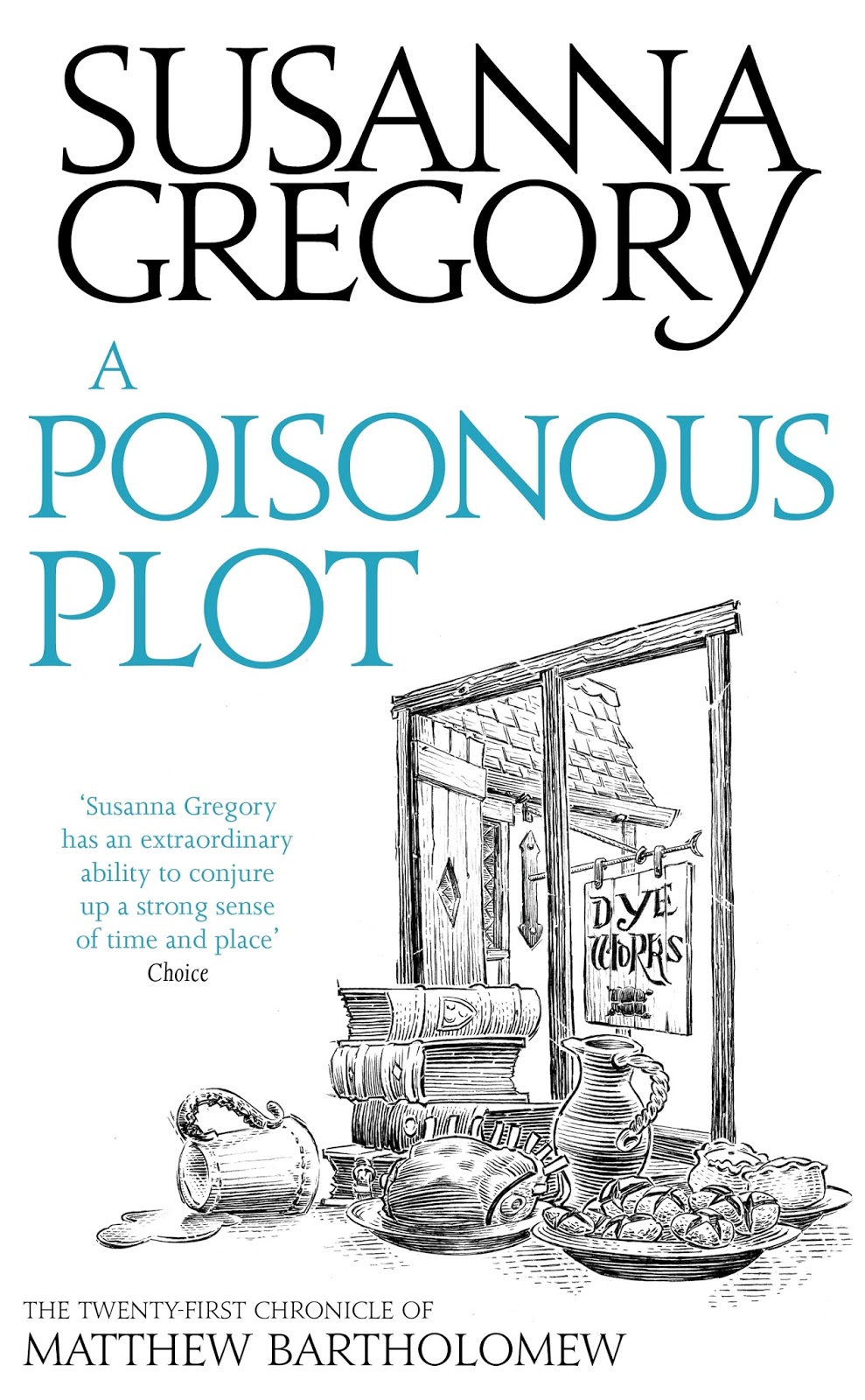
A Grave Concern by Susanna Gregory is published 2nd June by Sphere, price £19.99 in hardback. In addition, her previous book A Poisonous Plot is published in paperback on the same day, price £8.99.

Thursday, 16 August 2012

Karen Maitland talks about Death in the Land of Fire & Ice


Today’s guest blogger is Karen Maitland who is the author 4 historical thrillers. In 2008 The Company of Liars was shortlisted for the Sue Feder Memorial Historical Award and was selected as a Waterstone book of the year. The Owl Killers was a 2009 Shirley Jackson award finalist.  Karen is also a member of the group Medieval Murderers.

And that,’ said my guide, ‘is where they used to publically execute the women and girls.  ‘They’d bind them and hurl them off the cliff into the lake below to drown.’

We were standing in one of the most stunning places on earth, on the edge of a sheer-side ravine gazing across an emerald green valley to the snow-capped mountains beyond, and far below was a black volcanic lake.  It was said to be so deep not even divers with modern equipment had reached the bottom.  Just now, the surface was unruffled, reflecting the dazzling snow, but I wondered how many human bones lay beneath those dark waters.

I write historical thrillers and my latest novel, The Falcons of Fire and Ice, is published today.  It begins in 1564, during the Inquisition in Portugal when the royal falconer is arrested by the Inquisition for allegedly killing two royal gyrfalcons.  The death of two birds does not sound that serious until you remember that if a falconer lost a valuable bird through carelessness, his flesh could be cut from his living body equivalent to the weight of the bird he had lost.  However, a white gyrfalcon was worth more than a king’s palace.  Indeed the great warrior Saladin once refused return one to its owner even when offered jewels and 1,000 gold crowns in ransom.

So, the royal falconer and his family are sentenced to death by burning, unless they can replace the birds.  The falconer’s daughter, Isabela, knows her only hope is to travel to Iceland to try to capture a pair of gyrfalcons from the wild, a risky business at the best of times, since they are all the property of the Danish Crown and even to disturbed a nest is a capital offence, but made more dangerous still by the fact that unknown to her, the Inquisition have sent someone along to make sure she never returns alive.

The 16th century was a brutal time in most countries.  The Inquisition had a network of lay spies hidden among the population looking for any signs of heresy, which could be as simple as not buying eels from your local fishmonger – a sign you might be a secret Jew.  You would never know who had reported you.  Confession was obtained by torture and confessing your own guilt was never enough, you had to name others too.  Things were not much better in Iceland during the same period, for they were caught up in the Reformation and if a family was caught sheltering a Catholic priest the men and young boys could be hanged and women and girls hurled off a cliff to drown.

On that very first trip to Iceland, some years ago now, I was to see a number of sights which so haunted me so that I knew one day they would find their way into a novel.  I went to a cave in the mountains where men and women had been forced to hide in fear of their lives during the Reformation.  This cave contained a hot water underground lake, which, from Viking times, had been used for swimming, and even giving birth.

But about twenty years before my visit, a group of locals were swimming in the cave and had just got out of the water, when a jet of boiling water erupted from it, filling the cave with steam.  In seconds, the water had gone from a comfortable bathing temperature to over 200OC.  When I visit the cave the water was gradually cooling, but it was still far too hot to touch.

©David Karna
Coincidently, I was in staying in a hotel the day I started writing, The Falcons of Fire and Ice.  I came through the lobby to see everyone cluster round the TV, watching pictures of a massive volcanic eruption in Iceland.  Eyjafallajรถkull, otherwise known as the big E, had just erupted and was to bring air travel chaos to millions.  Iceland does not just export her crime fiction!

I had planned this novel long before the modern Scandinavian crime novels took off in Britain, but I think that the chilling and bloody history of many Scandinavian countries is an equally atmospheric setting for the crime and thriller genre and one that has yet to be fully explored.  Maybe we shall see more of the great Scandinavian crime writers start to dig deep into their countries’ past to come up with thrillers that will prove every bit as popular as the contemporary ones.  

More information on Karen and her work can be found on her website.

Thursday, 12 July 2012

For the Love of Old Bones


Lovers of historical crime fiction and especially medieval historical crime fiction will of course know about Michael Jecks brilliant Templar series featuring Sir Baldwin de Furnshill and Simon Puttock.  For the Love of Old Bones is a collection of four short stories featuring his protagonists.  "The Coroner's Tale", "For the Love of Old Bones", "The Amorous Armourer" and "A Clerical Error" have all appeared in anthologies in the UK and the US and for the first time ever have been collected together in one eBook.

So if you have missed out on reading these stories now is your opportunity to get them all in one place and indulge.  For Love of Old Bones and other Stories can be bought from AmazonUK and AmazonUS.