Showing posts with label Cambridge. Show all posts

Monday, 28 October 2024

Alison Bruce Interview

Ayo: - Your last book was a standalone I believe, so I wanted to know what made you want to write a standalone and now go back to writing a series.

Alison: - The last book was The Moment Before Impact and I wrote that expecting that to be the first in a new series. That was my plan. I absolutely loved the main character in it, the two main characters and I saw them as being the start of a new series. But both my agent and my publisher said no, we think it is a standalone by the way in which the story is told. It is still unfinished business, so that is something I would like to come back to later. But then I was left in a position where the publisher said that they would really like a new series, something related to the police rather than an amateur sleuth. So, I came at it from the point of view of thinking that well I did not want to do another version of the Goodhew books because that is its own thing and again, I do not feel that I am completely finished with that. So, I thought that as a starting point – do you remember Nancy Kominsky? She used to paint things and she would do a few daubs on the page and you didn't think that it is not going to turn into anything but she would gradually fill bits in and it was a bit like that so I thought that my starting sketch was to think that if I was going to go from somewhere which was the opposite to Goodhew I would be thinking of someone who doesn't love Cambridge the way in which he (Goodhew) loves Cambridge which implies somebody who has been forced to move to Cambridge for one reason or another. They do not naturally operate at the Cambridge pace or with the Cambridge mindset. So, it has a fish out of water element to some extent. Gary was new when he first joined in Cambridge Blue and that was his first murder investigation. So, I thought that I wanted it to be somebody a bit more experienced who had a bit of history in the police. I was coming from all these opposites really, a bit like a pendulum I was probably too far away at that point and so I rounded off some of those rough edges and I settled on this character Ronnie Blake, and she is new to Cambridge, she has family in Cambridge, she has reasons to stay without necessarily the enthusiasm to stay. 

Ayo: - When we were chatting earlier you were saying that there was a bit about the University It does have lots of university elements in them. What made you decide to incorporate those? I know that when everyone thinks of Cambridge they think of the university, but I would have thought that you would or might have wanted to avoid that.

Alison: - I do tend to avoid it because I write about Cambridge the way that I see Cambridge. I do work for not the University, but the other University in Cambridge and I tend to avoid that. I like to approach Cambridge from what I see and what are my experience in Cambridge is which I believe are just as valid as the University angle. It is the day-to-day Cambridge that I see. But I also have this storyline where Ronnie's sister had been living in Cambridge for a period and it was natural, and it worked very well that she had come as a student

Ayo:One of things, I mean over the years I know that you have a BSc in Science degree with honours in Crime and Investigation, how much did that help in writing this series because when you started the Goodhew series you did not have that. Things have clearly changed over the years. Did this help?

Alison: - I took my degree really because I wanted to write, I did not always want to be going to other people. I wanted to have a better base knowledge myself. So, when I first wrote the very first Goodhew book which came out third – The Calling now The Cambridge Calling I had the murder victims in quite exposed places where the bodies had been for quite a long time. So, I got away with there not being much forensic evidence. But what I did do always from the beginning was to seek out the right people from which to ask advice. There is no way that I had the same level of expertise than any of those. But I hope that I ask more informed and more plausible questions, and I can narrow down what’s viable and what is not more quickly. What I have found from doing my degree is that some people do really make things up, and I know it is fiction but it is interesting where the line is between fact and fiction and sometimes you can read a book where you think that ten minutes of research would have helped and that is really frustrating. When I wrote the last book there was a lot in there about seatbelt injuries and I had the idea originally whether it was plausible for the person to have been put in the driver’s seat after the crash. I quickly found out that there are so many reasons why not. Seatbelt injuries, the impact, the seatbelt locking, the airbags and so forth. And then part way through writing it I read somebody else's book and the big reveal at the end was that the people had switched places after she was unconscious. I felt for all those reasons, no. And I think that the research is massively important because everybody knows that you are reading fiction but, at the same time you have got to make them believe that it is viable. But if you stretch that too far then it doesn't make sense. I do try and do groundwork.

Ayo:- Groundwork is important and as an author one of the things I wanted to find out from you as a general point is on the one hand you have people that state that they really just want to be entertained and on the other hand both you and I know that if you are writing a crime novel then a lot of social policy will come in to it. So, how do you juggle that—as in wanting to entertain and wanting to make people realise what is actually going on. 

Alison: - Okay, I compare it to a drum. You know when you have got a drum, those little screw things which must be tightened up, you must think about what all of those are for you. Obviously setting, character, plot, things like the timeline, facts. You must look for where the saggy bits are and tighten them up. But sometimes you must ditch an idea because it is a great dramatic idea, but it doesn't hold water. Obviously, it won't work and if you have seen that this is the case then you need to deal with it. I have had lovely ideas that have gone in the bin. If you are not 100 % certain that you can tighten that drum, then throw it away.

The link to the full interview on the Shots website can be found here.


Because she Looked Away by Alison Bruce (Little Brown) Out Now.

After the sudden death of her sister, devastated detective DS Ronnie Blake relocates to Cambridge to help her brother Alex raise their sister's young son, Noah. She reports for her first day but instead finds herself being questioned by a special investigations unit, nicknamed the DEAD Team. With a small group of six, led by DI Fenton, the once-successful DEAD team has a single outstanding case, Operation Byron, and the failure to resolve it threatens the unit's existence. Their most promising lead is an anonymous note linking three seemingly unconnected people: a convicted fraudster, a dead academic... and Ronnie's sister Jodie. When Ronnie is denied information about Operation Byron, she follows a lead slipped to her by Malachi, the youngest member of the team, and makes a discovery which links Operation Byron to a disturbing unsolved murder. She is rapidly drawn into an intricate web of deceit, buried secrets and tragedy and the discovery that her connection to Cambridge is far darker than she could ever have guessed.

More information about Alison Bruce and her books can be found on her website. She can also be found on X @Alison_Bruce. On Instagram @alisonbruce and on Facebook.


Tuesday, 28 November 2023

Rachel Lynch on writing The Rich

Writing The Rich was a new challenge for me after writing eleven Kelly Porter police procedural books, but that was the point; I wanted to explore a new world. The world of the privileged elite and how they seem to stay out of the crime statistics and tend to be treated differently, even when caught, fascinated me. 

Diving into a new setting in Cambridge, as well as a host of new characters filled me with both excitement and trepidation. I love crafting new personalities for my books, but pulling it off, after the Kelly Porter books achieving such incredible success, was daunting. Writing a psychological thriller, with untrustworthy characters, numerous villains and a flawed hero made me face a new set of rules. In police procedural, good battles evil and the detective solves the riddle in the end; in the world of the psychological thriller, it’s all about the twists and suspense, and I wanted to make The Rich a true whodunnit right to the last page.

Writing crime from the point of view of those involved, rather than a hero trying to do good, was also new. Doctor Alex Moore is a psychologist to the wealthy of Cambridge, and she counsels an array of clients, but her own life isn’t perfect. She has three children, all of whom struggle with their own pressures, and an alcoholic husband. I wanted to make Alex as vulnerable as her clients, because at the end of the day, she’s human too. Simply because she’s a therapist for other people’s problems doesn’t mean she has none of her own. It was important to me that none of my characters were untouched by trauma because I believe it’s more of a reflection of true life.

In exploring the devastating effects of tragedy on people’s lives, I wanted to shine a light on their secrets and how they lie to protect them. As Alex steers her clients through their healing, she doesn’t stay immune to the impact that one’s past has on the present. As all their pasts unravel, it’s soon clear that when a person carries damage around with them, they’ll go to startling lengths to deceive. The plot was a complex one, but I’m used to that with my Kelly books, and I enjoy giving the reader multiple voices to contend with.

There’s often a serious social injustice theme to my writing and the Kelly books handle tough topics such as knife crime, bullying, people trafficking, drug abuse and serious crime. I wanted to be just as robust with The Rich by exposing the glaring discrepancies in the incidence of crime amongst people with adverse childhood experiences. It’s indisputable that you’re far more likely to go to prison, become an addict, fail in school, or have a shorter life expectancy if you have faced several childhood traumas and I wanted to play with the concept that, as a result of this inequity, The Rich could literally get away with murder, because society believes a certain stereotype of a criminal. This is exactly what Doctor Alex exploits in The Rich and her knowledge of the system puts her at the centre of the race to find out who committed a terrible crime.

I must admit I do have a soft spot for the baddies I create. I have fun with all my characters, and I find writing despicable back stories highly entertaining. I hope that if I enjoy the creative process then it will come across in my writing and give my readers a more satisfying and rounded experience. I don’t shy away from hard-hitting subjects and the ending of The Rich is a good example of that. I like to push the limits of what humans will do, and the lengths they will go to avoid exposure. 

It was a fine balance juggling between the two sub-genres when I wrote The Rich. I was completing Kelly Porter book eleven at the time – I’ve just finished editing number twelve – and it was jarring moving between the two. Kelly is a rounded heroine – not perfect – who I’ve been told in reviews is highly relatable. Readers have every right to feel secure when they pick up a Kelly book that she’s going to catch the perpetrators in the end. I find that when psychological thriller fans pick up one of their favourites, they expect something quite different, and the early reviews of The Rich have borne this out. There is common loathing for some of the characters and that is the whole point. It’s not clear who is the perpetrator because they’re all flawed. The detective is inept too, which was difficult for me to craft after writing so many books about Kelly who is a consummate professional. It was hard for me to craft a police officer who is so clearly corruptible, like DS Hunt. Again, that was the point, he is blinded by the status of those he investigates and immediately looks to those with a background he sees as fitting what criminals should look like.

I would like to write more privileged thrillers, and I have plenty of ideas. It’s a well-known fact that, as humans, we judge people within seven seconds of meeting them and much of that assessment balances on appearance, accent, and perceived social status. This is how to get away with murder.

The Rich by Rachel Lynch (Canelo) Out Now

They can buy everything except the truth. Each week, they come to lie on her couch. Carrie, Henry and Grace. They don’t know one another, but Dr Alex knows them all too well. She listens as they reveal their dirtiest little secrets. Then a murderer strikes in their elite neighbourhood. Could her clients hold the answers? As a psychologist, she knows that anyone can be a killer if they’re pushed hard enough. But only some can get away with it.

Rachel Lynch can be found on X at @r_lynchcrime. She can also be found on Facebook.


Tuesday, 17 October 2023

Crime and Nourishment 2023


Oleander is delighted to be joining forces with Richard Reynolds to bring you an exciting crime fiction event featuring 8 brilliant local authors.

Each of our authors will be taking the stage and speaking about their latest book releases, answering questions from the audience and all will be signing their books for attendees.

The authors' books will  be on sale at the event and complimentary tea and cake will be served.

Come along and have a fun afternoon with your favourite authors and buy some Christmas gifts (even if they're for yourself!)

Richard is well-known locally as the recently-retired Crime Specialist at the world-famous Cambridge bookseller Heffers. He is also Chair of the CWA Gold Dagger Award.

The Oleander Press has been the other Cambridge publisher since 1960.Oleander is delighted to be joining forces with Richard Reynolds to bring you an exciting crime fiction event featuring 8 brilliant local authors.

Each of our authors will be taking the stage and speaking about their latest book releases, answering questions from the audience and all will be signing their books for attendees.

The authors' books will  be on sale at the event and complimentary tea and cake will be served.

Come along and have a fun afternoon with your favourite authors and buy some Christmas gifts (even if they're for yourself!)

Richard is well-known locally as the recently-retired Crime Specialist at the world-famous Cambridge bookseller Heffers. He is also Chair of the CWA Gold Dagger Award.

The Oleander Press has been the other Cambridge publisher since 1960.

Tickets can be bought here.


Saturday, 16 October 2021

Flying Solo? Mike Ripley on writing his latest ‘Albert Campion’ mystery.

When I was first tempted to continue the adventures of Margery Allingham’s famous detective Albert Campion, almost ten years ago now, I had at least the starting point of a couple of introductory chapters written by her first ‘continuation author’, her husband, Pip Youngman Carter, who died in 1969, three years after Margery.

Asked to continue the series, placing an ageing, quintessentially ‘Golden Age’ sleuth in the Swinging Sixties (or thereabouts), I started Mr Campion’s Fox from scratch, saying that I hoped ‘to fly solo with, and do justice to, a great fictional character.’

With the publication of my ninth ‘Campion’ this month, which contains several flying scenes, it struck me that I have never really flown ‘solo’ with these stories.

For a start, thanks to Margery Allingham, I had wonderful, ready-made, resident cast of characters, notably Campion himself; Amanda, his wife of thirty years (in my timeframe); that solid and dependable policeman Charles Luke; the retired spymaster L.C. Corkran; and, of course, Magersfontein Lugg, that most magnificent of indestructible sidekicks. There was also Rupert, Campion’s son, who was coming of age and available to do some of the heavy lifting - or the ‘running, jumping and shooting’ (as Margery put it) which may be now beyond an elderly gentleman detective. And in one of his continuations, Youngman Carter had given Rupert a girlfriend, Perdita Browning, whom I made his wife, which opened the possibility of a ‘next generation’ of Campions.

Given such a repertory company, I could hardly be said to be flying solo when it came to creating characters. All I had to do was come up with a few plots, research the period I was writing about and stay on track with those much-loved characters, and none of that was done ‘solo’.

To keep faith with Margery’s characters, I had fabulous sources I could call on, the most important being Margery’s own Campion novels and short stories, and to avoid mistakes or fill in any gaps, I had the members of the Margery Allingham Society, who were far more versed in the Campion canon than I was. In addition, I had access to the Allingham archives now lodged in the Albert Sloman Library at Essex University, which gave me a fund of ideas and plot points, including, cheekily, allocating Margery’s passport number to an East German spy!

At work in the Allingham archive at Essex University

In an attempt to recreate the flavour of the original books, I decided to have, as often as possible, maps of the locations - mostly found (roughly) in Margery’s beloved East Anglia - mentioned in the story. There I was supremely fortunate in tapping in to the skills of Roger Johnson, an Allingham Society stalwart and a noted Sherlockian scholar, who has done fantastic work illustrating the topography in eight of the nine novels so far. Between us we have tried to capture the geography of Margery’s fictional world, though we might have invented extra parts of Suffolk..


Roger Johnson’s map for Mr Campion’s Fox.

And when it comes to basic plot ideas, especially on Mr Campions Wings, I had, literally, a flying lesson from my long time ‘technical advisor’ (i.e. on anything which remotely involves anything mechanical), research scientist and inventor, Tim Coles. Actually, more than just a flying lesson. 

Tim and I go back a long way, having met in Cambridge in 1971 whilst both of us worked vacation jobs in Joshua Taylor, the city’s poshest department store. (I think Tim was in ‘Electricals’ and I was in ‘Pots, Pans and Glassware’). His family home was on Barton Road - and the house features in the book - and he had a private pilot’s licence, hence the flying lessons. He had even, in a previous life when I was writing my ‘Angel’ series, taught me how to con my way into a local flying club and hotwire a light aircraft; purely for literary purposes, of course.

On one of our regular hook-ups, Tim said he had come up with a method of murder in an engineering workshop, though he was not sure how to get away with it. He was also keen on a Cambridge setting and, being a city of bicycles, had also thought up a bizarre form of velocipede (it’s in the book) which would have certainly appealed to Margery Allingham’s sense of the ridiculous. Given that Margery had decided, back in the 1930s, to give Amanda Campion (née Fitton) a career in aeronautical engineering and that Cambridge had been a kindergarten for spies, I was sure I could cook up something from these ingredients and the year 1965, for various reasons, virtually chose itself and fitted my Campion timeline perfectly.

But I still wasn’t quite ready to fly solo. There was one particular aspect of aircraft design and development in the 1960s I needed help understanding - an aspect which would be of interest to spies and worth murdering for.

Naturally I turned to another old pal, one who knew about both aircraft and spying, Len Deighton.

Now this wasn’t the first time I had picked the encyclopaedic brain of Mr Deighton. Some years ago, over lunch, our conversation had somehow ranged from the economic history of Florence under the Medicis to a currency scam in Vichy France during World War II and the basic plot of Mr Campion’s War began to take shape.

Ripley and Deighton plotting over lunch.

When I explained to Len what I was after, and the help I needed on (very) technical aspects of jet engines and aircraft design, he politely demurred, saying he was not up to speed on such things - however, he knew a man who was, his son Antoni, an aeronautical engineer in America. Antoni turned out to be an enthusiastic and incredibly patient teacher, answering my idiotic questions about hi-bypass engines and teaching me more about air-flow and wing design than I ever thought possible. 

I have made sure that Tim Coles and Antoni Deighton received advance copies of Mr Campion’s Wings (Severn House, 28th October), to give them plenty of time to discover all the mistakes I made despite their expert advice.

All of which goes to prove that when writing a novel, no-one ever flies solo and in my case, especially not with Margery Allingham looking over my shoulder.

                                                                                      Margery Allingham 1904-1966

Mr Campion's Wings by Mike Ripley (Severn House) Published 28 October 2021 £20.99

A gruesome discovery at an aircraft hanger leads Albert Campion into a turbulent mystery set in Cambridge in the middle of the Cold War. "I have often said that my wife is a constant surprise to me." Cambridge, 1965. The honorary doctorate ceremony for Albert Campion's wife takes a dramatic turn when Lady Amanda is arrested by Special Branch for breaking the Official Secrets Act. Never before having taken much interest in his wife's work in cutting-edge aircraft design, Mr Campion sets out to discover more about the top-secret Goshawk Project in which Amanda is involved. He quickly realizes he is not the only one keen to learn the secrets of the project. When a badly mutilated body is discovered at the Goshawk Project's hangar - the result, it would appear, of a bizarre accident - Campion is drawn into a turbulent mix of industrial espionage and matters of national security. And as he attempts to get to the bottom of the deadly goings-on, it seems that the bicycles and punts are almost as dangerous as the aircraft . . .


Tuesday, 1 June 2021

The Maidens by Alex Michaelides - Reviewed by Adam Colclough


W&N (10 Jun. 2021) £14.99 Hbk
 
Still grief stricken over the loss of her husband Mariana Andros is drawn back to Cambridge, where they met as undergraduates, when a friend of her niece is murdered. 

This is the first in a series of killings, the victims are all members of ‘the Maidens’, a group of students drawn into the orbit of charismatic academic Edward Fosca. As the murders continue and the police run out of leads Mariana becomes ever more convinced that Fosca is a killer and that her niece could be his next victim.
 
There is something pleasingly old school, possibly even golden age, about this second novel from the author of the hugely successful The Silent Patient. For all its location among the bicycles and dreaming spires of Cambridge and use of clues hidden in quotes from Greek tragedies Michaelides has delivered a very modern tale of suspense and psychological torment.
 
He is all too aware that the most dangerous secrets are the ones we keep from ourselves. A truth that the golden age writers towards whom Michaelides makes a discreet nod would have been either unaware of or would have thought wasn’t really cricket.
 
In line with this he gives Mariana a back story that might be nudging her perceptions of events towards paranoia and makes for an abundance of suspenseful situations. He is aided in this by the atmosphere of a Cambridge college, with its arcane ceremonies and endless dimly lit passages, the latter all the better for someone to, maybe, stalk his protagonist along.
 
This is a solid follow up to a successful debut from a writer who knows how to twist the piano wires of his readers nerves.


Alex Michaelides was born and raised in Cyprus. He has a MA in English Literature from Trinity College, Cambridge University, and a MA in Screenwriting from the American Film Institute in Los Angeles. The Silent Patient was his first novel. It spent over a year on the New York Times bestseller list and sold in a record-breaking 49 countries. He lives in London.

Adam Colclough lives and works in the West Midlands, he writes regularly for a number of websites, one day he will get round to writing a book for someone else to review. 

Wednesday, 26 February 2020

Murder Will Out at Cambridge

A Day of Crime, Thriller and Mystery Fiction
Saturday 14th March 2020​ 
at The Old Library, Emmanuel College
We're very much looking forward to hosting another day devoted to crime, thriller and mystery fiction, and hope you will come along to hear from these fantastic authors. Here's the full line-up (pun intended)!

The Difficult Second Book? with Stephanie Austin, Lesley Kara & Gytha Lodge.

Location, Location, Location: Stories with a Strong Sense of Place with Alison Bruce, Elly Griffiths, Christina James & Caro Ramsay.

Are These Authors Good or Bad? with Deepa Anappara, Mick Finlay, Sam Lloyd & Caro Ramsay.

Caught in Time: historical crime panel with Christopher Fowler & Nicola Upson.


Going For Gold - CWA Gold Dagger Winners with Steve Cavanagh & MW Craven.

There will be a pop-up bookshop at the event and the authors will be signing copies of their books after their panel slot.


Tickets are priced at £28 and can be purchased here or, by calling 01223 463200 or in person at Heffers bookshop.

Thursday, 2 January 2020

Murder Will Out 2020

On Saturday 14th March, a group of hand-picked crime writers will descend upon Cambridge for Heffers' second murderously good day of panel discussions, book signings - and answering those author questions you've been just dying to ask. 

This is Murder Will Out 2020, featuring Steve Cavanagh, Elly Griffiths, MW Craven, Gytha Lodge, Christina James, Lesley Kara and others to be announced.

Tickets are priced from £25 (Early Bird) and can be purchased through this page, by calling 01223 463200 or in person at Heffers bookshop. 

There will be a pop-up bookshop at the event and the authors will be signing copies of their books after their panel slot.

More information about the event and buying tickets can be found here.

Saturday, 10 December 2016

Call for Papers : - Agatha Christie: A Reappraisal

A two day conference, 19th - 20th June 2017, Lucy Cavendish College, University of Cambridge.

Confirmed Keynote Speakers:

Julius Green, author of Curtain Up: Agatha Christie: A Life in Theatre

Merja Makinen, author of Agatha Christie: Investigating Femininity

Agatha Christie (1890-1976) has become internationally recognised as one of the most significant writers of the twentieth century. Recent scholarship has legitimised Christie as a writer of substance and a major figure in twentieth and twenty-first century popular culture. This conference seeks to finally establish Christie Studies as an academic discipline, extending across and beyond the humanities.

Proposals for twenty-minute papers are invited. Possible themes include but are by no means limited to:

Theorising Agatha Christie
Crime and detectives: generic context
New biographical readings
Christie and modernism
Christie and postmodernism
Political readings, political revisionism
Christie and feminism
Gender, sexuality, and queerness
Adaptations, parodies, and pastiches
Continuation projects
Christie and art
Film and television legacies

Proposals for traditional papers are encouraged, as are proposals for innovative or creative presentations. Please send a 200 word proposal to Mia Dormer (University of Exeter) and Dr Jamie Bernthal (Middlesex University) at agathachristieconference @ gmail.com no later than Tuesday 31 January 2017.

The standard two-day registration fee is expected to be £120.

You can find out more at www.agathachristieconference.com.        

Thursday, 2 June 2016

Good friends are hard to find .........

Today's guest blog is by Susanna Gregory who has written 22 books in the series in the Matthew Bartholomew series. 

When I wrote A Plague on Both Your Houses in the early 1990s, I did it just for fun and personal satisfaction, never expecting it to reach a literary agent, much less be published. Therefore, I certainly had no idea that more than twenty additional books featuring Matthew Bartholomew and Brother Michael would follow. Nor, in those early stages, did I anticipate that the pair of them would grow to be such good friends. Although I carry out a great deal of historical research for my books, I don’t plan each and every aspect of the storyline in advance, so in a sense their friendship was just something that developed virtually of its own accord.

To begin with, Michael was just a useful foil for Bartholomew’s thoughts – someone to bounce ideas off, and to accompany him as he hunted the many killers that darkened the streets of medieval Cambridge. In Plague, Michael wasn’t a particularly important character, and Bartholomew might just have easily have gone on to partner up with someone else. But there was something appealing about a portly monk with a keen intelligence, who loved his University and was eager to thwart anyone who threatened it – as long as it didn’t interfere with dinner. Or breakfast, or lunch. And so Michael began to develop in his own right.

In reality, such a friendship might never get off the ground, because the two men are so different, and share few interests beyond the College in which they live. Michael is fiercely ambitious, and will bend and break the rules – and sometimes the law – to protect his University and the way he thinks it should be run. He is gluttonous, elegant, suave, occasionally, selfish, has a liberal take on his monastic vows and loves intrigue. By contrast, Bartholomew is abstemious, has scant interest in clothes or money, and his overriding ambition is to serve his patients as best he can by expanding his knowledge of medicine. Michael is popular with women, while Bartholomew’s ineptness at courtship at least temporarily loses him the woman he loves.

And yet the difference between the two is one thing what makes writing the Bartholomew series so much fun. For example, food. Michael is invariably aghast at the prospect of missing a meal, and often delays fairly pressing duties in order to dine first. Bartholomew will often forget to eat when he is engrossed in a case. Neither really understands the other in this respect. Bartholomew nags Michael about his ever-expanding girth, and is appalled by his fondness for red meat and lots of bread, while Michael regards Bartholomew’s affection for vegetables with deep suspicion.

Although the medieval notion of a balanced diet was not the same as that espoused today, medici of the time were deeply interested in the subject, and many wrote books about it, expounding their particular theories and bombarding readers with a plethora of conflicting information. Sound familiar? Perhaps not so much has changed in the last seven centuries!

Bartholomew and Michael are physically different, too. Michael is obese, has thin but neat hair around a perfectly barbered tonsure, and takes considerable pride in his appearance. Bartholomew is tall, thin and a bit scruffy, and would rather spend his spare money on books than clothes.

Yet despite their differences, there are things they share – such as the sense of justice that leads them to pursue evil characters together, and an innate compassion. Bartholomew’s is shown in his kindness to his patients, and Michael’s in the College Choir – the body of untalented singers whom he provides with free bread and ale after every practice. And although the two Michaelhouse Fellows would never say so, there is a degree of mutual respect: Michael appreciates Bartholomew’s dedication to his patients and his determination to be a better physician; Bartholomew admires Michael’s intellect, secret generosity, and skills as an investigator. The last is reciprocated, as shown by Michael’s growing reluctance in later cases to proceed without his ‘Corpse Examiner.’

Of course, none of this came from me alone. The wonderful ‘Team Bartholomew’ at Sphere – Hilary, Thalia and Liz to name but three – have views about where the friendship between Bartholomew and Michael should be going, and keep me on the straight and narrow, should I try to take it in a direction they feel is wrong or unrealistic. So do my readers, who often write to give me their thoughts and insights. I thank them all – no writer can work in total isolation, and I love the fact that so many people feel that Bartholomew and Michael belong to them as well.

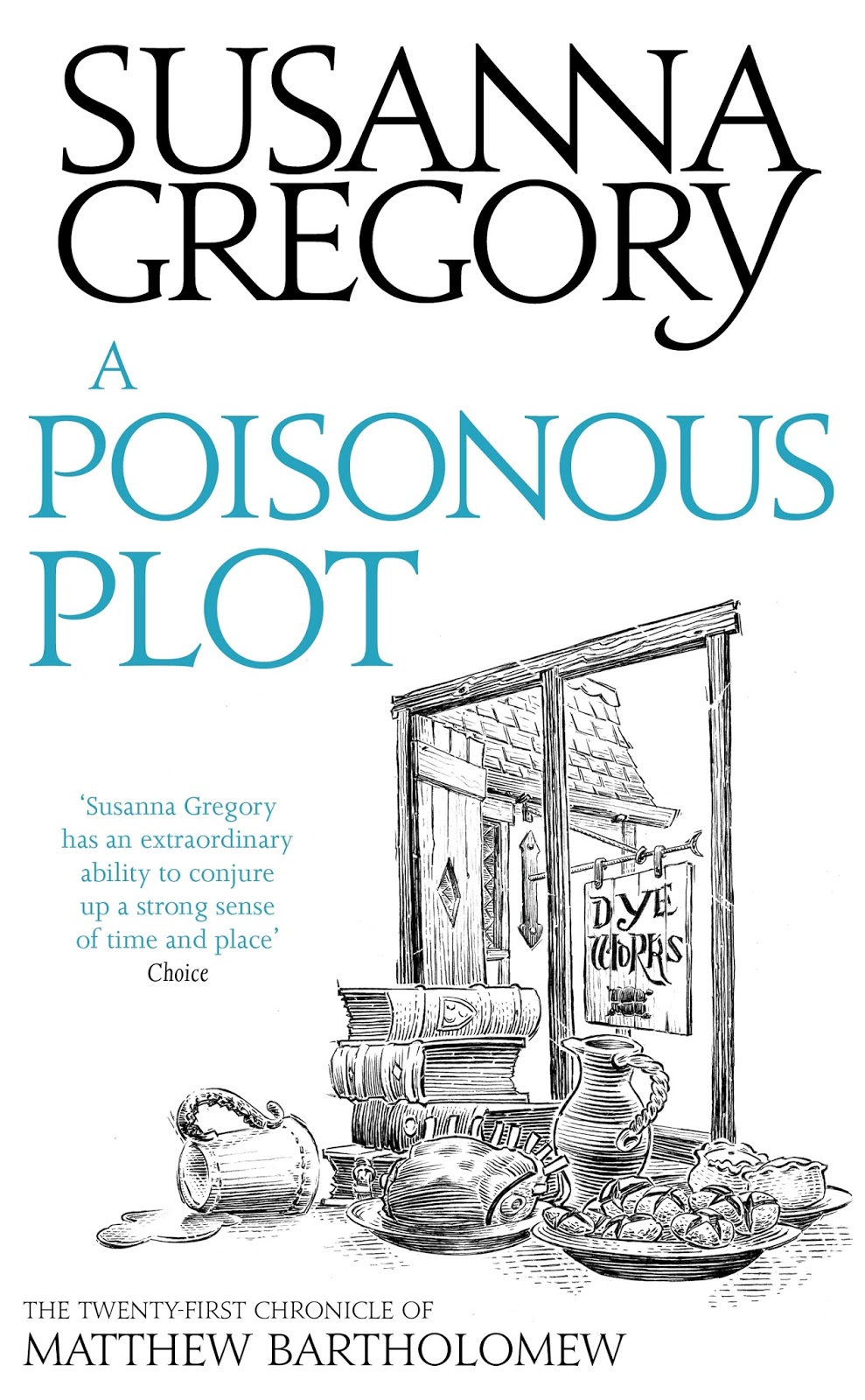
A Grave Concern by Susanna Gregory is published 2nd June by Sphere, price £19.99 in hardback. In addition, her previous book A Poisonous Plot is published in paperback on the same day, price £8.99.

Sunday, 6 September 2015

The New Cambridge Mysteries


Now published by Ostara’s Cambridge Crime imprint: The New Cambridge Mysteries by the award-winning Barbara Cleverly

From the CWA Historical Dagger winning author Barbara Cleverly, a collection of short stories of criminal activity in and around Cambridge in three distinct time frames representing Cambridge past, present and future.

Featuring World War I veteran turned policeman Detective Inspector Redfyre in 1922, the feisty and very contemporary Detective Constable Stella Kenton and, in a dystopian Cambridge future, Tom – a 65- year-old veteran of the Iraq war who has his own way of dealing with law and order in the year 2022.

Six Cambridge mysteries from Barbra Cleverly, the award-winning author of The Damascened Blade.

Barbara Cleverly was born in the north of England and graduated from the University of Durham but has spent most of her working life in Suffolk and Cambridge. Her first novel, The Last Kashmiri, was commissioned after submitting an outline in a competition for new writers organised by the Crime Writers’ Association and published to great acclaim in 2001, introducing her detective hero Joe Sandilands. Her third Sandilands novel, The Damascened Blade won the Ellis Peters ‘Historical Dagger’ award in 2004.


The New Cambridge Mysteries is published by Ostara Publishing under their Cambridge Crime imprint and is available as a trade paperback and eBook.

For all Ostara titles, see: www.ostarapublishing.co.uk .