Showing posts with label Sherlock Holmes. Show all posts

Wednesday, 12 June 2024

Reading and Escapism! - By Dr Luke Deckard

Raymond Chandler criticised Dorothy L Sayers in his essay The Simple Art of Murder (1950) for commenting that crime fiction wasn’t a serious type of literature but one of escapism. She’s not the only one to snub the genre that was an author’s bread and butter. Before Sayers, Sir Arthur Conan Doyle famously hated Sherlock Holmes! He didn’t want to be remembered solely for that character because he felt they were silly, unimportant stories. 

I can imagine Raymond Chandler sitting at his desk, reading these quotes while swishing a glass of whisky, pausing to look at his cat and huff. Chandler’s rebuttal to Sayers was simple: all pleasurable reading is a form of escapism. If that meant your jam was mathematics, philosophy, or Western or romance, that was fine. Chandler disagreed with Sayers’s implication that escapist literature is essentially dumb and unimportant literature. 

Nevertheless, this attitude persists today. I once read a press release for a book described as a “frothy thriller” That baffled me! A book without substance! I would be devastated if my work was described as frothy! I instantly felt bad for the author. My reaction couldn’t have been unlike Chandler’s when reading Sayers’s comments. But it’s not uncommon to see people on social media describe a film or a book as ‘turn your brain off fun’ or ‘you don’t have to think about it.’

This attitude of disposable, empty, forgettable storytelling is far too common. And is often used to excuse poorly told stories. 

When I started to write bad Blood, it was for my PhD at Kingston University. One of the most challenging aspects at the start was battling with the idea of how to make this book meaningful and live up to the quality of what a PhD novel should be. I was dead set on writing a historical noir. I wanted gangsters, femme fatales, and a tough-talking yet charming PI. I wanted it to be thrilling, fun, and sexy. 

But is that literary? Is that good enough? Hard-boiled fiction was birthed out of pulp magazines printed on cheap disposable paper. Were the tricks and tropes just as disposable today? Was there any literary appeal left? I wrestled with these questions. 

In the same essay, Raymond Chandler says that form doesn’t matter; it’s style that counts. What he meant was you can write any ole genre, but it is the author’s flare that makes it pop and stand out. Then, Chandler’s criticism of Sayers and his comments on style all clicked. I knew what I needed to do: escape into the genre. I needed to embrace the form shamelessly and respectfully while making it my own.

That’s what Chandler was getting at—there is no literature of escape in a derogatory sense. Meaning no single genre is less than simply because of its formula.

The filmmaker Robert Meyer Burnett once phrased what audiences are genuinely after: they want good stories told well. Genre is irrelevant. The form isn’t the it thing that makes something work. It’s all about style! The execution. That’s why you can read two books in the same genre and love one but hate the other. Audiences don’t seek out bad, forgettable, disposable art. So, we writers shouldn’t treat stories as such. When we’re hungry, we don’t go into a restaurant and say, ‘Give me the worst thing on the menu, please!’ We want something delicious. 

When I think about the book described as a frothy thriller, what the headline was trying to say was it’s a fun ride. The word choice of frothy was a mistake. The value of fiction doesn’t come from the seriousness of its content or ‘realism’, but from the joy the readers have with a well-executed story. That’s what Burnett means by a good story told well.

And that’s what I attempted to do with Bad Blood. It wasn’t about ‘writing literature’ or trying to make something more out of it. The form is the form. So I wrote it for the people who love noir fiction, who love historical fiction, who love Edinburgh, and tough and gritty atmospheres. There was no shame in embracing the tropes and trying to subvert a few along the way! If someone escapes into my book, that’s a beautiful achievement! 

So readers, feel free to escape into fiction! It’s not a bad thing. But do keep your brains switched on!

Bad Blood by Luke Deckard (Sharpe Books) Out Now

London 1922. American ex-pat Logan Bishop, suffering from shell-shock and an addiction to morphine, is working as a Private Investigator. When Logan’s father, Reverend Daniel Bishop, arrives from Chicago, desperate to see his son, Logan wants nothing to do with him. That is, until his father is brutally attacked. Daniel begs his son to find Greta Matas, a Bolshevik woman with an unknown connection to his father, in Edinburgh before she is murdered. Before Logan can learn more, his father slips into a coma. Logan takes the first train to Edinburgh. The journey proves far from routine, however, and two mysterious men follow the investigator out of Waverley Station. Logan soon discovers that Greta is missing and her son, Peter, is wanted for murder. The case begins to take a darker and deadlier turn than he ever imagined. As Edinburgh police suspect Logan of keeping information from them, the pressure to find Greta and her son increases. Secrets and lies are exposed as Logan clashes with Chicago gangsters, the authorities, and Edinburgh’s elite to expose the truth behind the woman's disappearance.

You can find Bad Blood on Amazon UK and Amazon US

More information about Dr Luke Deckard can be found on his website. You ca also find him on X @LukeWritesCrime. You can also find him on Facebook.


Tuesday, 27 February 2024

Murder by the Book: A Celebration of 20th Century British Crime Fiction


 Murder by the Book: A Celebration of 20th Century 
British Crime Fiction


23 March – 24 August 2024

Monday – Friday 9am – 6:30pm

Saturday 9am – 4:30pm

Closed Sundays, and 29 March to 1 April 2024 inclusive 

Booking is essential. Entry is FREE.

Crime fiction is the UK's most read, bought and borrowed genre. Cambridge University Library draws on its world-leading collections of British crime fiction to stage a murderously good exhibition! 

Bringing together literature, culture and heritage, Murder by the Book: A Celebration of 20th Century British Crime Fiction illuminates and celebrates the stories of the UK’s most popular fiction writing. Curated by award-winning crime novelist Nicola Upson, the Library's exhibition challenges traditional distinctions between literary fiction and genre fiction. Murder by the Book examines crime’s place in our literary history and the Library’s own Special Collections. 

The exhibition showcases rare books and audio-visual recordings looking at the genre from its origins in the works of Wilkie Collins and Charles Dickens to contemporary best-sellers Val McDermid and Ian Rankin. 

With first editions of The Moonstone and Bleak House, as well as Sherlock Holmes' debut appearance, the exhibition also looks at the Library’s remarkable collections and stylish dust jackets that represent more than a century of British book design. 

Tickets can be booked here.

Curated by crime novelist Nicola Upson.


Wednesday, 30 August 2023

Geraldine Steel and Unintended Consequences

Unintended consequences affect us in so many ways. Sometimes we realise with hindsight how significant they have been in our lives. Steve Jobs famously said, “You can’t connect the dots looking forward; you can only connect them looking backwards. So you have to trust that the dots will somehow connect in your future.” He goes on to explain that had he not attended a calligraphy class, more or less on a whim, personal computers might never have developed the range of fonts they offer today. Such fortuitous events are not unusual. If Conan Doyle had never met Joseph Bell, a surgeon renowned for his brilliant observational skills, it’s possible Conan Doyle might never have been inspired to create the character of Sherlock Holmes. 

Many years ago, my mother taught me to touch type. With my hands covered by a cardboard box, I learned to type without being able to see the keyboard. Little did I know that decades later I would make such good use of that skill. My writing career has often been called prolific, and the ability to type 70 words a minute has played a significant role in my output, with words sometimes appearing on the screen faster than I can call them to mind. In fact, I often don’t know what I’m thinking until the words appear before me on the screen. It’s a strange and mysterious process, and a great boon to a writer. 

Setting so many of my books in York is the result of another unintended consequence. A few years ago, my husband was invited to attend an event in York, as an alumni of the university. Had he not studied at York University before we met, I might never have visited the city. He was keen to return and show me the haunts of his youth, and it didn’t take me long to fall in love with York. The stunning juxtaposition of medieval and modern architecture, the atmospheric cobbled streets and narrow snickelways, and the rich history that is evident wherever you look, is inspiring for a writer. It’s impossible to walk very far without finding a historic site nestled among the modern buildings in this vibrant city. 

Before lockdown we used to spend several weeks in York every year, researching locations where my characters could live, and hunting for those all important sites where dead bodies might be discovered. We walked by the river and along streets evocatively named The Shambles, Micklegate, Stonegate, visited tourist spots like Clifford’s Tower, the Dungeons, Yorvik Museum, Museum Gardens, the university, the Chocolate Museum, the railway museum, and were fortunate enough to be offered a private tour of York Racecourse when I set a murder there. There always seems to be something happening in York, from morality plays to battle re-enactments, Christmas Fairs to Viking processions, and the literature festival. 

Without Trace is the twentieth of my books set in York. The story begins when a missing woman is discovered, unconscious, and mysteriously encased in earth. The woman is taken straight to hospital, where she dies before the police can question her. Her boyfriend is the obvious suspect in the ensuing murder investigation. Although he is questioned several times, the detectives are unable to find any evidence to convict him. Meanwhile, several other young women have been reported missing, all of them neighbours of the dead girl. As Geraldine and her team are trying to find out what happened, another young woman is reported missing…

Everything I have experienced in York has contributed to the development and success of my series. But what has always struck me as even more important than the city’s amazing architecture and lively events, is the friendliness of the people who live there. Whenever we visit York, we meet readers. They are always pleased that the books are set in York because, like me, as well as being interested in Geraldine Steel, they are also fans of York. 

In many ways, Geraldine has enjoyed a varied career so far. She began working in Kent, from where she moved to London, before ending up in York. As for the future, I cannot imagine she will ever move from York. How else would I have an excuse to keep returning to this wonderful and inspiring city?

Without Trace by Leigh Russell (No Exit Press) Out 31 August 2023. (£9.99)

She opened her mouth to scream, but he slapped something across her lips. The gag tasted of salt and mould, rough sacking on her tongue. With a terrifying certainty, she knew she was going to die. DI Geraldine Steel knows people go missing all the time; sometimes because they don't want to be found. So when her partner Ian asks her to look into the disappearance of his football-buddy's girlfriend, her first instinct is to reassure him there's no need for concern. Until she's called to a suspected murder, and all her instincts tell her she's right about the identity of the victim. The young woman has earth and leaf mould and fragments of twigs in her long fair hair, her nose, her mouth, under her finger nails, clinging to her clothes. It's as if she'd been completely encased in earth. And yet she was found on the pavement, at the side of a suburban road, where she wasn't in contact with any soil or mud. Had she managed to escape a living grave? Without a crime scene, the investigation focuses on her boyfriend. But Ian insists his friend is incapable of murder, and Steel is torn. Without evidence, she knows their case is weak. But without evidence, can she let a possible killer go free? She needs to find out what really happened. Where did the assault occur? Why are there traces of DNA from two other unidentified sources on the body? What reason could there be to attack a popular young woman who never did anyone any harm? And why bury her body so carelessly that she was able to escape? Then another young woman is reported missing. Unless he has an accomplice, they have an innocent man in custody. And Steel is running out of time . . .

More information about Leigh Russell and her work can be found on her website where you can sign up to her newsletter. You can also follow her on X @LeighRussell, on Instagram @leighrussell2020 and on Facebook.


Saturday, 7 January 2023

Forthcoming Crime Books from Titan Books (Incl Hard Case Crime)

 January 2023

The Further Adventures of Sherlock Holmes: Deathly Relics is by Sam Siciliano. Sherlock Holmes and Henry Vernier are visiting Rome on a diplomatic mission when the Pope asks the world’s greatest detective to help find a stolen relic: the forefinger of “doubting” Saint Thomas. But when the relic is quickly and mysteriously returned, and all seems to be easily resolved, the forefinger is stolen again in a brutal attack. Holmes and Vernier must follow the trail of a sacrilegious murderer through the streets of Rome and the halls of the Vatican, uncovering dark ties between members of the church and an Italian crime family.

February 2023

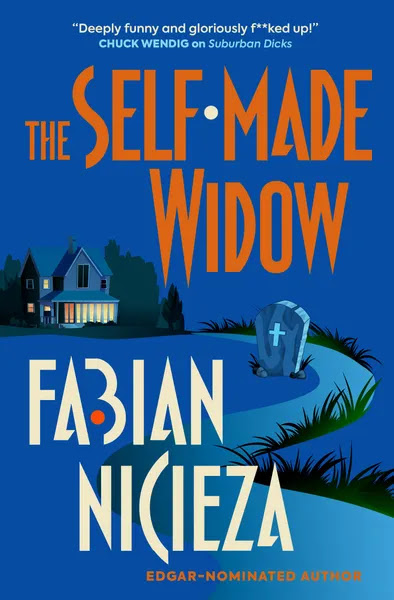
The Self-Made Widow is by Fabian Nicieza. After mother of five and former FBI profiler Andie Stern solved a murder—and unraveled a decades old conspiracy—in her New Jersey town, both her husband and the West Windsor police hoped that she would set aside crime-fighting and go back to carpools, changing diapers, and  lunches with her group of mom-friends, who she secretly calls The Cellulitists. Even so, Andie can’t help but get involved when the husband of Queen Bee Molly Goode is found dead. Though all signs point to natural causes, Andie begins to dig into the case and soon risks more than just the clique’s wrath, because what she discovers might hit shockingly close to home. Meanwhile, journalist Kenny Lee is enjoying a rehabilitated image after his success as Andie’s sidekick. But when an anonymous phone call tips him off that Molly Goode killed her husband, he’s soon drawn back into the thicket of suburban scandals, uncovering secrets, affairs, and a huge sum of money. Hellbent on justice and hoping not to kill each other in the process, Andie and Kenny dust off their suburban sleuthing caps once again.

Private investigators Bertha Cool and Donald Lam, stars of five of Hard Case Crime’s most popular novels, return to solve their toughest case yet. Hired to prevent a socialite from poisoning her husband, Donald Lam dreams up an ingenious scheme involving a carton of anchovy paste and a fictitious national ad campaign. But when the whole thing backfires spectacularly and bodies, witnesses, and suspects start piling up, it’ll take every ounce of Donald’s brainpower and Bertha’s bruising ruthlessness to keep the police at bay – and a killer from getting away with murder. Fools Die on Friday is by Erle Stanley Gardner.

April 2023

Mad Money is by Max Allan Collins. Nolan and Jon have put their lives of crime behind them – but when a cruel adversary from their past resurfaces, they’re forced back into the heist game with a brutal ultimatum: pull off an insanely ambitious overnight robbery or Nolan’s kidnapped lover won’t live to see the morning. Appearing in bookstores for the first time in 35 years, this is Nolan’s biggest and deadliest job – and Mad Money also features, for the first time ever in the same volume, the bonus full-length novel Mourn the Living, offering a look back at Nolan’s early years as a professional thief.

May 2023

A serene walking holiday in the Lake District becomes a far more sinister excursion for Dr Watson when disappearances and murders start occurring in the small town of Wermeholt. Local legends, rumours of large slithering reptiles and spooked palaeontologists have the denizens paranoid and terrified, so it is up to Watson and his inbound companion Sherlock Holmes to uncover the truth and discover what is really lurking in the lake… The New Adventures of Sherlock Holmes: The Monster of the Mere is by Philip Purser-Hallard.

June 2023

Introducing a new series from the creator of the beloved Vinyl Detective novels.Cordelia Stanmer knows books. An addict-turned-dealer of classic crime paperbacks, she spends her days hunting for the rarest of the rare in the charity shops and book sales of suburban London, pining for the woman of her dreams and avoiding her landlord’s latest demand for the rent. The most elusive prize of all, her white whale, a set of Sleuth Hound novels. A complete set of those would solve all her problems. By chance she discovers such a set. The only problem? They’re not for sale. Still, nothing a little burglary can’t solve. But when the owner of the books turns out to be a violent criminal, and Cordelia’s best laid plans to pay rent, buy weed and woo the object of her affections start to fall apart, she realises she may have placed herself in the crosshairs of a villain torn straight from the pages of her precious novels. The Paperback Sleuth :Death in a Fine Condition is by Andrew Cartmel.


Tuesday, 20 July 2021

In the Shadow of Sherlock by Mick Finlay


The Arrowood series is very much inspired by Sherlock Holmes. The idea for the character of my detective, William Arrowood, came to me while I was reading the Holmes stories one day. I began to wonder how other private detectives might have felt about Sherlock if they were trying to earn a crust in London at the same time as him. There really were both male and female consulting detectives working in Victorian London at the time, people such as Paddington Pollaky, Charles Field and Kate Easton. While most private detective work involved collecting evidence for divorce cases, other more interesting tasks were also done, such as Pollaky’s work collecting evidence of Confederate arms shipments. Putting myself in these early sleuths’ shoes, I thought I might be a little envious, perhaps even bitter, about the success of a Sherlock Holmes-type character. I might even doubt his methods. It was that thought that led to the creation of Arrowood. 

Because he’s a rival to Holmes, I needed him to be a very different type of man. In contrast to Holmes, he’s overweight with no interest in sports, a bit of a coward, a glutton, and also an emotional man. He lives among a ‘modern’ extended family which grows from book to book and overcrowds his home. And rather than relying on forensic evidence, he devours Victorian books on psychology and personality and tries to apply those ideas to his crimes. 

Sherlock is alive and working in the same city as Arrowood, although in the first four books he never actually appears. He sends Arrowood a couple of telegrams, his cases make newspaper headlines, and Arrowood tries unsuccessfully to visit him, but we never see him. Readers often ask me if they’ll ever meet, but so far I’ve avoided writing scenes where Sherlock actually appears. Although there are some fantastic authors publishing books featuring Sherlock, I didn’t feel I could take Doyle’s character and write him myself. It was a personal decision, and I certainly don’t think it’s wrong to do, but so far I haven’t felt comfortable enough to do it. Partly because I wanted my novels to be filled with my own characters, but also because I didn’t want the ghost of Conan Doyle to judge me for overstepping. And I do feel him sometimes, breathing heavily behind me as I tap away at my keyboard.

I love the Sherlock stories. The secondary characters are a joy, and Holmes’s sense of humour, particularly in how he teases Watson and the police, is great fun. The stories are incredibly well-formed, and Holmes himself is a complex man of weaknesses as well as strengths. I’m a huge fan. That said, Conan Doyle was a man of his time, and we get a good sense of him through his letters, collected in a fascinating volume by Jon Lellenberg, Daniel Stashower and Charles Foley. The Holmes stories reflect who Doyle was and the tastes of the audience at the end of the nineteenth and beginning of the twentieth century. Reflecting the beliefs and attitudes of polite society, there are places that Doyle wouldn’t go in the Sherlock stories, and places that many modern readers might wish he hadn’t. For example, while Doyle deals with the British empire mainly through backstories of adventure and intrigue, he doesn’t deal with the plight of colonised peoples. And while Jack the Ripper killed at least five women in 1888, and the first Holmes story was published in 1887, Holmes never takes up a similar case of serial killing. Holmes also has some rather sexist views about women, and Doyle’s description of non-white characters are often stereotypical and racist (although the Adventure of the Yellow Face is a good counter). When I started writing Arrowood books, I wanted to portray a more realistic London than we see in the Holmes stories, one where we see disability, the Irish question, crimes against women, racism and the appalling poverty up close. It’s here where I feel I need to step out of Sherlock’s shadow, and try to get closer to what life was like in those days. The Arrowood books aren’t preachy, they’re character- and plot-driven, but they don’t hide the bad stuff. And as to whether Arrowood and Sherlock will ever meet, well, if I can ever shake that sense of Doyle’s ghost watching me, it might just happen. 

Arrowood and the Meeting House Murders by Mick Finlay (Harper Collins) Out Now

London Society takes their problems to Sherlock Holmes. Everyone else goes to Arrowood. Nowhere to hide. London, 1896. As winter grips the city, a group of African travellers seek sanctuary inside the walls of the Quaker Meeting House. They are being hunted by a ruthless showman, who is forcing them to perform in his ethnic exhibition in the London Aquarium. Nowhere to turn. Private investigator William Arrowood and his assistant Barnett agree to help the travellers avoid capture. But when they arrive at the Meeting House, they find a scene of devastation. Two people have been murdered and the others have fled into the night. Nowhere to run. The hunt for the real killer leads Arrowood into the dark heart of Victorian London. A shadowy world of freak shows, violence and betrayal, where there are no good choices and only the slimmest chance of survival...


Monday, 12 April 2021

Conan Doyle and Storytelling - Call For Papers


Edinburgh Conan Doyle Network Conference 

‘Conan Doyle and Storytelling’ 

10–11 December 2021 

Birkbeck, University of London


Keynote speakers: 

Professor Christine Ferguson, University of Stirling 

Professor Robert Hampson, Royal Holloway, University of London 

“‘Pray compose yourself, sir,’ said Holmes, ‘and let me have a clear account of who you are, and what it is that has befallen you.’” (‘The Beryl Coronet’) 

Arthur Conan Doyle was one of the greatest of all storytellers. He is best known and most enjoyed not for the subtlety of his characterisation or the profundity of his ideas, but as a master of narrative, in many different forms. It is because of his powers as a storyteller that his work not only endures in book form, but continues to captivate television and cinema audiences internationally. The conditions of his own time were propitious for an author with his gift for narrative. He was writing in a period described as ‘the Age of Storytellers’, which was also an age of literature in transition, and of emergent Modernism. We would welcome proposals for 20-minute papers, which consider Conan Doyle’s writing in all these wider contexts, and which might explore:

  • Conan Doyle and genre: romance literature, detective fiction, historical fiction, the Gothic, sport, travel, and life-writing etc 

  • Narrative and the market: Conan Doyle and publishing history and practice 

  • Late-Victorian and early 20th-century shorter fiction 

  • Neo-Victorian adaptation: Conan Doyle’s stories in the 20th and 21st centuries 

  • Conan Doyle and narratology 

  • Character and action 

  • Narrating the Empire: Conan Doyle and colonialism 

  • Storytelling and Modernism 

  • Conan Doyle’s narrators 

  • Stories of Spiritualism and the supernatural 

    Please send abstracts of 200–300 words together with a brief biography to:- james.machin@birkbeck.ac.uk

    Deadline for proposals: - 31 July 2021 

    ‘Conan Doyle and Storytelling’ is hosted in partnership with the Birkbeck Centre for Nineteenth Century Studies, and will be the third event associated with a new scholarly enterprise,The Edinburgh Edition of the Works of Arthur Conan Doyle, sponsored by the Royal Society of Edinburgh and the Conan Doyle Estate. 

    Further information can be found here.


Thursday, 25 March 2021

Sherlock Holmes and the American Sherlocks


More than 130 years after his first appearance in print, Sherlock Holmes remains the most famous fictional detective in the world. Yet he and his dependable sidekick, Dr Watson, were not the only ones racing down Victorian and Edwardian London’s gaslit streets in pursuit of criminal masterminds. The years between 1890 and 1914 were a golden age for English magazines and nearly all of them published crime and detective fiction. Sherlock Holmes had plenty of rivals.

In the last few years I’ve compiled several anthologies of crime stories from that era. I’ve scoured the back numbers of old magazines and blown the dust off half-forgotten volumes of short stories in second-hand bookshops in search of Holmes’s competitors. In The Rivals of Sherlock Holmes and More Rivals of Sherlock Holmes I highlighted 30 of them. Some, like GK Chesterton’s Father Brown, still have their own fame. Others, such as Addington Peace, created by the man who gave Sir Arthur Conan Doyle the basic idea for The Hound of the Baskervilles, and Percy Brebner’s Christopher Quarles, are scarcely remembered today. Some were such Holmes clones you wondered why their authors were never charged with plagiarism; others, like the wizened Hindu sage Kala Persad and Hagar, the Romany pawnbroker, were more exotic.

In Supernatural Sherlocks I gathered together stories of a special type of crime-solver – the occult detective whose investigations took in the supernatural world. The most famous of these is probably William Hope Hodgson’s Carnacki the Ghost Finder. In Sherlock’s Sisters I put together tales of women detectives. They range from Catherine Pirkis’s Loveday Brooke, representative of what was known at the time as ‘The New Woman’, independent and intent on her own career, to the lip-reader Judith Lee who can never go anywhere without encountering villains discussing outrageous crimes, blithely unaware that their every word has been understood by the young woman on the far side of the room.

My latest anthology is American Sherlocks. The title is self-explanatory. Its heroes are transatlantic ones. We all have a picture in our mind of the archetypal detective of American fiction. He (and it very nearly always is a he) is a hardboiled, wisecracking private eye, walking a city’s mean streets. Dashiell Hammett’s Sam Spade, Raymond Chandler’s Philip Marlowe or one of the hundreds, probably thousands, of other gumshoes who have trodden in their footsteps. But that style of detective only came into being in the late 1920s and early 1930s. American crime fiction has a much longer history. 

It began with Edgar Allan Poe’s Dupin stories (‘The Murders in the Rue Morgue’ etc) in the 1840s. It’s tempting to believe that then nothing much happened in American crime fiction between Poe’s ‘tales of ratiocination’ and the arrival of writers like SS Van Dine, Hammett and Ellery Queen in the 1920s but this is far from being the case. The USA had as many fictional crimebusters in the late nineteenth and early twentieth centuries as Britain. Broadly, they fell into two categories.

The first was the dime novel hero. Dime novels, first appearing in the 1860s, were the American equivalents of British ‘penny dreadfuls’. They came in a range of genres, including crime fiction in which characters like ‘Old Sleuth’ and ‘Sam Strong the Cowboy Detective’ battled bad guys in stories that made up in lively action for what they lacked in literary sophistication. However, the major detective to emerge from the dime novel was Nick Carter. He arrived in 1886 and new stories about him were still being published a century later. I’ve included one from 1914 in my anthology. 

The second type of American detective was one modelled much more closely on Sherlock Holmes. Conan Doyle’s stories were just as popular in the USA as they were at home. Scores of American rivals to Holmes appeared in magazines and collections of short stories. The impressively named Professor Augustus SFX Van Dusen, known as ‘The Thinking Machine’, was even more cerebral than Holmes. Madelyn Mack, who chewed on cola berries for stimulus while exercising her formidable deductive powers, was a female Sherlock, working as a private detective in New York. The blind detective Thornley Colton was a wealthy New Yorker who took on cases purely for intellectual interest.

Both in the USA and in Britain there are plenty of Sherlock’s rivals to be enjoyed. In my five anthologies I have highlighted a few dozen. There are even more out there to be discovered and I hope to do so in the future. 

American Sherlocks Edited by Nick Rennison (Oldcastle Books) Out Now

Sherlock Holmes is the most famous of all fictional detectives but, across the Atlantic, he had plenty of rivals. Between 1890 and 1920, American writers created dozens and dozens of crime-solvers. This thrilling, unusual anthology features stories about 15 of them, including Professor Augustus SFX Van Dusen, 'The Thinking Machine', even more cerebral than Holmes; Craig Kennedy, the so-called 'scientific detective'; Uncle Abner, a shrewd backwoodsman in pre-Civil War Virginia; Violet Strange, New York debutante turned criminologist; and Nick Carter, the original pulp private eye. Editor Nick Rennison gathers together often neglected tales which highlight American crime fiction's early years.


Friday, 27 December 2019

Books to Look Forward to from Titan Books Incl (Hard Case Crime)

January 2020
The Manifestation of Sherlock Holmes is by James Lovegrove. Tales of treachery, intrigue and evil… Maverick detective Sherlock Holmes and his faithful chronicler Dr John Watson return in twelve thrilling short stories.  The iconic duo find themselves swiftly drawn into a series of puzzling and sinister events: an otherworldly stone whose touch inflicts fatal bleeding; a hellish potion unlocks a person’s devilish psyche; Holmes’s most hated rival detective tells his story; a fiendishly clever, almost undetectable method of revenge; Watson finally has his chance to shine; and many more – including a brand-new Cthulhu Casebooks story.

February 2020
What’s hidden behind the silver screen? In New York City, a movie critic has just murdered his girlfriend – well, one of his girlfriends (not to be confused with his wife). Will the unlikely crime-solving partnership he forms with the investigating police detective keep him from the film noir ending he deserves?  On the opposite coast, movie star Dawn Devayne – the hottest It Girl in Hollywood – gets a visit from a Navy sailor who says he knew her when she was just ordinary Estelle Anlic of San Diego. Now she’s a big star who’s put her past behind her. But secrets have a way of not staying buried…  Double Feature is by Donald Westlake.

The Big Bang is by Micky Spillane and Max Allan Collins.  It’s the middle of the Swinging Sixties in midtown Manhattan. Hammer, recuperating from a near fatal mix-up with the Mob, disturbs some drug dealers assaulting a young motorbike messenger who was transporting medicine for a hospital. He saves the kid but the muggers are not so lucky. The Mob and a new young breed of drug trafficker assume he will target them, and they target him right back, with a street-corner knife attack. Hammer and his beautiful, deadly partner Velda take on the drug racket in New York. In a world of flashy discos, swanky bachelor pads and the occasional dark alley, Hammer deals with doctors, drug addicts and hit men, and meets changing times with his trademark brand of violent vengeance.

The Further Adventures of Sherlock Holmes - The Martian Menace.  A new addition to the Further Adventures of Sherlock Holmes series from science fiction and crime author Eric Brown. A deadly plot. For the second time in human history, Martian invaders occupy planet Earth. After a common terrestrial virus thwarted the first deadly invasion, another Martian armada arrived six years later to make peace. Now, mankind enjoys unprecedented prosperity due to the aliens' scientific wonders and technology, and an entente exists between the two races. But when Sherlock Holmes and Dr John Watson are called upon to investigate the death of an eminent Martian philosopher, they unravel an intricate web of betrayal and murder that leaves no one - human or Martian - beyond suspicion...

Mike Hammer, the iconic PI created by hard-boiled crime master Mickey Spillane and written by New York Times bestseller Max Allan Collins, returns in Masquerade for Murder. Hammer is at a high society party when a wealthy and well-respected man, Colby, is hit by a car and badly injured. When all he expected was a night on the town, Mike is hired to find out who was driving the car. His search leads him on a trail of murders, the victims often exhibiting the same kind of strangulation as the cause of death. How are they connected to an accident involving Corby, and why is the man himself acting so strangely?


FBI agent Reed Markham is haunted by one painful unsolved mystery: who murdered his mother? Camilla was brutally stabbed to death more than forty years ago while baby Reed lay in his crib mere steps away. But a shattering family secret changes everything Reed knows about his origins, his murdered mother, and his powerful adoptive father, state senator Angus Markham. Now Reed has to wonder if his mother’s killer is uncomfortably close to home.  Reed enlists his friend, suspended cop Ellery Hathaway, to join his quest in Vegas. Ellery has experience with both troubled families and diabolical murderers, having narrowly escaped from each of them.   Far from home and relying only on each other, Reed and Ellery discover young Camilla had snared the attention of dangerous men, any of whom might have wanted to shut her up for good. They start tracing his twisted family history, knowing the path leads back to a vicious killer―one who has been hiding in plain sight for forty years and isn’t about to give up now.  All The Best Lies is by Joanna Schaffhausen


March 2020
Are Snakes Necessary is by Brian de Palma and Susan Leham.  When the beautiful young videographer offered to join his campaign, Senator Lee Rogers should've known better. But saying no would have taken a stronger man than Rogers, with his ailing wife and his robust libido. Enter Barton Brock, the senator's fixer. He's already gotten rid of one troublesome young woman -- how hard could this new one turn out to be? Pursued from Washington D.C. to the streets of Paris, 18-year-old Fanny Cours knows her reputation and budding career are on the line. But what she doesn't realize is that her life might be as well...

April 2020
Sherlock Holmes acquires a new client when a beautiful young woman, Isabel Stone, faints on the steps of his Baker Street rooms. She has come to beg his assistance in reclaiming some priceless jewels kept from her by her tyrannical stepfather, Captain Grimbold Pratt. But shortly after agreeing to take her case, Captain Pratt comes to Baker Street, not quite so tyrannical as Isabel would have them believe. Holmes and his cousin, Dr Henry Vernier, must unravel a tense family mystery dating back to the Indian Mutiny, where neither of them is sure who to believe... The Further Adventures of Sherlock Holmes - The Venerable Tiger is by Sam Siciliano

July 2020
She Lies Close is by Sharon Doering.  Five-year-old Ava Boone has been missing for six months. There are have been no leads, no arrests, no witnesses. The only suspect was quiet, middle-aged Leland Ernest.  And Grace Wright has just bought the house next door. Recently divorced, Grace uprooted her two small children to start again and hopes the move will reset her crippling insomnia. But now she understands bargain-price for her beautiful new house.  With whispered neighbourhood gossip and increasingly sleepless nights, Grace develops a fierce obsession with Leland and the safety of her children. Could she really be living next door to a child-kidnapper? A murderer?  With reality and dream blurring more each day, Grace desperately pursues the truth – following Ava’s family, demanding answers from the police – and then a body is discovered…

You Again is by Debra Jo Immergut.  Abigail Willard first spots her from the back of a New York cab: the spitting image of Abby herself at age 22 – right down to the silver platforms and raspberry coat she wore as a young artist with a taste for wildness. But the real Abby is now 46, married with a corporate job and two kids. As the girl vanishes into a rainy night, Abby is left shaken. Was this merely a hallucinatory side-effect of working-mom stress? A message of sorts, sent to remind her of passions and dreams tossed aside? Or something more dangerous?  As weeks go by, Abby continues to spot her double around her old New York haunts—and soon, despite her better instincts, Abby finds herself tailing her lookalike. She is dogged by a nagging suspicion that there is a deeper mystery to figure out, one rooted far in her past. All the while, Abby’s life starts to slip from her control: her marriage hits major turbulence, her teenage son drifts into a radical movement that portends a dark coming era. When her elusive double presents her with a dangerous proposition, Abby must decide how much she values the life she’s built, and how deeply she knows herself.


Wednesday, 18 December 2019

Edinburgh Conan Doyle Network Conference - Call for Papers

Conan Doyle in Edinburgh 
25th – 27th June, 2020
Edinburgh Napier University

Proposals are invited for a conference in Edinburgh about Arthur Conan Doyle. At the centre of the conference will be the relation between the writer and his native city, but papers about all aspects of his work and life will be welcome.

“I do not come before you as a stranger. I was born in Edinburgh. I spent my boyhood there. I was educated at the University, and I graduated there. I owe much to the old City” (Arthur Conan Doyle, The Edinburgh Evening Dispatch 25th Sept 1900.) Arthur Conan Doyle was born in Edinburgh on the 22nd of May 1859, and studied medicine at the University of Edinburgh from 1876 to 1881. Famously, Dr Joseph Bell, one of his professors, was said to be the inspiration for the character Sherlock Holmes.  Although Conan Doyle only spent 12 years of his life in Edinburgh, it was the city which shaped him and out of which his stories grew. As Val McDermid notes: “those early years in Edinburgh played a crucial role in his development as a writer” (2009). This conference will explore the interplay between city and writer, and we invite broad, imaginative and interdisciplinary interpretations on the topic of ‘Conan Doyle in Edinburgh’. We also welcome proposals for papers on other topics concerning the writings and life of Arthur Conan Doyle.

Key note speakers: Owen Dudley Edwards and Nicholas Daly

We will also be running a virtual conference alongside the physical conference which we hope will encourage greater participation for those unable to attend for financial, environmental or other reasons. If selected, the online participants will be asked to record their presentation which will be hosted on our website before, during and after the conference. Viewers and attendees of the conference will have the opportunity to ask questions of the online participants. The online participants will be included in the conference programme.

‘Conan Doyle in Edinburgh’ is the second event associated with a new scholarly enterprise, The Edinburgh Edition of the Works of Arthur Conan Doyle, sponsored by the Royal Society of Edinburgh. Selected papers from across the conference will be considered for book publication.

Please send proposals for 20-minute papers, panels of three papers, posters, or virtual attendance, on topics which can include, but are not limited to:

Conan Doyle and Edinburgh
Conan Doyle and Cities
Conan Doyle and Medicine
Conan Doyle and other Authors
Conan Doyle’s Campaigns
Conan Doyle and his Fiction
Travel and Empire Writing
Science and Science Fiction
Spiritualism and the Supernatural
The City and Crime Writing
Editing Conan Doyle

Proposals should be no more than 300 words, and submissions should include a 50 word biography. Online participants should note on their proposal their wish to be considered for the virtual conference. If you are only able to attend for one day please state which day in your proposal. Proposals should be sent in Word or .odt format to Linda Dryden, Douglas Kerr and Jonathan Wild at: edinburghconandoyle@gmail.com

Deadline for proposals: Friday 31st January 2020

Attendance: full conference £200, single day £75, virtual conference £45. A social events calendar, including opportunities for visits, walks and planned meals, will be sent to participants before the conference. Conference attendees will have Saturday afternoon free to explore Edinburgh.


Wednesday, 17 July 2019

The Rules For Eight Perfect Murders


With the 2019 Theakstons Crime Writing Festival, almost upon us I started to think about the allure of crime and thriller fiction, becoming the biggest selling genre in UK fiction publishing. Crime and thriller narratives deal with the darkest areas of the human experience – namely murder, so why the appeal?

While enjoying an early preview of Peter Swanson’s 2020 novel, thanks to John Grindrod writer and marketeer at iconic British Publisher Faber and Faber - we got into discussion about Murder, and its appeal to readers as well as film viewers. Some would consider it amoral to read about the killing of others, so why do so many read about these fictions? Surely the world is filled with enough real-life horror and murder without writers [and their publishing entourage] having to conjure up killings for the amusement of others?

One reason for the appeal of reading about fictional murder, is just that – it is a fiction; an escape from the reality of the human situation, where murders actually happen around us, viewed on our flat screens and in our palms, via our Television sets, our phones and in our newsprint. The novels that fictionalise murder can be an escape, a comfort from the harsh reality that surrounds us; as well as helping us understand the motivations and situations that can arise, leading to a killing.

So, with this in mind, as John Grindrod knew of my love of crime novels, especially those that feature murder and amorality as themes - here’s my eight favourite classic crime novelists and their work, that feature murders that could be considered, perfect.


PATRICIA HIGHSMITH

Of course we could discuss the perfect murder at the centre of Highsmith’s debut STRANGERS ON A TRAIN or the antics of Tom Ripley in THE TALENTED MR RIPLEY [and the further ‘adventures’ of this interesting character] but instead I’ll pick 1964’s THE GLASS CELL, a tough little novel that details the murder of a lawyer, by an educated and cultured man - wrongly imprisoned for fraud. Incarceration and torture in a penitentiary changes Philip Carter. The Glass Cell shares themes from Fyodor Dostoevsky’s CRIME AND PUNISHMENT, but is not judgmental as to the actions of its protagonist; so typical of Patricia Highsmith’s work, she once proclaimed “I don’t think my books should be in prison libraries.”

Read More HERE

IRA LEVIN

With an interesting body of work, it is Levin’s thought-provoking debut 1953’s A KISS BEFORE DYING, awarded the Edgar from the Mystery Writer’s of America [MWA] that is my selection. It details the ruthless pursuit of ambition that powers Bud Corliss to commit murder. Filmed twice in America, its plot was reworked later in Bollywood. Levin’s debut is a disturbing look at what naked (and unrestrained) ambition can do, and how it can overcome all things, including taking the life of another person in the ruthless pursuit of a goal.


THOMAS HARRIS

It would be the escape of Dr Hannibal Lecter from his holding cell in Baltimore that would give the 1988 novel THE SILENCE OF THE LAMBS a perfect murder, a bloody locked-room mystery that claimed the life of two prison guards [filmed with panache in 1991].
Many literary commentators have remarked that Thomas Harris’ Dr Hannibal Lecter’s precursor was Patricia Highsmith’s Tom Ripley, an amoral murderer but also a man of culture and taste.

Read more HERE


JOHN DICKSON CARR

A writer that is credited as the master of the Locked-Room Mystery, though he also crafted narratives under pennames, such as Carter Dickson, Carr Dickson and Roger Fairbairn. Though it would be his character Dr Gideon Fell, that brought great appeal. In the novel The Three Coffins, Dr Fell speaks of a "locked room lecture", in which he delineates many of the methods by which apparently locked-room [or impossible-crime] murders might be committed. In the course of his discourse, he states, off-handily, that he and his listeners are, of course, characters in a book, participants, witnesses in a Perfect Murder.
The British Library’s publishing wing are reissuing golden-age classics including J D Carr, and well worth adding to your shelves.

It would be Thomas Harris paying a homage to John Dickson Carr, that would see Harris’ own singular creation Dr Hannibal Lecter deploying the identity of Dr Fell in 1999’s Hannibal.

Read More Here

DAME AGATHA CHRISTIE

With a vast canon of work, it would be the 1934 novel MURDER ON THE ORIENT EXPRESS that I select as a perfect murder. Though at the time of publication, the US title Murder in the Calais Coach was used to avoid confusion with the 1932 Graham Greene novel Stamboul Train which had been published in America as Orient Express.

A perfect murder occurs onboard the eponymous train when it becomes snowbound during Hercule Poirot's return to London from the Middle East.
Filmed twice, it also features a locked room mystery.


SIR ARTHUR CONAN DOYLE

Arguably the most renowned outing for Sherlock Holmes and Dr John Watson, THE HOUND OF THE BASKERVILLES is my selection. I can add little to the extensive commentary to this tale of a perfect murder, which was first serialised by Strand Magazine in 1901.

Often filmed, it is the Basil Rathbone and Nigel Bruce adaptation from the 1940s that remains a firm favourite of many of us, and it can be viewed HERE


JIM THOMPSON

A writer who elegantly exposed the darker desires inherent in flawed people. It would be the Texan deputy sheriff Lou Ford in Thompson’s 1952 THE KILLER INSIDE ME that I would select for this listing of perfect murders. It details sexual sadism as an undercurrent to the horrors Thompson exposes. Even decades on, it packs a powerful reading experience. Filmed initially in 1976 with Stacy Keach; it would be the 2010 adaptation directed by Michael Winterbottom and starring Casey Affleck and Jessica Alba that would court controversy, with many [myself included] feeling nauseous over the notorious ‘punching’ scene. 

Read more HERE


JAMES M CAIN

Between James M Cain’s THE POSTMAN ALWAYS RINGS TWICE and DOUBLE INDEMNITY, I pick the latter for this selection of tales of perfect murders.  Published in 1943, it details an insurance man Walter Huff falling in love with married Phyllis Nirdlinger who wants to kill her husband - in an insurance scam; complete with a bleakness that is hard to match, it was adapted for screen in 1944 by Billy Wilder and Raymond Chandler [who also worked on the script for Patricia Highsmith’s Strangers on a Train for Alfred Hitchcock].


But I could go on, and on about these books and several others, but with packing for the upcoming Theakstons’ Crime Writing Festival 2019 which commences tomorrow; let me leave you with an anecdote from the festival, a few years ago, an anecdote that features murder.


It was late and we found ourselves in conversation with crime writer, biographer and journalist Andrew Wilson. There was a group of us huddled in a circle, drinking Gin (well I was) - so I asked everyone 'if you had to, and I mean really HAD TO murder another person, knowing your own nature, what would be your chosen motive for a perfect murder?'
So, we went in the circle; we had Revenge, we had Hate, we had Money, Blackmail we had Love, we had Random event, we had Self-Defence, you get the drift. I was last, and had posed the question - I grew nervous, as all the usual motives were taken, so I attempted to change the subject; however Andrew Wilson, Crime Writer, Journalist and Biographer of Patricia Highsmith in his definitive BEAUTIFUL SHADOW - had other ideas and asked 'so enough with the excuses Ali, what would be your Motive for a perfect Murder?'
I had to answer. I had to reveal, so I did.

'Boredom. If I met someone sufficiently boring, I think I could commit murder' and we laughed, and we talked talked about Tom Ripley and the attraction of the amoral.

Coming full circle, anticipation awaits readers for Peter Swanson’s Eight Perfect Murders / Rules for Perfect Murders, so let’s look back at his earlier work and also a little background to those yet to experience his narratives, tales of fractured lives and flawed characters.

Here’s a little tease of what to expect from Rules for Perfect Murders / Eight Perfect Murders, the story of a bookseller who finds himself at the centre of an FBI investigation because a very clever killer has started using his list of fiction’s most ingenious murders.

Years ago, bookseller and mystery aficionado Malcolm Kershaw compiled a list of the genre’s most unsolvable murders, those that are almost impossible to crack—which he titled “Eight Perfect Murders”—chosen from among the best of the best including Agatha Christie’s A. B. C. Murders, Patricia Highsmith’s Strangers on a Train, Ira Levin’s Death Trap, A. A. Milne's Red House Mystery, Anthony Berkeley Cox's Malice Aforethought, James M. Cain's Double Indemnity, John D. Macdonald's The Drowner, and Donna Tartt's A Secret History.

But no one is more surprised than Mal, now the owner of the Old Devils Bookshop in Boston, when an FBI agent comes knocking on his door one snowy day in February. She’s looking for information about a series of unsolved murders that look eerily similar to the killings on Mal’s old list. And the FBI agent isn’t the only one interested in this bookseller who spends almost every night at home reading. There is killer is out there, watching his every move—a diabolical threat who knows way too much about Mal’s personal history, especially the secrets he’s never told anyone, even his recently deceased wife.
To protect himself, Mal begins looking into possible suspects . . . and sees a killer in everyone around him. But Mal doesn’t count on the investigation leaving a trail of death in its wake. Suddenly, a series of shocking twists leaves more victims dead—and the noose around Mal’s neck grows so tight he might never escape.

Peter Swanson’s debut novel, The Girl With a Clock for a Heart (2014), was described by Dennis Lehane as ‘a twisty, sexy, electric thrill ride’ and was nominated for the LA Times book award. His second novel The Kind Worth Killing (2015), a Richard and Judy pick, was shortlisted for the Ian Fleming Steel Dagger and named the iBooks Store’s Thriller of the Year, and was followed by three more critical and commercial hits, Her Every Fear (2017), All the Beautiful Lies (2018) and Before She Knew Him (2019). He lives with his wife and cat in Somerville, Massachusetts.

And here’s a recording of Peter from Portland talking about his work.


Peter Swanson’s new work is tentatively titled EIGHT PERFECT MURDERS coming March 2020 from Faber and Faber in the UK and Ireland and tentatively titled RULES FOR PERFECT MURDERS for US and Canada from the William Morrow imprint of HarperCollins in March 2020.

Whatever the title, it is available for pre-order, and rumour has it that those wonderful people at Faber and Faber will have a limited number of Proof / Review copies to issue at this years’ Theakstons’ Crime-Writing Festival in Harrogate.

Now time to pack, and see you in Yorkshire.


 Images used are copyrighted to the publishers and film companies as appropriate