Showing posts with label John Murray Press. Show all posts

Thursday, 12 June 2025

Mel Pennant on Miss Hortense

My protagonist in A Murder for Miss Hortense is retired nurse, keen gardener, renowned cook and fearless sleuth, Miss Hortense, a formidable woman from the Windrush generation. She emigrated from Jamaica in the 1960s and moved to the quiet fictional suburb of Bigglesweigh in Birmingham, where she was not immediately welcomed.   

She takes great pride in her home and is also quite observant about other peoples’, though she doesn’t care what other people think about her. She’s gots skills . . . She can tell when a Jamaican patty doesn’t include all the right ingredients and is an expert at uncovering secrets.

My husband describes Miss Hortense as ‘like water’ – she gets everywhere. She is fearless and will knock down walls to get to the truth. But Miss Hortense also carries a wound. Something very traumatic happened to her thirty-five years ago and when an unidentified man is found dead, her long buried past comes rushing back to greet her. She knows that, in order to solve the crimes of the current day, she must go back and solve the crimes of the past. 

At the heart of my novel is the Pardner. A Pardner, also called Box Hand or Sousou in the Caribbean community, is at its basic level a mutual saving scheme. A group of people come together and pool their resources, then the accumulated wealth is distributed on a regular basis amongst the contributing members.  

In the UK, the Pardner was and still is used by the Windrush generation (‘Windrush generation’ to describe the women and men who came to the UK between 1948 and 1971 from the Caribbean to assist in rebuilding the country after the Second World War, and who went on to make the UK their home). At that time, one of the reasons the Pardner was so prolific was because many Afro-Caribbean communities were excluded from traditional forms of credit and finance and/or distrustful of it.  

At the core of any Pardner there is a person who leads it, often a matriarchal figure, who provides discipline and keeps everyone in line; she is often called the Pardner Lady.  

The idea of the Pardner fascinates me. It was used as a solution to a problem encountered by my grandparents and their generation because of a lack of access to traditional forms of finance. I thought, what other problems might a community like theirs have encountered? What other ideas might they come up with to overcome them? It felt logical to me to extend the remit of Miss Hortense and her Pardner Network to solving crime – and so the Pardner Network of Bigglesweigh was born, originally a group of eight men and women whose mission was to find justice for those who couldn’t find it for themselves.  

The inspiration for A Murder for Miss Hortense partly came from my grandmothers, who were both phenomenal women and my paternal grandmother was even a Pardner Lady. As I’ve got older, I’ve become more in awe of them and their courageousness.

Golden Age crime mysteries were a big influence while writing A Murder for Miss Hortense, along with Barbara Neely’s Blanche White series, whose heroine is an African-American housekeeper turned sleuth and one of the first Black female fictional detectives who used the whodunit as a tool for racial and social commentary.  

A Murder for Miss Hortense is set in the 1960s and 2000s. I wanted readers to understand the history of Miss Hortense and how and why the Pardner Network was created as part of the grounding for what happens in the current day. I’m a firm believer that the past is part of our present.

I hope you enjoy being with Miss Hortense and the Pardner Network as much as I have. I’m really excited for what’s to come.

A Murder for Miss Hortense by Mel Pennant (John Murray Press) Out Now

Death has come to her doorstep . . .Retired nurse, avid gardener, renowned cake maker and fearless sleuth Miss Hortense has lived in Bigglesweigh, a quiet Birmingham suburb, since she emigrated from Jamaica in 1960. She takes great pride in her home, starching her lace curtains bright white, and she can tell if she's been short-changed on turmeric before she's even taken her first bite of a beef patty. Thirty-five years of nursing have also left her afraid of nobody - be they a local drug dealer or a priest - and an expert in deciphering other people's secrets with just a glance. Miss Hortense uses her skills to investigate the investments of the Pardner network - a special community of Black investors, determined to help their people succeed. But when an unidentified man is found dead in one of the Pardner's homes, a Bible quote noted down beside his body, Miss Hortense's long-buried past comes rushing back to greet her, bringing memories of the worst moment of her life, one which her community has never let her forget. It is time for Miss Hortense to solve a mystery that will see her, and the community she loves, tested to their limits.

More information about Mel Pennant can be found on her website. You can also find her on X @MelPennant, on Instagram @mel_pennant and on Facebook.


Thursday, 19 January 2023

In a Lonely Place: Reading Men in Early Twentieth Century Crime Fiction


I’ve been a voracious reader of early twentieth crime fiction since childhood. Christie was my Blyton. A firm favourite of ten-year-old Natalie was ‘A Pocketful of Rye.’ I’d fallen a little in love with Lance Fortescue – his charm, his sadness – so the abject cruelty and base misogyny of poor Gladys Martin’s murder still haunts me today. There is nothing cosy about Christie. Read between each genteel line and you will see a world riddled with corruption, or to use a word both Marple and Poirot would be comfortable with – evil.

After Christie, came Sayers and another charmer. Lord Peter Wimsey quoted poetry I neither knew nor understood. His speech was affected, and he wore a monocle. However, I liked him. His cleverness, his devotion to, and passion for, Harriet Vane and his war-born vulnerabilities were all fascinating to me.

I was a good way through a Marjory Allingham reading jag when I discovered the Americans. On film, this time, and to be precise through a BBC Humphrey Bogart season. I devoured the great film noirs – The Maltese Falcon, The Big Sleep, Key Largo, In a Lonely Place – and was mesmerised by the lurking psychological shadows of war, trauma and social change expressed in both imagery and narrative. I read Hammett and Chandler voraciously. Finding the sociopathic carapace of Sam Spade and the Continental Op disturbing and wild, I preferred Philip Marlowe, that sardonic white knight with a patter in similes so impressive they’d make a writer kick a hole through a library window. Marlowe was a man a bookish girl could love.

I’d read In a Lonely Place not too long after I’d seen the Nicolas Rey film. It was a disappointment. I wanted a Byronic Dix and a tale of thwarted love. The man who said: ‘I was born when she kissed me. I died when she left me. I lived a few weeks while she loved me’ and meant it. But the teenage me got a psychopathic, serial killer Dix. And, strangely, I would’ve sworn the novel was written in the traditional American first person, hardboiled style. It’s not. It’s in third person close. If this seems like an overly technical point, please bear with me.

I think there is a psychological theory which says we form our cultural tastes in adolescence. The type of music we enjoy, the films we love, the sports teams we support, we cherish and protect these first loves way into adulthood, dragging them about like Sebastian Flyte does Aloysius.

So, thirty years later when I began to write a Needless Alley, my love letter to the crime fiction of the period, I knew I’d write some form of noir. And I knew I needed to write from the point of view of a man. Men own the night. It’s why femme fatales do their violence by proxy. Women have partial access to the shadowy corners of noir, and the back-alley beatings, dive bars and private clubs which define noir’s (mostly) urban settings. Importantly, I wanted my detective to uncover a corruption he contributed to. But, in all honesty, I’m interested in those men I read as a young woman. The troubled men of interwar crime fiction. War-worn men, brutalised, violent or giddy, outsiders, bookish, perhaps, and in the case of the Americans, desperately lonely. They work alone. They are alone. Marlowe has no Bunter. Sam Spade would let Hastings bleed out from a gunshot to the gut.

So, let’s get technical. How does a woman write this kind of man? The answer for any writer is to learn from the best. Therefore, I revisited In a Lonely Place. The teenage me was premature in her assessment of the novel. It is what the great Megan Abbott calls, ‘a dark, cold gem of a book.’ In Steele, Dorothy B. Hughes uses third person close to enter the mind of a violent rapist and killer, but with enough distance to enable the reader to see the power of the surrounding women. The strength of Laurel and Sylvia lies in what Dix instinctively knows. They can see the true Dix. Something Brub, the LA detective and Dix’s best friend, cannot do. Hughes rejects the intrinsic self-absorption of the first person, with its powerful associated male noir gaze, to give full scope to the women in the story. 

Needless Alley doesn’t have In a Lonely Place’s icy intensity. I don’t think I have that in me. William Garrett is no hard-boiled hero, and, as much as he is complicit in the exploitation of women, he is no misogynist. He’s soft-boiled. His loneliness, and his disfunction, isn’t a protective carapace, but something he finds painful. And during the novel, something he begins to solve. I suppose I humanised the noir detective, fashioned him to suit my purpose. After all, he is mine. And as William’s inner voice says, ‘He never got the hang of men. He prefers the company of women.

Needless Alley by Natalie Marlow (John Murray Press) Out Now

Birmingham, 1933. Private enquiry agent William Garrett, a man damaged by a dark childhood spent on Birmingham's canals, specialises in facilitating divorces for the city's male elite. With the help of his best friend - charming, out-of-work actor Ronnie Edgerton - William sets up honey traps. But photographing unsuspecting women in flagrante plagues his conscience and William heaves up his guts with remorse after every job. However, William's life changes when he accidentally meets the beautiful Clara Morton and falls in love. Little does he know she is the wife of a client - a leading fascist with a dangerous obsession. And what should have been another straightforward job turns into something far more deadly. Drenched in evocative period atmosphere and starring an unforgettable cast of characters, Needless Alley takes the reader from seedy canal-side pubs, to crumbling Warwickshire manor houses, and into the hidden spaces of Birmingham's Queer, bohemian society.

You can follow Natalie Marlow on Twitter @NatalieMarlow2


Tuesday, 26 July 2022

Charlotte Carter - In a world of jazz with Nanette Hayes


New Yorker Nanette Hayes the main protagonist in Charlotte Carter's excellent noir jazz infused series is a young black jazz musician who not only has a lust for life but an aptitude for solving crimes. Set in streets of New York this acclaimed series has just been republished by Baskerville with some glorious covers by Bristol based artist Lucy Turner who was asked to redesign the covers. Originally published in the 1990s this underrated but brilliantly written series when first published pointed me in the direction of a character who was not only funny with a sense of humour that made the series stand out but also showed that there could be strong sexually confident women who knew what they wanted and be a dab hand at solving crimes as well. 

At a time when there were not (in my opinion) enough black female crime writers visible within the genre (we did have Eleanor Taylor Bland, Barbara Neely, Valerie Wilson Wesley, and Grace F. Edwards) coming across Charlotte Carter made me realise that one had to dig deeper to find these gems to read and also the fact that this series was and still is a delight, whether you are reading them for the first time or whether you are reacquainting yourself with them like I am. Any author who uses Theolonius Monk song titles as chapter headings is is certainly worth reading.

The first book in the series Rhode Island Red sees jazz loving Nanette offering a fellow street musician a bed for the night. Finding him dead the following morning Nanette is soon involved with a strange and sinister couple, a fellow jazz lover who just happens to be a gangster as well and who is someone that she could easily fall for as well as trying to solve what might be the mystery that the jazz world has been trying to solve for quite sometime. Rhode Island Red was clearly inspired by Dashiell Hammett's The Maltese Falcon, which being one of my all time favourite crime novels is another reason to enjoy this book so much. Furthermore, Charlotte Carter's love of film noir also comes shining through in her prose.

The second book in the series is Coq Au Vin and this time it sees Nanette in the city of love that is Paris. Nanette is trying to find her aunt Vivian who has disappeared. As Nanette hooks up with André a self-taught violinist from Detroit (who is also in Paris) as she searches for her bohemian aunt she finds herself once again deep in the midst of danger, this time in the dark side of historic Paris and at the centre of attention of some extremely dangerous people. Once again Charlotte Carter has continued to share her love of jazz by giving the chapter titles the names of songs sung by some very impressive jazz artists including Billie Holiday and Ella Fitzgerald, John Coltrane, Billy Strayhorn and Clifford Brown to name a few. 

© Ayo Onatade

Like Rhode Island RedCoq Au Vin is an intensely jazz filled book. Jazz is certainly the main narrative that is seen via both Nanette and André and their interactions with each other. This time around one has the added love affair, that of the relationship between Paris and Black Americans. One cannot forget that some of the best jazz musicians for example Miles Davis, Dexter Gordon, Billie Holiday, John Coltrane, Nina Simone, Theolonius Monk and Charles Mingus all spent time in Paris during their lives. 

The third book in the series is Drumsticks and after a rather tragic sojourn to Paris, Nanette is back in New York drowning her sorrows metaphorically and figuratively and just about managing to make ends meet. Things start to look up when she receives a Voodoo doll as a present. Could her luck be changing after all? It falls to Nanette to investigate when the lady who sent her the doll is found dead. Who killed her and why? Liking up with some unlikely allies sees Nanette delving into the life of Ida the dead women who had rather a large number of dark skeletons in her cupboard.

Whilst it was great to see Nanette in Paris in the second book in the series seeing her back in her usual haunt of New York was a delight. There was slightly more grittiness in the dialogue (which I loved) which was not so evident in Coq Au Vin, but the descriptions of New York were just as vivid as those of Paris. Charlotte Carter certainly knows how to draw her readers into a city. Her descriptions are profound, lush and very much part and parcel of this trilogy. Again Charlotte Carter does not disappoint us when it comes to her chapter titles, with song titles from the Nat King Cole Trio, Ella Fitzgerald, Charlie Parker, Sarah Vaughan, Horace Silver, John Coltrane, Chet Baker and Dexter Gordon.

Nanette's ability to be ferocious in what she delights in whether it be falling in love with men (decent or not) fine wine and food and of course the best of jazz music and not forgetting her innate ability to solve mysteries is what makes this series amongst the best music inspired series to read. 

It is an utter shame that we readers only have a trilogy to read about Nanette Hayes. I certainly wish that there were more. Charlotte Carter not only managed to write a thrilling series with a strong, sexy female character but she also brought jazz to life and enthused this series with jazz music that would delight anyone whether or not the are a novice when it comes to their love of jazz or a longstanding lover of Jazz. 

One of the best things of this series which always makes these books worth rereading is the great sense of place, characterisation and the love of jazz and jazz history that flows through the pages. I love the fact that jazz songs are cited, it makes you want to go and seek out all of them, You don't have to be a fan of jazz to enjoy this series but it does help and its incredibly easy to immerse yourself in reading this series with jazz playing in the background.

If you haven't read this series before then do so. They may have been originally published in the 90s but that has not stopped them from being great reads today. Welcome to the world of sexy, sassy Nanette Hayes, who if anything will bring jazz to life as she solves a number of mysteries. Re-reading these have been a joy. 

Charlotte Carter's Nanette Hayes series has been re-issued by Baskerville a John Murray Press imprint. More information can be found here.


Wednesday, 8 December 2021

Books to Look Forward to from John Murray Press


January 2022

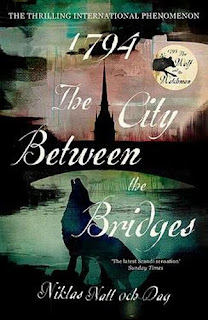
1794: The City Between The Bridges is by Niklas Natt och Dag. The year is 1794. A young nobleman, Eric Three Roses, languishes in hospital. Some think he would be just at home in the madhouse across the road. Ridden with guilt, he spends his nights writing down memories of his lost love who died on their wedding night. Her mother also mourns her and when no one listens to her suspicions, she begs the aid of the only person who will listen: Jean Mickel Cardell, the one-armed watchman. Cecil Winge is six months in the ground but when his younger brother Emil seeks out the watchman to retrieve his brother's missing pocket watch, Cardell enlists his help to discover what really happened at Three Roses' estate that night. But, unlike his dead brother, the younger Winge is an enigma, and Cardell soon realises that he may be more hindrance than help. And when they discover that a mysterious slave trader has been running Three Roses' affairs, it is a race against time to discover the truth before it's too late.In 1794, the second installment of Niklas Natt och Dag's historical noir trilogy, we are reunited with Mickel Cardell, Anna Stina Knapp, and the bustling world of late eighteenth century Stockholm. The city is about to see its darkest days yet as veneers crack and the splendour of old gives way to what is hiding in the city's nooks and crannies.

February 2022

Lady Joker is by Kaoru Takamura. Tokyo, 1995. Five men meet at the racetrack every Sunday to bet on horses. They have little in common except a deep disaffection with their lives, but together they represent the social struggles and griefs of post-War Japan: a poorly socialized genius stuck working as a welder; a demoted detective with a chip on his shoulder; a Zainichi Korean banker sick of being ostracized for his ethnicity; a struggling single dad of a teenage girl with Down's syndrome. The fifth man bringing them all together is an elderly drugstore owner grieving his grandson, who has died in suspicious circumstances. Intent on revenge against a society that values corporate behemoths more than human life, the five conspirators decide to carry out a heist: kidnap the CEO of Japan's largest beer conglomerate and extract blood money from the company's corrupt financiers. Inspired by the unsolved true-crime kidnapping case perpetrated by "the Monster with 21 Faces," Lady Joker has become a cultural touchstone since its 1997 publication, acknowledged as the magnum opus by one of Japan's literary masters, twice adapted for film and TV and often taught in high school and college classrooms.

May 2022

Intelligence has a new home. A governmental think-tank, whose remit is to curb the independence of the intelligence service, has lost one of its key members, and Claude Whelan-one-time head of MI5's Regent's Park-is tasked with tracking her down. But the trail leads straight back to the Park itself, with Diana Taverner as chief suspect. Has Diana overplayed her hand at last? What's her counterpart, Moscow's First Desk, doing in London? And does Jackson Lamb know more than he's telling? Over at Slough House, with Shirley Dander in rehab, Roddy Ho in dress rehearsal, and new recruit Ashley Khan turning up the heat, the slow horses are doing what they do best, and adding a little bit of chaos to an already unstable situation . . . There are bad actors everywhere, and they usually get their comeuppance before the credits roll. But politics is a dirty business, and in a world where lying, cheating and backstabbing are the norm, sometimes the good guys can find themselves outgunned. Bad Actors is by Mick Herron.


Friday, 22 November 2019

Books to Look Forward to from John Murray

 February 2020

Searching for Sylvia Lee is by Jean Kwok.  It begins with a mystery. Sylvie, the beautiful, brilliant, successful older daughter of the Lee family, flies to the Netherlands for one final visit with her dying grandmother - and then vanishes.  Amy, the sheltered baby of the Lee family, is too young to remember a time when her parents were newly immigrated and too poor to keep Sylvie. Seven years older, Sylvie was raised by a distant relative in a faraway, foreign place, and didn't rejoin her family in America until age nine. Timid and shy, Amy has always looked up to her sister, the fierce and fearless protector who showered her with unconditional love.  But what happened to Sylvie? Amy and her parents are distraught and desperate for answers. Sylvie has always looked out for them. Now, it's Amy's turn to help. Terrified yet determined, Amy retraces her sister's movements, flying to the last place Sylvie was seen. But instead of simple answers, she discovers something much more valuable: the truth. Sylvie, the golden girl, kept painful secrets . . . secrets that will reveal more about Amy's complicated family - and herself - than she ever could have imagined.

May 2020

Aunti Poldi and the Handsome Antonio is by Mario Giordano.  All the beloved, irascible Aunti Poldi wanted from her sicilian retirement was time to enjoy sunshine, a free-flowing supply of wine, and a sultry romance with Chief Inspector Montana.  But then her idyll is rudely interrupted by the last person she wants to se on her doorstep - - John Owenya, detective inspector with the Tanzanian Ministry of Home Affairs, who is also her estranged, lying cheat of a husband.  Not only is John's sudden reappearance putting a kink in Poldi's dreamy love affair with Vito Montana, but his presence also comes with a plea for help - and unwanted clashes with Mafia.  Where is John's half-brother? What is the ten-million-dollar 'it' that John's brother was last seen with that has both the Sicilian and Tanzanian mobs in a frenzy? With only a postcard that has a phone number and a name, 'Handsome Antonio', on the back, Auntie Poldi hops begrudgingly (albeit with a great deal of gumption and panache) back into the saddle (in this case, an immaculate red Maserati Cabrio from the 80s with cream leather upholstery). The faster she finds Handsome Antonio, the sooner she can get John Owenya out of her hair and love-life. But the people Poldi discovers along the way may very well knock her immaculate wig askew.

June 2020

Killing Eve: Die for Me is by Luke Jennings. As Villanelle returns to face her childhood demons and the Russian winter, Eve finds herself on the run from The Twelve, who want her dead. As the action moves between London and St Petersburg, and Eve and Villanelle finally admit their mutual erotic obsession, the chess game approaches its lethal, unforgettable conclusion.

Friday, 15 November 2019

Apple TV to Adapt Slough House for the Small Screen


Great news! According to Variety.com Mick Herron’s outstanding Slough House series is being adapted.

Actor Gary Oldman will star in a small screen adaptation of Mick Herron’s Slough House books at Apple.  More information can be found here. The small screen adaptation is entitled Slow Horses after the first novel in the series.  

The Slough House series has won a number of awards. The first book in the series Slow Horses was nominated for the Ian Fleming Steel Dagger Award.  The second book in the series Dead Lions won the Gold Dagger in 2013. The third, Real Tigers, was shortlisted for both the Gold and Steel Daggers, for the Theakstons Crime Novel of the Year, and for the 2017 Macavity Award. It won the Last Laugh Award at Crimefest 2017, for the best humorous crime novel of 2016. The fourth book in the series Spook Street won Ian Fleming Steel Dagger and was also shortlisted for the CWA Gold Dagger, the Barry Award and The Theakston’s Old Peculier Crime Novel of the Year Award. Spook Street won the Last Laugh Award. 

The fifth book London Rules, was shortlisted for both the Gold and Steel Daggers and was also shortlisted for the Barry and Last Laugh Awards and the Theakston’s Old Peculier Crime Novel of the Year Award. It was also shortlisted for Last Laugh Award.   London Rules was the winner of the inaugural Capital Crime Best Thriller Award.

The most recent book is Joe Country which was published earlier this year.

Friday, 26 October 2018

Books to Look Forward to from John Murray Press


January 2019

The year is 1793, Stockholm. King Gustav of Sweden has been assassinated, years of foreign wars have emptied the treasuries, and the realm is governed by a self-interested elite, leaving its citizens to suffer. On the streets, malcontent and paranoia abound. A body is found in the city's swamp by a watchman, Mickel Cardell, and the case is handed over to investigator Cecil Winge, who is dying of consumption. Together, Winge and Cardell become embroiled in a brutal world of guttersnipes and thieves, mercenaries and madams, and one death will expose a city rotten with corruption beneath its powdered and painted veneer.  The Wolf and the Watchman is by Niklas Natt och Dag.

June 2019

In the sixth Jackson Lamb thriller by Mick Herron, in Slough House memories are stirring, all of them bad.  And with winter taking its grip Jackson Lamb would sooner be left brooding in peace, but even he can’t ignore the dried blood on his carpets.  So when the man responsible breaks cover at last, Lamb sends the slow horses out to even the score.  This time they are heading into joe country.  And they’re not all coming home.

Sunday, 13 May 2018

Books to Look Forward to from John Murray Press


June 2018

This is What Happened is by Mick Herron.  Something's happened.  A lot of things have happened.  If she could turn back time, she wondered how far she would go.  Twenty-six-year-old Maggie Barnes is someone you would never look at twice. Living alone in a month-to-month sublet in London, with no family but an estranged sister, no boyfriend or partner, and not much in the way of friends, Maggie is just the kind of person who could vanish from the face of the earth without anyone taking notice.  Or just the kind of person MI5 needs to thwart an international plot that puts all of Britain at risk.  Now one young woman has the chance to be a hero - if she can think quickly enough to stay alive.

October 2018

At a restaurant in Sloane Square, a politician confides to journalist Jon Swift that he is concerned for his own safety; a few months later he is found dead in his flat. But when the police and even Swift's paper refuse to investigate the death further, he must take matters into his own hands.  Soon Swift finds himself hunting down the killers on a global scale and, between MI5 and Russian thugs, a suspicious death in London unravels into an international conspiracy that stretches all the way to the Kremlin.  On their trail, it's not long before Swift becomes a target himself . . .Moscow Midnight is by John Swift.

November 2018

Old spooks carry the memory of tradecraft in their bones, and when Solomon Dortmund  sees an envelope being passed from one pair of hands to another in a Marylebone cafe, he knows he's witnessed more than an innocent encounter. But in relaying his suspicions to John Bachelor, who babysits retired spies like Solly, he sets in train events which will alter lives. Bachelor himself, a hair's breadth away from sleeping in his car, is clawing his way back to stability; Hannah Weiss, the double agent whose recruitment was his only success, is starting to enjoy the secrets and lies her role demands; and Lech Wicinski, an Intelligence Service analyst, finds that a simple favour for an old acquaintance might derail his career. Meanwhile, Lady Di Taverner is trying to keep the Service on an even keel, and if that means throwing the odd crew member overboard, well: collateral damage is her speciality.  A drop, in spook parlance, is the passing on of secret information.  It's also what happens just before you hit the ground.  The Drop is by Mick Herron

Monday, 27 November 2017

Books to Look Forward to from John Murray Press

January 2018

Wine and murder - nothing is more likely to rouse Auntie Poldi's love of the chase.  Still relishing the notoriety from her spectacular resolution of the Candela case, Poldi is alive to the faintest whiff of criminality.  What to others might seem a series of misfortunes - the water supply cut off, a poisoned dog - is clearly, to Poldi, an escalation: the Mafia have had her in their sights ever since she solved Valentino's murder.  Poldi has tasted blood. No one is above suspicion. And trouble will surely follow.  Auntie Poldi and the Fruits of the Lord is by Mario Giordano

February 2018

London Rules is by Mick Herron.  London Rules might not be written down, but everyone knows rule one. Cover your arse.  Regent's Park's First Desk, Claude Whelan, is learning this the hard way. Tasked with protecting a beleaguered prime minister, he's facing attack from all directions himself: from the showboating MP who orchestrated the Brexit vote, and now has his sights set on Number Ten; from the showboat's wife, a tabloid columnist, who's crucifying Whelan in print; from the PM's favourite Muslim, who's about to be elected mayor of the West Midlands, despite the dark secret he's hiding; and especially from his own deputy, Lady Di Taverner, who's alert for Claude's every stumble.  Meanwhile, the country's being rocked by an apparently random string of terror attacks, and someone's trying to kill Roddy Ho.  Over at Slough House, the crew are struggling with personal problems: repressed grief, various addictions, retail paralysis, and the nagging suspicion that their newest colleague is a psychopath. But collectively, they're about to rediscover their greatest strength - that of making a bad situation much, much worse.  It's a good job Jackson Lamb knows the rules. Because those things aren't going to break themselves.