Showing posts with label Shotsmag. Show all posts

Saturday, 24 April 2021

Murder at Monk's Barn (and more) by Cecil Waye - Reviewed by L.J. Hurst


Dean Street Press, Feb 01, 2021 pbk £10.99 / eBook £1.89


Perhaps you remember the excitement of a few years ago when we learned, via Geoff Bradley’s magazine CADS: Crime and Detective Stories, that more gold had been discovered in the hinterland of crime fiction. We learned that John Rhode, who also wrote as Miles Burton, had for three years and four titles had a third identity. He had been Cecil Waye (his real name was Cecil Street, hence ‘Rhode’ and ‘Waye’, and had lived near a village named Bruton which in an act of metathesis became ‘Burton’). There was only one problem: Cecil Waye’s titles were so rare as to be impossible to find. We despaired. Thanks now to Dean Street Press we need despair no longer: all four books are in print, each using an introduction by Tony Medawar.

Rhode had his series characters (police officers Hanslet and Waghorn and brain Dr Priestley), as did Burton (Inspector Arnold and gentleman detective Desmond Merrion). Cecil Waye varied his approach slightly, his books revolve around Perrins’s detective agency, run by brother and sister Christopher and Vivienne Perrins. DSP label the covers ‘A “Perrins” Private Investigations Mystery’ and number the books 1 to 4, which is useful, for while each book in this series can be read alone the presence of Christopher and Vivienne or their absence, or their abode, is explained as the books progress. 

Vivienne is the prominent detective in Murder at Monk’s Barn, as a local industrialist calls in the agency when the local police suspect that he murdered his brother. This book is also the one most like John Rhode’s other detective stories in the complexity of the murder (the first victim is shot through a curtained window apparently from a vantage point in the air; a later victim is poisoned), though neither Rhode nor Burton tended to emphasise marital difficulties and problems of obtaining grounds for divorce as we find here. It is Vivienne, too, who explains ultimately the elaborate machinations required for the placing of the weapon, though coolly or cruelly it is to the murderer that she reveals how the crime was committed, which should give them the chance to take the easy way out. Unfortunately, again, that is not what happens.


Closing events mean that Vivienne is absent from the second book in the series, The Figure of Eight (ISBN13: 9781913527853). Again this begins with a mysterious death (a bus passenger who has been thought to be asleep for too long) but develops into more of a thriller based around rival struggles in London of the diplomats and their agents of two South American countries. This, though, is far above the standard thriller of the inter-war years and progresses through detection. Three dead men in an upstairs office when only one of them was seen to go in and no one was seen emerging is the nexus of the puzzle. Waye introduces here what will become an element in the later books: never trust the driver of a hire car or taxi.


The End of the Chase (ISBN13: 9781913527877, Perrins number three) in distinction to The Figure of Eight, which had foreign battles in London, moves across Europe as Christopher Perrin first helps nab a crook in Belgium, then must travel to Vienna and Budapest. Tony Medawar’s Introduction provides some help here: Cecil Street had been in military intelligence and then in the 1920s had written about the politics of a number of European countries. His familiarity with these places – he adds little just for the sake of local colour – helps to make the gathering of international crooks and their stooges from them more believable. The most interesting point about this is that the crooks—in a smaller scale version of Goldfinger’s plan to rob the international gold reserves – intend to make use of a German Weimar (this was published in 1932, remember) scheme to merge with Austria (years before the Nazi Anschluss) and so to play havoc with the international banking system, which in turn would lead to war. A character with multiple identities and a love interest too close to the villains all help to confuse the issue. Is there a problematic car drive? At least Christopher Perrins gets a bash on the noggin when he has his car bonnet lid up.


The Prime Minister’s Pencil (ISBN13: 9781913257891) was the last of Cecil Waye’s books, and takes us back to the John Rhode style. This is the Golden Age: the daughter of a wealthy man comes to the Perrins Agency wanting them to look for her father’s secretary. The man has disappeared and the father is not particularly worried. In other books of the period this secretary would be a young man of good background but limited means with whom the young lady was in love. Not here. Here the lady wants the secretary found because her father will not pay her bills and the secretary is the only man who can get money out of him on her behalf. It might be nice if the secretary were to return to the family mansion. In fact he does. But he is dead and his body is found in a pavilion in the grounds. It takes some time before it is discovered that he died of an acute tropical disease.

Becoming curious about the father, Sir Ethelred (a parvenu businessman who is trying to become a major figure in his political party), Christopher starts to track the secretary’s movements in his last days only to find that one of his informants is soon pulled from the Thames, dead. Then the worst happens – except that it is not the worse because Christopher goes along with the police investigation – the Prime Minister is killed in a blast that knocks out his assistant. Everything revolves around the pencils that the Prime Minister and his circle prefer to use – soon we are in a world of ‘H’s and ‘B’s, of round and hexagonal barrels, and where those pencils were obtained and where sharpened and with what.

Dodgy cars and drivers appear, as well as faked escaped attempts, but the master plan is likely to end in tears because the villains use their own properties – even if they are country properties – for their villainous ends and nidos commaculans inmundus habebitur ales (it’s an ill bird that fouls its own nest) as the old saw has it. The secret of the exploding pencil is explained, too, though that requires a suspension of disbelief to accept it, yet the motive for the murder has almost exactly re-occurred in 2021 (financial benefit in government legislation), even while the politics (which supposes two party politics) is another invention (the ‘National’ government of Stanley Baldwin in the 1930s had a tiny opposition, hence power similar or greater to today’s majority party). That the girl who started it is left in the hands of the money-lenders who will strip her of everything seems to be taken for granted. Christopher Perrins ends the series as cynical as any hardboiled detective in Chicago or LA.

Why Cecil Street abandoned the Perrins and their adventures is difficult to say: he managed to use two bright young things in murders as clever as anything he devised elsewhere. Equally, given that the discovery of Cecil Waye provoked such interest it is surprising the re-issue of the four books by Dean Street Press has not provoked more notice. Here they are. Take them all. They are good.

Total Blackout by Alex Shaw - Reviewed by Andy Hill


HarperCollins, pbk £8.99. Released Nov 26, 2020

Jack Tate is having a well-earned break in Maine, after a recent mission. The former SAS trooper is now a member of E Squadron, an ‘off the books’ military cadre, employed by MI6 for undercover operations where the Government needs support a regime but doesn’t want visibility.

His sojourn in America’s most north-easterly state is rudely interrupted by the detonation of an EMP (Electro-Magnetic Pulse) device over Washington D.C. With the devastation of the U.S. power grid and anything with a computer chip in it looting and violence in the streets erupts across the country.

In the ensuing chaos, the entities behind the EMP start a systematic campaign to assassinate or kidnap important targets. Is this another country bringing down the U.S.A?

With the conventional military impotent, it falls to Jack to improvise and overcome.

Alex Shaw takes the reader on a breakneck ride that just doesn’t let up for a moment. There’s certainly enough ‘tech’ and weapons for Clancy and McNab fans, but, Jack is by no means just a chisel-jawed, one-dimensional hero. The author gives him a backstory, feelings and a raison d’etre, which added to this readers enjoyment.

Add in a Washington D.C. cop on a mission; a ‘back from the dead’ villain; Jack’s foster parent’s son; EMP-shielded cars; helicopters; private jets and action that never lets up for a moment and you have a white-knuckle ride opener for a new series from Alex Shaw.

Thoroughly recommended.


Sunday, 28 May 2017

Mike Ripley’s KISS KISS, BANG BANG launches in Gerry’s Club London

Not long after Mike Ripley and Barry Forshaw battled it out at Crimefest with Peter Guttridge [from NATO] keeping the peace; many of London’s literary community headed to the West End, to Gerry’s club to celebrate the launch of Mike Ripley’s KISS KISS, BANG BANG.

It was a remarkable gathering of writers, journalists, publishers, editors, reviewers and agents from British Intelligence - all congregated to celebrate the launch of the remarkable KISS KISS, BANG BANG by Mike Ripley; a reflection upon the Golden Age of the British Thriller. This new work from HarperCollins is a labour of love from literary critic, writer, Shots’ columnist, Deadly Pleasures commentator, book reviewer, raconteur, archaeologist and butterfly collector Mike Ripley.


This volume is an essential part of any reader of Thriller Fiction’s bookcase, as Harper Collins point out –

An entertaining history of British thrillers from Casino Royale to The Eagle Has Landed, in which award-winning crime writer Mike Ripley reveals that, though Britain may have lost an empire, her thrillers helped save the world. With a foreword by Lee Child.
When Ian Fleming dismissed his books in a 1956 letter to Raymond Chandler as straight pillow fantasies of the bang-bang, kiss-kiss variety’ he was being typically immodest. In three short years, his James Bond novels were already spearheading a boom in thriller fiction that would dominate the bestseller lists, not just in Britain, but internationally.


The decade following World War II had seen Britain lose an Empire, demoted in terms of global power and status and economically crippled by debt; yet its fictional spies, secret agents, soldiers, sailors and even (occasionally) journalists were now saving the world on a regular basis.

From Ian Fleming and Alistair MacLean in the 1950s through Desmond Bagley, Dick Francis, Len Deighton and John Le Carr in the 1960s, to Frederick Forsyth and Jack Higgins in the 1970s.

Many have been labelled boys’ books’ written by men who probably never grew up but, as award-winning writer and critic Mike Ripley recounts, the thrillers of this period provided the reader with thrills, adventure and escapism, usually in exotic settings, or as today’s leading thriller writer Lee Child puts it in his Foreword: the thrill of immersion in a fast and gaudy world.’


In Kiss Kiss, Bang Bang, Ripley examines the rise of the thriller from the austere 1950s through the boom time of the Swinging Sixties and early 1970s, examining some 150 British authors (plus a few notable South Africans). Drawing upon conversations with many of the authors mentioned in the book, he shows how British writers, working very much in the shadow of World War II, came to dominate the field of adventure thrillers and the two types of spy story spy fantasy (as epitomised by Ian Fleming’s James Bond) and the more realistic spy fiction created by Deighton, Le Carr and Ted Allbeury, plus the many variations (and imitators) in between.

The launch party was a delight, as Mike’s son Guy who is a qualified chef provided the buffet, while Gerry provided the venue and Harper Collins copies of KISS KISS BANG BANG.


So after we all quaffed some Gin, Chris Smith - Mike’s editor at Harper Collins said a few words, followed by Mike Ripley who took a balcony position and welcomed us all. Mike indicated that the surprise appearance by Len Deighton had been cancelled as Len was in hospital but well on the way to recovery; so we all raised our glasses to Len Deighton. Incidentally it was thanks to Mike Ripley that Andrew Gulli secured a rare interview for Strand Magazine – which is still available Here

Despite the lighting in Gerry’s Club, we managed to record the welcome and introduction for our readers from Chris Smith of Harper Collins and Mike’s Balcony speech –


To list all the guests would be too much of a task; instead we feature photos of the event of many of the guests. Images of Agents of Her Majesty’s Secret Service have been redacted.
More information about Mike Ripley’s KISS KISS, BANG BANG is available from HarperCollins Here and Shots Magazine Here


We would urge you to grab a copy of this most amusing as well as interesting book KISS KISS, BANG BANG and remember Shots Magazine have discounted copies available from our bookstore HERE


Wednesday, 6 November 2013

Shots's GWEN MOFFAT publishes her Autobiography and more...


Gwen in action
Gwen Moffat was the first woman to qualify as a mountain guide in the UK and is one of the greatest female climbers this country has ever produced. She is also a prolific writer and novelist, with more than 30 books to her name. We at SHOTS know her better for the numerous book reviews she has written over the many years. In fact, if memory serves, Gwen was writing for SHOTS back in the day when it was Called A SHOT IN THE DARK, and even before I became involved. So it's nice to turn the spotlight on Gwen as Orion/Phoenix publishes her autobiography on November 7th 2013, paperback £12.99

In 1945, when Gwen Moffat was in her twenties, she deserted from her post as a driver and dispatch rider in the Army and went to live rough in Wales and Cornwall, climbing and living on practically nothing. She hitch-hiked her way around, travelling from Skye to Chamonix and many places in between, with all her possessions on her back, although these amounted to little more than a rope and a sleeping bag.

When the money ran out, she worked as a forester, went winkle-picking on the Isle of Skye, acted as the helmsman of a schooner and did a stint as an artist's model. And always there were the mountains, drawing her away from a 'proper' job.

Throughout this unique story, there are acutely observed accounts of mountaineering exploits as Moffat tackles the toughest climbs and goes on to become Britain's leading female climber - and the first woman to qualify as a mountain guide.


As a story of climbing and compulsive love of mountains, SPACE BELOW MY FEET is magnificent —

OBSERVER
Phoenix, paperback £12.99 Released 7th November 2013
Also available as Eboook


Happy Birthday CWA
On 5th November 2013 the Crime Writers' Association celebrated their 60th birthday (founded in 1953) at a special event held in Foyles bookshop on Charing Cross Road in central London. It also announced the results of a poll that asked its members to pick the foremost author and books in the genre. Christie triumphed in two of the three categories. “With her elegant precision and her perfect sense of place, she is still our most popular crime author,” proclaimed CWA chair Alison Joseph. Its full results are below.
CWA Best Ever Novel:
The Murder of Roger Ackroyd (1926), by Agatha Christie
Also nominated: The Big Sleep (1939) by Raymond Chandler
Gorky Park (1981), by Martin Cruz Smith
The Hound of the Baskervilles (1902) by Arthur Conan Doyle
The Long Goodbye (1953) by Raymond Chandler
The Moonstone (1868) by Wilkie Collins
Murder on the Orient Express (1934) by Agatha Christie
The Nine Tailors (1934) by Dorothy L. Sayers
On Beulah Height (1998) by Reginald Hill
and The Silence of the Lambs (1988), by Thomas Harris
CWA Best Ever Crime Author:
Agatha Christie
Also nominated: Raymond Chandler, Arthur Conan Doyle, Dashiell Hammett, Reginald Hill, P.D. James, Elmore Leonard, Ruth Rendell, Dorothy L. Sayers, and Georges Simenon
CWA Best Ever Crime Series: Sherlock Holmes, from Arthur Conan Doyle
Also nominated: Albert Campion, from Margery Allingham; Adam Dalgliesh, from P.D. James; Dalziel and Pascoe, from Reginald Hill; Philip Marlowe, from Raymond Chandler; Inspector Morse, from Colin Dexter; Hercule Poirot, from Agatha Christie; John Rebus, from Ian Rankin; and Lord Peter Wimsey, from Dorothy L. Sayers

Thursday, 23 August 2012

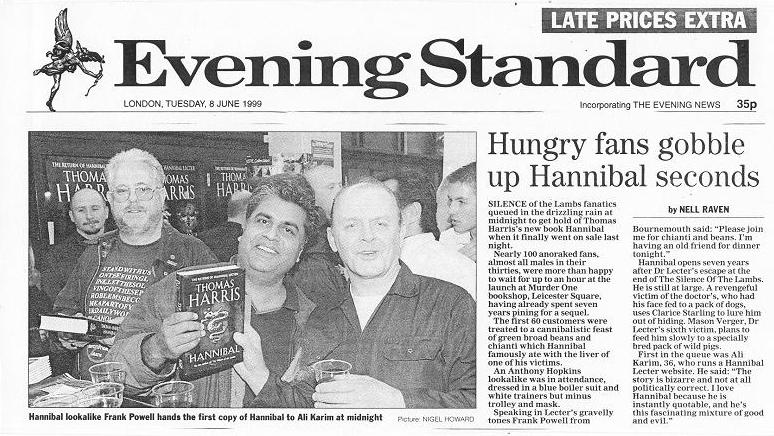
Ali Karim's Silence To Die For - The Silence of the Lambs by Thomas Harris


Ali Karim is Assistant Editor at Shots eZine, a contributing editor at January Magazine & The Rap Sheet and writes for Crimespree Magazine, Deadly Pleasures. He is an associate member of The Crime Writers Association [CWA], International Thriller Writers [ITW] and the Private Eye Writers of America [PWA]. Karim contributed to ‘Dissecting Hannibal Lecter’ ed. Benjamin Szumskyj [McFarland Press] a critical examination of the works of Thomas Harris; The Greenwood Encyclopedia of British Crime Fiction [ed. Barry Forshaw] and the Edgar and Anthony Award nominated ITW 100 Thriller Novels ed David Morrell and Hank Hagner [Oceanview Publishing]. In 2011 at the Anthony Awards held at Bouchercon St Louis, he was presented with the 2011 David Thompson Memorial Award for Special Services to the Crime and Thriller Genre.

Ali Karim is also the programming chair for Bouchercon 2015 in Raleigh, North Carolina, USA.

When Ayo Onatade asked me to write about John Connolly and Declan Burke’s Books To Die For, she remarked that she didn’t need to guess which featured book and essay I would chose. She was right, despite the massive array of masterful essays from some of our leading writers commenting on novels that appear at the apex of the genre, there will always be one book, and one writer that I would die for.

Firstly, I have to admit my love and hatred of books like this, having contributed to them myself. The love of these peer reviews / appreciations comes from my own reading compulsion, and reading extensively allowing me to learn about life and the “world / reality” I see before me through the eyes of others. The hate comes from my knowledge that I am far from as ‘well-read’, as I consider myself, though this is tempered by using tomes such as this, in seeking out books and writers that I have overlooked, or perhaps cajoling me to re-read a particular work due to someone else noticing something or aspects writing, that I had missed. Much of this comes from my understanding of the aging process in a reader. Some books that knocked ‘me for six’, when I was a teenager, when I re-sampled them later in middle age, have not stood the test of time. Others however appear much more complex than my teenage mind understood at the time I first cracked their spines. You see, the books [per se] have not changed [unless they are redux versions, like Stephen King has done with ‘The Stand’ releasing it a decade later with additional text that was edited out in the first release]. Though what has changed is the reader [and his/her mind]. Age [and life] alter ones thinking and cognition and therefore changes aspects of the book, when re-read many years later with a more mature mind.

I have to applaud the Irish writers Connolly and Burke for producing such an interesting and hefty tome; an audacious idea soliciting erudite and passionate essays from some of the worlds greatest writers about books that enthused them. For what is life without passion and enthusiasm? And who best to select such milestones in the crime and thriller genre than the writers who plough that dark road themselves. The contributors are a “who’s who” of contemporary fiction, and to list them all would be a feat itself, and proves what a herculean task Connolly and Burke have achieved. Speaking in hyperbolic terms, the novel and essay that Ayo Onatade guessed would be the one I would write about is of course Kathy Reichs’ essay on Thomas Harris’ The Silence of the Lambs.

Reichs’ essay is filled with insights, that start with Harris’ precursor, the 1981 Red Dragon and Harris’ reoccupation with the injustices of God, as viewed by Lecter and Harris’ own Southern Baptist past. As a scientist, Reichs indicates the layered authenticity in the narrative from Harris’ own journalistic background as a crime reporter, but special mention is made on the characterization, how Harris carves the protagonists and antagonists as if deploying the skills of a master sculptor. Writing about such a well known work of the genre is a tricky assignment, though Reichs’ excels at showing the importance of secondary characters such as the Smithsonian entomologists Pilcher and Roden and how the scenes that flow from the narrative owe more to Poe than Ludlum. She uses the term ‘unsettling’ in her examination of Harris’ novel and how this atmosphere bleeds into the narrative, making the reader as edgy as one of Buffalo Bill’s victims. Naturally mention of the examination of the relationship between Lecter and Starling is shown as being pivotal to the proceedings. The critical point in the examination of Harris’ Silence of the Lambs rests in the opening from the editors “Harris maintains a low media profile and is reputed to find the process of writing intensely difficult: he has published only five novels in thirty-seven years”. This indicates that to produce something as definitive as Silence of the Lambs is hard, hard work, something that is shared with the novels dissected in this wonderful book.

Kathy Reichs’ last line ‘His writing greatly influenced mine’ shows the respect she has for this genre-shaping novel; a work that is as unsettling as it is insightful. Reading it makes one feel what it is like, to be that rabbit hypnotized and paralyzed by the headlights of that oncoming car, the self same metaphor that Harris uses in the first chapter. The Silence of the Lambs is not a book that you walk away from without your worldview being shaken, like a bullet wound, when you close the covers, it remains inside you, reminding you what the dark end of the street feels like.

Continuing the hyperbolic theme, Books To Die For is probably the most important work chronicling the novels and writers that make the crime and thriller genre the most interesting part of fiction-publishing. Any enthusiast who does not have this volume on their bookshelf is depriving themselves of the most enlightening glimpse of what the vertigo-inducing heights that crime and thriller fiction can scale. Reading it is like going back into a time machine, as you get flooded with memories of ‘what and who you were’ when you read some of these magnificent novels; because they scar your psyche.

Bravo Mr John Connolly and Mr Declan Burke for producing such a treat, and one that will endure and one that I hope to see in the non-fiction award nominations for 2012.  

And Ayo, you guessed right, it will always be The Silence of the Lambs for this reader, as Thomas Harris has produced a monster of a novel, and one that Kathy Reichs’ essay does justice to.

Monday, 20 August 2012

Barry Forshaw’s Book To Die For - The Ministry of Fear by Graham Greene


The first of our blogger/reviewers take on Books to Die For is Barry Forshaw.

British critic Barry Forshaw is a writer and journalist whose writing career covers a number of genres.  He is the acknowledged expert on Scandinavian crime fiction and the author of numerous work on films and crime fiction.  He has done documentaries on crime fiction for a number of television stations.  His work includes The Rough Guide to Crime Fiction, British Crime Writing: An Encyclopaedia.  He is also the editor of the well-regarded online crime fiction magazine Crime Time.  His most recent book is Death in a Cold Climate - A Guide to Scandinavian Crime Fiction and his latest book, which is due out in September, is British Crime Film: Subverting the Social Order.  A former Vice-Chair of the Crime Writers’Association.  He also wrote the first UK biography on Stieg Larsson – The Man Who Left Too Soon.


Had Graham Greene (1904-1991) not written the 'serious' novels (such as A Burnt Case and The Heart of the Matter) which marked him out as one of the greatest of all English writers, his ‘entertainments’ (as the author rather dismissively described them) would constitute a body of crime and thriller fiction almost without equal in the field.  Early in his career, Greene introduced an element of the spy story into The Confidential Agent (1939), in which D, the agent of a Latin government (Republican Spain in all but name), figures in a narrative that was clearly influential on such later writers as John le Carré.  The latter has long acknowledged Greene’s considerable influence on his work.  Greene's most celebrated crime novel, of course, is Brighton Rock (1938, with its psychotic young antihero Pinkie), which the author decided to move out of his ‘entertainments’ category.  This sometimes slippery shifting of genres by the author was always a rather arbitrary endeavour: the moral concerns of the thrillers were often precisely those of the more serious books, while the pursuit narratives of the serious books (such as the whisky priest on the run in The Power and the Glory, 1940) had precisely the same visceral trajectory as the thrillers.  However, all the books have that dark and sardonic view of existence, which quickly became identified as ‘Greeneland’, a queasy admixture of the seedy, the surrealistically funny and the dangerous.  Two other crucial ingredients need to be identified in the Greene mix: the author’s uneasy relationship with Catholicism (he converted under the influence of his wife's piety, but was never an unquestioning believer after the fashion of his correspondent and colleague Evelyn Waugh, who chastised Greene for his doubts).  Greene’s work is also distinguished by its frank and realistic depiction of the sexual relations between men and women – not, that is to say, in any graphic fashion, but with an unblinking assessment of the joys and despair concomitant with sexual passion.


Which novel is the best of his thrillers?  Brighton Rock, with its brilliantly realised picture of a violent seaside underworld, is as strong a starting point for those new to Greene as anything he wrote, but my personal choice, on balance, is the superbly honed thriller The Ministry of Fear (1943), which demonstrates an authority and mastery of the narrative form that makes most practitioners look mere journeymen.  London in the Blitz is brilliantly conjured by the author in this dazzling piece.  This is an ‘entertainment’, but the moral issues here are as rigorously handled as anything tackled by Greene in his more ambitious novels.  Arthur Rowe, full of guilt after the death of his sick wife, is plunged into a dangerous world of murderous, shadowy figures.  The Ministry of Fear is possibly the author’s most sheerly enjoyable novel in the ‘thriller’ vein.  (Fritz Lang made a creditable stab at The Ministry of Fear for the cinema.)

Wednesday, 14 September 2011

Bouchercon here we come!!


This is the first of what will hopefully be my blog about Bouchercon. How frequent it is going to be I do not know.

Bouchercon does not exactly start until tomorrow but pre-Bouchercon stuff has been fun already. Thanks to Jon Jordan so far I have managed to go to a baseball game and saw the St Louis Cardinals beat the Atlanta Braves along with the ever delightful Ruth Jordan (Mrs Crimespree), Kirstie Long and Paul Jordan. At the same time the St Louis Rams were playing the Philadelphia Eagles and I have to say that despite the fact that I was at the baseball game I was also keeping my eye on the football results. Why you may ask? That is because I support Philadelphia Eagles so it was nice to see the results and realised that they beat the Rams! I have had a trip round the City Garden and have seen the wonderful sculptures and the pink flamingos! If you have chance to go to the City Garden then one should do so as it is a delight.


Since mid-morning Monday people have already started to turn up. I finally got to meet the wonderfully delightful Jen Forbus. Hi Jen! Adrian Magson and his wife Ann were amongst the first Brits to arrive (aside from myself and Kirstie long) who have been in St Louis since Saturday. Also renewed my acquaintance with Ann McNulty whom I last saw at Baltimore and also B G Ritts. Also met Kat Tromp again, John Purcell and Emily Bronstein (whom I last saw at Crimefest last year!). It was also lovely to see again after such a long time McKenna Jordan who owns Murder by the Book in Houston and Crimespree’s comic and film extraordinaire Jeremy Lynch along with his lovely wife Jill and his mother. Of course the place to be is the bar!

Pictures © Ayo Onatade

Yesterday evening (Tuesday) a lot more Brits started to arrive. My fellow Shotsmag colleagues Mike Stotter and Ali Karim flew in with Roger Ellory, Lauren Henderson, CWA Chairman Peter James, and Guest of Honour Val McDermid and rather later on Tuesday night (sans luggage) Russel McLean. Even though things have not really started today (Wednesday) is going to be rather busy. Trucks to unload with all the book bags and the stuff for registration, which should start @3pm this afternoon. The book bags are stuffed full of wonderful books and I dare anyone to complain! There will also be a swap table set up so if people want to leave books and or swap them there. It will be interesting to see how the hotel manage to cope with the large influx of people that are no doubt due to turn up today. I am sure that they will be fine as they have been excellent so far. So, if you see me wandering around the hotel at some stage during Bouchercon please do come up and say hello, give me a hug as I am sure that I may not remember to do so or I might be distracted and I would not want anyone to think that I was ignoring them on purpose.

There are also a lot of pre-Bouchercon activities taking place as well today. Noir at the Bar will be starting at eight PM, will be held at Meshuggah Café 6269 Delmar Boulevard Saint Louis, MO 63130 (314) 726-56626269. Admission is free, but bring money for drinks and books. Food is also available. Subterranean Books and Bouchercon present Charlaine Harris and Laurell K. Hamilton in an intimate Q&A to benefit the St. Louis Public Library, at Christ Church Cathedral, 1210 Locust Street (across from Central Library, two blocks from convention hotel), Wednesday, Sept 14 6pm (Doors at 5pm). This is a ticketed event and your ticket price gains you admittance to the one-hour event and gets you a signed copy of Harris' SOOKIE STACKHOUSE COMPANION or Hamilton's HIT LIST.

Tickets available here

St Louis County Library presents “Suspense Night 2011” on Wednesday, September 14, at 7 p.m. at Library Headquarters, 1640 S. Lindbergh Blvd. The free event brings together seven suspense authors from across the country. The authors are Megan Abbott, Reed Farrell Coleman, S J Rozan, Peter Spiegleman, Steve Hamilton, Lisa Lutz and Christa Faust.

Saturday, 21 May 2011

Crimefest Day 2 Part 3

This blog is now seriously running behind and I can only put it down to the fact that I am having such a good time!

The last "formal" event that took place on Friday was the announcement of a number of the CWA shortlists. These were the International Dagger, the Non-Fiction Dagger, the Dagger in the Library, the Debut Dagger and the Short Story Dagger which as Chair of the Short Story panel I got to anounce.The short list -

THE CWA INTERNATIONAL DAGGER-

The Wings of the Sphinx by Andrea Camilleri, Tr. Stephen Sartarelli, (Mantle)

Needle in a Haystack by Ernesto Mallo, Tr. Jethro Soutar (Bitter Lemon Press)

The Saint-Florentin Murders by Jean-François Parot, Tr. Howard Curtis (Gallic)

Three Seconds by Anders Roslund & Börge Hellström, Tr. Kari Dickson (Quercus)

River of Shadows by Valerio Varesi, Tr. Joseph Farrell (Maclehose)

An Uncertain Place by Fred Vargas, Tr. Siân Reynolds (Harvill Secker)

Death on a Galician Shore by Domingo Villar, Tr. Sonia Soto (Abacus)


THE CWA GOLD DAGGER FOR NON-FICTION

Judith Flanders: The Invention of Murder (HarperCollins)

Colin Evans: Slaughter on a Snowy Morn (Icon Books)

Douglas Starr: The Killer of Little Shepherds (Simon & Schuster)

Wilbert Rideau: In the Place of Justice (Profile)

Michael Capuzzo: The Murder Room (Michael Joseph)

Kate Colquhoun: Mr Briggs’ Hat (Little, Brown)


CWA SHORT STORY DAGGER

East of Suez, West of Charing Cross Road by John Lawton - Agents of Treachery - Ed Otto Penzler (Atlantic Books)

Wednesday’s Child by Ken Bruen - First Thrills - Ed. Lee Child (Atlantic Books)
The Princess of Felony Flats - by Bill Cameron - First Thrills - Ed. Lee Child - (Atlantic Books)
The Dead Club - by Michael Palmer & Daniel Palmer - First Thrills - Ed. Lee Child (Atlantic Books)
Homework by Phil Lovesey - The Mammoth Book of Best British Crime Vol 8 - Ed Maxim Jakubowski (Constable and Robinson)

CWA DAGGER IN THE LIBRARY

S J Boloton

RJ Ellroy

Jason Goodwin

Mo Hayder

Susan Hill

Phillip Kerr


CWA DEBUT DAGGER

A Burial Place for Strangers – Sharon Hunt (Canada)

A Quiet Night in Entebbe – Peter Wynn Norris (UK)

A Vicious Indulgence – Annie Hauxwell (Australia)

Biographies of a Victim – Gunnar Lange-Nielsen (Norway)

Hide and Seek – Sarah Darby (UK)

Men of the Rose – Jessica Ramage (UK)

The Boy Who Loved Penguins – SWC Webb (UK)

The Greengrocers and Fruiterers’ Convention – Martin Ungless (UK)

The Outrageous Behaviour of Left-Handed Dwarves – Graham Brack (UK)

The Temp – Luke Melia (UK)

Unveiled Threats – Stephanie Light (UK)

What Hidden Lies – Michele Rowe (South Africa)


The winners will be announced at the Harrogate Crime Festival in July. Congratulations to all the nominees!


Dinner was a joyus affair. Nicci Praca from Quercus took the Shotsmag team along with Jake Kerridge, Shona MacLean, Nigel McCrery and Colin Cotterill out to dinner. We all had a wonderful time. Needless to say that once we got back to the hotel none of us went to bed immediately and I spent the evening in the pleasant company of a lady called Caroline (whose surname I must find out) and various other members of the crime fiction fraternity. So what time did I go to bed? Now that would be telling! I can only say that it was rather late and in the wee hours!